
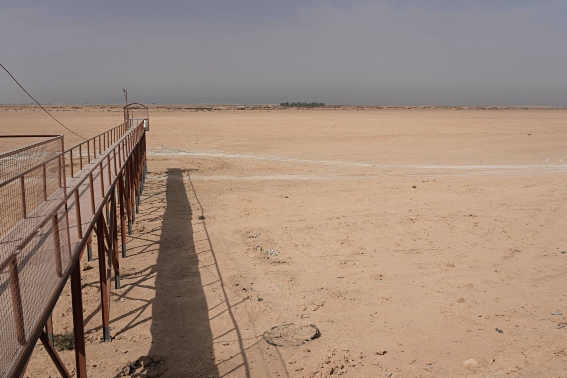

The evident repercussions of climate change, ranging from soaring temperatures to dwindling rainfall, intensified droughts, water scarcity, frequent sand and dust storms, recurrent flooding, salinisation, and soil pollution, are glaringly apparent to all except the leaders of Iraq. They appear to be turning a blind eye to this unfolding catastrophe.
Severely afflicted by climate change at all levels, Iraq has emerged as one of the top five nations grappling with its dire consequences. According to a recent World Bank report, the country faces an annual depletion of approximately 250 square kilometres of arable land, with 39% of its total landmass succumbing to desertification. Moreover, projections indicate a staggering 20% reduction in its water resources by 2050. The escalating salinisation of soil, driven by diminishing rainfall, is further compounding the crisis, pushing the population perilously closer to catastrophe. Iraq’s water stress index indicates an alarming level of scarcity, set to escalate significantly by 2040, ultimately culminating in widespread drought.
The initial ramification of water scarcity will undoubtedly manifest as a drastic surge in the poverty rate, currently estimated by the Ministry of Planning at 25% nationwide. As water becomes increasingly scarce, both production and consumption will decline, exacerbating the situation. Consequently, access to essential resources will become restricted to privileged social strata at the pinnacle of society, while those at the bottom of the social hierarchy will be left deprived. Despite Iraq’s ability to import food items, their prices will soar significantly, rendering them unaffordable for the most marginalised segments of the population.
Various studies on Iraqi society[1] highlight the hypothesis of mass migration from the southern areas of Iraq, which will be massively affected by desertification, but also impacted by a remarkably high fertility rate of 4.12. These migrants are expected to relocate to Iraqi Kurdistan, where the effects of climate change are projected to be less severe and the fertility rate is anticipated to remain below 2.98.
In this context, it is crucial to consider how the Kurdish population will respond and whether they will pursue a strategy of inclusion. If they opt for inclusion, it raises questions about the demographic implications on their identity as a distinct Kurdish group. Conversely, if the Kurds opt for exclusion and rejection, the likelihood of a civil conflict between Arabs and Kurds becomes a pressing concern. The answers to these inquiries hinge on the evolving balance of power among the various factions within Iraqi society in the forthcoming twenty-five years.
Iraq finds itself confronting a formidable adversary within its borders — not the Islamic State organisation nor an invasion by a foreign power, but rather climate change, evidenced by nine sandstorms in 2022 and the disappearance of Lake Sawa, encompassing a surface area of 5 km², in southern Iraq. According to a report by the Norwegian Refugee Council (NRC), half of Iraqi families residing in drought-affected regions face the looming threat of food insecurity. Since 1980, the Tigris and Euphrates rivers have witnessed a staggering 30% decline in their water supply, a figure projected to escalate to 50% by 2030.
Is defeat inevitable? Specialists argue that Iraq has the potential to effectively combat this adversary if it adopts a holistic and comprehensive approach to resistance. This entails rehabilitating water and irrigation infrastructure, enhancing water accessibility, modernising the electricity grid, curbing gas flaring and utilising it for electricity generation, and embracing an ambitious decarbonization strategy for transportation, as outlined by the World Bank. In essence, the execution of a comprehensive modernization plan is imperative for Iraq’s survival.
With this in mind, Iraq must mobilise a sum of $233 billion between now and 2040 to address its critical development requirements while advancing towards sustainable and inclusive growth (refer to Table 1).
| Table 1: Summary of Iraq’s investment needs to close the development gap | |
Needs | Component investment by 2040(in billions of dollars) |
| Rehabilitation of water infrastructures and irrigation | 42 |
| Water and agriculture non-structural | 6 |
| Eliminate gas flaring and use it in electricity generation | 29 |
| Adopting the CEDP route for the electricity electricity sector | 63 |
| Modernisation of the electricity network | 52 |
| Adopting the path of decarbonisation of high-ambition transport | 31 |
| Total | 233 |
Source : World Bank Group. 2022. Iraq Country Climate and Development Report. CCDR Series;. World Bank, Washington, DC. © World Bank Group. https://openknowledge.worldbank.org/handle/10986/38250 Licence: CC BY-NC-ND.”
Notes
[1] Youssef Courbage, op. cit. World Bank Group, op. cit. Fabrice Balanche, « L’économie irakienne », EISMENA, 2023.