

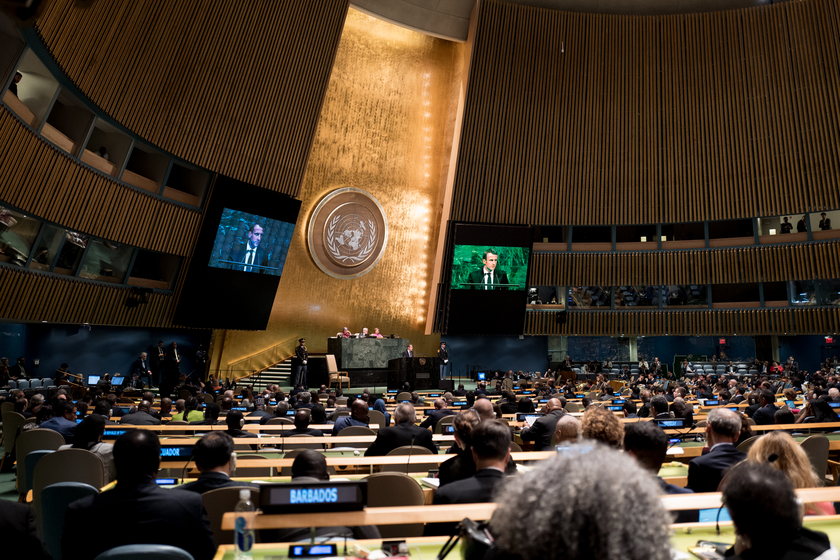

On July 24, 2025, Emmanuel Macron announced that France would officially recognize the State of Palestine at the upcoming United Nations General Assembly, scheduled for September (the 80th session will take place on Tuesday, September 9, 2025, with the general debate starting on September 23, 2025). This announcement comes amid a diplomatic context marked by an unprecedented collective appeal from 15 countries, including Canada and Australia, calling on all states worldwide to join them in recognizing Palestine as a sovereign state. Among the signatories are European countries such as Andorra, Finland, Iceland, Ireland, Luxembourg, Malta, Norway, Portugal, San Marino, Slovenia, and Spain. Nine of these have not yet proceeded with formal recognition but now express a “positive willingness” to do so. The Franco-Saudi initiative, launched following the ministerial conference in New York on July 21 and 22, aims to keep the two-state solution alive—a solution undermined by the ongoing war in Gaza and the expansion of Israeli settlements in the West Bank. Several Arab countries, including Saudi Arabia, Qatar, and Egypt, have also called on Hamas to hand over its weapons to the Palestinian Authority—an effort to strengthen unified governance for the future Palestinian state. Therefore, between symbolic weight and geopolitical consequences, this decision raises fundamental questions of international law and could reshape diplomatic balances surrounding the Palestinian issue.
The Legal Foundations of State Recognition
Legally speaking, the recognition of a state is a discretionary act of foreign policy. It is based on criteria defined by the 1933 Montevideo Convention:
- A permanent population
- A defined territory
- An effective government
- The capacity to enter into relations with other states
Palestine partially meets these criteria, as it has a permanent population and a political-administrative structure embodied by the Palestinian Authority. However, it does not fully control its territory, and its governmental authority is compromised by the division between the West Bank and Gaza. This explains why some countries—particularly in the West—have conditioned recognition on a negotiated agreement with Israel, in line with UN Security Council Resolutions 242 (1967) and 338 (1973), which set the principle of peace based on Israel’s withdrawal from occupied territories and direct negotiations.
Palestine at the United Nations
Since 2012, Palestine has held the status of a non-member observer state at the UN, granted by General Assembly Resolution 67/19. This status allows it to sign multilateral treaties, join international organizations, and refer cases to the International Criminal Court. However, it does not grant voting rights or a seat on the Security Council—something blocked by the U.S. veto. The diplomatic trajectory of the Palestinian question is part of a long international history. In 1947, the UN adopted the Partition Plan (Resolution 181), proposing two states—one Jewish, one Arab—and international status for Jerusalem. The following year, the creation of Israel and the subsequent war triggered the Nakba, the exodus of hundreds of thousands of Palestinians. In 1967, after the Six-Day War, Israel occupied the West Bank, East Jerusalem, Gaza, Sinai, and the Golan Heights, prompting the adoption of Resolution 242, which called for withdrawal from the occupied territories.
In 1988, the PLO unilaterally proclaimed the State of Palestine in Algiers, receiving recognition from over 100 countries. The Oslo Accords (1993–1995) established the Palestinian Authority and mutual recognition between Israel and the PLO, but the peace process was disrupted by the Second Intifada (2000–2005). In 2012, Palestine achieved its observer state status. In May 2024, Spain, Ireland, and Norway officially recognized the State of Palestine, and in 2025, France is preparing to do the same.
Diverging International Reactions
Paris’s announcement has sparked mixed reactions. Israeli Prime Minister Benjamin Netanyahu condemned the move on X (formerly Twitter), calling it a decision that “rewards terror” in the wake of Hamas’s October 7, 2023, attack, and adding that a Palestinian state under current conditions “would be a launching pad to annihilate Israel.” The United States, through Secretary of State Marco Rubio, “strongly rejected” the French initiative, calling it “reckless” and reiterating its long-standing position: the creation of a Palestinian state must result from bilateral negotiations. This approach has been criticized by academics such as Fawaz Gerges of the London School of Economics, who argue that it effectively grants Israel a veto over Palestinian aspirations for self-determination. On the Palestinian side, recognition by a permanent member of the Security Council represents a diplomatic victory. Today, over 140 UN member states already recognize Palestine, including nearly all Arab, Muslim, and so-called “non-aligned” countries. However, the symbolic weight of French recognition is considerable, as it breaks the image of a hesitant Western consensus. In Europe, Spain, Ireland, and Norway paved the way in May 2024, and France’s announcement could trigger a ripple effect within the European Union—even though countries like Germany and the Netherlands remain firmly opposed.
Possible Geopolitical Scenarios Following France’s Recognition
Geopolitically, several scenarios are possible. In the most optimistic case, recognition could revive diplomatic efforts and pressure Israel to return to negotiations—especially under pressure from economic or military partners. It could also bolster the international legitimacy of the Palestinian Authority at the expense of Hamas, provided that Arab countries engage in inter-Palestinian reconciliation. But in a more pessimistic scenario, this move could harden Israel’s stance, accelerate settlement expansion in the West Bank, and diplomatically isolate France among certain allies, particularly the United States. Recent history shows that unilateral recognition of a disputed state—as was the case for Kosovo in 2008 or South Sudan in 2011—tends to have mainly symbolic effects in the short term and fails to resolve core territorial and security issues. For Palestine, major obstacles remain: the status of Jerusalem, border delineation, the right of return or compensation for refugees, and security guarantees for Israel.
Conclusion
Ultimately, France’s announced recognition is a political act with significant symbolic weight, potentially shifting diplomatic dynamics in the Middle East and triggering a reshuffling of alliances. But its ability to affect the reality on the ground will depend on the willingness of regional and international actors to commit to a credible peace process, one based on international law and United Nations resolutions, rather than isolated diplomatic gestures.