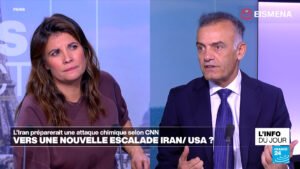


Speaking from Paris on Kurdistan 24, Dr. Adel Bakawan took a firm stance against statements and initiatives suggesting the possible division of the Kurdistan Region into two separate entities. Against a backdrop of growing political controversy, notably marked by an appeal signed by more than a thousand Kurdish intellectuals and academics defending the non-negotiable nature of the Region’s existence, he recalled that its territorial unity constitutes a fundamental principle of Kurdish nationalism. For the Director of EISMENA, the issue goes beyond partisan rivalries and institutional balances between Erbil and Sulaymaniyah. He believes that no actor deeply committed to Kurdish national consciousness, or kurdayeti, could legitimately advocate such a division. Drawing on the historical memory of the Kurdish people, whose territory has been divided between Iraq, Syria, Türkiye and Iran, he considers that any further fragmentation would constitute a break with the very foundations of the Kurdish national project. He therefore describes any attempt at division as an act of “national betrayal”, regardless of the identity of those promoting it.
This position does not, however, mean that political tensions between the two main Kurdish parties are non-existent. Adel Bakawan acknowledges the reality of public statements by political leaders referring to the possibility of two separate regions, particularly in Sulaymaniyah and Erbil. Nevertheless, he urges against confusing these public positions with the political dynamics unfolding beyond the media. In his view, relations between the KDP and the PUK must be analysed through a fundamental distinction between political communication and the reality on the ground. Drawing on his regular exchanges with the Region’s various decision-making centres since 2021, particularly in Erbil, Sulaymaniyah, Duhok and Halabja, he states that not a single day goes by without communication, discussion or dialogue between the two parties. He stresses that this continuity of exchanges contradicts the idea of a definitive political rupture. He thus distinguishes between two simultaneous dynamics: a highly visible media confrontation and political competition that remains within a shared institutional framework.
To illustrate this situation, Adel Bakawan compares relations between the KDP and the PUK to a competition in which each party seeks to score points against its rival. Since 2020, the two parties have engaged in a succession of political confrontations, both in Baghdad and within the Kurdistan Region. He refers in particular to geopolitical, legal and institutional power struggles in which each party seeks to strengthen its position. This competition does not, however, mean that either actor wishes to leave the same political space. On the contrary, according to him, both continue to seek the reactivation of the Kurdistan Parliament and the formation of a government, albeit under different arrangements and conditions. This divergence is particularly apparent in two institutional matters. The first concerns the Iraqi presidency, the resolution of which does not satisfy the KDP. The second relates to the reactivation of the Kurdistan Parliament, which the PUK considers an unresolved issue. These disagreements are compounded by security-related matters, which the researcher considers particularly decisive for normalising relations between the two parties. As long as these issues remain without practical and realistic solutions, tensions are likely to persist in one form or another.
For Adel Bakawan, the challenge therefore extends beyond simply restoring parliamentary operations. It is a matter of rebuilding a political relationship between two parties whose mutual trust has gradually deteriorated. He warns in particular that prolonging the current situation could fuel questions among the Kurdish population about whether the unity of the Region is truly inviolable. He therefore believes that the two parties must take a major political initiative to put an end to the deadlock. It is in this context that he reveals the existence of a particularly serious attempt to propose a decisive initiative between the KDP and the PUK. Without disclosing its initiators or the details of its arrangements, he indicates that its success will depend directly on the decision-making centres of both parties and their willingness to accept an approach aimed at bringing them closer together. He also specifies that the initiative must be kept away from premature media exposure in order to preserve its chances of success.
The researcher does not, however, present this prospect as a foregone conclusion. Two scenarios remain possible: a far-reaching political initiative capable of rebuilding trust between the two parties, or the continuation of the deadlock until the next elections to the Iraqi and Kurdistan Parliaments, scheduled to take place in two years. He thus acknowledges that the crisis could continue despite regular contacts and mediation efforts.
Ultimately, Adel Bakawan’s intervention rests on a distinction between partisan conflict and territorial integrity. While rivalries between the KDP and the PUK continue to undermine the Region’s institutional functioning, they do not, in his view, reflect a genuine desire for partition. His analysis above all highlights the need for a political compromise that goes beyond media confrontations and partisan calculations. Preserving the territorial unity of Kurdistan therefore remains, in his eyes, a shared national responsibility, while breaking the current deadlock now depends on the ability of the two parties to turn their daily dialogue into a concrete political initiative.
Interview link: https://www.kurdistan24.net/ar/story/953432