


“Without the US, there would be no Israel. Without me, there would be no Israel, because no other president was willing to do what I did. I’ve had a great relationship with Bibi, but now Bibi has to be more responsible with respect to Lebanon.”
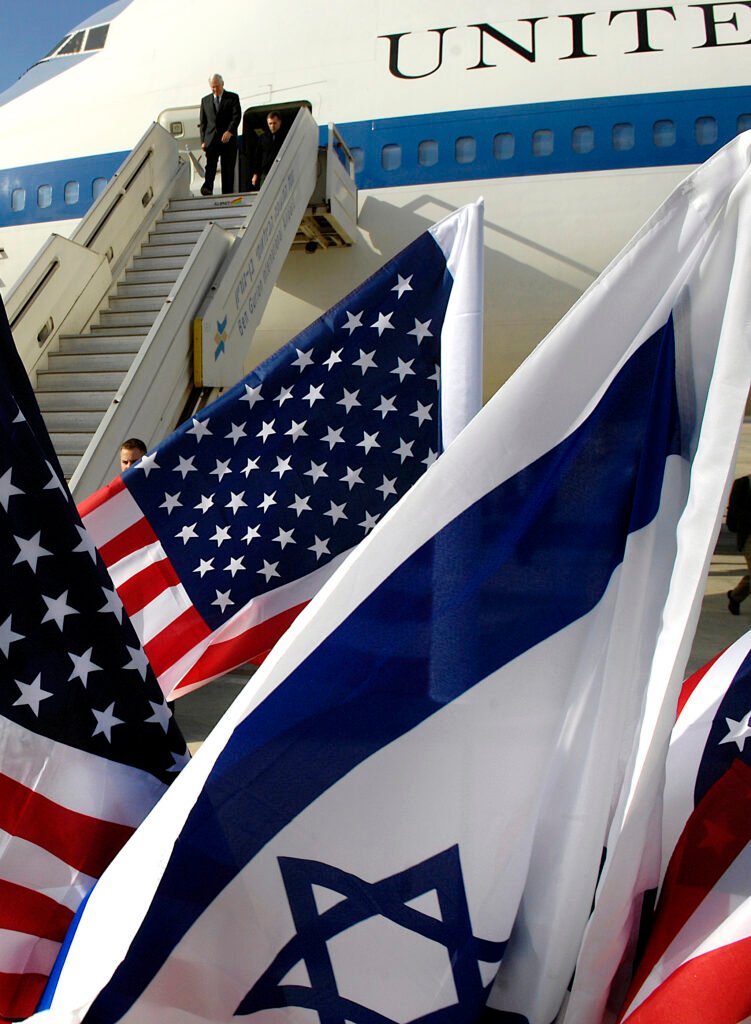
With this statement at the G7 summit in June 2026, the American president did more than simply recall the United States’ longstanding support for Israel; he claimed the capacity to influence Israel’s political and strategic existence. A few days later, his public criticism of Benjamin Netanyahu over the strikes on Beirut gave rise in Tel Aviv to an unusual expression: that of a ’protectorate.’ This term was taken up by several Israeli political leaders and commentators, extending well beyond the controversy. It calls into question the very nature of a bilateral relationship often presented as an alliance between sovereign partners. Historically, a protectorate designates a legal regime in which a state retains its internal institutions while delegating all or part of its defence to a protecting power. This definition, developed during the colonial period, appears at first sight ill-suited to the Israeli case. Israel is a sovereign power, equipped with a modern army, nuclear weapons, a developed economy, and fully autonomous institutions. Nevertheless, the recent evolution of its relationship with Washington invites reflection on the heuristic relevance of this concept.
If Israel is constrained by the White House in the conduct of its foreign policy, can the country be described as a protectorate?
The hypothesis advanced here is not that Israel constitutes a protectorate in the established colonial sense of the term, characterised by an institutionalised structure of control later incorporated into trusteeship regimes. Rather, this analysis does not seek to deny the sovereign reality of either Israel or the United States, but to highlight the similarities between the present relationship and historical patterns, in light of the political, diplomatic, religious, military, and economic ties binding the two states.
The Historical Roots of the Alliance Between the United States and Israel
To understand the contemporary nature of the Israeli-American relationship, it is necessary to return to the historical dynamics that gradually made the United States the principal political, military, and diplomatic guarantor of the State of Israel. This relationship is the product of a succession of ideological, geopolitical, and strategic developments which, from the birth of Zionism to the Cold War, shifted the centre of gravity of the Zionist project from Europe to Washington.
European Antisemitism and the Emergence of the Zionist Movement
Political Zionism emerged in a context marked by the rise of European nationalism and the intensification of modern antisemitism. At the end of the nineteenth century, antisemitic violence multiplied both in the Russian Empire and in several countries of Western Europe. In France, for example, the Dreyfus Affair (1894–1906) revealed the extent of the political and social divisions running through the Third Republic.[1] Captain Alfred Dreyfus, who was Jewish, was wrongly accused of high treason and espionage on behalf of Germany. The French press fuelled a cycle of rumours that mobilised public opinion and state institutions, a campaign denounced by Émile Zola in J’Accuse…![2] The antisemitic campaign accompanying the affair illustrated the difficulties of Jewish integration into the European nation-states.
Witness to both the Dreyfus Affair and the broader antisemitic socio-political climate, Theodor Herzl formulated the theory of Zionism in 1896, a form of Jewish nationalism referring to Mount Zion, in his work The Jewish State (Der Judenstaat). There he advocated for the establishment of the Jews in Palestine not only because of its historical and religious significance, but also because of its strategic importance.
“Palestine is our unforgettable historic homeland. That name alone would constitute an immensely powerful rallying cry for our people. If His Majesty the Sultan were to give us Palestine, we could undertake to put the finances of Turkey completely in order. For Europe, we would constitute there a part of the rampart against Asia; we would be the advanced sentinel of civilisation against barbarism.”[3]
This passage encapsulates the very essence of Herzl’s theory, showing that the Zionist project was not limited to a simple national claim. Rather, it formed part of a geopolitical vision in which the future Jewish state was conceived as a partner of the Western powers in the Levant.
A few years later, in 1917, the Balfour Declaration constituted the first stage in the international recognition of the Zionist project.[4] In a socio-economic context marked by antisemitism and the demands of wartime mobilisation, the British government, by allowing for the establishment of a Jewish national home in Palestine, secured the support of Jewish banking interests for the continuation of the war effort. The Wilson administration likewise endorsed the declaration.[5] The earliest Zionist discourse was deliberately secular in order to mobilise the broadest possible section of the population and diversify its international partners and sources of support.
The Establishment of the Jewish Community in the United States
The establishment of the Jewish community in the United States can be explained by a combination of socio-political and economic factors.
Initially, the arrival between 1820 and 1880 of an estimated 3,000 to 250,000 Sephardic Jews corresponded to the period of the Spanish Inquisition. Subsequently, the pogroms in the Russian Empire beginning in 1881 accelerated the immigration of approximately two million Ashkenazi Jews.[6] Their economic integration was facilitated by the development of department stores, the film and cultural industries, and the banking sector (the Seligman Bank, for example, financed Union bonds during the American Civil War).[7] The influence of the Jewish community did not rest solely on its demographic weight, which remained limited (2 per cent of the American population[8]), but also on its high level of political participation, its considerable capacity for financial mobilisation, and its significant presence in several electorally decisive states. This combination gradually gave the ’Jewish question,’ and later, after 1948, support for Israel, a distinctive place in debates over American foreign policy.
From 1933 onwards, Hitler’s rise to power and the intensification of antisemitic persecution in Europe confronted the United States with a major contradiction. While the need to receive refugees increased dramatically, American immigration policy remained restrictive under the Johnson–Reed Act of 1924, which primarily targeted immigrants from Asia but also those from Eastern Europe. In this context, the Zionist project gradually came to be seen, by a section of Western political leaders, as a solution capable of providing refuge for European Jewish populations without requiring any relaxation of the immigration restrictions imposed by the United States. At the same time, figures such as Abraham Feinberg,[9] a close associate of President Truman and chairman of ’Americans for Haganah,’[10] exercised significant influence over American foreign policy in the Middle East, particularly with regard to the recognition of and support for Israel.
The Recognition of the State of Israel (1944–1993)
The Allied discovery of the Nazi extermination camps in July 1944[11] profoundly transformed public opinion throughout the Western world. The scale of the genocide of Europe’s Jews permanently altered international perceptions and considerably strengthened the political legitimacy of the Zionist project. For Washington, the creation of a Jewish state was both a moral responsibility arising from the Holocaust and a strategic issue within a Middle East that was becoming a central theatre of the Cold War. United Nations Resolution 181 therefore constituted the second pillar of international legitimacy granted to the Zionist project. Adopted on 27 November 1947, it approved the partition of Palestine by 33 votes in favour, including those of the United States and the Union of Soviet Socialist Republics, 10 abstentions, and 13 votes against.[12] Drawing directly upon the terms of this resolution, David Ben-Gurion unilaterally proclaimed the establishment of the State of Israel on Palestinian territory on 14 May 1948.[13] The emergence of this new state on the international stage prompted a wave of diplomatic recognition and political claims. Within the Western camp, taking electoral and religious considerations into account, President Harry Truman recognised Israel the very next day despite warnings from both his administration and the Pentagon. The Soviet bloc followed the same course on 17 May 1948.
A certain paradox nevertheless emerges. Although the Jewish population in Israel had been influenced by the socialism of Eastern Europe, including the collectivisation of land and land acquisition in Palestine through the kibbutz movement, it ultimately aligned itself with the Western bloc during the Cold War. Following the Vietnam War (1955–1975), the decisive successes of the Israeli armed forces, employing American weaponry during the Six-Day War (1967) and the Yom Kippur War (1973), against Soviet military equipment used by the Arab states, shifted the regional balance of power decisively in favour of the West. However, the humanitarian situation of the Palestinians, from the Nakba (1948) to the First Intifada (1987–1993), gradually led public opinion to question the continued support extended to Israel.
“Aid to Israel is not an act of charity but a wise investment that yields substantial returns.” — Menachem Begin[14]
This statement by Menachem Begin highlights one of the foundations of a bilateral relationship based on a lasting convergence of strategic interests. This asymmetric interdependence now fuels questions regarding Israel’s actual ability to conduct a fully autonomous foreign policy and explains why some observers have resorted to the notion of a ‘protectorate’ to characterise this relationship.
2001: The Right to Self-Defence
The year 2001 marked a turning point in Israeli-American relations. Before this period, the alliance rested primarily upon shared geopolitical interests in the Middle East. However, Ariel Sharon, an opponent of the Oslo Accords (1993), was elected Prime Minister of Israel (2001–2006). Shortly thereafter, the United States was shaken by the terrorist attacks of 11 September, fundamentally altering its strategic priorities. A few months later, on 1 December 2001, Hamas carried out attacks in Jerusalem and Haifa.[15] From that point onward, Tel Aviv drew a direct parallel between al-Qaeda, Hamas, Palestinian Islamic Jihad, and Hezbollah, presenting these organisations collectively as actors in the Israeli-Palestinian conflict, a new front of the ’Global War on Terror.’
For Israel, this new geopolitical environment represented a major diplomatic opportunity to formulate a common security doctrine with the United States centred on the fight against terrorism, legally characterised as ’the right to defend oneself.’ This right derives from Article 51 of the Charter of the United Nations, which establishes the principle of individual and collective self-defence. Its invocation is subject to several cumulative conditions: the attack must be attributable to a state; the response must be immediate, necessary, and proportionate; and the Security Council must be informed of the operations undertaken. This legal framework of self-defence subsequently became the principal justification for numerous security policies, placing security considerations once again at the forefront, particularly after the attacks of the Second Intifada (2000–2005). The construction of the separation barrier beginning in 2002 illustrates this shift. Stretching for approximately 700 kilometres, the barrier separates East Jerusalem from the remainder of the West Bank. This physical division of space has come to symbolise apartheid in Palestine.[16] Moreover, in its Advisory Opinion of 9 July 2004, the International Court of Justice declared the construction of the wall to be illegal.[17]
Under international law, apartheid is defined as an institutionalised regime of systematic oppression and domination by one racial group over another, carried out with the intention of maintaining that regime. It is recognised as a crime against humanity under Article 7(1)(j) of the 1998 Rome Statute of the International Criminal Court.[18] Furthermore, Report A/HRC/61/70 of the United Nations High Commissioner for Human Rights concerning Israeli settlements in the Occupied Palestinian Territory, including East Jerusalem, and in the occupied Syrian Golan concludes (pp. 15–16) that, through its discriminatory and violent policies, Israel is violating international law as well as Article 3 of the International Convention on the Elimination of All Forms of Racial Discrimination, which prohibits racial segregation and apartheid. Despite these condemnations, Israel has continued to pursue these policies.
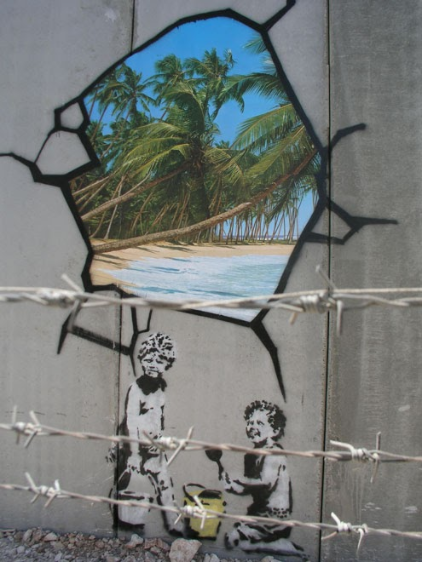
source : https://banksyexplained.com/the-segregation-wall-palestine-2005/
Iran’s Nuclear Programme and the Arrival of Donald Trump: A Dynamic Combining Christian Zionism, Prophecy, and an Evangelical Electorate
The signing of the Iran nuclear agreement (JCPOA) on 14 July 2015 constituted one of the rare points of divergence between the interests of the two allies. The agreement on the Joint Comprehensive Plan of Action was endorsed by United Nations Security Council Resolution 2231 of 20 July 2015.[19] For Netanyahu’s government, the agreement represented, and continues to represent, an existential threat. Since the Islamic Revolution of 1979, the Islamic Republic of Iran has been regarded as Israel’s principal strategic adversary. In the eyes of the Israeli authorities, the JCPOA merely delayed Tehran’s acquisition of a nuclear weapons capability while allowing it to recover economic and diplomatic room for manoeuvre. The Israeli prime minister therefore conducted an active campaign against the agreement, going so far as to address the United States Congress in March 2015. This episode reveals a first paradox in American-Israeli relations. Although Washington is the principal guarantor of Israel’s security, Tel Aviv has sought to influence American foreign policy directly whenever that policy appears contrary to its own interests.
Donald Trump’s arrival in the White House in 2017 accelerated the process of Israel’s normalisation in the Middle East and the legitimisation of the colonising of the West Bank as essential components of foreign policy. His election was due in part to the support of the evangelical electorate, whereas the Jewish community has traditionally voted predominantly for the Democratic Party.[20] Evangelicals constitute approximately 20 per cent of the American population, and 85 per cent of them voted for Trump in the 2020 presidential election.[21] This involvement encouraged a Zionist reading of the Bible that views Jewish settlement in Judea and Samaria, that is, the West Bank, as a necessary condition for Christ’s return to Earth. Christian Zionism itself contains an antisemitic dimension insofar as its interpretation of scripture envisages the eventual conversion of the Jews to Christianity upon Christ’s return.[22] The American ambassador to Israel, Mike Huckabee, himself a prominent evangelical figure, has interpreted a passage from the Book of Genesis according to which Abraham received a divine promise of a territory extending from the Nile to the Euphrates, encompassing present-day Egypt, Iraq, and Syria.
“I think that’s correct. And that would basically encompass the whole Middle East […] It would be nice if they took all of it.”[23]
This statement illustrates the convergence of the political, military, and religious interests underpinning the bilateral relationship between Israel and the United States in the Middle East. During Donald Trump’s first term, this convergence was reflected in several major decisions:
- Recognition of Jerusalem as Israel’s capital in December 2017, followed in May 2018 by the relocation of the American embassy and the suspension of aid to the Palestinians (UNRWA);
- Withdrawal from the JCPOA in 2018;
- Recognition of Israeli sovereignty over the Golan Heights through an executive order signed in March 2019, despite the fact that the territory had been occupied in 1967 and formally annexed in 1981 in violation of international law.[24]
The ’greatest diplomatic success’ nevertheless came on 15 September 2020 with the signing of the Abraham Accords, which normalised diplomatic relations between Israel and the United Arab Emirates, Bahrain, Sudan, and Morocco, the latter in exchange for American recognition of Moroccan sovereignty over Western Sahara.[25] Saudi Arabia’s participation in these agreements was, moreover, one of the factors that contributed to the events of 7 October 2023. American influence over Israeli foreign policy has therefore been exercised above all through the Abraham Accords. The concept of a protectorate thus embodies a principle that takes various forms.
It is precisely this tension that became visible after Donald Trump’s return to the White House in 2025. While Washington sought to stabilise the Middle East in order to contain Iran and preserve its broader strategic interests, Benjamin Netanyahu’s regional objectives gradually began to diverge from those of Israel’s principal ally. It was in this context that the first Israeli criticisms denouncing a form of ’protectorate’ emerged, not because Israel had lost its sovereignty, but because its freedom of regional action was increasingly conditioned by Washington’s strategic decisions.
First Criticisms in Israel
The G7 Agreement and Internal Divisions
The uncertainty in the Middle East generated by Israeli-American military operations in Iran, Lebanon, and the Strait of Hormuz led to renewed efforts to achieve a fragile regional stability. This objective took shape in the Islamabad Memorandum, signed on 17 June between the United States and Iran, which made the prospect of peace conditional upon the cessation of Israeli military operations in Lebanon. This agreement, together with Donald Trump’s public criticism of Israeli strikes against southern Beirut only hours before its signature, and JD Vance’s advice that Israel should ’open its eyes’ to its growing political and diplomatic isolation, relegated Israel to a secondary position, not that of an equal partner of the United States.
“If I were Israel, I wouldn’t attack the only powerful ally I have left in the entire world.”[26]
JD Vance’s statement does not call into question the strategic alliance between the two countries. Rather, it illustrates a change in the hierarchy of American priorities. Regional stabilisation has now become an American objective capable of limiting Israel’s military freedom of action. In other words, Israel retains its decision-making autonomy, but the continuation of its military operations depends to a considerable extent upon Washington’s political approval.
Let us recall a number of key figures illustrating Tel Aviv’s present-day dependence on Washington:[27]
- In 2024, the United States accounted for 28% of Israel’s merchandise exports (US$17 billion)
- In 2023, the United States accounted for 73% of all foreign investment in Israel (US$24 billion)
- In peacetime, annual American military assistance from 2019–2028 amounts to US$3.8 billion. Since 7 October 2023, however, military assistance has become continuous. During the 2023–2024 period alone, total American aid reached nearly US$18 billion.[28]
The Normalisation of the Far Right
Long presented as ‘the only democracy in the Middle East,’ Israeli policy is now increasingly being questioned by the international community, particularly its ‘right to defend itself.’ Today, the genocide,[29] the organised famine, the bombardment of Lebanon, and the strike on the Minab school in Iran give rise to a simple question: to defend itself against what? Numerous demonstrations have demanded an end to the total war. At the same time, expressions of support for Palestine at Columbia, Harvard, and Yale Universities have resulted in large numbers of arrests, accompanied by the cancellation of student visas.[30]
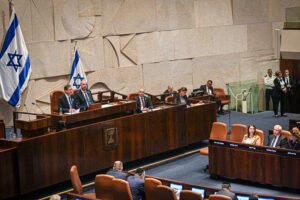
Held responsible for the ‘security failure’ of 7 October 2023, Benjamin Netanyahu, after more than thirty months of war, has secured no tangible progress either on Iran’s nuclear programme or on the Palestinian question. His continued hold on power, made possible by his coalition with the ultra-Orthodox parties, has nevertheless been weakened by the withdrawal of the United Torah Judaism party from the governing coalition.[31] Representing the fastest-growing demographic group in Israel (one in every three Jewish Israelis will be Haredi by 2060),[32] the ultra-Orthodox have traditionally been exempt from military service. However, the expansion of military operations on several fronts has led Israeli military leaders to reconsider their absence from the ranks of the armed forces. As regards foreign policy objectives in Lebanon, the framework agreement providing for the disarmament of Hezbollah was signed under American supervision.
These internal vulnerabilities and the reduction in Israel’s autonomy in decision-making during military campaigns undermine the impact of Netanyahu’s speeches in the Knesset, thereby strengthening the far right in the country during election periods; this has now become the political line of conduct that encourages settler attacks in the West Bank, accelerating settlement expansion, and the continuation of the war in Gaza. The emergence in 2021 of the alliance between Itamar Ben Gvir’s Jewish Power Party and Bezalel Smotrich’s Religious Zionism Party symbolises this ideological shift, the roots of which can be traced back to the Second Intifada (2000–2005).
Conclusion
The bilateral alliance between these two sovereign states therefore reveals a significant degree of Israeli dependence upon the United States, not only in the economic and military spheres, but also in moral and political terms, if one is to judge by Donald Trump’s statements, which were widely criticised by Israeli ministers. This development has been reflected in a particular expression circulated in the press: ‘bibisitting.’[33]
Taken together, American control over Israel’s external relations through the Abraham Accords, recognition of Israeli sovereignty over the Golan Heights, the legitimacy accorded to settlements in the West Bank, substantial financial and military support, and Washington’s refusal to endorse the bombing of Beirut, have placed Tel Aviv in a situation in which its diplomatic and political room for manoeuvre is increasingly conditioned by Washington. Although the term ‘protectorate’ is not, strictly speaking, appropriate to describe the relationship between these two sovereign states, a new hybrid dynamic nevertheless appears to be emerging. That said, the channels of influence operate in both directions, as demonstrated both by Netanyahu’s efforts to mobilise opposition to Iran’s nuclear programme and by the influence of AIPAC. The activities of the American Israel Public Affairs Committee (AIPAC) within the American electoral process contribute to strengthening diplomatic and economic ties by financing candidates favourable to Israeli policies and by helping to secure the United States’ veto against resolutions condemning Israeli actions in Gaza and the West Bank during sessions of the United Nations Security Council, thereby relegating the Palestinian question to a secondary position.
Notes
[1] French Ministry of Justice, The Dreyfus Affair, 2011
[2] Émile Zola, J’Accuse…!, published in Le Nouvel Observateur
[3] Theodor Herzl, The Jewish State (Der Judenstaat), 1896, excerpt (available in Babelio).
[4] David Elkaïm, “Introduction. Palestine up to the Second World War,” in History of Israel’s Wars: From 1948 to the Present Day, Tallandier, 2019, pp. 17–31.
[5] Richard Ned Lebow, “Woodrow Wilson and the Balfour Declaration,” The Journal of Modern History, University of Chicago Press, 1968, 40(4), pp. 501–523.
[6] La Croix, “Jews in the United States: For Whom Will They Vote in the Presidential Election?”
[7] Jewsa, “The History of Jews in America.”
[8] Benahmou, N. (2021), “American Jews (1): Demography,” The Times of Israel.
[9] Max Rotenberg, “Man in the Middle: Abe Feinberg & US–Israel Relations,” Emory College thesis, 2021.
[10] Jewish Telegraphic Agency, Daily News Bulletin, 3 July 1947.
[11] French Ministry of the Armed Forces, “1945: The Horror Revealed.”
[12] The states voting against were: Afghanistan, Saudi Arabia, Cuba, Egypt, Greece, India, Iran, Iraq, Lebanon, Pakistan, Syria, Turkey, and Yemen.
[13] Cyrille Beyer, “The Birth of Israel in 1948: From Theodor Herzl to David Ben-Gurion,” INA, 2018.
[14] Pascal Boniface, The Relationship Between the United States and Israel, translated statement, YouTube, 2023.
[15] Le Monde (2001), “The Hamas Movement Has Claimed Responsibility for This Weekend’s Attacks in Israel.”
[16] United Nations General Assembly, Report A/HRC/61/70 (2026).
[17] International Court of Justice, Legal Consequences of the Construction of a Wall in the Occupied Palestinian Territory, Advisory Opinion, 9 July 2004.
[18] International Criminal Court, Rome Statute of the International Criminal Court (1998).
[19] United Nations Security Council Resolution 2231 concerning Iran’s nuclear programme (2015).
[20] RFI, United States: Donald Trump Accuses American Jews Who Vote Democrat of “Hating” Their Religion, 2024.
[21] Laura-Julie Perreault, When Evangelicals Go to War, La Presse, 2026.
[22] Ibid.
[23] AFP / Le Monde, The American Ambassador to Jerusalem Angers Arab States With Remarks on Israel’s Right to Occupy Territory Across Much of the Middle East, 2026.
[24] State of Israel, Ministry of Foreign Affairs, Golan Heights Law, 14 December 1981.
[25] Ghadir Hamadi, The Abraham Accords: Who Is Part of Them, Who Might Join Them, and Who Remains Outside?, L’Orient-Le Jour, 2025.
[26] AFP, L’Orient-Le Jour (2026), “If I Were Israel, I Wouldn’t Attack the Only Powerful Ally I Have Left in the Entire World,” Says JD Vance.
[27] Jacques Bendelac, Israel on the Road to Becoming an American Protectorate, The Times of Israel, 2025.
[28] Pascal Brunel, American Military Aid to Israel Reaches Record Levels, Les Échos, 2024.
[29] Recognised as genocide by a United Nations Commission of Inquiry on 16 September 2025.
[30] Reuters / L’Orient-Le Jour (2025), The Trump Administration Seeks to Revoke the Student Visas of Pro-Palestinian Demonstrators.
[31] France 24, Netanyahu’s Coalition Weakened Following the Withdrawal of an Ultra-Orthodox Party, 2025.
[32] Simone Lipkind, Why Israel Wants to Enlist the Ultra-Orthodox into the Army, Areion24, 2025.
[33] Courrier International (2025), Word of the Day: “Bibisitting”—The United States Keeps a Very Close Watch on Benjamin Netanyahu.