

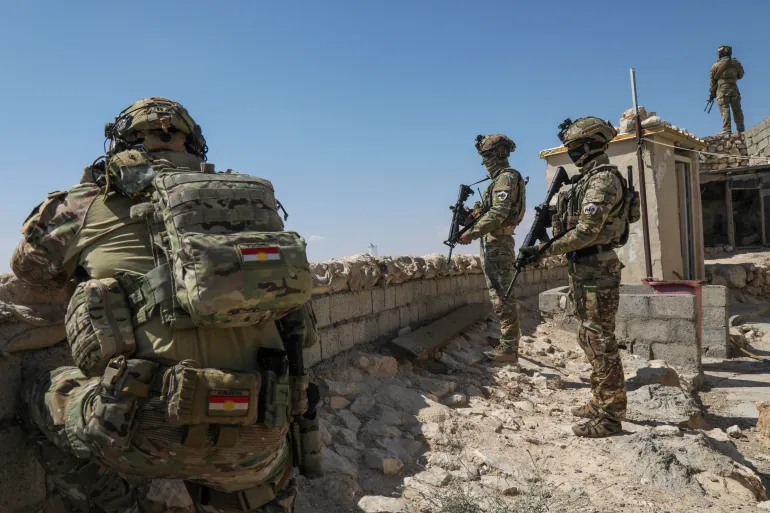

Since the war launched by the United States and Israel against Iran on 28 February, the Kurdistan Region of Iraq has faced a sustained campaign of drone and missile attacks, with 1,012 strikes reportedly killing at least 32 people and injuring 156 others, including 19 members of Iranian Kurdish opposition parties [1]. On 30 September, the withdrawal of 1,500 troops from the US-led Coalition further altered the region’s security landscape, raising questions about its capacity to defend itself against renewed Iranian attacks [2][3]. With no agreement reached between Washington and Tehran, the prospect of another round of hostilities has left Iraqi Kurdistan exposed to growing uncertainty over the future of its security arrangements.
The withdrawal comes amid mounting concerns that the Kurdistan Region could once again become a target if tensions between Iran and the United States escalate. The newspaper Foreign Policy has warned of the risk of renewed attacks, while CNN has reported that the Trump administration has considered using the so-called “Mother of All Bombs” [either before or after the mid-terms] against Iranian energy infrastructure and nuclear facilities [4][5]. Tehran, meanwhile, has signalled that the threat of further strikes has not disappeared. On 8 October, Iran’s consul general in Erbil, Faramarz Asadi, told Rudaw that new drone attacks against Iranian Kurdish opposition groups and other targets could not be ruled out following the Coalition’s departure [6]. He also alleged that CIA personnel remained present in the Kurdistan Region and could be targeted if they took action against Iran.
The drawdown has also raised questions about the effectiveness of the remaining air-defence arrangements. According to The Wall Street Journal, the United States removed a Patriot air-defence battery stationed near Erbil, potentially reducing the region’s protection against Iranian ballistic missiles [7]. Washington is expected to prioritise the defence of its embassy and consulate in Erbil, potentially leaving other areas more exposed. Although systems such as C-RAM can intercept certain incoming rockets and drones, they are not designed to provide equivalent protection against the full range of Iranian ballistic missile capabilities [8]. Iraqi air-defence systems intended for the Kurdistan Region are reportedly still years away from delivery [9]. Against this backdrop, the departure of Coalition forces raises a fundamental question: will the end of the international military presence reduce Iran’s incentive to target Iraqi Kurdistan, or leave the region more vulnerable to attack?
Attacks by Iran before and after February 28
The withdrawal of US-led Coalition forces does not necessarily mean an end to attacks on the Kurdistan Region. Even in the absence of American military installations, Iranian Kurdish opposition groups, energy infrastructure and other strategic or civilian targets could remain vulnerable to Iranian strikes. Historical data suggests that attacks on the region long predate the February 2026 war, with Iran and Iranian-backed Iraqi factions targeting Iranian Kurdish opposition parties, energy facilities, Kurdish business figures and US military positions through drones, missiles and other military means [10]. Although the scale of these attacks was considerably lower before 28 February, their persistence indicates that the security threat extends beyond the presence of foreign forces.
According to Community Peacemaker Teams (CPT), Iranian military operations inside Iraqi Kurdistan caused 143 civilian casualties, including 81 deaths and 62 injuries, between 1 January 1991 and 30 June 2024 [11]. More recently, the Washington Kurdish Institute documented 32 attacks by Iran and Iranian-backed Iraqi factions against the Kurdistan Region between September 2018 and October 2023 [12]. Iranian strikes have repeatedly targeted opposition groups based in Iraqi Kurdistan, including during the mass protests that followed the death of Jina (Mahsa) Amini, a Kurdish woman who died in the custody of Iran’s morality police on 16 September 2022 [13]. On 28 September that year, an Iranian strike killed 13 people [14]. Tehran accused the opposition groups of involvement in the protests, allegations that contributed to its justification for cross-border military action [15].
The latest war intensified this longstanding pattern of attacks. Since the Coalition withdrawal on 30 September, Iran has reportedly carried out further drone strikes against Iranian Kurdish opposition groups, including attacks in Koya and Topzawa in Erbil Governorate [16]. A strike on Koya on 12 October coincided with the annual Middle East Research Institute (MERI) Forum in Erbil [17]. These incidents suggest that the withdrawal of international forces has not removed the underlying sources of tension between Tehran and the Kurdistan Region. Rather, the future security of Iraqi Kurdistan will depend in part on how the presence of Iranian Kurdish opposition groups is addressed, whether through negotiations between Tehran and the groups themselves or through increased Iranian pressure on Baghdad and Erbil to disarm, relocate or expel them.
Jabar Yawar, the former Secretary General of the Ministry of Peshmerga, acknowledged that the Coalition’s departure could reduce the number of potential targets while emphasising that it would not eliminate the threat posed by Iran [18]. “It is possible that, with the international coalition’s bases and facilities no longer present, there will be fewer targets or bases to attack. However, Iran openly says that as long as bases belonging to the Iranian Kurdish opposition exist, it will strike them,” he said. For Yawar, the issue remains a pressing political and security challenge for the Kurdistan Region’s leadership.
The war also exposed the delicate position of the Iranian Kurdish opposition parties, whose presence in Iraqi Kurdistan has long complicated relations between Erbil, Baghdad and Tehran. At the beginning of the conflict, reports emerged that the United States and Israel were considering arming Iranian Kurdish groups to support an advance into western Iran [19]. The reported plans did not materialise, amid coordinated efforts by Iran, Turkey and Iraqi Kurdish political leaders to prevent the region from becoming a launchpad for military operations against a neighbouring state. In June, Turkish President Recep Tayyip Erdoğan confirmed the existence of “dialogue channels” that had helped prevent a US- and Israeli-backed Kurdish offensive into Iran during the conflict, and said he had personally contacted President Donald Trump [20].
At the MERI Forum on 12 October, Kurdistan Region President Nechirvan Barzani criticised Iranian Kurdish opposition groups for publicly suggesting that they were preparing to enter Iran, arguing that their statements had exposed the Kurdistan Region to unnecessary danger [21]. He stressed that the Kurdistan Democratic Party (KDP) and the Patriotic Union of Kurdistan (PUK), including PUK leaders Bafel Talabani and Qubad Talabani, had coordinated efforts to prevent Iraqi Kurdistan from being used as a base for attacks against a neighbouring country. “Regrettably, those groups presented themselves as heroes of the war, but we knew from the beginning that such an approach was not possible. Our position was clear,” Barzani said. “The Kurdistan Democratic Party and the Patriotic Union of Kurdistan controlled the borders from the first day of the war, deployed forces, and made it clear that we would not permit any such action to be taken from the Region.”
These statements reflect the dilemma facing the Kurdistan Region’s authorities. While they seek to preserve their autonomy and avoid being drawn into a wider regional confrontation, they must also contend with Tehran’s demands concerning armed opposition groups operating from their territory. A forced expulsion of these groups could carry significant domestic political and social costs, while allowing them to remain in place risks further Iranian attacks and diplomatic pressure. One possible way forward would be to facilitate negotiations between Iran and the Iranian Kurdish armed opposition groups based in the Kurdistan Region. PUK leader Bafel Talabani has suggested that such a process could draw lessons from the peace initiative between Turkey and the Kurdistan Workers’ Party (PKK) [22]. Iranian Kurdish parties, however, have denied that such a process is currently under way. Previous attempts to reach an accommodation have produced limited results [23]. In 2011, the Kurdish armed group Kurdistan Free Life Party (PJAK) declared a ceasefire with Iran, while talks held in Norway in 2019 between the Iranian government and four Iranian Kurdish parties failed to produce an agreement [24].
Meanwhile, pressure on Baghdad and Erbil appears to be increasing. On 20 October, Iran’s ambassador to Iraq claimed that Baghdad had agreed to expel Iranian Kurdish “separatist” groups from the Kurdistan Region and hand them over to Tehran [25]. The statement signals the possibility of further efforts to go further then the 2023 security agreement between Iraq and Iran, under which Baghdad committed to disarming and relocating Iranian Kurdish opposition groups away from the border areas. The latest conflict has reinforced Tehran’s concern that these groups could be used by external powers to threaten Iranian security.
For Iraqi Kurdish leaders, however, complying with demands to remove the groups by force would be politically sensitive. The opposition parties have established a presence in the region over several decades, and their members have their own political networks and supporters. Public Kurdish outcry against the reported refusal of medical treatment to an 18-year-old Kurdish opposition fighter in April illustrates the potential domestic backlash surrounding their treatment [26]. The authorities therefore face competing pressures: preventing their territory from being used against Iran, avoiding further Iranian military retaliation and managing the political consequences of any attempt to disarm or expel the opposition groups.
Ultimately, the Coalition’s withdrawal may alter Iran’s calculations regarding which targets remain available, but it does not resolve the dispute at the heart of the security crisis. As long as Iranian Kurdish opposition groups remain in the Kurdistan Region without a mutually accepted political or security arrangement with Tehran, the threat of further attacks is likely to persist. The central question is whether Baghdad and Erbil can broker a negotiated solution that limits the risk of cross-border escalation without provoking a new internal political crisis.
Threat of Iranian-backed Iraqi Factions
Another major security concern for the Kurdistan Region is the continued presence of Iranian-backed Iraqi armed factions, which have not been disarmed despite Baghdad’s earlier deadline of 30 September. Under pressure from Tehran, the Iraqi government subsequently postponed the deadline to 30 June 2027 [27]. As tensions between Iran and the United States persist, the prospect of these predominantly Shia armed groups surrendering their weapons remains uncertain. Their continued autonomy poses a potential threat to the Kurdistan Region, particularly if regional hostilities resume and Iraq’s territory becomes a battleground for confrontation between Washington and Tehran.
For Jabar Yawar, the former Secretary General of the Ministry of Peshmerga, the challenges posed by Iraq’s internal security arrangements may now outweigh the threat from the Islamic State (ISIS) [28]. “The risk, I would say, is now greater in terms of Iraq’s internal challenges than the threat posed by ISIS,” he argued. He pointed to several unresolved questions: “Will Iraq’s armed groups ultimately be brought under control? Will the Kurdistan Region and the Iraqi government resolve their disputes? Can Iraq and the Kurdistan Region improve coordination between their armed forces and intelligence services so they can work together? Will the disagreements we have seen recently come to an end?” His remarks highlight the extent to which the Kurdistan Region’s security depends not only on external military support, but also on Baghdad’s ability to bring armed factions under state authority and strengthen coordination with Erbil.
The rhetoric of some Iranian-backed factions has nevertheless sought to reassure Kurdish authorities. On 3 October, Abu Ala al-Walai, leader of the pro-Iran Kataib Sayyid al-Shuhada faction, said the withdrawal of US forces should not cause concern, emphasising that the security of the Kurdistan Region was an integral part of Iraq’s national security [29]. Such assurances, however, do not resolve the broader question of whether these factions would refrain from targeting the region in the event of renewed US-Iranian hostilities. Their continued refusal to disarm, alongside the unresolved disputes between Baghdad and Erbil, leaves the Kurdistan Region exposed to a security environment in which both regional escalation and Iraq’s internal political divisions could undermine its stability.
| Overview of attacks in Kurdistan Region | 1994 – 2026 |
| Date | Attacks |
| 1994 and 1996 | Iran shells and bombs PDKI positions with fighter jets |
| 2011 | IRGC forces launch attack and shelling on PJAK positions in Qandil |
| 2018 | First missile strike on Kurdistan Freedom Party (PAK) position |
| September 2018 to October 2023 | 32 drone and missile attacks on Iranian Kurds, energy infrastructure, U.S. bases by Iran and Iranian-backed factions |
| 28 September 2022 | Series of large-scale attacks using drones and long-range weapons on PDKI, Komala, and PAK, killing at least 17 members |
| January 15 2024 | Kurdish businessman Peshraw Dizayee killed by Iranian ballistic missiles |
| April 26, 2024 | Four Yemeni workers were killed by drones strikes on the Khor Mor gasfield launched by Iran-backed factions in Iraq [30] |
| July 25 2025 | 18 drone attacks were carried out by Iran-backed Iraqi faction on locations in the Kurdistan Region targeting infrastructure |
| 21 January 2026 | Drone strike kills one PAK member |
| February 28 2026 until now | 1,012 drones and missile attacks, 32 killed |
Concluding remarks
The Coalition withdrawal from the Kurdistan Region presents dangers, but also opportunities for the Kurdistan Region. While the withdrawal leaves the Kurdistan Region without air defenses, it also gives Iran less excuses to attack the Kurdistan Region now that the U.S. military bases have been evacuated. However, the continued presence of Iranian Kurdish parties in Iraqi Kurdistan could attract continued attacks. This is why both leaders from the PUK and KDP have underlined their neutrality in the current war and that they will now allow armed groups to use Kurdish territory to attack neighbouring countries. With this, it is likely that the Iraqi Kurds will undertake more efforts to gain air defenses, and try to find Iranian acceptance for the presence of Iranian Kurdish opposition parties through a peace process. Otherwise, they will face continued Iranian drones and pressure to remove these groups, unless the conflict deescalates to such an extent that Iran does not feel threatened anymore. Even if there are no Kurdish opposition groups in Iraqi Kurdistan, Iran and Iran-aligned factions have also targeted Kurdish businessmen and energy infrastructure in the Kurdistan Region before the February war. During the February 28 war, Iran also targeted the offices and residence of Kurdistan Region President Nechirvan Barzani, KRG Prime Minister Masrour Barzani, KDP President Masoud Barzani [31][32][33]. Therefore, the KRG will still lobby for such air defenses to be installed in vital locations such as oil and gas fields and airports.
Reedited by EISMENA
Notes
[1] Soran Hussein, “Last Month, 29 Drones and Missiles Attacked the Kurdistan Region,” Rudaw, October 1, 2026. https://www.rudaw.net/sorani/categories/kurdistan/1872027
[2] Al Jazeera Staff, “Pentagon Says US Troop Withdrawal from Iraq Is Complete”, Al Jazeera, September 30, 2026.
https://www.aljazeera.com/news/2026/9/30/pentagon-says-us-troop-withdrawal-from-iraq-is-complete
[3] U.S. Central Command (CENTCOM), “U.S. Forces End Operation Inherent Resolve Mission in Iraq,” September 30, 2026. https://www.centcom.mil/MEDIA/PUBLIC-RELEASES/Article/4614532/us-forces-end-operation-inherent-resolve-mission-in-iraq/
[4] Ali Hashem, “The Next Iran War Is This Iran War: The Iran War Is, and Always Was, About Regime Change,” Foreign Policy, October 8, 2026, https://foreignpolicy.com/2026/10/08/next-iran-war-regime-change/
[5] Zachary Cohen, Haley Britzky, and Kevin Liptak, “Exclusive: US Considering Using ‘Mother of All Bombs’ Against Iran, Sources Say,” CNN, October 15, https://edition.cnn.com/2026/10/15/politics/us-considering-mother-of-all-bombs-iran
[6] No author, “Iranian Strikes in Kurdistan Region Still on Table Despite US Exit: Envoy,” Rudaw English, October 8, 2026, https://rudaw.net/english/categories/interview/1079635
[7] Jared Malsin and Sangar Khaleel, “The U.S. Military Exits Iraq, Leaving Behind a Nation in Peril,” The Wall Street Journal, September 29, 2026.https://www.wsj.com/world/middle-east/iran-american-military-iraq-militants-e5e20c75
[8] Sgt. Steve Asfall, “TF DEFENDER Conducts C-RAM Live Fire Calibration Exercise,” DVIDS, July 9, 2025, https://www.dvidshub.net/image/9226116/tf-defender-conducts-c-ram-live-fire-calibration-exercise
[9] No author, “Iraq to overhaul air defenses over next three years: Officials”, The New Region, September 7, 2026 https://thenewregion.com/posts/6448
[10] No author, “Attacks on the Kurdistan Region by Iran and its Iraqi Proxies,” Washington Kurdish Institute, November 2, 2023. https://dckurd.org/2023/11/02/attacks-on-kurdistan-iran-iraqi-proxies/
[11] Community Peacemaker Teams – Iraqi Kurdistan (CPT-IK), “Civilian Casualties by Turkish and Iranian Military Operations, 1991–2024,” August 12, 2024. https://cptik.org/reports-1/2024/8/12/civilian-casualties-by-turkish-and-iranian-military-operations-1991-2024
[12] No author, “Attacks on the Kurdistan Region by Iran and its Iraqi Proxies,” Washington Kurdish Institute, November 2, 2023. https://dckurd.org/2023/11/02/attacks-on-kurdistan-iran-iraqi-proxies/
[13] U.S. Embassy in Iran. “Two Years After Mahsa (Zhina) Amini’s Death.” September 2024. https://ir.usembassy.gov/two-years-after-mahsa-zhina-aminis-death/
[14] No author. “13 Killed and 58 Injured in Iranian Air Strikes in Iraq’s Kurdish Region.” Relief Web, September 29, 2022 https://reliefweb.int/report/iraq/13-killed-and-58-injured-iranian-air-strikes-iraqs-kurdish-region-28-sept
[15] Ibidem
[16] Wladimir van Wilgenburg, “Two Drones Hit Iranian Kurdish Party Camp: CTD,” Kurdistan Chronicle, October 9, 2026, https://kurdistanchronicle.com/babat/4974
[17] Sehend Mayiwar, “Drone Strikes Target Iranian Kurdish Opposition Camp in Erbil; No Casualties,” The New Region, October 12, 2026, https://thenewregion.com/posts/6786
[18] Author’s Interview Jabar Yawar, Former Secretary General of Ministry of Peshmarga, October 13.
[19] Nadav Rapaport, “‘Turkey ‘Prevented Kurdish Invasion’ of Iran During Israeli-US War,” Middle East Eye https://www.middleeasteye.net/news/turkey-prevented-kurdish-invasion-iran-aimed-toppling-government-during-israeli-us-war
[20] No author, “Erdogan Says Dialogue with Kurds Prevented ‘Insidious’ Iran Offensive,” The New Region, June 24, 2026, https://thenewregion.com/posts/5713
[21] No Author, “President Nechirvan Barzani: The Middle East Is at the Beginning of a New Phase,” Kurdistan Region Presidency, October 12, 2026, https://presidency.gov.krd/en/president-nechirvan-barzani-the-middle-east-is-at-the-beginning-of-a-new-phase/
[22] No Author, “Iraqi Kurdish Leaders Raise Prospect of Peace Talks Between Iran and Kurdish Opposition,” VOA, October 14, 2026
https://www.voanews.com/a/iraqi-kurdish-leaders-raise-prospect-of-peace-talks-between-iran-and-kurdish-opposition/8211277.html
[23] Wladimir van Wilgenburg, “Iraqi Kurds Suggest Peace Process Between Iran and Iranian Kurdish Opposition,” Middle East Eye, October 15, 2026. https://www.middleeasteye.net/news/iraqi-kurds-suggest-peace-process-between-iran-and-iranian-kurdish-opposition
[24] Ibidem
[25] No author, “Iran says agreed with Iraq to expel opposition groups in Kurdistan Region”, The New Region, October 20, https://thenewregion.com/posts/6863
[26] No author, “KRG Health Ministry: Hospital Refusals in Mawlan Case ‘Unacceptable’, Kurdistan 24, https://www.kurdistan24.net/en/story/908809/krg-health-ministry-hospital-refusals-in-mawlan-case-unacceptable
[27] No author, “Iraq’s Zaidi Sets June 2027 Deadline for Militia Disarmament,” The Arab Weekly, September 22, 2026. https://thearabweekly.com/iraqs-zaidi-sets-june-2027-deadline-militia-disarmament
[28] Author’s Interview Jabar Yawar, Former Secretary General of Ministry of Peshmarga, October 13.
[29] No author, “Iraqi pro-Iran militia leader says US withdrawal not concern for Kurdistan Region”, The New Region, October 3, https://thenewregion.com/posts/6695
[30] Rudaw Staff, “Drone Attack on Khor Mor Gas Field Kills Four Yemenis, Cuts Power,” Rudaw, April 26, 2024. https://www.rudaw.net/english/categories/kurdistan/796801
[31] No author, “Baghdad Orders Probe After Drone Targets Kurdistan President’s Home,” Reuters, March 28, 2026. https://www.reuters.com/world/middle-east/baghdad-orders-probe-after-drone-targets-kurdistan-presidents-home-2026-03-28/
[32] No author, “Kurdistan Region Continues to Face Unwarranted Attacks,” Kurdistan Regional Government Representation in the United States, September 1, 2026. https://us.gov.krd/kurdistan-region-continues-to-face-unwarranted-attacks/
[33] Wladimir van Wilgenburg, “President Barzani Calls on Baghdad to Stop Attacks on Kurdistan,” Kurdistan Chronicle, March 29, 2026. https://kurdistanchronicle.com/babat/4545