

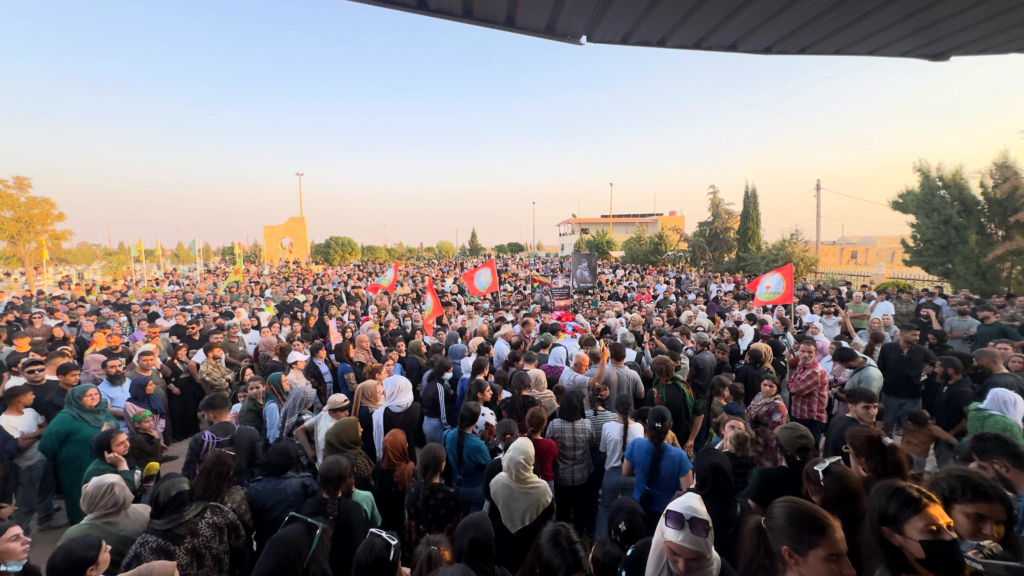

On 25 August 2026, at the presidential palace in Damascus, the commander of the Syrian Democratic Forces (SDF) Mazloum Abdi, announced the dissolution of his organisation and its integration into the Syrian army. This announcement put an end to a process that began with the agreement of 10 March 2025 between Abdi and the transitional president Ahmed al-Charaa – a process precipitated by the military offensive of January 2026 on Aleppo, Raqqa and Deir ez-Zor, and sealed by the framework agreement of 30 January 2026. As of 3 September, however, implementation remains held up by several obstacles: the military status of YPJ female fighters, the appointment of a deputy president in Damascus responsible for the issue, and the actual degree of local autonomy granted to predominantly Kurdish areas. This article examines the content of the compromise reached between Damascus and the Syrian Kurds, its implication for the regional balance – Turkey, the United-States, Israel, and the peace process with the PKK – and places it within the long-term context of the Kurdish question, comparing it to the far more institutionalised but as fragile trajectory of Iraqi Kurdistan, whose structural vulnerability, despite thirty years of constitutional autonomy, has been highlighted by Adel Bakawan. Finally, this article considers what the end of the Rojava era might mean for the future of the Kurdish national movement as a whole.
—
From triumph to dissolution: chronicle of a turning point
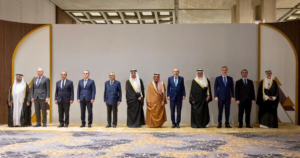
On 25 August 2026, in a carefully staged event at the al-Shaab Presidential Palace, Mazloum Abdi announced the dissolution of the SDF “as an independent military force”. Standing alongside him, the transitional president, Ahmed al-Sharaa, hailed it as a “historic” day, a description echoed by the US Special Envoy for Syria. Abdi summarised the significance he intended to attach to this shift: moving “from the era of arms to the era of peace”. The event was not improvised. It brings to a close a process that began on 10 March 2025, when Abdi and al-Sharaa signed – the next day following the fall of Bashar al-Assad – a framework agreement providing for the gradual integration of the Autonomous Administration of North and East Syria (AANES) and its military branch into the institutions of the Syrian state. For nearly a year, this agreement remained largely a dead letter: Damascus demanded that fighters be absorbed individually into the regular army, whilst the SDF insisted on integration in brigade-sized units, which they saw as the only guarantee of preserving their chain of command and, ultimately, a form of local autonomy.
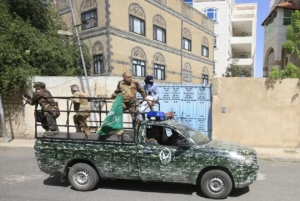
The disagreement nearly escalated into a full-scale conflict. Indeed, in January 2026, the Syrian army launched a multi-pronged offensive, which in less than three weeks, shifted the balance of power: the Kurdish neighbourhood of Sheikh Maqsoud in Aleppo was captured, followed by an advance towards Maskanah and Deir Hafer, and then a decisive breakthrough with the capture of Tabqa, the Euphrates Dam and the oil fields of Raqqa, with the latter city falling into the hands of tribal forces allied with Damascus. Two successive cease-fires failed before a comprehensive agreement signed on 30 January 2026, set out the framework for resolving the crisis: the reorganisation of the SDF into three brigades under the authority of the Ministry of Defense (including a brigade dedicated to Kobanî, administratively attached to the governorate of Alpeso), the deployment of Ministry of the Interior forces to Hassakeh and Qamishli, and cultural and linguistic guarantees for the Kurdish population. It is this text that the announcement of 25 August, seven months later, sets in motion.
As at 3 September, an agreement that is still largely theoretical
Nine days after the ceremony in Damascus, the announced dissolution of the SDF remains, on the ground, more of a political act rather than an operational reality. Three key sticking points underpin the issue. The first concerns the status of female fighters in the Women’s Protection Units (YPJ): Damascus is offering them only police posts within the Ministry of the Interior, whilst the women concerned are demanding to remain in military functions (negotiation that has taken up a significant portion of the past seven months without reaching a conclusion). The second relates to a seemingly technical but politically significant point: the appointment, in Damascus, of a deputy minister responsible for overseeing integration, the repeated postponement of which is delaying the establishment of the structures provided for in the January agreement. The third issue is to what degree local administration will actually be tolerated in Hassakeh and Qamishli once the central security forces have been deployed? Abdi himself had acknowledged, as early as January that “the integration process could take time”, whilst expressing confidence that it would be successfully concluded.
This slowness is not merely bureaucratic, it reflects an asymmetry of power now assumed by Damascus, which no longer needs to deal with the SDF as an indispensable military partner. This fact was made clear by the US envoy, who stated that the SDF’s role had “largely come to an end”, now that the Syrian government could assume sole responsibility for security in the north-east. The balance of power has shifted in just over a year: an indispensable partner of the international coalition against the Islamic State until 2019, and the de facto pivot of an autonomous administration since 2013, the Kurdish force is now negotiating the terms of its own dissolution.
A region that has changed its approach
The shift cannot be explained solely by the bilateral relationship between Damascus and the Syrian Kurds: it is the result of a broader regional realignment. Turkey has thrown its full weight behind rapid integration without any territorial concessions, having always regarded the SDF as the Syrian offshoot of the Kurdistan Workers’ Party (PKK). Paradoxically, this view was reinforced by Abdullah Öcalan’s call in February 2025 for the dissolution of the PKK as part of the peace process with Ankara. This Turkish-Kurdish process, which has remained largely separate from the Syrian issue in public debate, has in fact deprived the SDF of one of its rare bargaining chips: that of presenting itself as an actor whose fate would jeopardise the stability of the Turkish-Kurdish peace itself.
At the same time, the gradual withdrawal of American support played an equally decisive role. Washington, which had made the SDF its key partner in the fight against Daesh, shifted its focus toward the new regime that emerged following Assad’s fall, considering the SDF’s mission accomplished. Israel, for its part, signed a security agreement with the new Syrian authorities, which correspondingly reduced its strategic interest in supporting an autonomous Kurdish entity in the north-east of the country. Thus, overnight, Ankara, Washington, Tel Aviv and Damascus found themselves, each for their own distinct reasons, pulling in the same direction: that of a negotiated dissolution rather than the status quo of autonomy. For Fabrice Balanche, al-Sharaa’s manoeuvre forms part of a broader project to recentralise a territory fragmented by thirteen years of civil war, of which the absorption of the SDF is just one element amongst many. The Syrian Kurds, lacking contiguous territory and deprived of constant external support, have once again become a bargaining chip in negotiations that are largely beyond their control.
Iraqi Kurdistan, Rojava: two autonomous regions, two forms of failure
It is very tempting to compare the Rojavan experience against that of Iraqi Kurdistan, the only Kurdish entity to have ever achieved lasting recognition within an Arab state. Since 2005, the Kurdistan Regional Government (KRG) has enjoyed federal status enshrined in the Iraqi Constitution, a parliament, its own army – the Peshmergas – and de facto diplomatic relations with several Western capitals. Rojava, on the other hand, has never enjoyed such a strong position. Its autonomy arose from a security vacuum: the one left by the Syrian army’s withdrawal from the north-east in 2012, and was subsequently consolidated by the international coalition’s need for a partner on the ground to fight Daesh. This de facto autonomy has never been enshrined in the constitution nor even formally recognised by a Syrian central government, whether Ba’athist or, today, from the al-Sharaa faction. Yet this asymmetry in status did not prevent both experiments from running into comparable structural weaknesses, a few years apart. As Adel Bakawan and Jean Marcou have shown: the Kurdish question cannot be viewed as a single bloc, given that the Iraqi, Syrian, Turkish and Iranian trajectories remain, each in their own way, constrained by the specific logic of their host states and by internal rivalries within the Kurdish national movement itself. The Iraqi case illustrated this in its own way: despite its constitutional autonomy, Iraqi Kurdistan remains, according to the analysis already provided by Bakawan in 2017, trapped within a political duopoly, the Kurdistan Democratic Party (KDP) and the Patriotic Union of Kurdistan (PUK) – and an oil-based rentier economy, which together have stripped the promise of a de facto state of its substance.
The parallel is not merely institutional, it is also strategic. In both cases, Kurdish autonomy flourished as long as it served the interests of a third party – the coalition against Daesh for the SDF, and the balance of oil interests and anti-Iranian stance for the KRG – and was undermined as soon as that third party reassessed its position. Rojava, however, has never enjoyed the same long-term institutional stability: whilst Iraqi Kurdistan had three decades to establish the beginnings of a state before grappling with its own contradictions, the Rojava experiment has lasted only some fifteen years, caught in a vice between the Syrian civil war, Turkish hostility and the volatility of Western support.
Outlook: the Kurdish question in the face of the renewed fragmentation
Whether or not the dissolution of the SDF is fully implemented in the coming months, it already marks a symbolic turning point: the end of the era when a Kurdish movement could hope to transform a temporary military balance of power into a lasting political status. The PKK has renounced armed struggle at the behest of its own founder, the SDF are relinquishing their de facto autonomy due to a balance of power that has turned against them; and Iraqi Kurdistan, the only entity with constitutional status, is mired in a governance crisis that calls into question its ability to remain a model for the rest of the Kurdish national movement. In all three cases, it is not so much the Kurdish cause itself that is in retreat as its translation into autonomous instruments of power.
Three unknowns will dominate the way forward: the first concerns Damascus’s sincerity in implementing the promised cultural guarantees (the teaching of Kurdish, and civil and educational recognition), which alone would give tangible substance to the “integration” called for by al-Sharaa. The second concerns the internal cohesion of the Syrian Kurdish movement itself, now deprived of its unifying military instrument and exposed to the same dynamics of partisan fragmentation as its Iraqi and Turkish counterparts. The third, finally, concerns the region: the ongoing normalisation between Damascus, Ankara and Tel-Aviv leaves, for the time being, no room for an autonomous armed Kurdish actor – a shift that could prove as decisive for the future of the Kurdish question as the emergence of Daesh in its day. One thing remains certain: twenty years after Kobanî joined the resistance, the Rojava chapter is drawing to a close not with a military defeat, but with a negotiated surrender; for a movement whose history, spanning a century, has been shaped by the ever-postponed promise of a state, this is neither the first nor, no doubt, the last setback.
Notes
[1] Al Jazeera, « Kurdish-led forces in Syria dissolve after merging with the army », aljazeera.com, 25 août 2026.
[2] La Libre, « Conflit en Syrie – La dissolution des forces kurdes en Syrie est “historique”, dit l’envoyé spécial américain », lalibre.be, 26 août 2026.
[3] Al Jazeera, « Kurdish-led forces in Syria dissolve after merging with the army », art. cité ; voir aussi France 24, « Syrian Kurdish leader announces SDF dissolution after its integration… », france24.com, 25 août 2026.
[4] Syrian Observer, « SDF Integration into Syrian Ministry of Defense: Mazloum Abdi Outlines Agreement Mechanisms and Remaining Challenges », syrianobserver.com, 2026 ; « 2026 northeastern Syria offensive », Wikipédia, consulté le 3 septembre 2026.
[5] Al Jazeera, « Kurdish-led forces in Syria dissolve after merging with the army », art. cité.
[6] Syrian Observer, art. cité.
[7] Fabrice Balanche, « L’objectif du président al-Charaa est d’installer… », entretien, rts.ch, 2026.
[8] Adel Bakawan, Jean Marcou (dir.), La question kurde dans tous ses états, Orients stratégiques, n° 12, Paris, L’Harmattan, 2022.
[9] Adel Bakawan, « Les fragilités du Kurdistan irakien », RAMSES 2018, Paris, Ifri/Dunod, 2017.