

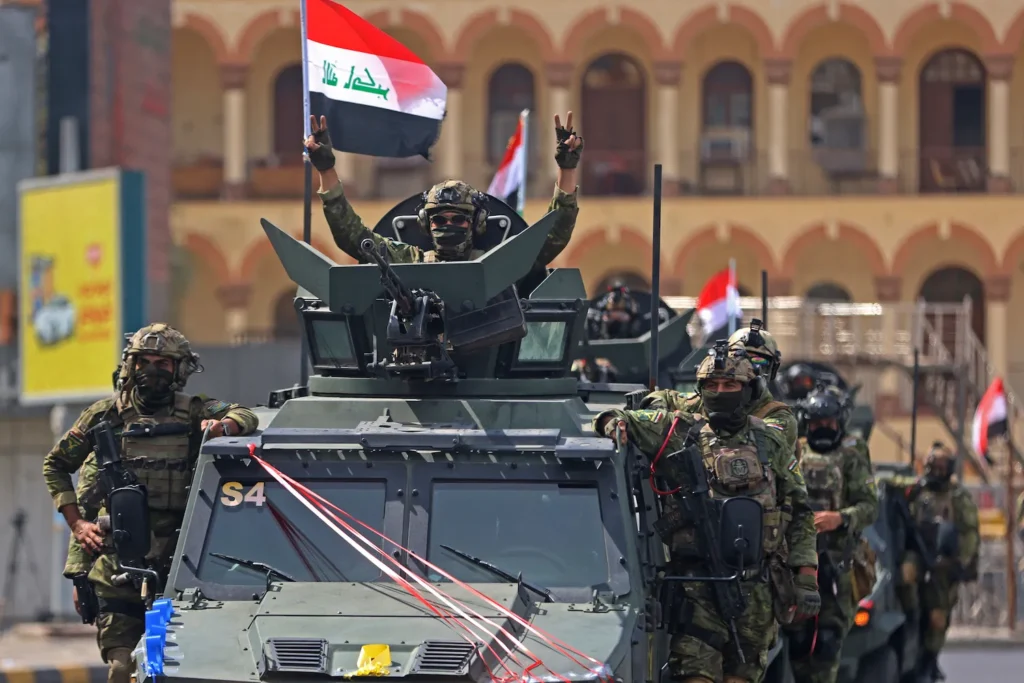

Like its predecessors, the government of Ali Falih al-Zaidi has included in its programme the fight against corruption, economic and banking reforms, energy, water, and economic diversification. Among its 139 priorities is also a particularly sensitive objective: bringing weapons under state authority and unifying security decision-making. Although this issue is not new, it took on particular significance in 2026 amid regional tensions and US pressure to disarm pro-Iranian factions possessing an autonomous capacity for action.
On 29 June, the government gave these factions until 30 September to resolve the issue of their weapons, a deadline coinciding with the scheduled end of the international coalition’s mission against ISIS. In July, in Washington, Zaidi reaffirmed his intention to bring weapons under state authority. Yet the meaning of this deadline gradually became less clear: disarmament, dissolution, integration into the security forces, control of weapons, or control over their use. Behind the principle of the “state monopoly on weapons,” the government and the factions do not necessarily mean the same thing.
On 21 September, Zaidi announced a new timetable: 30 September would mark the beginning of a 90-day period during which the factions would refrain from any attacks and US forces from striking them, followed by a gradual handover of weapons, now scheduled for completion by 30 June 2027.
These postponements reveal the difficulty the state faces in controlling actors that are embedded in both the security and political apparatus while potentially retaining their own chains of command. At stake are US pressure, Baghdad’s positioning between Washington and Tehran, the hybrid nature of the political-security system, and the factions’ divergent strategies.
I. Between US Pressure and the Iraqi Response
US pressure on Baghdad intensified significantly in 2026, as illustrated by US Secretary of Defense Pete Hegseth’s call, during al-Zaidi’s visit to Washington in July, for Iraq to assert its sovereignty by disarming Iran-aligned militias. At the same time, Washington linked progress in this area to deeper economic and security cooperation with Baghdad while tightening the conditions attached to its security assistance. Passed by the House of Representatives on 22 July 2026 but not yet in force, the FY2027 NDAA[1] bill (H.R. 8800) provides that only 25% of the relevant funds may be obligated before certification by the Secretary of Defense, compared with 75% in FY2026: the conditional share would therefore increase from 25% to 75%. Baghdad must take “credible measures” to reduce, through a publicly verifiable process of disarmament, demobilisation and reintegration (DDR), the operational capacity of Iran-aligned militias not integrated into the security forces; strengthen the Prime Minister’s authority and operational control over the security forces; and prosecute members of militias or security forces operating outside the official chain of command when they attack US or Iraqi personnel or engage in unlawful or destabilising activities. The bill thus distinguishes between non-integrated groups, which are subject to DDR, and already institutionalised forces, for which the issue is effective control over the chain of command.
This US pressure places al-Zaidi in a difficult position between Washington and Tehran, as the factions concerned are not external to the political system on which his government relies. Several have political representation within the Coordination Framework[2], which brought al-Zaidi to power, accounts for approximately half of the 329 members of parliament, and includes several parties closely linked to armed groups aligned with Tehran, notably al-Sadiqoun, Badr and Hoquq. This domestic political constraint is compounded by Iran’s position: on 11 August, during a visit to Baghdad, Quds Force commander Esmail Qaani reportedly asked the factions not to surrender their weapons “for the time being,” while warning them against any confrontation with government forces. Al-Zaidi must therefore respond to US demands without provoking an internal confrontation or disrupting the political and regional balances on which his government rests.
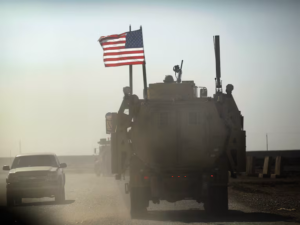
The US withdrawal nevertheless changes the equation, as the factions have long justified retaining their weapons by the presence of foreign forces. The conclusion of the coalition mission on 30 September and the departure of the remaining US troops therefore weaken one of their main arguments, without ending military cooperation between Baghdad and Washington: a committee was established in July to define the post-coalition security partnership, particularly in intelligence, counterterrorism, training, equipment and capacity-building for Iraqi forces.
The divergence therefore concerns what is meant by the withdrawal of foreign forces and, more broadly, by full Iraqi sovereignty. Some factions extend their conditions beyond the US departure: Kataib Hezbollah (KH), in particular, demands the withdrawal of Turkish forces and the dissolution of the Peshmerga. The definition of threats and sovereignty thus becomes broad enough to allow divergent interpretations and justify the retention of weapons. The continuation of a bilateral security partnership with Washington and the possible continued presence of US advisers could further fuel divergent interpretations over what still constitutes a foreign presence or foreign interference.
The demand concerning the Peshmerga directly conflicts with the position of the Iraqi authorities: President Nizar Amedi has reiterated that they constitute a constitutional institution and are not part of the process of bringing weapons under state control[3]. H.R. 8800 also explicitly excludes their funding from the conditionality imposed on other Iraqi forces. In September, the former Forces 70 and 80, historically linked respectively to the PUK and KDP, completed their reorganisation under a unified command-and-control structure within the Ministry of Peshmerga Affairs, illustrating the process of integrating historically partisan forces into a unified institutional chain of command, as well as their significant support for state efforts and their determination not to be instrumentalised by other militias.
II. State Integration and Factional Autonomy
The armed factions concerned by the process are neither fully within the state nor simply outside it. Often portrayed as a single Iran-aligned bloc operating within the Popular Mobilization Forces (PMF), they in fact constitute a heterogeneous group connected through political, security, economic and ideological networks, but displaying varying degrees of autonomy and integration into the state. This heterogeneity complicates the process, which does not simply pit the state against the militias but reveals divergent positions shaped by each group’s ideology, degree of political integration, regional role, relationship to the use of force and degree of autonomy from the Islamic Republic of Iran. These factions do not necessarily answer to the same loyalties or chains of decision-making.
Several realities overlap: the Islamic Resistance in Iraq (IRI)[4] emerged as a collective banner from October 2023, allowing several Iran-aligned factions to claim operations jointly without always identifying which one carried them out. The PMF, meanwhile, have constituted an official security institution since the 2016 law: they are part of the Iraqi armed forces, report directly to the commander-in-chief (the Prime Minister), and have their own institutional structure, the PMF Commission, distinct from the Ministry of Defense. They are therefore legally integrated into the state security apparatus while retaining their own organisation and hierarchy. Factions associated with the IRI have brigades within the PMF, although not all PMF components belong to the IRI. In practice, some factions have both brigades officially integrated into the PMF and brigades or other armed structures that remain outside its institutional framework and the official chain of command. This is notably the case with KH and Asaib Ahl al-Haq (AAH), which are respectively associated with PMF Brigades 45, 46 and 47, and Brigades 41, 42 and 43, registered and funded by the state, while both factions also maintain other armed structures outside the PMF.
The process does not concern only the integration into the PMF of factional brigades outside the official framework, but more broadly the elimination of autonomous military capabilities (units, cells, specialised structures or front groups), so that no faction retains the power to decide autonomously when and how to use its weapons. Yet even when personnel and weapons legally come under state authority, the question remains whether the chain of command is effective or whether some brigades continue de facto to obey their factional leaders. It is precisely in this gap between de jure integration and de facto control that the state monopoly on armed force is at stake: weapons may legally become state weapons while remaining within the same factional environment, since their legal ownership does not guarantee control over their use.
Shortly after Zaidi took office, Saraya al-Salam, Moqtada al-Sadr’s faction, which is not part of the IRI, announced its dissolution as an autonomous formation and its integration into state forces, providing an initial impetus to the process. This position is consistent with the Iraqi nationalist tradition of the Sadrist movement, which asserts its autonomy from Iran. AAH and Kataib al-Imam Ali subsequently began placing their weapons and military activities under state authority. For AAH, one of the pro-Iranian factions most deeply integrated into Iraq’s political system[5], this development reflects a logic of compromise with the state; for Kataib al-Imam Ali, political incentives may also have played a role, as its leader Shibl al-Zaydi, who also heads the Khadamat Alliance, joined the leadership of the Coordination Framework in August 2026 while publicly supporting state control over weapons. These developments do not necessarily imply abandoning “resistance” as a political position but rather relinquishing an autonomous military capability beyond state control. By contrast, KH and Harakat al-Nujaba (HaN) have rejected disarmament, linking any change in their position to Iraqi sovereignty and the end of foreign presence or interference. More recently, KH set three conditions: a complete US withdrawal, with guarantees of non-return and an end to US influence over political and economic decision-making; the withdrawal of Turkish forces; and the dissolution of the Peshmerga. Their position may be explained by a conception of “resistance” centred on ideological and armed mobilisation that extends beyond the Iraqi framework, by the regional dimension of their activities, and by their more limited dependence on electoral politics[6].
Kataib Sayyid al-Shuhada (KSS) occupies an intermediate position: while supporting al-Zaidi in governing the state and maintaining stability, the faction rejects disarmament at this stage and, in a statement issued on 29 August, set ten conditions, including the withdrawal of US and Turkish forces, the departure of the PKK and Iranian opposition groups, federal control over the territory, borders and airspace, the adoption of legislation protecting the rights of PMF members[7], and an end to what it describes as US domination over Iraqi decision-making. The breadth of these conditions effectively allows any disarmament to remain conditional over the long term.
Finally, the transnational dimension and the use of front groups such as Ashab al-Kahf[8], which allow attacks to be claimed while maintaining a degree of ambiguity regarding the identity of the actors that actually carried them out, further complicate state control. Even if Baghdad succeeded in regulating the weapons of official PMF formations, such groups could continue to obscure the attribution of attacks and the identification of the chain of command.
Conclusion
The state monopoly on weapons is an essential attribute of sovereignty; in Iraq, however, its implementation remains a challenge directly linked to the political-security order established since 2003. The issue goes beyond the physical handover of arsenals: the destination of weapons, the integration of fighters, the future of factional structures and control over the chain of command remain at the heart of the negotiations.
Transferring weapons to a state institution is not sufficient to end the factions’ military autonomy if they retain their own structures and their ability to influence how those weapons are used. The difficulty lies precisely in the nature of the Iraqi system: the issue is not simply to disarm groups outside the state, but to impose a single military authority on actors already embedded within its security and political structures.
The hesitations between disarmament, integration, dissolution, regulation or control of weapons, together with successive changes to the timetable, reflect this complexity while perpetuating ambiguity over the ultimate objective. Beyond declarations and deadlines, the real test will therefore be whether the state succeeds in exercising not only legal and material control over weapons, but above all exclusive control over the decision to use them.
Notes
[1] National Defense Authorization Act: an annual US law that sets defence policy priorities and budgetary authorisations.
[2] Coalition of Iraqi Shiite parties and political blocs that maintain relations with Iran to varying degrees.
[3] The Peshmerga are a constitutional institution operating within the Kurdistan Region and are not parties to the process aimed at bringing weapons under state control.
[4] In 2024, the US Department of State publicly identified Kataib Hezbollah, Harakat al-Nujaba, Kataib Sayyid al-Shuhada and Harakat Ansar Allah al-Awfiya as members of the IRI.
[5] AAH holds 27 seats in parliament through Sadiqoun.
[6] KH has a political vehicle through Hoquq, which holds six seats, while HaN has no comparable parliamentary bloc.
[7] Two bills are concerned: the “PMF Restructuring Bill,” which reorganises the status, structure and hierarchy of the PMF and was amended in 2026 following the removal of controversial provisions; and the “PMF Service and Retirement Bill,” which regulates the status, careers and pensions of PMF personnel and was withdrawn because of disagreements concerning, in particular, the retirement age and Faleh al-Fayyad’s continuation in office. Both bills are to be submitted to parliament in amended form.
[8] Ashab al-Kahf, which emerged in 2019, officially renamed itself Kataib Sarkhat al-Quds in August 2024 before reverting to its former name, Ashab al-Kahf, in March 2026.