

INTERVIEW. As the international coalition’s military mission against Islamic State in Iraq officially comes to an end on September 30, Adel Bakawan, director of the European Institute for Middle East and North Africa Studies, examines the announced departure of American troops.
Interview by Julie Malo. Published on September 30, 2026, at 5:00 p.m. in Le Point.
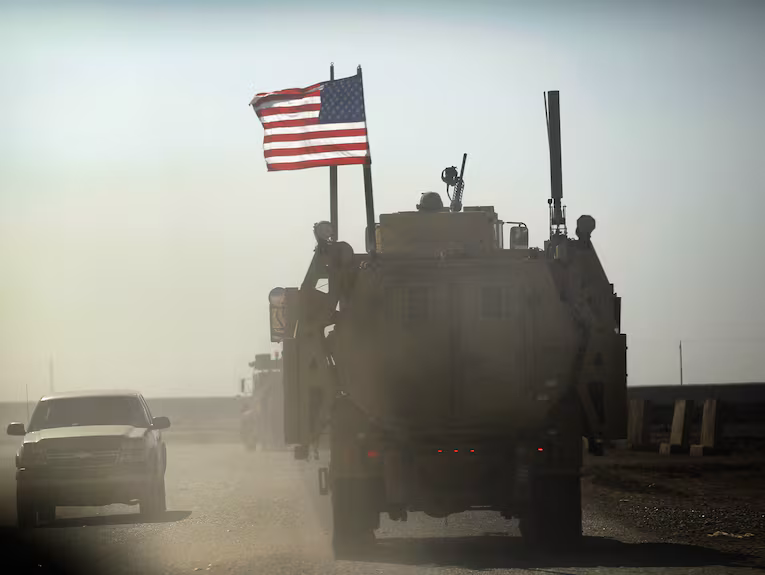
American troops had already withdrawn from Iraq once before, in 2011. GETTY IMAGES VIA AFP
This Wednesday, September 30, the anti-ISIS coalition’s military mission in Iraq is scheduled to end, and the American troops still stationed there are expected to leave the country—including the Harir base in Kurdistan. Launched in 2014 against Islamic State (ISIS), Operation Inherent Resolve is officially coming to an end, along with an American military presence that began in 2003 and was interrupted only between 2011 and 2014. The timetable was agreed upon in 2024, during Joe Biden’s presidency, through an agreement between Washington and Baghdad. In July, Donald Trump and Iraqi Prime Minister Ali al-Zaidi confirmed it: “We no longer think we need military forces there,” the US president said. According to Intelligence Online, a specialist intelligence newsletter, members of the international coalition against ISIS—which brings together around 90 participants—are due to meet in Rome this Thursday, October 1, to redefine its priorities in light of this change.
In any case, the departure comes amid heightened tensions. Since the war with Iran began in February, American positions in Iraqi Kurdistan have regularly been targeted by pro-Iranian armed groups, and NATO already withdrew its troops from the country in March. Iraqi forces and Kurdish peshmerga will now have to fight ISIS on their own. The organization lost its territory in 2019, and US military intelligence considers it “severely weakened” in Iraq and “focused on its survival.” Nevertheless, it has not disappeared. But for Adel Bakawan, director of the European Institute for Middle East and North Africa Studies (EISMENA) and author of La Décomposition du Moyen-Orient (Tallandier), the real issue lies elsewhere: in his view, the announcement is purely symbolic.
Le Point: What will the coalition’s withdrawal actually change in Iraq?
Adel Bakawan: It is a very, very symbolic withdrawal, one that will not change the nature of the relationship. For an international coalition—which can broadly be described as an American presence on the ground—it is symbolic because both the Americans and the Iraqis have fully internalized how the local political system works. In other words, it means putting on a show for a society that has nothing left to lose and needs that spectacle.
In practical terms, the presence on the ground will remain the same: we are moving from a presence under the banner of the international coalition to bilateral agreements between Baghdad and Washington. Today, that presence operates within the framework of the international coalition against ISIS. Tomorrow, it will have a different status: a bilateral security agreement between two states. There will probably be some adjustments and some redeployments, but nothing major. I do not believe there will be a genuine departure like the one in 2011. Washington needs troops, if only to protect its largest embassy in the world, in Baghdad, and its largest consulate, in Erbil. In the midst of a war against Iran, the Americans will not give up that strategic asset. Moreover, 700 to 900 American soldiers remain in Rojava, in Syria, with Iraqi Kurdistan serving as their rear base. The comparison with 2011 is misleading anyway: back then, the Americans really did leave—they were negotiating with Iran, a silent partner in rebuilding post-Saddam Iraq, and had suffered thousands of deaths in the country. Today, they are at war with Iran.
The same applies to disarming the militias: it will not happen. Only their names will change. Instead of referring, for example, to “Kataib Hezbollah,” tomorrow we will refer to “Brigade 75” or “Brigade 102” of Hashd al-Shaabi. But the group itself, as an organization with its own structure and hierarchy, will remain the same.
So will there still be a military presence to prevent Islamic State from rebuilding itself in Iraq?
ISIS is no longer the organization we knew between 2014 and 2019. It no longer has the same social base, strength, resources, leadership, types of operations or capabilities. And the objective conditions for a resurgence are not present in either Iraq or Syria. In fact, we have not seen any major coalition operations against it for several years.
Above all, the country is no longer as fractured as it was in 2014. Amid the chaos in the Middle East, Iraq has managed to maintain a balance—admittedly a very relative one—between Tehran and Washington. Its prime minister, Ali al-Zaidi, meets Donald Trump in Washington, then President Pezeshkian in Tehran. Both capitals know that the situation is fragile and that excessive pressure would push Baghdad to breaking point, so Iraq remains relatively stable. That is why September 30 is a non-event for Iraqi society.
You say ISIS has far fewer resources and is severely weakened. Does it still have operational capabilities on the ground?
Between 2017 and 2019, the anti-ISIS coalition destroyed the caliphate as a territory, an institution and a state entity. Since then, ISIS has become an organization without a territorial base: it has no institutions, no territory, no local foothold and no solid social base from which to draw human and financial resources. It can still strike in various places—in Baghdad as in Paris, in London as in Damascus—but on a very limited scale.
During French President Emmanuel Macron’s visit to Damascus, there were two explosions right beside his hotel. Several explanations are possible: a state hostile to the French presence in Syria, pro-Iranian militias opposed to the normalization of relations between Europe and the new Syria, or ISIS, or even al-Qaeda. But the two explosions remained a very minor incident.
Who benefits from this withdrawal announcement?
Both governments. The Americans need this announcement with the midterm elections approaching. Donald Trump wants to be able to say: “I’m at war with Iran, but I’m done with ISIS. Mission accomplished, we’re going home.”
Ali al-Zaidi, whose government was appointed very recently, can tell his social base—particularly the Shia community—and the pro-Iranian militias refusing to lay down their arms: “You took up arms against ISIS and against the American presence. ISIS is finished, and the Americans are going home. You no longer have any reason to refuse to disarm.” As for the militias, they will be able to claim victory: according to their narrative, their pressure forced the world’s leading power to leave.
To be precise, if these pro-Iranian militias decide to not lay down their arms, can the Iraqi state really regain control?
Absolutely not. The Coordination Framework, which brings together most of the Shia parties that have held power in Iraq since Saddam Hussein’s fall, is the political arm of these militias. It holds 183 of the 329 seats in parliament. It is what propelled Ali al-Zaidi into the prime minister’s office; he took office with their approval, their agreement and their votes in parliament. And an employee cannot fire his boss. In 2022, when Mohammed Shia al-Sudani was appointed, Qais al-Khazali [leader of Asaib Ahl al-Haq, editor’s note] essentially said on camera: “In Iraq, we do not have a prime minister, but a general manager who handles our affairs.” He was right. Officially, the prime minister is the commander-in-chief. In practice, the Coordination Framework holds power. To sign an agreement with Washington, Ali al-Zaidi must first obtain its approval. Indeed, because of a lack of consensus, Iraq still has no interior minister.
Should we expect the militias to become more powerful?
That is very likely. The American presence, even if symbolic, constituted a formal barrier. They now have a free hand to control the prime minister and assert themselves more openly—even though their ranks already include ministers, ambassadors and intelligence officials. According to some reports, 2,000 militia officials now hold diplomatic passports and travel freely between Paris, London and Stockholm. If tensions with Iran escalate, Tehran could use them against the West as a substitute for ISIS terrorism.
Tensions between communities could also intensify. The pro-Western Kurds reject these militias, which regard Kurdistan as a legitimate target. The Sunnis, who consider themselves the legitimate heirs to the Iraqi state and have been excluded from it since 2003, could also demand their share.
Is the war against ISIS over?
The war against ISIS as a territorial entity, yes. Against ISIS as an organization without a territorial base, no—not in the Middle East, Europe or the United States.