


Introduction
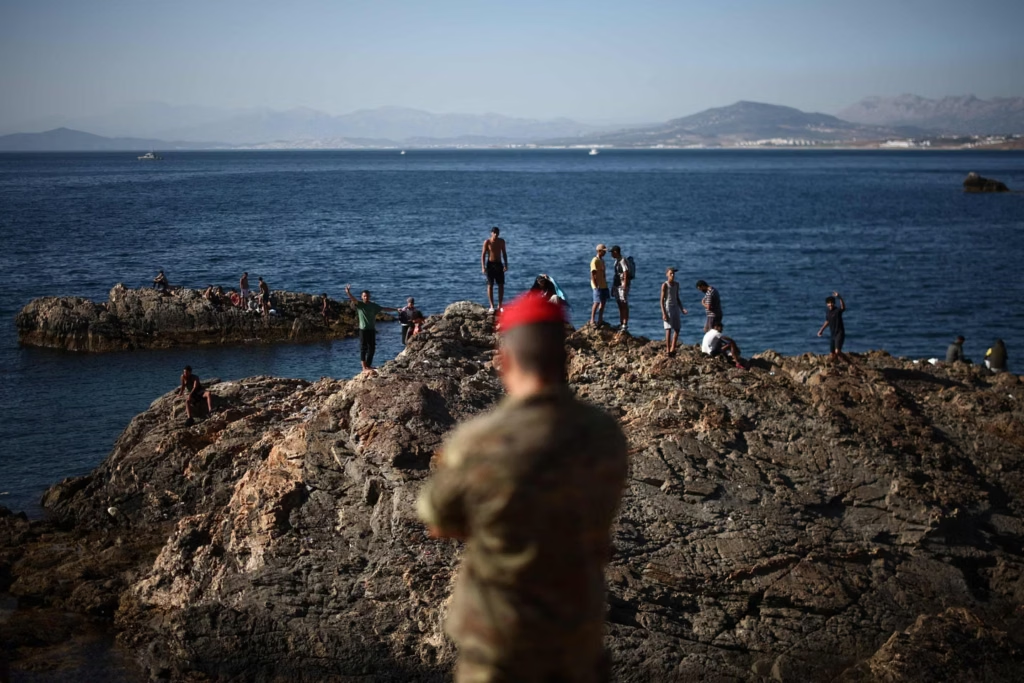
The Ceuta crisis of July 2026 showed the extent to which the European Union depends on third countries to manage its borders. Between 30 and 31 July 2026, around 72,000 people crossed the border into Ceuta from Morocco, while estimates of the number of deaths range from 88 to 141 depending on the source[1][2]. However, the migrants themselves, who were the most affected, were largely overlooked in the political debate, which focused instead on Spain: while the Spanish government avoided blaming Morocco directly, 22 EU member states questioned its migration policies and its regularisation of migrants[3]. In this way, the crisis was treated mainly as a problem of Spanish policy, rather than as the result of a model that depends on the cooperation of a neighbouring country with its own interests.
The crisis therefore raises a fundamental question: what happens when migration management becomes a bargaining tool between states? The literature on migration diplomacy has shown how migration flows can be used to exert political pressure and secure concessions from other actors[4].
This article argues that Europe’s dependence on third countries creates incentives whereby Morocco benefits both when it contains migration and when border control fails. The Ceuta crisis brings this paradox into view: according to Euronews, Morocco’s negotiating position has been strengthened, while EU officials anticipate new funding for migration control[5]. To analyse this dynamic, the article will first examine the model of EU–Morocco migration cooperation, then the Ceuta crisis and the European response, and finally the case of Tunisia as a comparative case.
The EU–Morocco Migration Cooperation Model
The existing model between the European Union and partner countries for containing migration flows is based on cooperation with third countries to manage these movements before they reach European territory. The externalisation of migration control means precisely that member states rely on the collaboration of countries of origin and transit. It is in this context that the concept of the transit state emerges: its position along migration routes can give it a certain bargaining capacity, since the cooperation of such states is necessary to manage flows towards Europe. Adamson and Tsourapas further note that a state can simultaneously occupy different positions within the migration system, such as country of origin and country of transit[6].
Morocco occupies a particularly strategic position within this model. On the one hand, it is a country of origin, in a context marked by high unemployment, especially among young people; on the other, it is a transit state located on a migration route to Europe[7]. Its geographical position, alongside the Strait of Gibraltar and facing the EU’s external border, makes its cooperation particularly relevant for Spain and for European migration management[8]. Spanish externalisation is not a new phenomenon either: according to Blanca Garcés, Spain’s southern border became a laboratory for European policies, and the externalisation of migration control to third countries began with the Africa Plan following the 2006 cayucos crisis[9].
In 2022, Spain and Morocco began a new stage in their bilateral relations, after the Spanish government changed its position on Western Sahara through Pedro Sánchez’s letter of 14 March 2022. This new stage was formalised in the joint declaration of April. In it, Spain considers the Moroccan autonomy initiative ‘the most serious, realistic and credible basis’ for resolving the conflict, while both countries undertake not to resort to unilateral acts or faits accomplis. At the same time, they agree to relaunch and strengthen cooperation on migration[10]. Migration thus becomes embedded in a broader bilateral relationship, alongside political and strategic issues, which can be understood as an example of issue linkage: the linking of migration with other matters of political, economic or security interest[11].
Finally, the financial dimension shows the extent to which this cooperation has developed. Between 2021 and 2024, the EU committed €222 million to Morocco’s migration management and plans to provide a further €190 million by 2027. In addition, Brussels is negotiating a strategic and comprehensive partnership with Morocco similar to the one agreed with Egypt in 2024, which included a €7.4 billion financial and investment package[12]. These resources show that externalisation is not based solely on political cooperation: it also involves a significant financial dimension and, with it, a relationship of interdependence in which Morocco controls part of the flows that Europe needs to manage.
July 2026: A Stress Test
The crisis of late July was the product of a combination of factors that predated the mass entry of migrants. Bassou identifies youth unemployment in Morocco as a first factor: in 2025 it reached 37.2% among 15–24-year-olds[13]. There had also been earlier crossings during the year, although none on the scale of what happened in July: some 2,582 entries between January and June 2026, compared with 978 over the same period in 2025[14]. To this must be added Spanish Supreme Court ruling STS 2965/2026, issued on 29 June and published on 8 July, which declared certain summary returns at sea without prior procedure unlawful. A false interpretation of this ruling, according to which arriving by swimming could guarantee protection from expulsion, spread rapidly on social media and acted as a trigger[15]. Bassou further notes that Rabat had warned of the ruling’s possible consequences, while Madrid reportedly failed to take them sufficiently into account[16]. On top of all this came a lack of anticipation on the part of the Spanish authorities: according to Félix Arteaga, the National Security System did not pre-emptively activate its coordination mechanisms before the mass entry, despite the existence of prior information and indicators on rising flows[17].
There is, however, another reading of the crisis: that of a possible instrumentalisation of the migration flow. Garcés observes that it is hard to imagine an event of such magnitude occurring without some form of intervention, by action or omission, on the part of the Moroccan government, although the Moroccan government itself has denied any responsibility[18]. Euronews, for its part, reports that the Moroccan authorities attributed the crisis to social-media hoaxes and smuggling networks[19]. There are also testimonies gathered by The New York Times, cited by Euronews, in which some migrants claim that Moroccan police officers showed them which way to go towards the border[20]. In addition, reports by El Español, also cited by Euronews, state that Civil Guard sources detected alleged Moroccan intelligence agents among the groups of migrants, acting as guides and coordinating the crossings[21]. Nevertheless, these elements should be understood as indications rather than definitive proof that the Moroccan government organised the mass entry.
Yet, for the purposes of this article, both readings lead to a similar outcome from the perspective of dependence. If, on the one hand, the crisis was the result of socio-economic factors, disinformation and failures of anticipation, it demonstrates the limits of a system that relies on the capacity of third countries to contain migration flows. If, on the other hand, there was a deliberate relaxation of border control, the crisis shows the extent to which that dependence can become a source of power for Morocco. In both cases, Ceuta functions as a stress test for the externalisation model: when the system works, the EU needs Morocco; and when it does not, it needs Morocco all the more.
The European Response: More Control, More Dependence
The European response to the Ceuta crisis brings into sharper focus the dependence on which the externalisation model has been built. Ceuta forms part of the only land border between the European Union and Africa, which makes Moroccan cooperation a particularly important element in the management of Europe’s external border[22].
First, the reaction towards Spain was markedly different from that of 2021. Whereas European representatives then unanimously supported the Spanish government and pressed Morocco to cooperate, in 2026 it was 22 member states that signed a letter implicitly questioning Spain’s management of the external border and identifying the extraordinary regularisation as a pull factor[23]. Italy, moreover, temporarily reintroduced Schengen controls for people arriving from Spain[24]. Subsequently, the European Parliament expressed serious concern about Spain’s regularisation policy, describing it as a pull factor[25]. Garcés, however, points out that irregular entries into Spain did not increase after the regularisation[26]. The European Commission, for its part, granted Spain €114.7 million in emergency assistance to manage the crisis[27].
The response towards Morocco followed a different logic. Ursula von der Leyen called for stricter controls and physical barriers, but also proposed strengthening technical and financial support for Morocco, which she described as an important strategic partner[28]. According to Euronews, the crisis strengthened Morocco’s negotiating position, and Brussels was preparing to expand the migration chapter of the partnership agreement[29]. At the same time, the European Parliament condemned the instrumentalisation of migration as a tool of hybrid warfare, but continued to describe Morocco as a ‘key partner’ and called on it to honour its commitments on border management, return and migration cooperation[30].
The contradiction is evident: more control entails greater dependence on third countries, and greater dependence in turn reduces bargaining capacity vis-à-vis those same countries[31]. Despite the costs of this model, Garcés notes that border management based on dependence on third countries remains unquestioned[32]. The question raised by Ceuta, therefore, is not whether there was an organised plan, but whether the crisis is an exception or a manifestation of a broader pattern in European externalisation policy.
Tunisia: The Same Model across the Mediterranean
Tunisia is another strategic point of departure towards the European Union, particularly towards Italy. Unlike Morocco, it has no land border with the EU: the main route links the Tunisian coast to Italy, with some 160 kilometres between Sfax and Lampedusa[33]. Nevertheless, Morocco and Tunisia occupy a similar position within the externalisation model: both act as transit countries whose cooperation is needed to manage flows towards Europe.
On 16 July 2023, the EU and Tunisia signed a Memorandum of Understanding based on five pillars, of which migration and mobility was the most important. The EU immediately released €105 million to support the coastguard and border management, and proposed a further €900 million in macroeconomic support and €150 million in direct budgetary support[34]. However, the initial results fell short of expectations. According to the EPRS, six weeks after the signing, irregular arrivals in Italy had risen by 68.6% compared with the previous six weeks, and Tunisia had become the main departure point in the central Mediterranean, ahead of Libya. At the same time, the Tunisian authorities claimed to have prevented some 40,000 migrants from departing between January and August 2023[35].
The memorandum itself also shows that cooperation has limits set by the partner. Tunisia reaffirms that it is not a country of settlement for irregular migrants and that its responsibility is limited to guarding its own borders. In the same text, the EU acknowledges the efforts and results of the Tunisian authorities and undertakes to provide additional financial support to improve border management[36]. Cooperation, therefore, does not eliminate the bargaining capacity of the transit state: Tunisia takes part in containment, but it also sets the conditions under which it does so.
This model is not confined to Tunisia. According to Euronews, the EU has concluded similar agreements with Egypt, Jordan and Mauritania, while negotiating a broader partnership with Morocco[37]. Ceuta, therefore, does not appear to be an isolated exception, but one case within a European externalisation strategy that continues to expand.
Conclusion
When migration management becomes a bargaining tool, it is no longer merely a matter of border control, but of a relationship of interdependence in which transit states retain the capacity to negotiate, make demands and set the terms of their cooperation. This dependence creates a clear asymmetry in the relationship. The Ceuta case demonstrates precisely this paradox: when the system works, the EU depends on Moroccan cooperation to contain flows; when it fails, the dependence does not disappear, but becomes even more evident and strengthens Morocco’s negotiating position.
The case of Tunisia illustrates that Ceuta is not an isolated exception, but part of a broader model of externalisation in which the EU seeks to manage migration beyond its borders through agreements, funding and cooperation with third countries. However, these instruments neither eliminate the bargaining capacity of transit partners nor, in themselves, guarantee the containment of flows.
Finally, the Ceuta crisis should not be viewed solely through the lens of border control or inter-state relations. Behind the logic of bargaining and externalisation agreements there remain the migrants themselves, who opened this article as the actors most affected and least present in the political debate. Sara Prestianni of EuroMed Rights argues that the real question is why so many young people are willing to risk their lives to cross Europe’s border[38]. Bassou reaches a similar conclusion, noting that young people cannot be asked to give up a dangerous crossing without being offered a credible alternative[39]. The final question, therefore, is whether European policies are offering sufficiently credible alternatives to those who decide to cross the border.
Bibliography
Adamson, Fiona B. and Gerasimos Tsourapas, ‘Migration Diplomacy in World Politics’, International Studies Perspectives, vol. 20, no. 2, 2019, pp. 113–128.
Arteaga, Félix, ‘Ceuta y el Sistema Seguridad Nacional’, Real Instituto Elcano, 18 September 2026.
Bassou, Abdelhak, The July 2026 Ceuta Crisis: Structural Conditions, Circumstantial Amplifiers, and Triggering Factors, Policy Brief no. 47/26, Policy Center for the New South, August 2026.
Garcés, Blanca, ‘Ceuta: qué es distinto esta vez’, CIDOB Opinion, no. 897, September 2026.
Muñoz Morillo, Maria, ‘Ceuta explained: How Spain’s biggest migration crisis unfolded’, Euronews, 3 August 2026.
Stanicek, Branislav, ‘EU-Tunisia Memorandum of Understanding’, At a Glance, European Parliamentary Research Service, PE 751.467, September 2023.
Vasques, Eleonora and Luca Bertuzzi, ‘Exclusiva: La UE dará más fondos a Marruecos tras la crisis en Ceuta’, Euronews, 20 August 2026.
Sources
Official documents
European Commission, ‘Mémorandum d’entente sur un partenariat stratégique et global entre l’Union européenne et la Tunisie’, press release IP/23/3887, Tunis, 16 July 2023.
European Parliament, Resolution on the recent hybrid attacks and instrumentalisation of migrants in Ceuta and the need for a coordinated response to protect the EU’s external borders, 2026/2870(RSP), 17 September 2026.
Government of Spain and Kingdom of Morocco, ‘Nueva etapa del partenariado entre España y Marruecos: Declaración conjunta’, Rabat, 7 April 2022.
Spanish Supreme Court (Tribunal Supremo), Administrative Litigation Chamber, judgment STS 2965/2026, 29 June 2026 (as reported in Bassou, 2026).
Statements and data (as reported in the works listed above)
Letter from 22 EU member states on the Ceuta crisis, August 2026 (as reported in Garcés, 2026, and Muñoz Morillo, 2026).
Letter from Ursula von der Leyen, President of the European Commission, to Pedro Sánchez, President of the Government of Spain, August 2026, and statements by a European Commission spokesperson on EU funding to Morocco (as reported in Vasques and Bertuzzi, 2026).
Spanish Ministry of the Interior, figures on irregular entries into Ceuta, 2025–2026 (as reported in Bassou, 2026, and Vasques and Bertuzzi, 2026).
Italian Ministry of the Interior, data on irregular sea arrivals in Italy, 2023 (as reported in Stanicek, 2023).
High Commission for Planning of Morocco (HCP), annual results on employment and unemployment, 2025 (as reported in Bassou, 2026).
Testimonies of migrants reported by The New York Times and information from Civil Guard sources reported by El Español (as cited in Muñoz Morillo, 2026).
Notes
[1] Eleonora Vasques and Luca Bertuzzi, ‘Exclusiva: La UE dará más fondos a Marruecos tras la crisis en Ceuta’, Euronews, 20 August 2026.
[2] Maria Muñoz Morillo, ‘Ceuta explained: How Spain’s biggest migration crisis unfolded’, Euronews, 3 August 2026; European Parliament, Resolution on the recent hybrid attacks and instrumentalisation of migrants in Ceuta and the need for a coordinated response to protect the EU’s external borders, 2026/2870(RSP), 17 September 2026.
[3]Blanca Garcés, ‘Ceuta: qué es distinto esta vez’, CIDOB Opinion, no. 897, September 2026; Muñoz Morillo, op. cit.
[4] Fiona B. Adamson and Gerasimos Tsourapas, ‘Migration Diplomacy in World Politics’, International Studies Perspectives, vol. 20, no. 2, 2019, pp. 113–128.
[5] Vasques and Bertuzzi, op. cit.
[6] Adamson and Tsourapas, op. cit., p. 119.
[7] Abdelhak Bassou, The July 2026 Ceuta Crisis: Structural Conditions, Circumstantial Amplifiers, and Triggering Factors, Policy Brief no. 47/26, Policy Center for the New South, August 2026, p. 3. Bassou notes that most of those attempting to migrate via Ceuta are driven by economic motives and highlights an unemployment rate of 37.2% among 15–24-year-olds in 2025.
[8] Bassou, op. cit., p. 4.
[9] Garcés, op. cit., p. 4. The ‘cayucos crisis’ refers to the arrival of 31,678 people in the Canary Islands in 2006, mostly in cayucos (wooden fishing boats) departing from Senegal and Mauritania. It was the highest annual figure until 2023. In response, Spain launched the Africa Plan and signed readmission and cooperation agreements with several West African countries, while Frontex began joint patrols off their coasts. See ‘Canarias supera las llegadas de migrantes de la crisis de los cayucos de 2006’, RTVC, November 2023.
[10] Government of Spain, ‘Nueva etapa del partenariado entre España y Marruecos: Declaración conjunta’, 7 April 2022, points 1, 2 and 8. Quotation: author’s translation.
[11] Adamson and Tsourapas, op. cit., p. 120.
[12] Vasques and Bertuzzi, op. cit.
[13] Bassou, op. cit., p. 3.
[14] Bassou, op. cit., p. 5.
[15] Bassou, op. cit., p. 6.
[16] Bassou, op. cit., p. 7.
[17] Félix Arteaga, ‘Ceuta y el Sistema Seguridad Nacional’, Real Instituto Elcano, 18 September 2026.
[18] Garcés, op. cit., p. 2.
[19] Muñoz Morillo, op. cit.
[20] The New York Times, cited in Muñoz Morillo, op. cit.
[21] El Español, cited in Muñoz Morillo, op. cit.
[22] Vasques and Bertuzzi, op. cit.
[23] Garcés, op. cit., p. 3.
[24] Muñoz Morillo, op. cit.
[25] European Parliament, op. cit.
[26] Garcés, op. cit., p. 3.
[27] European Parliament, op. cit.
[28] Vasques and Bertuzzi, op. cit.
[29] Vasques and Bertuzzi, op. cit.
[30] European Parliament, op. cit.
[31] Garcés, op. cit., p. 4.
[32] Garcés, op. cit., p. 3.
[33] Branislav Stanicek, ‘EU-Tunisia Memorandum of Understanding’, At a Glance, European Parliamentary Research Service, PE 751.467, September 2023.
[34] Stanicek, op. cit.
[35] Stanicek, op. cit.
[36] European Commission, ‘Mémorandum d’entente sur un partenariat stratégique et global entre l’Union européenne et la Tunisie’, press release IP/23/3887, Tunis, 16 July 2023.
[37] Vasques and Bertuzzi, op. cit.
[38] Vasques and Bertuzzi, op. cit.
[39] Bassou, op. cit., p. 7.