

“From Kirkuk to Deir ez-Zor: Threatened Kurdish Autonomies”
On Saturday, September 2, 2023, violent riots broke out in Kirkuk, Iraq, resulting in the deaths of four individuals, all of Kurdish ethnicity. The return of a city building to the Kurdistan Democratic Party (KDP) served as the pretext for these ethnically charged demonstrations, as Arabs and Turkmen clashed with Kurds. This episode reflects the communal tensions present in Iraq, which are, of course, exploited by the Iraqi government and especially its Iranian backers. Can we draw parallels between this conflict and the uprising in Deir ez-Zor, Syria, where Arab tribes from the Euphrates Valley took up arms to drive out the Syrian Democratic Forces, predominantly led by the Kurds?
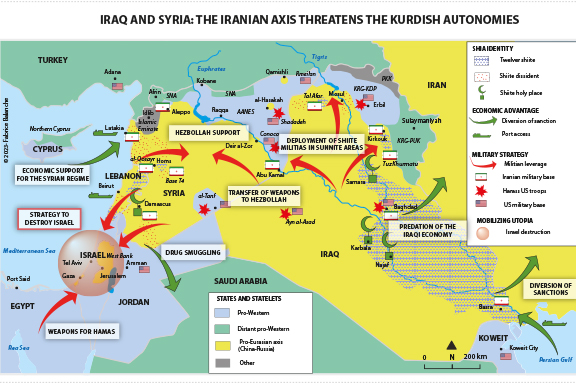
Balanche, F. (2023). The Iranian Axis Threatens Kurdish Autonomies [cartographic document].
1cm = 200km.
Kirkuk is a multi-ethnic city that is part of the disputed territories between the Kurdistan Regional Government (KRG) and Iraq. The Kurdish administration and fighters of the Patriotic Union of Kurdistan (PUK) and the Kurdistan Democratic Party (KDP) were expelled by pro-Iranian Shiite militias (Hashd al-Shaabi) in October 2017, who now control the city, relying in particular on the Shiite Turkmen minority and some Sunni Arab clans. Empowered by their new authority, they attempt to seize Kurdish lands and properties, forcing the Kurds to leave the region. In Deir ez-Zor, the population is exclusively Sunni Arab, but divided into various rival tribes. Some of them support the Autonomous Administration of North and East Syria (AANES) and are heavily involved with the Syrian Democratic Forces (SDF), while others remain hostile and maintain strong sympathies for ISIS.
It appears that we are in two different contexts, but they are actually very similar, as they both stem from an anti-Kurdish sentiment in both Iraq and Syria. In Deir ez-Zor, Arab tribes resent being part of an entity led by Kurds. They blame them for all the problems in the region, accuse them of taking “their oil,” and keeping them in destitution, as I personally observed during a recent trip to the area. In Iraq, I gathered similar testimonies against the Kurds, who are accused, among other things, of monopolizing the Iraqi budget, stealing hydrocarbons, and obstructing the reconstruction of Mosul. Resorting to Israel to divert public anger from the authorities seems to no longer be effective, as the Kurds have become the new scapegoats. The KRG’s impressive economic success, the security it maintains, and the quality of public services further fuel this animosity.
The anti-Kurdish sentiment is being exploited by Arab leaders in Damascus and Baghdad who seek to eradicate both Kurdish entities. It’s important to remember that the KRG and the AANES emerged following the collapse of these central states during the American invasion in Iraq and the Syrian civil war. The weakening of Western influence in the Middle East, the strengthening of both the Syrian and Iraqi regimes, both supported by Iran, raises questions about the very existence of the KRG and the AANES Additionally, we must consider Turkey’s neo-Ottoman strategy, which currently doesn’t pose a threat to the KRG but clearly targets the AANES. It is within this geopolitical context that we must analyze the recent events in Kirkuk and Deir ez-Zor.
The strategic importance of both regions, due to the presence of oil, is also worth emphasizing. Kirkuk accounts for 15% of Iraqi production, and Deir ez-Zor holds 70% of Syrian oil reserves. The resources in Kirkuk allowed the KRG to become less reliant on the budget allocated by Baghdad under the 2005 constitution. This is why pro-Iranian Shiite militias swiftly took control of the region after the Kurdistan independence referendum in 2017. The hydrocarbons in Deir ez-Zor are a key bargaining chip for the AANES in negotiations with Damascus and, more importantly, for securing its energy supply. Deprived of this resource, the de facto autonomy of Northeastern Syria would be significantly undermined.
Damascus and Tehran have a clear interest in supporting the uprising of Arab tribes to reintegrate this territory and its oil into a devastated Syria. However, they may not necessarily have the means for this ambition, and more importantly, the rebellious tribes may not want to return under Bashar al-Assad’s control. They rather naively imagine being able to create a small Arab kingdom and thus benefit from the oil wealth, but for this, they would need external protection. However, the United States is not inclined to invest in such a venture, and Turkey is too far away to take a keen interest in Deir ez-Zor. The scenario of Kirkuk in 2017 could therefore be repeated in Deir ez-Zor: an invasion led by Iraqi Shiite militias. Iran would strengthen its Syrian ally in this way and push American troops to leave, thereby expanding its strategic corridor between Tehran and Beirut. However, to complete the construction of this famous “Shiite crescent”[2] that began with the fall of Saddam Hussein in 2003, it must rid itself of the pro-Western autonomous Kurdish territories.
In Iraq, the KRG is under pressure from the pro-Iranian government in Baghdad, which is withholding its share of the budget and blocking its oil exports via Turkey, depriving it of financial resources. It is hard not to see in the Kirkuk affair the beginning of a pro-Iranian intervention against the KRG if the latter does not yield to Iranian demands to disarm the Iranian Kurdish opposition groups present on its territory and to allow the Iraqi army to control its border. Tehran’s ultimatum expires on September 19th. In Syria, Iran has fewer levers, but it relies on the Turkish threat to bring the AANES back under Damascus’ control. While the Syrian Democratic Forces (SDF) remain capable of stopping an attack by pro-Turkish Arab militias equipped with light weapons, they would not be able to repel a coordinated offensive with Turkish air and artillery support, as in October 2019.
The Persian and Ottoman empires are threatening Kurdish autonomies with military interventions that would be fatal for them, but are currently challenging to implement due to opposition from the United States. Waiting for a new American president to decide to withdraw troops from the region. Meanwhile, both empires are working to destabilize them, one in Syria and the other in Iraq, using various means: economic blockade, water retention, regular bombings, support for rebel groups, bellicose declarations, and more. These tactics cultivate an atmosphere of insecurity that is detrimental to the economy. The objective is to drive away the active forces, sow political divisions, and incite revolts, making it easier to deliver the decisive blow later on.
Notes
[1] Fabrice Balanche, From the Iranian Corridor to the Shia Crescent, Hoover Institution Press, 2018.