


Introduction
Iraq and Syria recently agreed in Washington to revive the Kirkuk-Baniyas pipeline [1]. As the notion of “revive” indicates, the pipeline has a history. What does that history tell us, and how different is the current situation from the past? By chronicling the pipeline’s history, the article seeks to shed further light on the current agreement and its possible future success. Understanding the pipeline cannot be separated from understanding the broader history of the two countries. Throughout their modern history, the relations between Baghdad and Damascus have been marked by mistrust, disagreement, and rivalry. Despite their geographical proximity and periods in which both states were governed by Ba’athist regimes, they failed to establish a stable and strategic partnership. Both states shared a similar ideology for a long period of time; instead of bringing them together, it caused more distance and a source of competition and friction [2]. The Kirkuk-Baniyas pipeline surprisingly occupies a unique place in their relationship. It has often been described as a “barometer” of Iraqi-Syrian relations [3]. The metaphor of a barometer indicates that all the fluctuations—wars, coups, party factional squabbles, economic demands, and personal revelry in the bilateral relationship—are immediately reflected in the functionality of the pipeline.
Will the current attempt for the rival of the pipeline be any different than the past? Through evaluating the minor history of the pipeline, this piece tries to answer that question.
The Current Deal
The current initiative, which was signed in the US, is primarily driven by the US Special Presidential Envoy for Iraq and Syria, Tom Barrack, and Iraq’s new Prime Minister, Ali al-Zaidi, with strong support from Syria’s transitional authorities led by Ahmed al-Sharaa. According to Tom Barrack, At the heart of the Middle East, Iraq is uniquely positioned to connect the region through deeper integration with the GCC, Türkiye, Syria, Jordan, Central Asia, the Balkans, and the Caucasus [4]. The proposed revival of the pipeline forms part of a broader regional connectivity strategy aimed at linking all the aforementioned geographical regions together while positioning Türkiye and Syria as major energy transit hubs. The core idea of this new approach is connectivity. The latter, in this case, is an attempt to connect Iraq to its neighboring countries to decrease the dependency on Iran. The emerging vision to connect Syria and Iraq faces challenges and opposition from several regional powers, especially Iran and Israel, albeit for different reasons.
The reviving of the pipeline had already begun under former Iraqi Prime Minister Mohammed Shia’ al-Sudani, during the last years of the former regime al-Assad [5] and specifically following concerns surrounding a potential closure of the Strait of Hormuz by Iran. Under the current Prime Minister al-Zaidi, the project has gained political and economic significance because of the urgent Iraqi need to find other export routes, and, more importantly, it coincides with the current US administration’s vision of the region, namely, ending Iran’s project and connecting the countries in the region. Every pipeline possesses its own political, geopolitical, and economic history, and the Kirkuk–Baniyas pipeline is no exception. Pipelines constitute the “midstream” segment of the energy sector, connecting upstream production with downstream refineries, export terminals, or final markets. Under normal market conditions, pipelines benefit from economies of scale, allowing oil to be transported over long distances at relatively low average costs, as well as economies of scale, improving overall logistical efficiency. Yet purely economic explanations are insufficient in the case of the Kirkuk–Baniyas pipeline. Its history has always been shaped less by commercial logic than by regional and international power dynamics. Understanding this history is therefore essential not only for tracing the pipeline’s origins but also for assessing its future horizon.
Kirkuk-Baniyas: A Complex History
The Kirkuk-Baniyas pipeline was constructed in the late 1940s after Iraq ceased exporting oil through the Kirkuk–Haifa pipeline. [6] That earlier route supplied crude oil to British Mandate Palestine until 1948, when the Arab-Israeli War and the establishment of the State of Israel brought its operations to an end. The origins of the Kirkuk–Baniyas pipeline were therefore geopolitical rather than economic, and this remains largely true today. The interaction between energy policy, regional geopolitics, and domestic political considerations has shaped Iraq’s oil strategy throughout its modern history, both externally and internally. Following the closure of the Kirkuk–Haifa route, finding an alternative outlet to the Mediterranean became an urgent strategic priority for Iraq. Consequently, the negotiations with Syria began in early 1949. At the time, Syria was facing severe economic difficulties and chronic political instability. In March 1949, the country’s first military coup overthrew its democratic government. Led by Husni al-Za’im, the coup initiated a cycle of successive military interventions that ultimately culminated in the Baʿth Party’s consolidation of power. In June 1949, the Syrian government granted the Iraq Petroleum Company a seventy-year concession to construct and operate the necessary infrastructure. [7] The agreement reflected Syria’s urgent need for both energy supplies and transit revenues. Construction began in November 1950, and after eighteen months of work the pipeline entered service on 16 April 1952. The total construction cost amounted to 41 million Iraqi dinar. [8] The pipeline encountered its first major political challenge in 1955, when Syria demanded higher transit royalties, increased security payments, and additional compensation for protecting the infrastructure, including payments to tribal communities to prevent acts of sabotage. This followed by the 1956 Suez Crisis, in which Israeli forces targeted several pumping stations along the pipeline route. [9]
In 1966, another military coup transformed Syria’s political landscape. The new government in Damascus demanded higher royalties and compensation for what it considered years of underpayment. Iraq Petroleum Company rejected these demands, leading to an eighty-day suspension of exports. A compromise was eventually reached in 1967, under which the company agreed to pay five million Iraqi dinars. The 1966 coup also marked the triumph of the radical faction within the Baʿth Party, formalizing the split between the Syrian and Iraqi branches of the movement. [10] Shortly afterwards, the Six-Day War of 1967 profoundly reshaped regional energy politics. For the first time, Arab oil-producing states mobilized oil exports as a political instrument, creating supply shortages and sharp increases in international prices. The concept of the “oil weapon” consequently entered geopolitical discourse. [11] Iraqi oil exports through Syria were once again suspended. The 1970s proved equally turbulent. Following Iraq’s nationalization of its oil industry, Syria demanded increased transit royalties together with larger quantities of discounted crude oil for domestic consumption. After the construction of the Kirkuk–Türkiye pipeline, Damascus further insisted on receiving the same transit fees as Ankara. Iraq initially refused, leading once again to the suspension of oil exports. A brief rapprochement occurred in 1978 following Egyptian President Anwar al-Sadat’s visit to Jerusalem, prompting a reassessment of Syrian-Iraqi relations. One tangible outcome was the resumption of Iraqi oil exports through Syria to the Mediterranean. The improvement proved short-lived. In July 1979, President Ahmad Hassan al-Bakr resigned, allowing Saddam Hussein to assume power. Almost immediately, Baghdad accused the Syrian Baʿth regime of plotting to overthrow the Iraqi government. [12]
The relationship between Saddam Hussein and Hafez al-Assad became defined less by ideological differences than by personal rivalry. Some scholars have described this period as the “Bonapartist age” [13], reflecting the dominance of personalistic regimes and mutual distrust over institutional cooperation. In February 1979, Iraq eventually accepted Syria’s financial demands and concluded a new pipeline agreement. However, implementation was suspended only a few months later under Iranian pressure. [14] The outbreak of the Iran-Iraq War transformed Iraqi oil exports into a strategic military objective. Tehran concluded that Iraq’s ability to finance its war effort depended directly on its export capacity. While Iranian forces deliberately avoided targeting the Iraqi-Turkish pipeline, the Kirkuk–Baniyas route became one of their principal objectives. Iran proposed that Syria permanently close the pipeline. Concerned about the resulting loss of transit revenues, Damascus initially hesitated. Tehran ultimately compensated Syria through a generous oil supply agreement. On 8 April 1982, the two governments reached an agreement, and the Kirkuk–Baniyas pipeline was permanently shut down. [15]
The Prevailing Patterns
The history presented above serves as data that allows for the identification of consistent patterns, aiding in the understanding of current and future challenges. Consequently, the history of the Kirkuk–Baniyas pipeline reveals several structural features that, despite their evolution over time, continue to influence its prospects today. First, the pipeline’s viability has always depended on the political stability of both Iraq and Syria. The current momentum behind its revival is not the result of a sudden convergence of long-term strategic interests but rather of immediate geopolitical necessity, driven in part by concerns over the vulnerability of maritime exports through the Strait of Hormuz. Consequently, any significant shift in the regional political or security environment could once again undermine the project’s strategic relevance. As energy expert Harry Istepanian observes, Iraq is rushing to build several pipelines to bypass the Strait of Hormuz, committing billions of dollars over the coming years to projects that could ultimately become white elephants if the United States and Iran reach a durable agreement guaranteeing freedom of navigation through the Strait. [16] This observation is particularly relevant given that Iraq’s principal oil markets remain in Asia rather than Europe. If maritime exports through Hormuz were to become fully secure once again, the economic rationale for investing heavily in alternative export routes could weaken considerably.
Second, the history of the pipeline demonstrates that domestic politics often outweigh purely economic considerations. Successive Iraqi and Syrian governments have repeatedly subordinated energy policy to ideological disputes, regime survival, or personal rivalries. Rather than serving as a tool for economic cooperation, the pipeline has frequently become an instrument of political bargaining. As the brief history illustrates, ideology, leadership rivalries, and regime calculations have consistently overridden commercial logic. There is little evidence that these structural characteristics have fundamentally changed. Third, geopolitical dynamics continue to exert decisive influence over the pipeline’s future. The Middle East is currently undergoing one of its most profound periods of strategic transformation in decades. The proposed route crosses territories that remain only partially controlled by the central governments in Baghdad and Damascus. Historically, tribal dynamics represented the principal security concern along the route. Today, these challenges are compounded by the continued presence of ISIS remnants, local armed groups, and deeply impoverished communities that may view energy infrastructure as both a strategic target and an economic opportunity. Fourth, despite these constraints, the current initiative enjoys one important advantage absent from previous attempts: strong American political backing. According to U.S. Special Presidential Envoy Tom Barrack, the project forms part of a broader regional paradigm currently afoot. [17] This emerging ‘paradigm’ seeks to replace traditional geopolitical rivalries with what Tom Barrack describes as “connectivity alliances” built around strategic infrastructure linking Mesopotamia, the Levant, Türkiye, and the Gulf under American political sponsorship and private-sector investment. Within this framework, new energy corridors are expected to reduce the strategic importance of the Strait of Hormuz over time.
Nevertheless, this transformation should not be overstated. Even under optimistic scenarios, the construction of new export infrastructure would require several years before substantially altering regional energy flows. Fifth, regionally, the initiative also faces significant opposition. Iran sees it as an alternative project to its own regional project. Hence, it views the project as part of a broader American strategy aimed at limiting its regional influence and reducing its strategic leverage over Gulf energy exports. For Tehran and its regional partners, integrating Iraq and Syria into an American-sponsored infrastructure network directly challenges the “Axis of Resistance” that has underpinned Iranian regional strategy for decades. Israel’s position, as another regional actor, is more nuanced. On the one hand, weakening Iran’s regional influence broadly aligns with Israeli strategic interests. [18] On the other hand, restoring the Iraq–Syria oil corridor could diminish Israel’s own ambitions to position itself as a major transit hub for Middle Eastern energy exports to Europe. Moreover, a stronger and economically revitalized Syria could gradually reshape regional energy competition in ways that are not necessarily favorable to Israeli interests.
Finally, the Iraqi militias are likely to oppose the revival of the pipeline in the long term for two principal reasons. First, the project forms part of the broader U.S.-backed connectivity paradigm, which seeks to reduce Tehran’s regional influence by integrating Iraq and Syria into alternative political, economic, and energy networks. Second, placing both Baghdad and Damascus under closer American sponsorship would complicate Syria’s ability to maintain its strategic alignment with Hezbollah while simultaneously positioning itself as a reliable partner in the U.S.-supported regional energy architecture. The two objectives are increasingly difficult to reconcile.
Conclusions
The Kirkuk-Baniyas pipeline’s resuscitation may be a late realization of the problems with Iraq’s oil export strategy, which was mostly dependent on the Strait of Hormuz. The pipeline has a multifaceted political, geopolitical, and local history, which is directly influenced by them. Throughout its history, the pipeline has reflected the broader complex relationship between Iraq and Turkey. The pipeline’s history shows that these factors, including political, geopolitical, party political, and even personal dynamics, have consistently influenced it. The failure of separation between the pipeline functionality and other issues has made the flow of oil through the pipeline sporadic. In order for the current revival to be different from the past, there must be a separation between the pipeline functionality and other issues. Especially as the history of the Iraq-Syria relationship shows, it is almost impossible to manage a bilateral relationship without frequent problems. For this isolation of the pipeline from other issues to manifest, a different strategy for managing the bilateral relationship is needed.
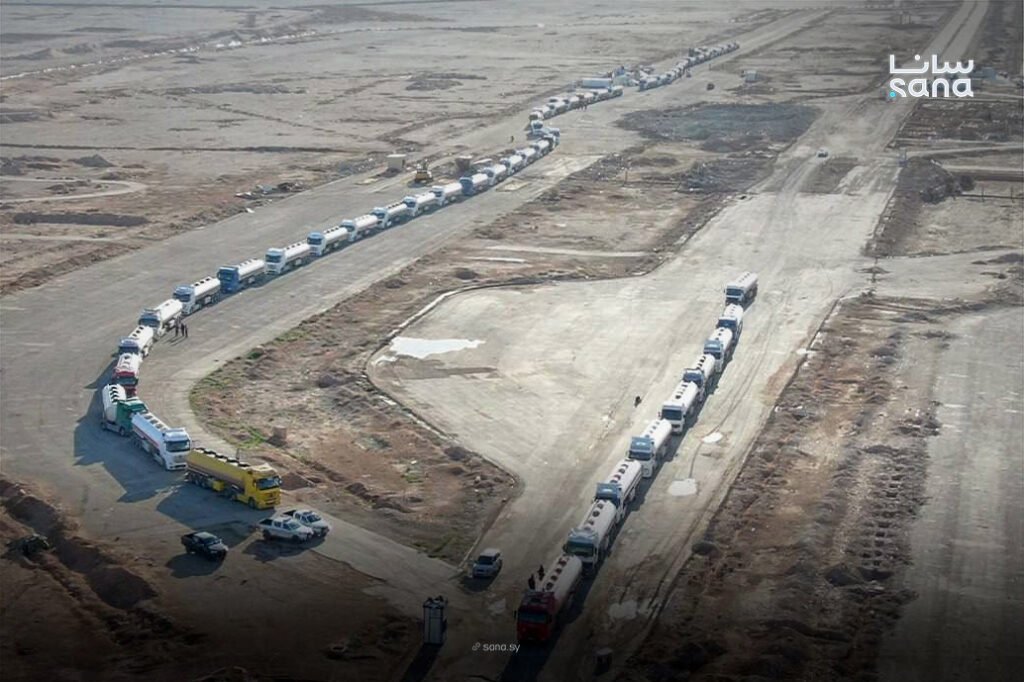
From the Iraqi side, the country has a new prime minister, who’s facing a financial crisis, which makes the flow of oil crucial. In addition to this, the United States is supporting the initiative; a move could be a blessing and a curse at the same time. However, despite all these, it may not be sufficient to ensure the success of the initiative.Current incidents [19], like seizing weapons at the border, which included long-range missiles, rockets, and drones concealed inside one of the oil tanker trucks headed to the city of Baniyas, or the Iraqi deployment of thousands of military, security, and Popular Mobilization Forces along the border strip with Syria, show how fragile the relationship is and indicate that the potentiality of crises to erupt is imminent [20]. From the Siyan side, there seems to be more hunger for the initiative, as the country needs energy and revenue rather desperately. Nevertheless, challenges such as local armed groups, a lack of infrastructure, and the country’s unpredictable future persist. All these indicate that the past is never dead. It’s not even past, as the saying goes.
References
[1] US. Dep. of State. Announcement of Cooperation Between the Government of the Republic of Iraq and the Government of the Syrian Arab Republic on the Rehabilitation and Reconstruction of the Iraq-Syria Crude Oil Pipeline. 2026. https://www.state.gov/releases/office-of-the-spokesperson/2026/07/announcement-of-cooperation-between-the-government-of-the-republic-of-iraq-and-the-government-of-the-syrian-arab-republic-on-the-rehabilitation-and-reconstruction-of-the-iraq-syria-crude-oil-pipeline
[2] Rasheed, Amjed Majeed. Syro-Iraqi Relations: The Puzzle of the Perpetual Theory. Doctoral thesis, Durham University. 2017. https://etheses.durham.ac.uk/id/eprint/12046/
[3] Ihsan A. Hijazi, Iraq Abandons Syria Pipeline, New York Times. Dec. 14, 1988. https://www.nytimes.com/1988/12/14/world/iraq-abandons-syria-pipeline.html
[4] Tom Barrack’s Twit. https://x.com/USAMBTurkiye/status/2077107694889054426
[5] Ali Nuraldin. It is time to open the Kirkuk-Baniyas Pipeline. 2023. https://alkhanadeq.com/post/5548/حان-الوقت-لإعادة-خط-كركوك-بانياس-الى-العمل
[6] Demir, I. (2009). The Kirkuk-Haifa pipeline. Uluslararası Hukuk ve Politika, 5(19), 131 – 147. https://unis.asbu.edu.tr/app_files/2025/12/Yayin_Pdf_8946_26ab411d.pdf
[7] Dilshad Oumer. The Kirkuk-Banias pipeline and its impact on Iraqi-Syrian relations (1952-1982). 2025. hgate.net/publication/398536944_The_Kirkuk-Banias_pipeline_and_its_impact_on_Iraqi_-_Syrian_relations_1952-1982.
[8] Dilshad Oumer. The Kirkuk-Banias pipeline and its impact on Iraqi-Syrian relations (2025). gate.net/publication/398536944_The_Kirkuk-Banias_pipeline_and_its_impact_on_Iraqi_-_Syrian_relations_1952-1982
[9] Andrew Tabler. Syria’s Pipeline Dream Meets Hard Realities. Washington Institute, 2026. https://www.washingtoninstitute.org/policy-analysis/syrias-pipeline-dream-meets-hard-realities
[10] Eberhard Kienle’s book, “Ba’th v. Ba’th: The Conflict Between Syria and Iraq 1968–1989,” was published by I.B. Tauris in 1990, on page 35. I.B. Tauris. 1990.
[11] Samantha Gross. The 1967 War and the “oil weapon.” 2017, Brookings. https://www.brookings.edu/articles/the-1967-war-and-the-oil-weapon/
[12] Rasheed, Amjed Majeed. Syro-Iraqi Relations: The Puzzle of the Perpetual Rivalry. Doctoral thesis, Durham University. 2017. https://etheses.durham.ac.uk/id/eprint/12046/
[13] Malik Mufti. Sovereign Creations: Pan-Arabism and Political Order in Syria and Iraq. By Ithaca and London: Cornell University Press, 1996
[14] Ibrahim Hamidi. Saddam to al-Assad: No handshakes. https://en.majalla.com/node/289426/documents-memoirs/saddam-al-assad-no-handshakes
[15] Pierre Razoux. The Iran-Iraq War. 2015. Belknap Press
[16] Harry Istepanian, Twit. https://x.com/harryistepanian/status/2078733275670188379
[17] Tom Barrack Twit: https://x.com/USAMBTurkiye/status/2078151069671055696
[18] Vita Avrahamov. Restoring the Iraq–Syria Oil Pipeline: Regional Strategic Implications. 2016. JISS. https://jiss.org.il/en/avrahamov-restoring-the-iraq-syria-oil-pipeline/#:~:text=The%20pipeline%20connects%20the%20oil,routes%20through%20the%20Persian%20Gulf
[19] Al-Jazeera. Syria seizes advanced weapons it says were bound for Lebanon’s Hezbollah, 2026. https://www.aljazeera.com/news/2026/7/16/syria-seizes-advanced-weapons-it-says-were-bound-for-lebanons-hezbollah
[20] Sky News Arabia 2026 النظاميون والمسلحون… انتشار سوري على الحدود مع العراق https://www.skynewsarabia.com/middle-east/1763361-قوات-نظامية-ومسلحون-انتشار-سوري-الحدود-العراق