


Tehseen Fatima Syed and Aamira Bibi are Pakistani researchers whose respective areas of expertise focus on violent extremism, Pakistan’s national security policy and strategic competition, as well as Middle Eastern geopolitics and regional security. Their complementary expertise is reflected throughout this article, allowing them to assess the significance of Islamabad’s emerging security alignment with Ankara and Riyadh from both a Pakistani and regional perspective. Building on this understanding, the authors examine the broader implications of these trilateral accords, exploring the potential benefits for each of the three states, while also addressing a key question: why is this strategic alignment emerging now, rather than earlier?
– –
August 9, 2026, appeared to be yet another day in an increasingly volatile international environment. The global order was already grappling with the continuing repercussions of the Russia–Ukraine war, and the growing confrontations between the United States and Iran. At the same time, sustained U.S. and Israeli strategic misadventures across the region, specifically in Palestine and Lebanon, have further intensified regional tensions while reflecting broader struggles over power, security, deterrence, and influence in the Middle East. These developments had begun to reshape regional strategic calculations, as the escalation of the Iran conflict disrupted energy markets, threatened critical maritime routes, and raised renewed questions about the effectiveness and credibility of the existing U.S.-led security architecture in the Gulf.
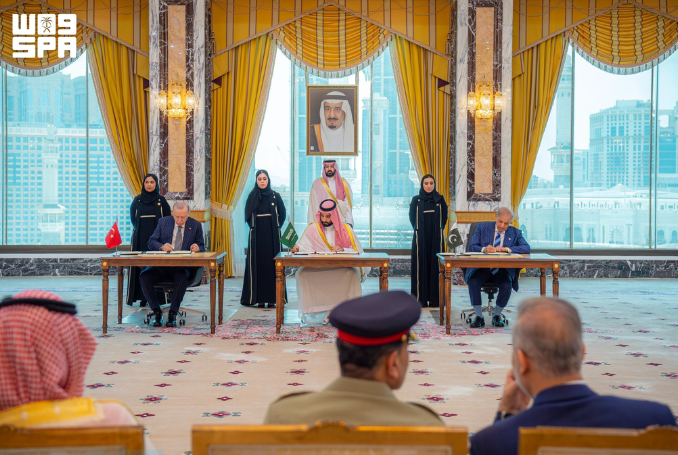
Against this backdrop, the decision by Saudi Arabia, Türkiye and Pakistan to establish the “Makkah Agreement for Joint Defence” acquired particular strategic significance. The agreement transformed longstanding bilateral relationships and historical bonds among the three countries into a formal framework based on the principle of collective defence. The central idea is straightforward: “an armed attack against one member would be regarded as an attack against all”.
But this trilateral arrangement poses some pertinent but difficult questions, particularly “how this new treaty will differ from previous efforts by Muslim states, particularly the GCC countries, to protect one another from external aggression? Unfortunately, there are not enough poised examples that can be cited to demonstrate that these mechanisms have efficiently worked in practice. Instead, vulnerabilities of such arrangements have been widely exposed in events such as Iraq’s invasion of Kuwait, the 2017’s Qatar crisis, and, more recently, the continuing failure to provide effective protection to Palestine amid Israeli aggression since 2023. Hence, the critical question ultimately comes down to whether these three parties will really succeed in aligning their political will behind a credible collective security mechanism despite their divergent national interests and perceptions of threat.
Moreover, the timing of this agreement is as significant as the agreement itself. Why did these three countries choose this particular moment to formalize their security relationship? And what does the selection of Saudi Arabia, Türkiye and Pakistan tell us about the security architecture that may be emerging in the Middle East? The answer is quite tricky as it will not just begin with the transformation of the regional security environment following the US-Israel’s war against Iran but also how the threat perceptions of the core parties are pushing to challenge the already existing regional status quo.
WHY NOW?
For decades, Gulf security rested heavily on an external security architecture, particularly the military presence and guarantees provided by the United States. Gulf states regarded the American presence as an essential deterrent against regional threats, however, since the US-Iran conflict started spreading across the Gulf countries, the fundamental dilemma within that arrangement started to be exposed. This conflict made the scales fall from their eyes and it was very clear that whenever Washington itself will become directly involved in any regional confrontation, the same military infrastructure located in the Gulf could potentially make host countries targets of retaliation, and the consequences will not only be military but also economical. The distinction between protection and exposure therefore became increasingly blurred.
Hence, for Saudi Arabia in particular, this environment reinforced an existing trend towards strategic diversification. Riyadh has maintained its longstanding relationship with Washington, but it has simultaneously expanded its relationships with other major powers and regional actors. Its rapprochement with Iran in March 2023, its expanding relationship with China and Russia, and now its defence agreement with Türkiye and Pakistan all indicate a desire to broaden its strategic options. The Saudi-Iran diplomatic opening had previously demonstrated the Kingdom’s preference for regional pragmatism. Diplomatic relations were restored and embassies reopened after years of rivalry. Yet the subsequent escalation illustrated how fragile regional détente can become when larger military confrontations intervene.
The Makkah Agreement should therefore be understood not simply as a reaction to one war, but as part of a broader KSA’s regional reassessment. The conflict against Iran accelerated a process that was already underway: Middle Eastern states are increasingly seeking greater control over their own security calculations rather than relying exclusively on established external guarantees.
WHY THESE THREE COUNTRIES?
The core question is why these three countries, despite their different geographical positions, threat perceptions, and strategic capabilities, chose to come together under a collective security arrangement. There are some clear and compelling answers to this, but there are also several complex and less straightforward dimensions that deserve closer examination. The three countries and their diverse military, strategic and diplomatic statures surely have enough potential to create a complementary security framework provided that its institutionalisation remains effective. Saudi Arabia contributes enormous financial resources, diplomatic influence, energy importance and considerable weight across the Arab and Muslim worlds. Its primary security concerns are closely associated with the protection of its territory, energy infrastructure, maritime routes and the wider stability of the Gulf.
Türkiye brings a substantial conventional military capability, NATO experience, a growing defence-industrial base and an increasingly independent regional foreign policy. Its security environment extends beyond the Gulf and includes Syria, Iraq, terrorism, the Eastern Mediterranean, Russia and broader regional developments.
Pakistan, meanwhile, contributes a large and experienced military, an established defence-industrial base, strategic deterrence capabilities and decades of defence cooperation with Saudi Arabia. Another important, yet potentially contentious, dimension is Pakistan’s geographical position. Pakistan occupies a strategically significant space linking South Asia with the Gulf and the broader Muslim world, while also sharing a direct border with Iran. This geographical connectivity offers considerable strategic advantages, but it can equally become a source of complexity and challenge within the emerging security framework. More importantly, the three countries have relationships that extend across different parts of the region. Their combined strategic reach therefore potentially connects the Gulf, South Asia and the wider Middle East. The agreement is consequently not simply an alliance among three friendly states. It represents an attempt to bring together three different forms of strategic capability within a single institutional framework. Hence, the three countries can potentially strengthen one another’s military security and reinforce their defensive capacities through collective efforts.
WHAT DOES SAUDI ARABIA SEEK?
For Saudi Arabia, the most immediate objective is to strengthen deterrence and reduce excessive dependence on any single external security provider. The Kingdom faces a security environment in which missile and drone threats, maritime insecurity, attacks on critical infrastructure and instability around the Gulf and Red Sea can have direct consequences for its national security and economic interests. The experience of the Iran conflict has made this vulnerability particularly visible. Saudi Arabia therefore has an interest in developing partnerships that can provide additional political and military depth and suggests that Saudi Arabia wants greater flexibility and additional security partnerships so that its national security does not depend entirely on the decisions of one external power. Pakistan and Türkiye both offer different forms of strategic value including sophisticated conventional military capabilities and defence-industrial potential, experienced military personnel, defence cooperation and a longstanding strategic relationship with Saudi Arabia. The Kingdom therefore gains not only another security agreement but also access to two partners with capabilities that can complement its own resources.
WHAT DOES TÜRKIYE SEEK?
Türkiye’s decision to join the agreement can be understood within its broader effort to diversify its security partnerships and preserve strategic autonomy in an increasingly multipolar international order. This motivation is further reinforced by growing strains within NATO as well as widening differences between the US & European countries under Trump’s administration. Moreover, President Erdoğan has pursued a foreign-policy which combines diplomatic, political and religious orientation, and this multidimensional approach is often being depicted by him through his increasingly vocal opposition to Israeli policies specifically in Gaza.
This strategic ambiguity also resonates with Saudi Arabia’s own dilemma over the reliability and long-term sustainability of US security guarantees which have always been tied to Abraham Accords. The Makkah framework gives Türkiye an opportunity to deepen its relationship with two strategically important Muslim states while minimizing the pressure of choosing between Western and non-Western alignments. Instead, they are developing overlapping partnerships according to their own national interests. However, it is important to note that if we examine Türkiye’s threat matrix, many of its core national security threats emanate from Greece, Cyprus, Syria and Iraq, and particularly from armed Kurdish groups. Paradoxically, all these threats are geographically distant from both Pakistan and Saudi Arabia and in this context, how these two countries will practically activate the automatic military-intervention scenario to protect Türkiye need to be examined very carefully.
PAKISTAN’S STRATEGIC CALCULATION
Pakistan’s strategic challenges in this arrangement are perhaps the most complicated. Pakistan has a longstanding strategic relationship with Saudi Arabia and deepening ties with Türkiye. Both relationships are important politically, diplomatically and militarily. Pakistan also has its own security priorities, however, and these cannot simply be subordinated to the concerns of its partners.
India has always been Pakistan’s direct, external and the overt traditional security threat. Specifically, after the 2025’s military escalation which brought the region at the brink of the nuclear confrontation and India’s continued warmongering bellicose rhetoric regarding references to the possibility of a “Sindoor 2.0,” has sustained fears of renewed confrontation. In this context, India remains the most significant conventional security concern shaping Pakistan’s strategic and defence calculations. This creates the central dilemma of the Makkah Agreement specifically for Pakistan. Saudi Arabia’s bilateral trade ties with India are very strong, with India being the Kingdom’s second-largest trading partner and in FY 2024–25, bilateral trade stood at USD 41.88 billion. Hence, if at some point India attacks Pakistan, will Saudi Arabia assist Pakistan in a collective-defence manner?
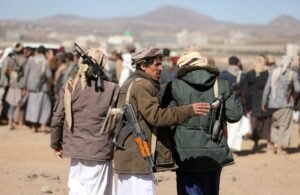
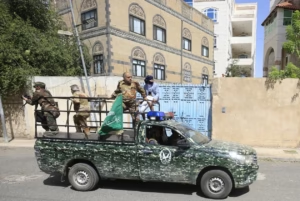
On the other hand, the Houthi threat provides an important illustration of the convergence of Pakistan and KSA’s interest. Saudi Arabia has viewed Houthi activity as a direct threat to its territory, energy infrastructure and maritime access and for Pakistan the security of the Red Sea and Bab el-Mandeb is very crucial because its trade and energy supplies depend upon secure maritime routes. The threats to commercial shipping therefore demonstrate that a conflict geographically distant from Pakistan can quickly become a Pakistani economic, maritime and human-security issue. Hence, Pakistan launched Op. Muhafiz-ul-Bahr on March 9 to counter the threats in the Red Sea and Bab Al-Mandab.
Pakistan shares a border with Iran and has important geographical, economic and social links with its western neighbour. Islamabad therefore cannot afford to treat the Makkah Agreement as an automatic alignment against Tehran. Despite the most serious rupture between Iran and Pakistan which came in 2024 the neighbors neutralized the tensions abruptly and it was clear that neither side wanted to continue the friction. However, as Iran’s escalating attacks on the Gulf countries and specifically the Houthis’ threats to shipping lanes remain a mutual security concern, a crucial question emerges: If Saudi Arabia is attacked, or Turkish interests come under attack, would Pakistan be compelled to confront Iran? And how can Pakistan avoid being caught in the crossfire while simultaneously fulfilling its collective-defence commitments under the Makkah Agreement?
The strategic challenge for Pakistan is not simply choosing between Saudi Arabia and Iran. It is finding a way to deepen its strategic partnership with Saudi Arabia and Türkiye while preserving sufficient diplomatic space with Iran to protect Pakistan’s own national security interests. This balancing role may ultimately become one of Pakistan’s most important contributions to the Makkah framework.
CAN THE AGREEMENT BECOME A GENUINE COLLECTIVE-DEFENCE ALLIANCE?
The existence of complementary capabilities does not automatically create an effective collective-defence mechanism. The most important question is whether the three countries would actually fight for one another when their threat perceptions diverge.
This is not merely a theoretical question. They go directly to the credibility of the agreement.
A collective-defence arrangement becomes meaningful when its members possess not only common interests but also the political will and institutional mechanisms necessary to respond to a crisis. The Makkah Agreement has taken an important institutional step by establishing a Strategic Political and Defence Committee and a permanent secretariat in Saudi Arabia. Yet institutionalization is only the beginning. The real test will be whether the three countries can develop mechanisms for intelligence cooperation, defence coordination, maritime security, protection of critical infrastructure and crisis consultation without creating automatic obligations that could pull one member into conflicts unrelated to its core national interests.
The agreement may be most credible when the three states identify areas where their security interests genuinely overlap. The agreement’s greatest strength may therefore lie not in forcing the three states to share identical threat perceptions, but in creating an institutional mechanism through which they can cooperate despite those differences.
BEYOND AN “ISLAMIC NATO”?
This trilateral arrangement could also serve as a litmus test for the long-debated idea of expanding the military domain of the OIC or even creating a broader NATO-like defence framework for the Muslim world. Pakistan has always remained a strong proponent of this idea of military cooperation between the Muslim countries. Although it is too early to draw conclusions, Saudi Arabia, Türkiye and Pakistan are influential members of the Organisation of Islamic Cooperation. Stronger institutions and appropriate mechanisms could pave the way for cooperation with other Muslim-majority powers. Over time, this could lay the groundwork for an OIC military structure with an integrated command and binding operational mechanisms, potentially offering greater protection to vulnerable Muslim communities, particularly Palestinians in Gaza. That possibility depends on whether the three members can turn political symbolism into practical cooperation.
THE REAL TEST: CONVERGENCE WITHOUT ENTRAPMENT
Ultimately, the Makkah Agreement’s greatest challenge is also its greatest opportunity. A successful security architecture does not necessarily require complete strategic uniformity. It requires sufficient convergence of interests, credible institutions and political mechanisms capable of managing disagreements. For Pakistan, this distinction is particularly important. Islamabad must strengthen its strategic relationships with Saudi Arabia and Türkiye while avoiding the transformation of the agreement into an automatic commitment to participate in every conflict involving either partner. Pakistan’s national-security interests require strategic flexibility. Its relationship with Iran, its rivalry with India and its economic dependence on regional stability all demand careful calculation. The Makkah Agreement can therefore become an asset for Pakistan if it expands Islamabad’s strategic options rather than narrowing them.
If they can institutionalise their areas of convergence while respecting their different national interests, the agreement could become a significant new component of Middle Eastern security. If, however, collective defence is interpreted as automatic participation in conflicts where threat perceptions diverge, the differences among the three states could become its greatest weakness.
The real achievement of Makkah, therefore, will not be measured by the symbolism of the agreement itself. It will be measured by whether Saudi Arabia, Türkiye and Pakistan can build a security partnership strong enough to deter threats, flexible enough to accommodate differences, and credible enough to survive the next regional crisis.
Notes :
[1] Ministry of Foreign Affairs, Government of Pakistan. “Makkah Al Mukarramah Summit for Joint Defence.” 7 August 2026.
[2] Government Communications Office, State of Qatar. “GCC Crisis.” June 5, 2017. Government Communications Office — GCC Crisis
[3] Ministry of Foreign Affairs of the People’s Republic of China. “Joint Trilateral Statement by the People’s Republic of China, the Kingdom of Saudi Arabia, and the Islamic Republic of Iran.” March 10, 2023.
[4] Saudi Press Agency (SPA). “Saudi Arabia, India Deepen Strategic Partnership amid Robust Trade and Investment.” April 22, 2025. Saudi Press Agency
[5] Arab News Pakistan. “Pakistan Says Naval Operation Protecting Energy Lifelines amid Middle East Conflict.” September 8, 2026. Arab News Pakistan