

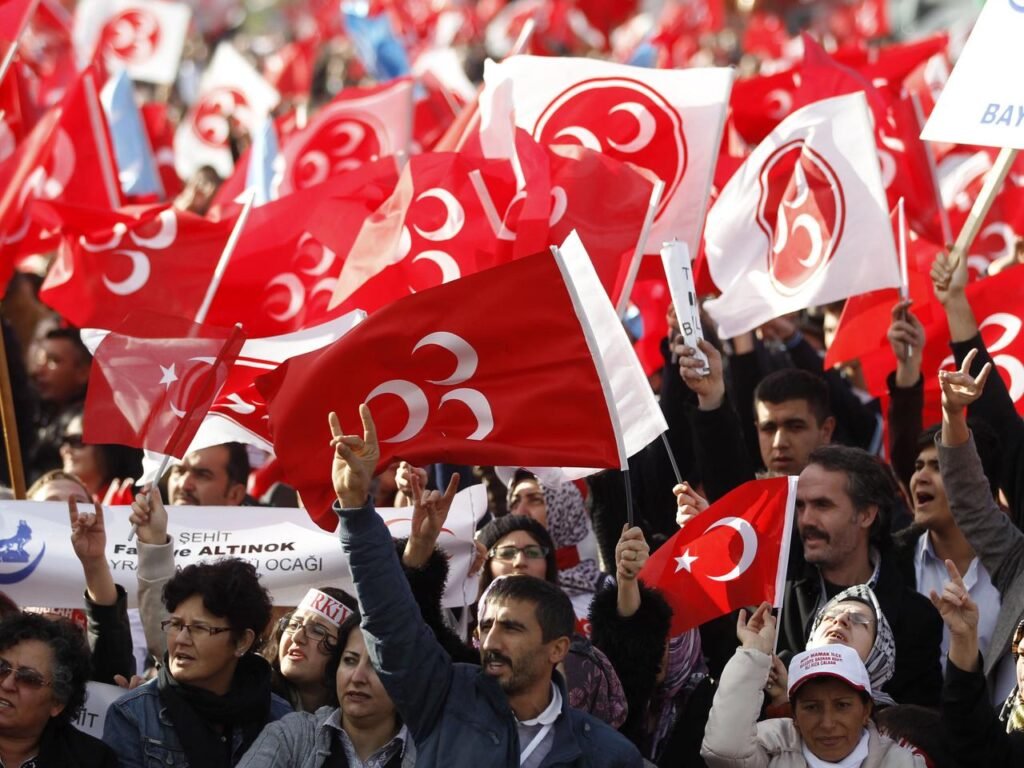

In autumn 2024, Türkiye once again embarked on a process aimed at resolving the Kurdish question. Since the AKP[1] came to power, this is the fourth such initiative, following the “democratic opening” (demokratik açılımı, 2009), which initiated a debate in the Turkish parliament intended to lead to concrete solutions; the “Oslo process” (Oslo görüşmeleri, 2010–2011), which involved secret negotiations between the Turkish government and the PKK[2] in the Norwegian capital; and the “solution process” (çözüm süreci, 2012–2015), negotiations between Ankara and Abdullah Öcalan through the Kurdish parliamentary party[3]. In some respects, the current process resembles its predecessor, which was abruptly brought to an end in 2015, to the extent that some have referred to it as the “İkinci çözüm süreci” (the second solution process). As in the previous process, the main protagonists of the negotiations have been the Turkish government and the imprisoned PKK leader, with the DEM[4], the current Kurdish parliamentary party and, incidentally, the third-largest political formation in the Turkish parliament, acting as an intermediary. This role has been illustrated in particular by the regular visits of its MPs to İmralı Island, off the coast of Istanbul, where Abdullah Öcalan is imprisoned, followed upon their return by briefings to the government and the country’s main parliamentary parties.
Yet one major difference marked this process from the outset, which the Turkish government would later come to call the Terörsüz Türkiye süreci (the “process for a Terror-Free Türkiye”). The initiative originated with Devlet Bahçeli, leader of the MHP (Milliyetçi Hareket Partisi, Nationalist Movement Party), the ultranationalist far-right party founded in 1969 by General Alparslan Türkeş. To general surprise, on 1 October 2024, during the opening of the autumn parliamentary session, Bahçeli conspicuously approached the Kurdish MPs to shake their hands. Three weeks later, on 22 October, he went further by inviting Abdullah Öcalan to address parliament and call for an end to the armed struggle and the dissolution of the PKK, offering him in return what he described as the “right to hope” (umut hakkı)[5], that is, the possibility of conditional release. Since then, Bahçeli’s gesture has been followed by a series of striking decisions and developments: Abdullah Öcalan’s call for an end to the armed struggle, the formal dissolution of the PKK, and the launch of a framework law in parliament intended, among other things, to address the sensitive issue of the return of former PKK fighters.
What is most remarkable, however, is Devlet Bahçeli’s continued commitment to such a process, despite having previously been its most determined opponent and even having expressed his opposition to the very existence of a legally recognised Kurdish political party in Türkiye. Over the past two years, Bahçeli has not only succeeded in maintaining this course but, above all, in containing the nationalist backlash that such a Kurdish policy might have provoked. This raises the question of why Turkish nationalism, which had long been mobilised against any political settlement of the Kurdish question, has remained relatively quiet. This is the question that this article seeks to address.
Fierce but Politically Marginal Ultra-Nationalist Reactions
Although the government has sought to contain and marginalise them, nationalist reactions have indeed emerged throughout the process. The first came from Müsavat Dervişoğlu, leader of the İYİ Party (Good Party), a small nationalist formation generally regarded as more moderate than the MHP. Founded in 2017 by dissidents from the MHP and joined by nationalists from the CHP[6], the party reacted strongly to Bahçeli’s initiative. The day after Bahçeli invited Abdullah Öcalan to address parliament in October 2024, Dervişoğlu brandished a rope from the parliamentary rostrum, recalling a gesture Bahçeli himself had made towards Recep Tayyip Erdoğan in 2007, when he called on him to have Öcalan hanged. Dervişoğlu also received significant support from Alparslan Türkeş’s daughter, Ayyüce Türkeş Taş, an İYİ Party MP for Adana, who declared: “Bahçeli’s remarks are unacceptable. Parliament is not a place for terrorists. I will not allow my father’s legacy to be betrayed. No one has the right to stand in the place of Alparslan Türkeş, the founder of the MHP, and glorify terrorists[7].”
The other major nationalist dissident to accuse Bahçeli of betrayal in similarly forceful terms was Ümit Özdağ, leader of the Zafer Partisi (Victory Party), one of the MHP’s ultranationalist rivals. Özdağ described the invitation to Öcalan to address parliament as “tam bir siyasi cinnet” (“complete political madness”), questioning how the leader of the MHP, who had made himself a champion of the fight against “terrorism”, could contemplate granting the Kurdish leader a “right to hope[8]”. Similar condemnations of Bahçeli’s position came from other prominent ultranationalist figures, including Mustafa Destici, leader of the BBP[9], a marginal Islamist-nationalist party, and Doğu Perinçek[10], leader of the Vatan Partisi, a small left-wing Eurasianist nationalist formation.
The striking nature of these statements nevertheless had a limited impact. This was largely due to the limited influence of these parties. Since its founder Meral Akşener’s defeat in the 2023 presidential election, the İYİ Party has been losing ground and struggling for political survival. Its vehement opposition to the Kurdish process initiated by Bahçeli appeared primarily as an attempt to regain visibility and attract some of the voters sceptical of the process. As for Ümit Özdağ and the Zafer Partisi, although their role in Turkish politics has recently become somewhat more significant, it has been primarily associated with migration issues, particularly the debate over Syrian immigration during the 2023 presidential campaign. In 2025, Özdağ did face legal proceedings following his statements on the Kurdish question and was even imprisoned for nearly five months. However, these legal difficulties were primarily related to statements he had made about Syrian immigration and which personally targeted Recep Tayyip Erdoğan[11].
More consequential for the governing AKP-MHP coalition were less spectacular but politically more substantive criticisms from figures capable of exerting genuine influence in Türkiye’s current political landscape. This was particularly the case with Fatih Erbakan, leader of the YRP (Yeniden Refah Partisi, New Welfare Party)[12], who has sought to occupy the political space on the right left open by the AKP, drawing on the political legacy of his father, Necmettin Erbakan. Presenting himself as the custodian of a genuine Turkish Islamist tradition, Fatih Erbakan seeks both to distinguish himself from the AKP, whose compromises he criticises, and to attract part of the conservative and religious electorate that constitutes one of his main potential constituencies. His more nuanced criticism of the Kurdish process therefore carries particular significance: the YRP has not only criticised an initiative supported by the government and portrayed as excessively conciliatory towards the PKK, but has also questioned the AKP’s ability to remain the defender of conservative, religious and ultimately nationalist values. The challenge is all the more significant because, in the 2024 local elections, the YRP demonstrated its ability to attract voters on the right who were dissatisfied with the current government. Fatih Erbakan has also called for a referendum on the Kurdish process[13].
The Diffuse Presence of Republican Nationalism
In a different register, Mansur Yavaş, the highly popular CHP mayor of Ankara, has also expressed reservations about the initiative. His opposition is particularly significant because it does not stem solely from opposition to the government, but is rooted in a tradition of republican nationalism that may resonate among CHP voters and potentially among supporters of the New Party (Yeni Parti), although Yavaş has not joined the new formation established by Özgür Özel to replace the old Kemalist political establishment, which has recently undergone internal divisions.
Yavaş’s reaction to the PKK’s decision to dissolve itself in May 2025 is particularly revealing. The Ankara mayor argued that the dissolution was “the result of our country’s uncompromising policy” towards “terrorism”, and deemed “any concession… or any attempt that would lead the Republic of Türkiye to negotiate with members of a terrorist organisation” unacceptable. Stressing that decision-making authority ultimately rested with the Grand National Assembly and also calling for a referendum if necessary, he concluded by invoking the Treaty of Lausanne as the “title deed to a homeland conquered under the leadership of Gazi Mustafa Kemal Atatürk” and as the “guarantee of living together on these lands[14]”.
Yavaş’s political trajectory is worth recalling in this regard. Before joining the CHP in 2013, he spent a significant part of his political career within the MHP. His nationalism continues to shape his political positions, allowing him to challenge the government’s claim to a monopoly over the defence of national unity. Yavaş’s position illustrates how the Kurdish process can become a field of electoral competition infused with nationalism, extending well beyond the most hardline nationalist circles. Without openly rejecting the process, the left-wing opposition, represented primarily by the CHP until the summer of 2026 and now increasingly by Özgür Özel’s New Party, has consistently expressed scepticism and called for a more transparent procedure, particularly one involving parliament more closely.
Confronted with Bahçeli’s efforts to portray the dissolution of the PKK as a victory for the state, more moderate politicians such as Mansur Yavaş can implicitly appeal to the nationalist sentiment present among voters in order to raise concerns among a public unsettled by the dialogue initiated with Abdullah Öcalan. Özgür Özel, who at the time was still chairman of the CHP, interpreted the Kurdish process somewhat differently from Yavaş. He stressed in particular that the solution to all of the country’s problems, including the Kurdish question, lay above all in the rule of law, justice and democracy. Ultimately, however, he too stated: “The guarantee of social peace in Türkiye is our Republic. Founded by Gazi Mustafa Kemal Atatürk more than a century ago, it rests on the will of the nation, on our national sovereignty, on our independence enshrined in the Treaty of Lausanne, and on the indivisible integrity of our country[15].”
From Resolving the Kurdish Question to the “Terror-Free Türkiye Initiative”
In order to neutralise these various nationalist pressures, as well as less chauvinistic criticisms concerned with defending the national interest through reference to foundational republican values, the Turkish government has pursued a strategy of, in a sense, “nationalising” its new attempt to address the Kurdish question and transforming it into a process aimed at freeing Türkiye from terrorism.
“Democratic opening”, “Oslo process”, “solution process”: the Turkish government has never openly and officially described its successive initiatives as attempts to resolve the Kurdish question. Moreover, Recep Tayyip Erdoğan had been repeatedly sobered by the nationalist reactions they generated. In 2009, the televised coverage of the return of the Barış Grubu, groups of PKK rebels who came to the Turkish-Iraqi border to symbolically lay down their arms, provoked a nationalist backlash that immediately discouraged the government from pursuing the Kurdish democratic opening it had initiated[16]. In June 2015, the AKP’s setback in the parliamentary elections was partly attributable to an electoral surge by the MHP reflecting significant nationalist opposition to the solution process that had begun two years earlier[17]. These previous experiences probably explain why, this time, Recep Tayyip Erdoğan initially kept a cautious distance from the initiative launched in October 2024, allowing Devlet Bahçeli to take the lead. The Turkish president could thus give the impression of joining a Kurdish process that had been set in motion by the most nationalist of Türkiye’s political leaders.
Subsequently, the head of state began to support the operation launched by Bahçeli, albeit cautiously. He never referred to negotiations aimed at resolving the Kurdish question, instead speaking only of a policy intended to strengthen national unity. Only gradually, through a series of public statements, did the president develop the idea that the process was intended to promote a “Terror-Free Türkiye”. Then, following the first major development—the 27 February 2025 call by Abdullah Öcalan for the dissolution of the PKK—he began systematically using the notion of Terörsüz Türkiye. In the course of the process, Recep Tayyip Erdoğan has adopted a distinctly more nationalist posture than during the previous initiatives.
In 2005, shortly after coming to power, the AKP leader made headlines by declaring that there was a Kurdish problem in Türkiye and that efforts should be made to resolve it[18]. Ten years later, when bringing the “solution process” to an end, he would just as openly deny the existence of such a problem[19]. During the AKP’s first three attempts to find a political solution to the Kurdish question, however, considerable attention was devoted to Kurdish rights and even to the recognition of a Kurdish reality in Türkiye. This has not been the case in the current process, where the focus so far has been primarily on ending the armed struggle, the disarmament of the PKK and the future of its leader, while the notion of Terörsüz Türkiye has become a genuine political slogan.
An Attempt to Reinterpret the Turkish Nationalist Paradigm?
Semantically and ideologically, Devlet Bahçeli has largely paved the way for reconciling Turkish nationalism with a settlement of the Kurdish question. Significantly, on 29 October 2024, on the 101st anniversary of the proclamation of the Republic, the MHP leader declared: “The Republic of Türkiye has no Kurdish problem and never will… The problem that exists is the problem of separatist terrorism, and this plot will be eradicated once and for all[20].” To pre-empt accusations of betrayal or abandonment of nationalism, the MHP leader has never presented his initiative as a concession to the Kurds or the PKK, but rather as a strategy aimed at definitively eliminating terrorism and strengthening the unity of the Turkish state. He has sought to persuade the public that he was not negotiating with Abdullah Öcalan in order to grant rights to the Kurds, but instead attempting to secure the imprisoned leader’s abandonment of the armed struggle. Ultimately, he presented the talks with the Kurdish leader not as a process of reconciliation, but rather as a form of capitulation by his interlocutor.
At its core, this rests on the idea of aspiring to a strong Türkiye[21], which lies at the heart of the ideological matrix of the Turkish nationalist movement: the Ülkü Ocakları (Idealist Hearths), commonly referred to as the “Grey Wolves” or Bozkurtlar in Turkish, which have remained relatively discreet since the beginning of the process. Far from abandoning this ethnic nationalist paradigm, Bahçeli’s initiative seeks to reinterpret it in light of immediate political imperatives. By replacing the prospect of an endless struggle against the PKK with the objective of its dissolution, he transforms the resolution of the Kurdish conflict into an effort to consolidate the nation-state. “Terror-Free Türkiye” thus appears as the culmination of a nationalism based on national unity, Sunni Islam, shared by the majority of Turks and Kurds, the preservation of territorial integrity and the primacy of the state.
At the same time, this notion does arguably set aside some of the more idealistic and utopian dimensions of this nationalism that may conflict with the Kurdish process currently under way, particularly pan-Turkism and an ethnic conception of citizenship. Will Bahçeli’s pragmatic nationalism ultimately prevail over its doctrinal imagination? Much will, of course, depend on the eventual success of the initiative launched by the MHP leader in October 2024.
By Way of Conclusion…
Beyond the debate addressed here regarding the compatibility of this initiative with the pressures of Turkish nationalism, the success of the Kurdish process launched in 2024 rests on another, even more fundamental ambiguity: its relationship with the evolution of democracy in Türkiye. Abdullah Öcalan ultimately called on the PKK to renounce the armed struggle and dissolve itself because, as he explained in his February 2025 statement, he considers that Kurdish aspirations can now be achieved within a democratic society and through political means. Yet the process in question is unfolding in a Türkiye where democratic space is shrinking day by day, where the political opposition is subject to significant constraints, and where the institutional mechanisms through which Kurdish demands can be expressed pluralistically have been weakened.
The paradox therefore has two dimensions. On the one hand, the process must overcome the risk of rejection by Turkish nationalism and convince it that the end of the armed struggle is not a concession to the Kurdish movement, but rather the culmination of the fight against separatism and the consolidation of national unity. On the other hand, the same process cannot avoid addressing the creation of political conditions that give Kurds a meaningful reason to abandon violence: namely, the possibility of participating in political life, defending their rights, and asserting their distinctiveness within a democratic framework.
Caught between these two requirements, the process faces a difficult tension to resolve. Its success will not depend simply on the dissolution of the PKK or the end of violence, but also on the regime’s ability to transform “Terror-Free Türkiye” into a more democratic Türkiye. It is arguably this contradiction between the necessary closure of an armed conflict that has lasted for more than forty years and the reopening of political space in Türkiye that makes the current Kurdish process vulnerable, despite its ambitions and its initial achievements.
Notes
[1] AKP (Adalet ve Kalkınma Partisi – Justice and Development Party), the party led by Recep Tayyip Erdoğan.
[2] PKK (Partiya Karkerên Kurdistan, Kurdistan Workers’ Party), a Kurdish political and military organisation founded by Abdullah Öcalan in 1978, which announced its dissolution on 12 May 2025, following its leader’s decision to abandon the armed struggle.
[3] Jean Marcou, “The Kurdish Question in Türkiye and the AKP Regime: Recognition, Attempts at Settlement and the Resurgence of Denial,” Orients stratégiques, No. 12, 2022, pp. 29–44.
[4] DEM Parti, contraction de Halkların Eşitlik ve Demokrasi Partisi (Parti pour l’égalité des peuples et la démocratie), dernier avatar des partis kurdes légaux et parlementaires, créés depuis les années 1990
[5] This expression, which has been widely used since the beginning of the current process to resolve the Kurdish question in Türkiye, derives from the case law of the European Court of Human Rights, which holds that even a life sentence must not rule out the possibility of release and must preserve the hope for every prisoner that they will not die in prison.
[6] CHP, Cumhuriyet Halk Partisi (Republican People’s Party), a party founded by Mustafa Kemal in 1923.
[7] “Bahçeli’nin ‘Öcalan Meclis’e gelsin’ çağrısına siyasilerden sert tepki” (“Political Figures React Strongly to Bahçeli’s Call for Öcalan to Come to Parliament”), Medyascope, 22 October 2024.
[8] “Ümit Özdağ’dan Bahçeli’ye sert tepki: Öcalan’a bu konuşmayı yapması için ne verdiniz?” (“Ümit Özdağ Strongly Criticises Bahçeli: What Did You Give Öcalan to Invite Him to Make This Speech?”), Oksijen, 22 October 2024.
[9] BBP, Büyük Birlik Partisi (Great Unity Party), a small nationalist-Islamist party founded in 1993 by Muhsin Yazıcıoğlu, who died during the 2009 local election campaign in a helicopter crash whose causes remain unresolved to this day. After breaking with the MHP, Yazıcıoğlu also broke with the Grey Wolves (Ülkü Ocakları – Idealist Hearths), from which he had emerged, to establish a rival organisation, the Alperen Ocakları (Hearths of the Holy Warriors).
[10] A prominent figure on the Turkish far left from the 1960s onwards, Doğu Perinçek has, since the beginning of the millennium, often distinguished himself through an assertive form of sovereigntism and nationalism, which has led him to embrace conspiracy theories, pro-Russian and Eurasianist positions, and denial of the Armenian genocide, for which he was convicted in Switzerland. The latest political formation he founded, and which he has led since 2015, is the Vatan Partisi (Patriotic Party), which presents itself as both populist, nationalist, and socialist.
[11] BLACKBURN Gavin, « Far-right politician, Ümit Özdağ goes on trial for allegedly inciting anti-Syrian riots », Euronews, June 12, 2025
[12] Founded in 2018, this party seeks to revive the legacy of the Refah Partisi (Welfare Party), the emblematic Turkish Islamist party of the 1980s and 1990s, within which Recep Tayyip Erdoğan began his political career.
[13] “Erbakan’dan, ‘Terörsüz Türkiye’ süreciyle ilgili referandum çağrısı” (“Erbakan Calls for a Referendum on the ‘Terror-Free Türkiye’ Process”), Ekonomim, 22 December 2025.
[14] « KK’nın feshi: Mansur Yavaş’tan referandum çıkışı », Deutsche Welle Online, May 13, 2025
[15] Ibid.
[16] PERRIER Guillaume, « Accueillis en héros, des rebelles kurdes du PKK rentrent en Turquie dans l’espoir de négociations avec Ankara », Le Monde, 22 October 2009
[17] Interview by Anne-Lucie Chaigne-Oudin with Jean Marcou, “An Update on Türkiye Following the 7 June 2015 Legislative Elections,” Les Clés du Moyen-Orient, 22 June 2015.
[18] BIRCH Nicholas, « Türkiye looks for peace with Kurds », The Guardian, August 13, 2005
[19] JÉGO Marie, « En Turquie, le président Erdoğan rattrapé par la question kurde », Le Monde, 22 March 2015
[20] « Gov’t-ally Bahçeli now denies Kurdish issue », duvarR.english, October 29, 2026
[21] CENGIZ Fatih Çağatay, « Resistance to change: the ideological immoderation of the Nationalist Action Party in Türkiye », Turkish Studies, 2020, p. 462-480
[22] BALCI Tamer, « The rise and fall of the Nine Lights Ideology », Politics, Religion and Ideology, vol.12, p. 145-160