

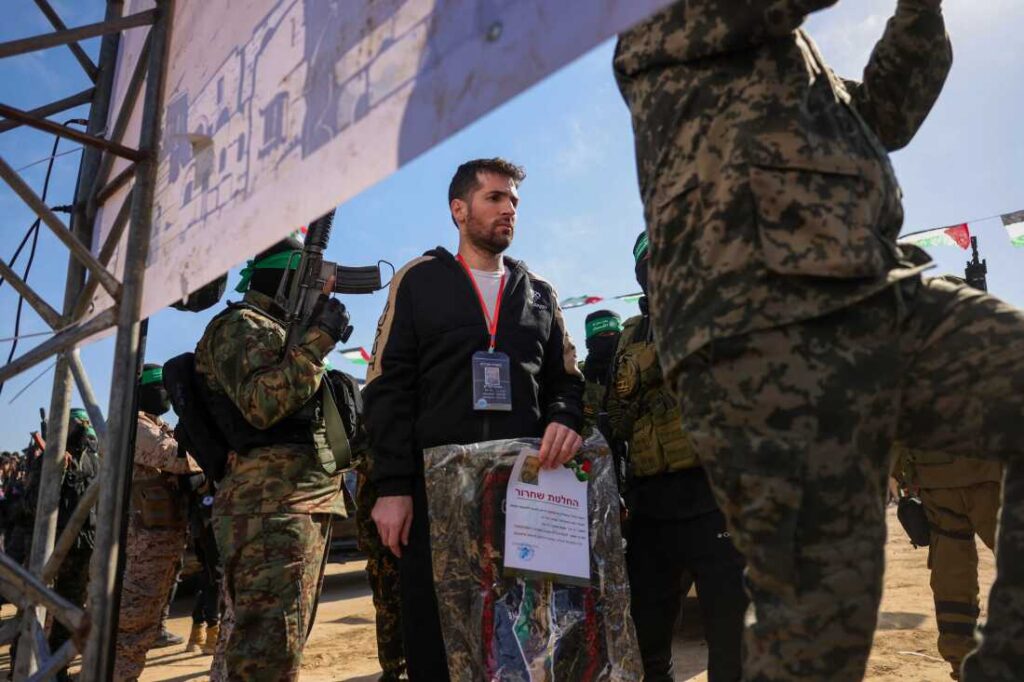

This translation benefited greatly from the expertise and collaboration of Dr. Lalla Amina Drhimeur, who holds a PhD in Political Science from Sciences Po Lyon. Her research explores the evolution of political Islam in government, comparing the experiences of the AKP in Turkey and the PJD in Morocco within their broader national and international contexts. (For more information about her, check the expert section)
Introduction
This article, which extends and builds on our book[1], seeks to analyse how Hamas strives to offset the asymmetry in the military and diplomatic balance of power with Israel, by leveraging a religious imaginary, emotional registers as well as the representations and staging of the release of Israeli hostages. Both are organized during truces that followed the launch of a large-scale Israeli military response in the Gaza Strip after the 7 October massacres in southern Israel, carried out primarily by the Palestinian Islamist movement. We will first adopt a minimal definition of wartime propaganda as a process that consists in devaluating the adversary, by amplifying their supposed flaws or shortcomings, while simultaneously enhancing and magnifying one’s own image, or downplaying aspects likely to tarnish one’s reputation both domestically and internationally. Such a framing does not, however, overlook the propaganda of the Israeli state and military, which themselves strive to impose their own narrative of the war in Palestine on both their society and the world, legitimizing it politically, religiously, and morally, while also benefiting, in their case, from more extensive informational channels in the Western context in general, and in France in particular. Given the limited scope of this analysis, we will focus more closely on the methods employed by Hamas, without overlooking the Israeli case, in what can be described as a war of images, representations, and religious narratives[2], mirroring the armed confrontation itself. Given that each protagonist is “interest bearing”, they draw on available discursive and practical repertoires to lend credibility to their message, both to their own constituency and to a broader audience. From this perspective, it is important to guard against any “moral a priori” regarding the notion of propaganda, which would prevent us from understanding its “functioning”. In doing so, the aim is less to study reception than to examine production, as recommended in the work of linguist Patrick Charaudeau[3]. The latter, and this will complement the initial definition, proposes to define “propagandistic discourse” as follows: “The discursive aim is Incitement, which provides the subject who stages it with instructions for discursive organization that constitute the characteristics of this type of discourse.” He further specifies that “the aim of Incitement is characterized” by three fundamental aspects: “The speaking subject wants to make the other do, say, or think something; the speaking subject is not in a position of authority such that they could, through the mere utterance of an order, compel the other to comply (they do not have the possibility of sanction); they cannot prescribe, and in this respect their aim cannot be one of Prescription; they must therefore make the other believe that they will benefit from the action being proposed: the speaking subject must necessarily pass through the enunciation of a ‘make-believe.’ The addressee of the enunciation, knowing that the speaking subject is not in a position of authority, is thereby placed in the position of a ‘duty-to-believe’ that they will benefit from the action being proposed[4]”. With regard to its content, we will adopt the hypothesis that propagandistic discourse “stages a struggle between Good and Evil, configured in different ways, while suggesting the possibility of the former triumphing over the latter[5].” It is precisely—and among other means—through a religious lexicon, grammar, and set of categories that members of both the Netanyahu government and Hamas pursue, in their respective political, even theo-political, propagandistic discourses, “an aim of ‘informing’ in order to ‘induce action[6]’”—that is, “to induce action by first inducing belief.” What emerges, in this respect, is an “agonal rivalry,” insofar as each of the two opposing camps positions itself against the other with a view to “eliminating” and/or discrediting it. The ultimate goal is less “truth” than “belief in truth.”
Accordingly, within the scope of this analytical article, it is necessary to pose three sets of questions, to which we will attempt to provide not definitive answers, but rather a number of explanatory hypotheses. More precisely, it will examine how Hamas activists and militiamen “narrate” the conflict, based on their own categories of perception. This is all the more necessary given that the Israeli, or more broadly “Western” perspective, as noted above, tends most often to impose itself spontaneously, whether consciously or unconsciously. Indeed, it constitutes the primary interpretive lens through which readers, listeners, and common sense in France apprehend the events and crises in the region. Consequently, it is crucial to reconstruct the motivations expressed by the actors themselves. In this respect, it is an attempt to gain access to their “rationality.” This assumes that all social action—whether it involves the decision to do something, to adhere to a preference, an opinion, a positive or normative belief, or to pursue an objective—follows a cognitive logic.” In this sense, beliefs, as Raymond Boudon suggests, “are grounded in reasons that individuals belonging to a given context regard as valid, but which are not regarded as valid by individuals belonging to other contexts[7].”
Benjamin Netanyahu and the (Futile?) Project of Eradicating Hamas: Is Wartime Propaganda Treated Fairly in the Media?
In the days following the Hamas attack of 7 October 2023, specifically on Wednesday 11 October, Benjamin Netanyahu, in a speech addressed to members of the war cabinet formed earlier that same day, pledged, while taking both national and international public opinion as witness, to eradicate Hamas. This meant eliminating all its members, regardless of their status, whether they were political leaders, ordinary activists, or militiamen, directly or indirectly involved in the armed operation in question. On this occasion, he declared: “Every member of Hamas is a dead man.” In this bellicose statement, and later in more explicitly biblical terms, he equated the Islamist organization with ISIS and with the figure of Amalek, a reviled enemy of the Jewish people in Mosaic history[8]. This reference, also implies, to a greater or lesser extent, a demonization of Gaza and its inhabitants, by invoking a religious textual authority that blends both epideictic and pathetic registers. The latter, on the one hand, praise the army and its services, and on the other, condemn Gaza, its armed groups, and also Palestinian civilians, albeit not always explicitly. To associate civilians, directly or indirectly, even tacitly or metaphorically, with the figure of Amalek inevitably demonize them, potentially paving the way for a genocide under a sacred and religious framing.
By stating elsewhere, “Hamas is ISIS, and we will crush and destroy them just as the world destroyed ISIS,” Netanyahu is not only making a discourse of “promise, even prophecy,” but also engages in a discursive strategy of “simplification through the use of figurative expressions and slogans that have the effect of ‘essentializing’ judgments, transforming them into stereotypes and making them a basis for identification and appropriation[9].” Although the comparison between the two organizations is spurious, insofar as ISIS is a transnational movement that engages in indiscriminate terrorist acts, whereas Hamas and its armed wing operate primarily on a local scale, for the Israeli politician this analogy was intended to provoke widespread opprobrium. It was designed to persuade Western allies of the legitimacy of a war framed in civilizational terms: in other words, a life-and-death struggle between civilization, embodied by Israel as the forward outpost of the West in the East, and barbarism, represented by Hamas or even Palestinians as a whole[10]. Hence Netanyahu’s reference to the prophecies of Isaiah, contrasting “a people of Light”, presumably Israeli and Jewish, with “a people of Darkness”, presumably Palestinian, Arab, and Muslim. This stance was spontaneously echoed, albeit in a different form, by the then Minister of Defence, Yoav Gallant. In addition to comparing the people of Gaza to “human animals” in a blatant denial of their humanity and that of the Palestinian population, (which once again, has the potential effect of facilitating their killing), Gallant declared, in a tone similar to that of the Prime Minister: “We will wipe Hamas off the face of the earth.” In doing so, he draws an implicit parallel between the biblical Amalek, the Amalekites, the Islamist organization, and the inhabitants of Gaza. This culturalist rhetoric, which negatively essentializes Palestinian identity, and bellicose rhetoric, which justifies absolute hostility toward them, has found compliant or complicit media outlets in France, allowing it to spread widely. Given that Hamas is considered a terrorist organization by the United States and the European Union—and due to the very fact that journalists are prohibited from accessing the area, the Israeli narrative has more readily prevailed. An example illustrates this one-sided narrative: in the early months of the Israel’s response against Hamas, Benjamin Netanyahu gave an interview on 23 October 2024, in Israel to the French news channel CNews. During the interview, he freely described the military campaign in Gaza as “a war of civilization against barbarism” that the Jewish state was waging on behalf of its own country and the West. He compared Hamas’s actions to “Nazi savagery.” This “Nazification” of the enemy was accompanied by a tenuous parallel with the assassinations of French teachers Samuel Paty and Dominique Bernard, carried out by radicalized individuals more or less inspired by the apocalyptic ideology of ISIS. Such an analogy reflects the Netanyahu government’s strategy aimed at mobilizing the emotions of audiences, unhesitatingly instrumentalizing the memory of the Holocaust, particularly that of the French, who remain especially sensitive to the genocide of the Jews between 1939 and 1945, due to the French State’s record in this matter under the Vichy regime.
From these statements by Israeli officials, three provisional conclusions could initially be drawn, none of which have since been refuted. First, the martial tone, insofar as the symbolic repertoires of war were extensively mobilized by the Israeli Prime Minister and his then Defence Minister, (Yoav Gallant), and later taken up and amplified by his successor, Israel Katz. Their objective was to reassure their population of a firm response to a sudden and extremely deadly attack. For example, Minister Katz declared on X (formerly Twitter): “[…] Return the hostages and expel Hamas, and new options will open for you—including relocation to other parts of the world for those who choose to do so. The alternative is total destruction and devastation.” These statements also served to obscure, as far as possible, their own failure to ensure the safety of their citizens, as well as their long-standing contempt for Gaza and its inhabitants, who have been under blockade since 2007. Second, confusing, by indiscriminately dehumanizing, the planners, the perpetrators of 7 October, and the civilians of Gaza, effectively amounted to granting the military a license to kill and destroy, in the name of reprisals, or even vengeance. This has led international and Israeli human rights organizations to compile evidence suggesting genocidal intent attributable to the Israeli state. This is precisely what emerges from a report published in September 2025 by the Independent Commission of Inquiry established by the UN Human Rights Council, which analysed the situation through the lens of the 1948 Convention on the Prevention and Punishment of the Crime of Genocide.
Additionally, it is worth noting that both the Israeli and Hamas sides employed discourses drawing upon religious references rooted in their respective[11] Scriptures and engaged in processes of nazification of their adversary. Each portrays the other as an existential enemy of humanity, thereby seeking to gain global public sympathy.
Netanyahu Government Twofold Failure
Israel has nonetheless suffered a twofold failure. On the one hand, a failure in the realm of public communication despite sustentive efforts deployed in this regard. Since 21 November 2024, the Prime Minister and the former Defence Minister have been the subject of international arrest warrants issued by the International Criminal Court (ICC), which has tarnished Israel’s image on the global stage. On the other hand, the country has experienced a strategic failure, insofar as Hamas, although weakened militarily, has not been eradicated or defeated, since the sympathy and support it enjoys, both domestically and transnationally, do not seem to have faded amid the ruins of Gaza[12]. Tel Aviv’s overwhelming military and logistical superiority, and the enormous damage it has inflicted upon its adversary, cannot be equated with a full-fledged military victory nor, a fortiori, with a symbolic victory. On the contrary, Hamas continues to contest this narrative with the means at its disposal. Indeed, the latter’s symbolic struggle is intended to compensate, in the eyes of its militants and supporters, for its material limitations in the face of Israeli military firepower and destructive capacity. Indeed, Hamas and its military wing, which compared to the Israeli State, are “small-scale actors”, may be regarded as “entrepreneurs of violence”, by choice and by necessity, endowed with a “remarkable capacity for harm or deviance that weighs considerably on international affairs[13].” This is why Hamas adopts a “strategy of nuisance”: in other words, “failing to win or to make others win, it only seeks to make the other lose, by creating disorder, inflicting marginal losses, sowing fear, doubt, and unpredictability. In return, this type of behaviour brings its perpetrator increased visibility and a strengthening of its tribunitian capacity[14]”. This dynamic is highlighted by the political scientist Bertrand Badie in The Impotence of Power[15], when referring to asymmetrical warfare, a framework that aligns closely with the structure of Middle Eastern conflict. This explanatory model applies particularly well to the Palestinian movement, which alternates between a repertoire of disruption and more conventional actions, through direct and indirect negotiations, including with Israel.
This is also why, building on the work of historians such as Maurice Agulhon (1926–2014) and Serge Bernstein, who drew inspiration from the former, it may be heuristically useful to reflect on the intertwinement of the symbolic and the political regarding the Israeli-Palestinian conflict. In this context, we may later refer to the symbol deliberately chosen by the Al-Qassam Brigades as the emblem of their combat and propaganda wing. This symbol serves as both an “identity marker” and, on a more internal level, a “factor of cohesion among members of the same political culture,” aiming to “strengthen the loyalty of members [or sympathizers, this is our addition] to the organization with which they identify[16].” In other words, the exaltation of the confrontation , of holy war, or jihad, against Israel is both a sacred and existential struggle intended to bring together Muslims worldwide, Sunni and Shia alike.
Above all, Hamas, whose actions extend beyond mere strategies of disruption, remains an unavoidable interlocutor. It is with Hamas that Israel, the United States, Egypt, Qatar, Saudi Arabia, and Turkey engage in dialogue, or are compelled to do so, on issues both preceding and following ceasefires. These include negotiations relating to hostages, the bodies of Israeli hostages in Gaza, the release of Palestinian prisoners held in Israeli jails, and security arrangements.
Each side nonetheless strives to impose its own interpretation and narrative of the confrontation, and to present itself internationally, beyond its own citizens or governed populations, who remain the primary target audience, as the victor over the enemy, whether victory is understood in moral, tactical, strategic, or religious terms. This is, at the very least, what each belligerent attempts to assert through its own images and discourse.
It is true that the war of images and narratives, as in any conflict, mirrors the war that destroys and affects people and lives, in this case, Gaza’s infrastructure and inhabitants, following the killing of Israeli and foreign civilians and families on 7 October during the assaults carried out by Hamas militants and other armed groups. Once again, each collective actor seeks to persuade its own constituency of the truth, legitimacy, and primacy of the struggle it is waging. Each must also engage with third parties, foremost among them the United States.
Donald Trump’s Plan for Ending the Gaza War
Against all odds, Donald Trump succeeded in brokering a ceasefire, which he described as a ” strong, durable, and everlasting peace,” with the assistance of Qatari, Egyptian, and Turkish mediators. The agreement included twenty provisions that the belligerents were expected to respect and uphold. However, none of these provisions, which appear to operate in only one direction, explicitly requires Israel to cease all hostilities against Gaza and its civilian population, as has been the case for many years of military actions in the name of security imperatives, effectively cutting Gaza off the rest of the world, particularly since the unilateral blockade imposed in 2007.
This highly fragile ceasefire agreement, concluded in October 2025, was intended to unfold in three main phases. The first phase included the release of all Israeli hostages and the withdrawal of the Israeli armed forces “to the agreed-upon line.” The vagueness of this formulation was likely due to disagreements between the Palestinian and Israeli parties: Does it refer, as seemingly suggested, to the confinement of Israeli forces to the Philadelphia Corridor near Rafah, between the Gaza Strip and Egypt? Does it mean a redeployment or withdrawal to the Netzarim Corridor, the east-west axis separating northern and southern Gaza? Does it concern buffer zones along the border with Israel, or temporary deployment lines intended solely to facilitate the entry of humanitarian aid and the return of war-displaced persons? Additionally, in exchange for the return of Israeli hostages, whether alive or deceased, Israel reportedly committed, according to statements by Islamist leaders interviewed on the matter, to release approximately 2,000 Palestinian prisoners, including 250 serving life sentences and 1,700 detained since the outbreak of the war. The first phase also provided for the entry of at least 400 humanitarian aid trucks per day into the Gaza Strip “during the first five days following the ceasefire,” with those volumes expected to increase in subsequent days. Furthermore, the agreement provided for “the return of displaced persons from the southern Gaza Strip to Gaza City and to the northern part of the territory from the very beginning of its implementation.” At the time of writing, however, it remains unclear whether these provisions have been implemented fully on the ground, given the volatility of events and Israel’s continued targeted assassinations and airstrikes affecting civilians.
While the three phases, in their broad outlines, do not explicitly include the disarmament of Hamas, provision 6 of Trump’s plan nevertheless refers to it. With regard to demilitarization, ambiguity prevails within the organization. Some of its officials, foremost, Oussama Hamdan, who have spoken or had the opportunity to do so, do not reject it outright but instead argue that no ultimatum exists, rendering such a demand “devoid of any official basis.” Hamdan further states the Netanyahu government, backed by the Trump administration, is engaging in diversionary tactics to avoid fulfilling the “fundamental obligations” of the agreement that both parties have accepted namely, “the delivery of humanitarian aid, the opening of crossing points, and the authorization for humanitarian organizations to operate.” However, the Islamist leadership does not rule out the possibility of handing over its weapons to a future new sovereign Palestinian entity, led by independent national figures, within the framework of a territorial administration based on a committee responsible for its management, drawing on “an Egyptian proposal approved during the Arab-Islamic Summit[17].” This proposal was reportedly formulated at the Arab Summit in Cairo held on 4 March 2025, under the auspices of Egyptian President Abdel Fattah al-Sissi. It is impossible to determine precisely which elements of the Egyptian proposal the Hamas spokesperson is referring to, but these may correspond to sections reaffirming the demand for “an end to the Israeli occupation”, the establishment of “an independent and sovereign Palestinian state, in accordance with international law, on the borders of June 4 1967, with East Jerusalem as its capital”, the categorical rejection of “any displacement of Palestinians from their land, whether internal or external, under any pretext,” and the condemnation of “policies of starvation aimed at forcing Palestinians to leave their homes.” Provision 10 of the final communiqué is particularly significant for understanding how Hamas justifies the continuity of its future presence in Gaza as part of a new, exclusively Palestinian and national administration. It states the following:
“Welcoming the Palestinian decision to form an administrative committee for Gaza, placed under the authority of the government of Palestine and composed of local experts, for a transitional period, alongside the return of the Palestinian Authority to Gaza, embodying the political and geographical unity of the Palestinian territories occupied since 1967. We welcome the proposal by Jordan and Egypt to form the Palestinian police force. Security remains an exclusively Palestinian responsibility, exercised by the legitimate institutions of Palestine in accordance with the rule of law, with full international support.”
The delicate question of Hamas’s disarmament
Provisions 11 and 12 also mention the possibility of deploying, under the auspices of the UN Security Council, “international peacekeeping forces to ensure the security of Palestinians and Israelis in the West Bank and Gaza, within the framework of strengthening the political horizon leading to the Palestinian state,” on the basis of “the organization of legislative and presidential elections […] and the importance of unifying all Palestinian factions under the auspices of the Palestine Liberation Organization, the sole and legitimate representative of the Palestinian people.” Hamas primarily seeks to preserve one central principle, while remaining more reserved and evasive on other issues, namely that Palestinians alone must not relinquish any part of their sovereignty over Gaza to third parties, and even less to Israeli or Western actors, whom it accuses of violating the inalienable right to self-determination.
However, through other voices within the organization, Hamas indicates that it is not categorically opposed, not to the idea of unilateral disarmament imposed under Israeli-Western pressure, but rather to a project of an autonomous administration of the Gaza Strip, involving all political sensitivities and factions within the Palestinian Territories, in coordination with actors from the Arab-Islamic Summit, on the basis of a selection of around forty national candidates potentially eligible to participate. While not ruling out the possibility of UN forces enforcing the ceasefire, Khalil al-Hayya, one of Hamas’s prominent leading figures, stated that the organization would only consider disarming if the Israeli occupation ended. For him, the weapons held by Hamas militiamen are justified solely in relation to “the occupation and aggression” of the Israeli state. In other words, the organization’s armed violence is nothing but resistance and counter-violence.
Indeed, Hamas has no objective, and even less a strategic interest, in laying down its arms unconditionally, as this would inevitably expose it to several possible setbacks. First, such a move, apart from the fact that it would not prevent Israeli attacks in the name of security imperatives, but it would also amount to admitting defeat and to acknowledging that the 7 October operations ultimately yielded only relatively limited gains, without producing any substantial improvement in the Palestinian situation compared to the pre-war period. This could also risk, in the long run, marginalizing the specific role Hamas seeks to play in the future political equation.
Second, it would place Hamas in a position of weakness against its primary adversary, Israel, and make it more vulnerable than ever, insofar as it derives its primary legitimacy from its armed struggle against Israel’s colonization of Palestine, while retaining the capacity to retaliate and “resist” militarily Israeli assaults or territorial expansion carried out by successive Israeli governments, which do not hesitate to suppress even peaceful form of protest. At the same time, the Palestinian Authority under Mahmoud Abbas appears more than ever disconnected from its population. It has shown a chronic inability to stop repeated settler attacks in the West Bank, despite its ties with Tel Aviv, which have never been fully severed.
Compensating for Material and Military Weakness through the Symbolic: How Hamas Narrates “its” War
It is within this broader context that the leadership of Hamas, across both its political and military wings, despite significant losses sustained since 7 October, has strived to demonstrate that the elimination of key political and military figures[18] have not affected its determination or its resolve to continue the political and armed struggle at all costs. This message is directed first and foremost at Israel: while the Islamist organization has been severely shaken, significantly weakened and depleted in its ranks, it nevertheless signals that it is not willing to abandon military confrontation.
Similarly, the Izz al-Din al-Qassam Brigades aim to demonstrate that they remain on course and do not show signs of weakening. In this way, they seek to prove that they have not emerged fatally weakened from two-year confrontation with a far better-equipped military force whose operational capacity is sustained through consistent American supply of weapons and ammunition. The scale of Israel’s lethal military superiority has been demonstrated in various ways over two years of a full-scale war. Yet, Hamas’s performative display of endurance and Palestinian resilience were also staged during the truce between Hamas and Israel in January 2025, when armed Islamist fighters filmed the handover of hostages to Red Cross representatives.
Thus, the al-Qassam Brigades were able to display a large banner, on a stage prepared for the occasion, behind Israeli hostages, who were about to be handed over to humanitarian actors in Deir al-Balah. The banner bore an inscription in three languages Arabic, Hebrew, and English, stating: “We are the Deluge (al-Tûfân), we are the aftermath,” alongside portraits of fallen fighters and commanders of the armed wing. This was clearly a theatrical staging of the event, designed to theatricalise the event and, as in all propaganda, to convey multiple messages simultaneously to Palestinians, Israel, and Arab, Muslim, and Western audiences. On the one hand, the idea that Israeli hostages had indeed been treated humanely and with respect, as prescribed by classical Islamic texts, in contrast to the allegedly inhumanity suffered by Palestinian prisoners in Israeli jails, detained without trial and deprived of basic rights. On the other hand, the presence of masked, heavily armed men standing on jeeps was intended to demonstrate their capacity to continue the struggle to death. Above all, it was a categorical rejection of any attempt by Tel Aviv to permanently prevent the return of an Islamist administration in Gaza or to exclude Hamas from any future governance of the territory.
Through this staging, in both the literal and figurative sense, Palestinian militiamen also sought to inflame Israeli public opinion, as well as the families of the hostages, in the hope that they would exert greater pressure on Netanyahu to cease hostilities against Gaza, thereby enabling the release of all captives or bodies in exchange for a halt to the war:
“These images have provoked anger among Israelis, who are questioning where these fighters were during the fifteen months of the Israeli war on Gaza, and why the Israeli army failed to reach them[19].”
In an official statement, Hamas commented on its decision to highlight such a slogan “We are the aftermath”, using carefully chosen language that simultaneously evokes national rights and the right of post-1948 exiles:
“The striking images of the handover operation [of the hostages], as well as the resistance’s messages concerning the ‘aftermath,’ (nahnu al-yawm al-tali) confirm that the hand of our people and their resistance will remain supreme and that the aftermath will be an eminently Palestinian day, bringing us closer to return, freedom, and self-determination[20].”
What does this return mean? Is it the promise of the return of the Palestinian diaspora to the lands from which they were displaced in 1948 following the establishment of the State of Israel? Does it refer to the restoration of Palestinian sovereignty over the currently occupied territories—namely the West Bank and East Jerusalem—from the Jordan River to the Mediterranean Sea? Or does it point to an even broader objective: the reassertion of Palestinian, Arab, and Islamic sovereignty not only over the illegally occupied territories since 1967 but also over those upon which the Israeli state was established in 1948?
Throughout its history, Hamas has never uniformly endorsed one option over the others. Instead, there seems to be a tension between the movement’s ideological aspirations, by definition purist and at times utopian, and a pragmatic outlook that compels decisions dictated by conjunctural, although temporary, reversible necessities. Hence the movement invokes the concept of hudna, which literally refers to a truce but also carries a plurality of political and symbolic meanings, ranging from the most open to compromise to the most restrictive. In other words, it does not entail renouncing, once and for all, the struggle against Israel until it is completely defeated, but rather accepting ceasefires, truces, and temporary halts to hostilities, together with tactical compromises, only in situations of weakness or vulnerability, until the organization can regain strength and once again become a credible threat.
Al-Sharq al-Awsat also reported that the Hebrew inscription displayed “beneath the platform” where the hostages, humanitarian personnel, and Islamist protagonists were gathered read “absolute victory” (al-nasr al-mutlaq) a slogan that has become emblematic of Benjamin Netanyahu’s maximalist wartime rhetoric and was, on this occasion, turned back against him. This is a case of semantic appropriation, a tactic well-known to political scientists working on the language of politics. The slogan appeared alongside Netanyahu’s portrait and the image of a destroyed Israeli tank. Hamas declared in this regard that “the absolute victory sought by the criminal Netanyahu and his army for 471 days was nothing more than an illusion, definitely shattered on the soil of dignified of Gaza.” This statement provoked Netanyahu’s anger, prompting him to assert that such a staged provocation “would not go unpunished.” This is a classic example of semantic or discursive reappropriation, aimed at inverting the polemical framing of mocking and denigrating the adversary: here, Benjamin Netanyahu.
Added to this is another explicit message aimed at suggesting a presumed fusion between the armed “resistance” movement, its objectives, and the Palestinian population at large, insofar as if they are sharing a common aspiration to an independent state whose contours nevertheless remain undefined or unspecified. Such a discourse can be described as populist as it implicitly relies on shared cultural and religious references, while glorifying the cult of martyrdom and ethno-nationalist sentiment, and it indirectly positions itself against the hegemonic claims of the Judeo-Israeli nationalism:
“You are the glory and the dawn of a glorious history. What an honour and what pride that the blood of the fighters mingles with that of their loved ones, and that the leaders and their families are found at the heart of those who sacrifice everything they possess. We are yours and you are ours; together, with willing souls, we have offered what we hold most precious to us in response to the call of our Lord and in the hope of what He holds. And we are convinced that God will not diminish our deeds in any way and that these pure bloods will not lose with Him. Trust in your Lord: the reversals of fortune will eventually befall the unjust, even after some time. And do not think that God is unaware of what the unjust do[21].”
Under close supervision, with cameras rolling and only a handful of journalists present on site, the hostages, due to be released, spoke briefly. They did so under the instruction of militiamen, and in circumstances that were clearly not of their choosing, exhausted by months of captivity, deprivation, and extremely precarious conditions, and therefore without being in full possession of psychological and physical capacities:
“For the first time, the prisoners spoke from the temporary podium set up for the handover ceremonies. A fighter from the al-Qassam Brigades asked them several questions in Hebrew, to which they responded by calling on their government to engage in the second phase of negotiations and to see through the various stages of the ceasefire agreement […] One of the prisoners stated: ‘We hope the negotiations will continue and the war will end.’ […] ‘What would you like to say to the al-Qassam Brigades?’ a Hamas fighter asked one of the released hostages. The latter thanked the al-Qassam Brigades for having preserved their lives and for providing them with food and water.”
Some Aspects of the Izz al-Din al-Qassam Brigades’ propaganda: What Role Does Religious Rhetoric Play?
We are dealing with what must still be called propaganda, the aim of which, among others, is “to exert influence over the individuals and groups to whom it is addressed […] propaganda is an attempt to influence; it aims to change the behaviour of the interlocutor through their opinions[22].” In other words, making people act by making them believe, as previously noted. The difficulty for observers such us ourselves lies at least in being aware that “the propagandist” may use information, but “depending on the behaviour he is tasked with inducing, he will provide or withhold certain information, and may even invent false ones if necessary. The aim is to make the interlocutor believe what he must believe in order to act as he is intended to act”, by appealing both to “the desires” and “the fears of the population being addressed[23].”
Such propagandistic techniques have been employed by both the Israeli and Palestinian sides, particularly psychological warfare, which the al-Qassam Brigades have sought, and continue, to exploit to the fullest. As previously noted, this serves to compensate on the moral, ideological, and communicational level for what is lacking on the strictly material level, even though Islamist fighters have managed to kill Israeli soldiers (in uncertain numbers) and to destroy or disable Merkava tanks equipped with sophisticated and advanced technology. Since Israel’s invasion of the Gaza Strip in October 2023, Palestinian armed groups have regularly filmed their operations on the ground, which were then widely broadcast on the Qatari channel Al Jazeera and across various social media platforms. These combat excerpts, were widely praised online with enthusiastic messages whenever fighters struck Israeli targets, were a key part of this strategy.
Religion and its associated beliefs are mobilized by both sides. It is worth noting that “religious arguments have often been used in wartime propaganda[24].” This makes it essential to examine their role. The al-Qassam Brigades frequently and consistently invoke Quranic verses and prophetic exhortations. The movement’s emblem is in this respect revealing. On a semiological level, it is particularly significant.
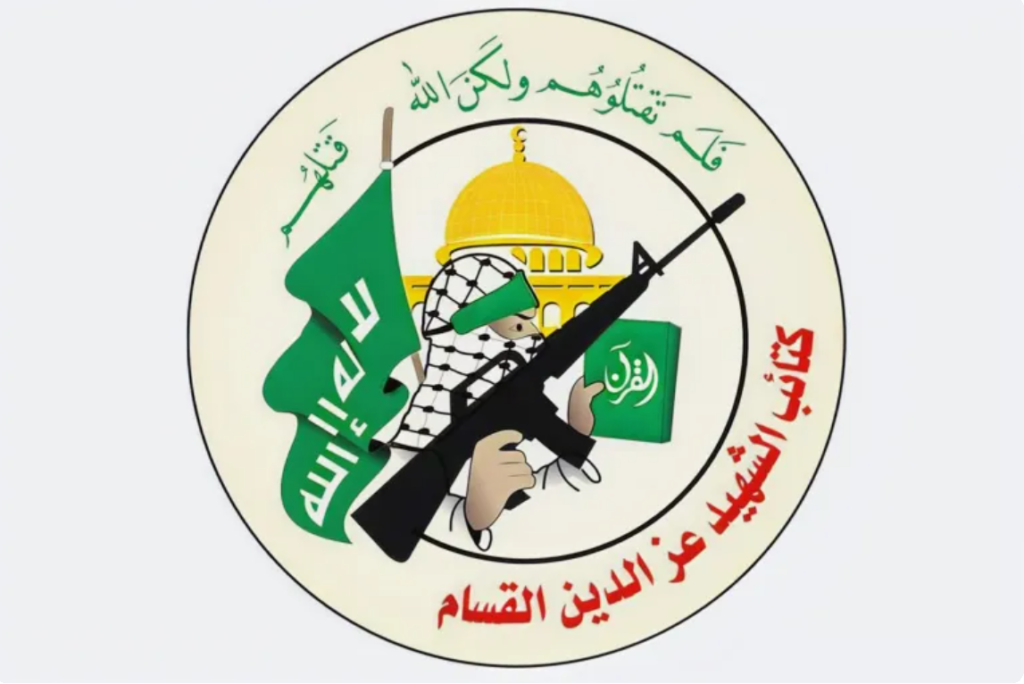
source: al-Jazeera.net
The emblem features a deliberately chosen fragment of a Quranic verse: “La taqtuluhum wa lakin Allah qataluhum” (a passage from the Medinan Surah: Al-Anfal [The Spoils of War], no. 8, Verse 17). In sum, this conveys the idea that Allah, through His Omnipotence, guides the military efforts of Palestinian Muslim fighters; that the true defenders of His Word and holy sites are those of al-Qassam. The emblem also includes the declaration of God’s oneness (Tawhid), with the Dome of the Rock Mosque. In the background, and in the foreground, there is an al-Qassam fighter holding a Quran, wearing the traditional Palestinian or Eastern keffiyeh.
What, in this case, does the verse invoked state?
The full verse (translated here using Hamidullah’s 2000 revised translation) reads:
” So, it is not you who killed them, but in fact Allah killed them. And you did not throw when you threw but Allah did throw, so that He might bless the believers with a good favour. Surely, Allah is All-Hearing, All-Knowing.”
To retain the initiative and avoid merely “enduring” Israeli’s announcements of targeted assassinations of Hamas military leaders in the post–7 October war—presented by the Netanyahu government as operational successes of the Israeli army and intelligence services, the new spokesperson for the Izz al-Din al-Qassam Brigades officially acknowledged the “martyrdom” of several leading figures in the movement. Foremost among them his predecessor, Abu Obeida (who served as spokesperson from 2006 until his death in August 2025), Abu Ubeyda, alias of the man who, in civilian life, was Hudayfa Samir al-Kahlout, a graduate student with a master’s degree. And the author of a research thesis entitled: The Sacred Land: Between Judaism, Christianity, and Islam.”
The thesis opens with Verse 128 of Surah 7:
” Said Moses to his people, “Seek help through Allāh and be patient. Indeed, the earth belongs to Allāh. He causes to inherit it whom He wills of His servants. And the [best] outcome is for the righteous”’. [Hamidullah’s 2000 revised translation]
Most significantly, in the acknowledgments, special mentions and dedication section of his thesis, it is written: “To every Muslim: with love, loyalty, and gratitude. And to every Jew and Christian: as an argument, proof, and injunction.?.” In other words, Jerusalem is presented as a sacred site shared by the three monotheistic faiths, but with a clear primacy accorded to Islam, whose texts, considered more authentic than those of the other two traditions, are held to provide the most decisive testimony. He further states, again in the opening pages, that he seeks to demonstrate that Palestinians hold a special right to this “blessed land, granted by the Lord of the Worlds.”
As frequently the case within Islamist movements, whether legalist, clandestine, or violent, the statement opens with praises addressed to God, accompanied by references to Quranic verses presented as the expression of the eternal divine Word, intended to convey a message to humanity as a whole and to provide moral edification to those who are its custodians and primary recipients. Which verses are mobilized for this purpose by the new spokesperson in al-Qassam Brigades’ communiqué? Once again, it is first and foremost a passage from Surah Al-Anfal (The Spoils of War), Verse 26:
“And remember when you were few and oppressed in the land, fearing that people might abduct you, but He sheltered you, supported you with His victory, and provided you with good things – that you might be grateful.” [Hamidullah’s 2000 revised translation]
And another verse, namely Surah Al-Ahzab (The Coalitions), Verse 23:
“Among the believers are men who have proven true to what they pledged to Allah. Some of them have fulfilled their pledge ‘with their lives’, others are waiting ‘their turn’. They have never changed ‘their commitment’ in the least.” [Hamidullah’s 2000 revised translation]
As the sociologist Farhad Khosrokhavar wrote regarding “revolutionary martyrdom[25]” in Iran: “the fusion of the religious and the political is highly dangerous, for the failure of the latter directly reflects on the former, rendering the sacred lethal.” The martyrdom glorified and upheld by Hamas’s military wing thus “sacralises” or “religionizes” despair, the national struggle, going so far as to place Palestinian lives at stake whether through combat or suicide “in the name of the primacy of a new type of sacredness in which the religious is henceforth embodied in the political[26].”
The Prophet Muhammad, to whom prayers are addressed, is described as mujâhid and shahîd, terms which literally means “one who strives in the path of God” and “witness” or “martyr.” The figure of Muhammad, in accordance with classical Islamic apologetic and hagiographic literature, serves as a model of moral and behavioural emulation. In other words, since Muhammad, through whom the divine message reached humanity, spreading gradually from the nearest to the farthest, endured suffering, demonstrated patience, and remained steadfast in the face of adversity, resisting those who oppose and fought him , it follows that Muslims in general, and Palestinians and activists of Izz al-Din al-Qassam in particular, are expected to display the same unyielding steadfastness and equally unwavering courage in hardship and against the enemy, victory being located at the end of sacrifices made in this worldly life.
In the militia discourse, Palestine is invariably depicted as “a land of dignity and pride, of jihad, martyrdom, purity, and noble defiance (al-kibriyâ).” The spokesperson, and through him the various Hamas factions, seeks to transform the extreme distress and destitution of Gaza’s population into individual and collective forms of heroic virtue. The apparent weakness, mere survival in the face of the existential and material tragedy inflicted by repeated Israeli military actions is thus transfigured into moral and physical strength and exemplarity, elevated into a sign of divine and prophetic election:
“[…] Our great pride in its inhabitants, the great mujahideen—patient and steadfast (seeking divine reward), heirs of the prophets, descendants of Muhammad—may God’s peace and blessings be upon him. O greatest of men, O greatest of men, O the elite of God among His servants, in the elite of His lands; you, the truthful among those who wait and have not wavered [in their trust in God, etc.]. Peace be upon you for what you have endured; what an excellent final abode[27].”
The ultimate message delivered to Israel by the Islamist spokesperson is that despite Tel Aviv weapons and military superiority, nothing can break the will of “the resistance”, neither that of the militias nor that of ordinary Palestinians. Secular language and discourse continually intertwine with religious language, religious imagery, and the religious imagination. A fusionist vision that unmistakably echoes the populist dynamic mentioned earlier. Linking fighting forces and the civilian population is deliberately proclaimed, even poeticized.
While it is primarily directed at Palestinians, both inside and outside the territories, with “inside” extending even to the land of Israel, described as “colonized” territory, it also encompasses “all the sons” or children of the “majestic Ummah,” as well as the “free people of the world,” meaning those committed to freedom and the fate of oppressed peoples. This reflects a laudatory vocabulary directed at Palestinians wherever they may be across the globe. It also extends to individual and collective actors sensitive to anti-colonialism and human rights worldwide. In other words, those among the Izz al-Din al-Qassam Brigades fighters who fell under Israeli assaults, dying as “martyrs”, are not portrayed as separate from the non-combatant Palestinian population or from the anti-colonial cause. Rather, they are integral to it, their courage and blood are rendered as precious as those of all Palestinians denied territorial sovereignty.
The new spokesperson of the Islamist Brigades also reproduces key elements of political language and communication circulated in the aftermath of attacks to justify the 7 October operation, despite the killings, sometimes under horrific circumstances, of unarmed Israeli, or others, civilians:
“The Flood [of al-Aqsa] occurred to correct the trajectory and restore to the forefront a cause that was beginning to sink into the abyss of oblivion. It awakened the consciences of the free people of the nation and of the world, exposed the Nazi character of the occupation [of the Israeli power], as well as its brutality, its criminality, and its policy of extermination, placing it in the position of a criminal fleeing justice. Our great people, through their resilience and the sacrifices made in their steadfastness, have thwarted all the enemy’s plans: from projects of forced displacement to concentration camps and deadly traps, to attempts at colonial re-settlement. They have also thwarted all the objectives of the war. The enemy has failed to uproot the spirit of resistance from the people of Gaza; on the contrary, it has bequeathed a thirst for revenge in every Palestinian home. Nor did it succeed in recovering its prisoners [hostages] by force: they were only returned through exchange, after having been protected throughout the confrontation by the courageous Shadow Unit [the militia members responsible for their surveillance and protection].”
In this excerpt, the homiletic and epideictic discourses converge in a clearly polemical and hyperbolic framing. This is evident when the spokesperson equates the Israeli occupation with Nazism, attributing to it atrocities (“concentration camps”) perpetrated in the past by Nazi Germany, while the Palestinian population and armed group are consistently cast in heroic terms. This excerpt exemplifies the propagandistic discourse we have analysed above, which establishes an ontological and metaphysical opposition between Good and Evil. Within this framework, both Hamas, which is “the producing instance” and the “great people”, as “the receiving instance”, share the burden of ensuring the triumph of the former, demanding not only resilience but also “an ethical positioning of morality or a pragmatic stance of interest.”
What, then, can be further inferred from the perspective of the al-Qassam Brigades? In the absence of “resistance,” and without accepting an ineluctable form of self-abnegation and the sacrifice of the Palestinian population, Gaza would have been annihilated, and “policy of extermination targeting civilian populations, material goods, and the natural environment” would have persisted. The underlying argument here is that Palestinian civilian deaths post-October 7th were not in vain. The spilled blood is thereby sanctified. That 7 October is framed as a strategic and existential necessity. The Brigades have an imperative need to reaffirm their unity with the people of Gaza, and to assert that their sole objective is to protect them, to end the Israeli occupation and its aggressions. They inscribe this struggle and the armed response it entails, with an inalienable “right”, understood as inherent to the rights of war and resistance as enshrined in international treaties intended to guarantee them. This entails, however, a selective reading of said treaties, insofar as Hamas itself would be liable for war crimes on 7 October, a claim it consistently denies.
“Despite the series of aggressions and violations committed since the end of the war, which have crossed all red line, the resistance has honoured its commitments and demonstrated the highest sense of responsibility, out of concern for the interests of our people and in order to deny the occupation any opportunity to fabricate false pretexts to resume the bloodshed. We nevertheless reaffirm that our right to respond to its crimes remains a fundamental and guaranteed right.“
From this perspective, the aim is to deny American, Israeli, and Western authorities the legitimacy of demanding disarmament and that Palestinian fighters surrender weapons, which are instead framed as a guarantee of honour and of inalienable rights to self-defence. This offers another way of justifying the legitimacy of the 7 October attacks, which are portrayed less as an act of aggression than as an act of “resistance.”
Among the key points emphasized by the new spokesperson is, of course, the religious dimension, the sanctity of both religious sites and historic lands of Palestine. In addition to condemning the violence against Gaza, he invokes the “attacks on Al-Aqsa Mosque […] the desecration of Al-Aqsa’s sacred character […],”. On this occasion, he also claims credit for the transnational mobilizations in solidarity with Palestine and Gaza:
“[…] We also salute all those who have supported our people in various forums and platforms, as well as the free men and women of the world who have organized marches, rallies, and freedom flotillas[28].”
He tacitly issues threats against those who fail to provide assistance to Gaza during the war, warning that Israel’s expansionist ambitions are insatiable and boundless. Within this logic operates a form of communal moral coercion:
“Let it be known that whoever remains silent in the face of injustice inflicted upon his Arab and Muslim brothers should expect that his own turn will come to face desecration and aggression[29]”.
Indeed, he appeals to solidarity from the “Ummah”, through the language of threat, in reference to what might in turn befall it at the hands of Israel, which would not be satisfied with merely bombarding Gaza and its people. The Brigades even argue that “the autumn of the occupying power has begun.” This significant passage, which combines performative aspiration with prophetic and apocalyptic dimensions, namely the divine promise of the destruction of the State of Israel as it celebrates its “eighth decade” of existence, may be highlighted:
“Know that the autumn of the occupation has begun, that the curse of its eighth decade has befallen it, and that another battle is now shaking its foundations and corroding its structure. This is one of the signs heralding its imminent demise, by the will of God.
The curses of the blood of children, women, and the innocent, as well as the scourges [of the Palestinians in Gaza] resulting from the destruction of crops and offspring, will continue to pursue it until it is rejected by all of creation, including stone and tree. Its isolation, the rupture of the human ties that once sustained it, and the onset of its decline after an era of arrogance and profound corruption are all signs announcing the approach of its end: the annihilation of its dominion, and the fulfilment of the Ultimate Promise.
Under the shadow of this promise, justice will be rendered to all those who committed crimes against our people, those who normalized, coordinated, and conspired with our enemy, those who collaborated with the occupier and accepted to be its agents. All will be cast aside in humiliation or struck down, as happened a few weeks ago to those bearing the primary responsibility for these crimes[30].”
Conclusion
We have attempted, in this article, to substantiate the central hypothesis that Israel’s military superiority, evident since 7 October and the subsequent deadly invasion of Gaza, has indeed translated into intelligence and military successes. These have enabled Israel to identify and eliminate a number of senior political and military figures of Hamas, with the organization being significantly weakened both in personnel terms and in its combat shelters and infrastructure. Israel also makes extensive use of propagandistic discourse to rally Western partners who might otherwise be unsettled by the Israeli army’s atrocities in Gaza and the systematic destruction of the territory without clearly defined military objectives. However, these operational or material outcomes have not sufficed to neutralise Hamas’s mobilization or its clearly persistent determination to continue confronting Israel on both military and, above all, symbolic grounds. This is expressed through communiqués, carefully staged performances, the use of ethno-religious symbols, and the narratives that accompany them. Unable to compete on equal military terms with an army backed and largely equipped by major powers, chief among them the United States, Islamist militias thus seek to leverage their symbolic power and disruptive power, typical of asymmetric conflicts.
Indeed, it must be acknowledged that Hamas and its armed wing enjoy, through certain figures elevated to the status of “martyrs” of the Palestinian cause, a degree of popularity and moral legitimacy that extends well beyond Gaza and the Palestinian Territories, as suggested by analysis of messages on social media, which would merit far more systematic and in-depth and analysis. Many of these messages, often laudatory, posted beneath the propaganda videos disseminated by the militia organization, provide clear evidence of this. Furthermore, the al-Qassam militias are working to quickly replace their fallen leaders with new ones, to avoid any organizational vacuum and to prevent the reputational risk of appearing weakened in the face of Israel.
What emerges from these messages posted by internet users worldwide is not necessarily full adherence to the movement’s ideology, but rather an expression of support for its uncompromising opposition to Israeli assaults and to colonization, often interwoven with religious references and invocations of the symbols of sanctity attached to Jerusalem and its places of worship, which the Islamist organization claims to defend against what it presents as the exclusivist claims of radical strands of politicized Judaism.
For the al-Qassam Brigades, Islam constitutes a key symbolic resource intended to unite Muslims across geographical, ethnic, and linguistic boundaries. Its purpose is to generate within their respective national public spheres, a broad movement of solidarity and support against what is perceived as the violent and ethnocidal expansionism of the Israeli state. It is in this respect that the “staging” or televised spectacles, particularly through Al Jazeera, of the Hamas handover of the Israeli hostages has been presented as an illustration of the movement’s capacity to stand up to Israel through propaganda. This is also employed by the Israeli state in its own way, including when engaging with French media without encountering outright rejection, despite the context of an asymmetric war that has claimed an enormous number of civilian casualties, overwhelmingly among the Palestinian non-combatant population.
Although this is clearly propaganda, in the non-polemic sense of the term, it nevertheless produces impact on both adversaries and civilian populations. Furthermore, at this stage, there is no indication that Hamas will agree to relinquish its stockpiles of weapons, especially as the Netanyahu government has not withdrawn from Gaza, has not consistently honoured ceasefire agreements, and, under these circumstances, the Palestinian organization has no tactical nor strategic interest in doing so. In any case, such an outcome would presuppose that the governance of Gaza be entrusted to Palestinian political and security forces, alongside the possible presence of an international peacekeeping force tasked with managing and regulating tensions with the Israeli state at its borders. It is because the war of images and symbols, in a context of ever-expanding information and communication technologies, both mirrors and amplifies armed confrontation that it has become a matter of sustained attention for both Israeli and Palestinian state and non-state actors. It is also for this reason that it requires equal attention from us as researchers.
Notes
[1] See Haoues Seniguer, Dieu est avec nous ! Les conséquences du 7-octobre. Comment les religions juive et islamique justifient la violence, Bordeaux, Le Bord de l’eau, 2025.
[2] See Haoues Seniguer, « Comment Israéliens et Palestiniens en appellent à Dieu depuis le 7-octobre? », journal en ligne AOC, Analyse, International, jeudi 13 novembre 2025.
[3] Charaudeau, P. (2009). Chapitre 1. Il n’y a pas de société sans discours propagandiste. Communication de l’état et gouvernement du social: Pour une société parfaite? (P. 19-38). Presses universitaires de Grenoble.
[4] Ibid
[5] Ibid.
[6] Ibid.
[7] Boudon, R. (2014). II. Une approche cognitive de la rationalité. Le Rouet de Montaigne : une théorie du croire : Convictions et croyances (p. 77-111). Hermann.
[8] See the analysis of Martino Diez : https://www.oasiscenter.eu/fr/amalek-ou-la-guerre-sainte-de-netanyahou accessed January 25, 2026; note what the author writes: “The moral regression triggered by the third Gaza war accelerated further on Sunday, October 29 [2023], when the Israeli Prime Minister compared the Palestinians to the Amalekites, the people whom the prophet Samuel commanded Saul, the first king of Israel, to exterminate (cf. 1 Sam 15) […]”. To find the original source of Benjamin Netanyahu’s statement, see https://www.gov.il/en/pages/statement-by-pm-netanyahu-28-oct-2023?utm_
[9] Ibid. https://www.courrierinternational.com/article/gaza-un-daech-palestinien-israel-jure-de-detruire-le-hamas?utm_ Accessed January 21, 2026
[10] See Haoues Seniguer, Dieu est avec nous ! Le 7-octobre et ses conséquences. Comment les religions juive et islamique justifient la violence, Bordeaux, Le Bord de l’eau, 2025.
[11] This is the case of Mohammed Deif, one of the masterminds of the October 7 operations, who also justified them by speaking of “jihad”, on the basis of numerous Quranic verses, in particular those taken from Surah 8, which is of Medinan origin, and which extols in particular the virtues of armed combat against unbelievers, infidels or enemies of Islam
[12] Indeed, if we consider both the support traditionally given by Islamist movements and parties around the world to Hamas up to and including after October 7, the fact that Arab nationalist parties, without sharing the Islamist ideology, nevertheless recognize its national legitimacy, as well as certain polling surveys, a salient point emerges that is important to emphasize: Palestinians, more specifically those in the West Bank who face daily settler violence, tend to support armed resistance in general and the groups that resort to it in particular, to which Hamas precisely belongs. See https://www.pcpsr.org/sites/default/files/Poll%2090%20English%20press%20release%2013%20Dec%202023%20Final%20New.pdf (accessed April 16, 2026). Another survey reports that 92% of Arabs express solidarity with the population of Gaza, and 69% of respondents express solidarity with both the population and Hamas, while 23% express both solidarity with the Palestinians in Gaza and opposition to the Islamist movement. See https://arabindex.dohainstitute.org/EN/Pages/APOIsWarOnGaza.aspx?utm_ (accessed April 16, 2026).
[13] Bertrand Badie, L’impuissance de la puissance. Essai sur les nouvelles relations internationales, Paris, CNRS Éditions 2013 (1ère édition 2004), p. VIII.
[14] Ibid., p. 172-173.
[15] Ibid.
[16] Serge Bernstein, « Symbolique et politique : nature et fonction des symboles partisans », in Maurice Agulhon, Annette Becker et Evelyne Cohen (dir.), La République en représentations. Autour de l’œuvre de Maurice Agulhon, Paris, 2006, Éditions de la Sorbonne, p. 43-47
[17] See https://new.oic-oci.org/Lists/ConferenceDocuments/Attachments/2791/emr_is_sep_2025_fc_en.pdf?utm_ (accessed January 20, 2026). We do not know exactly which summit Oussama Hamdan is referring to. It is not the official communiqué following the urgent Arab-Islamic Summit to discuss the Israeli attack against the State of Qatar, which occurred on September 9, 2025, and targeted a building in Doha where Hamas members and officials were meeting to discuss the conditions for a cessation of hostilities by Israel against the Gaza Strip; during this summit, however, Palestine and the denunciation of the continued violations by the State of Israel of the Geneva Conventions and international law were discussed. Hamdan is probably referring more specifically to the Egyptian proposal, perhaps taken up at the Arab-Islamic Summit after March 4, 2025, the date on which the Arab summit was held in Egypt, in the city of Cairo.
[18] See two main articles that refer to the Islamist figures eliminated by Israel: https://www.aljazeera.net/encyclopedia/2024/7/31/%D8%A3%D8%A8%D8%B1%D8%B2-%D9%82%D9%8A%D8%A7%D8%AF%D8%A7%D8%AA-%D8%AD%D9%85%D8%A7%D8%B3-%D8%A7%D9%84%D8%AA%D9%8A-%D8%A7%D8%B3%D8%AA%D9%87%D8%AF%D9%81%D8%AA%D9%87%D8%A7?utm_; https://www.aljazeera.net/news/2025/3/27/%D8%A5%D9%86%D9%81%D9%88%D8%BA%D8%B1%D8%A7%D9%81-%D8%A3%D8%A8%D8%B1%D8%B2-%D9%82%D8%A7%D8%AF%D8%A9-%D8%AD%D9%85%D8%A7%D8%B3-%D8%A7%D9%84%D8%B0%D9%8A%D9%86?utm_ Accessed April 15, 2026
[19] Ibid.
[20] Ibid.
[22] Guy Durandin, L’information, la désinformation et la réalité, Paris, P. U. F., 1993, p. 138.
[23] Ibid., p.140
[24] Anne Morelli, Principes élémentaires de propagande de guerre. Utilisables en cas de guerre froide, chaude ou tiède…, Bruxelles, Éditions Labor, 2001, p. 65.
[25] Farhad Khosrokhavar, L’islamisme et la mort. Le martyre révolutionnaire en Iran, Paris, L’Harmattan, 1995, p. 14.
[26] Ibid.
[28] Ibid.
[29]Ibid.
[30]Ibid.