

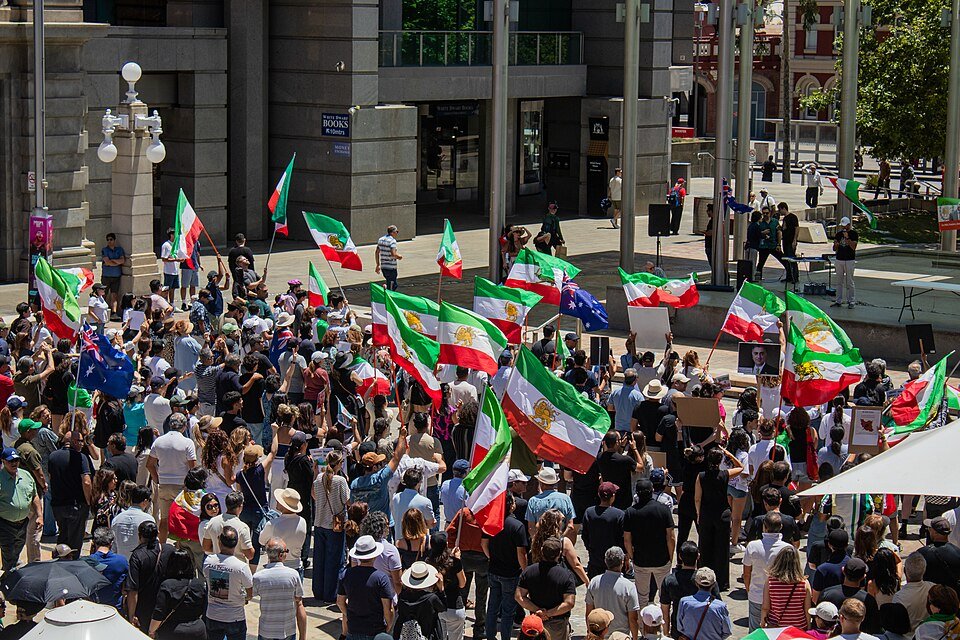

Following the death of Supreme Leader Ayatollah Khamenei in February of 2026, widespread celebrations took place among Iranians abroad. Some viewed the US-Israel military strikes not as an assault on the Iranian nation, but as an external movement of liberation against the Islamic Republic. This reality can be explained by a complex matrix of factors:
First, strategic realpolitik, which is the principle that one’s enemy is an ally. Then, the historical memory of Iran-Israel cooperation under Shah Mohammad Reza Pahlavi, and the presence of a significant Israeli diaspora of Iranian origin. This political framing also invokes narratives of Jewish-Persian solidarity (Naghibi, 2026), which resonate deeply within highly concentrated communities such as Los Angeles’s “Tehrangeles,” home to a substantial Iranian Jewish diaspora actively engaged in influential political networks (Lozano, 2024).
Behind this monolithic image, however, there are deep divisions within the diaspora itself. The Iranian expatriate community is fractured; its ideological composition is influenced by geographical distribution, socio-economic variables, and generational experiences. In practice, the diaspora fractures along distinct ideological axes, most notably between monarchists and republicans (Toossi, 2024). North America (the United States and Canada), alongside the United Kingdom and Australia, has served as the institutional core for Pahlavi-aligned monarchist networks since 1979 (Emami, 2026). These networks have consistently championed the restoration of the Pahlavi dynasty, pushing a narrative of pre-revolutionary Iran as a golden age of secular Persian modernity. By contrast, continental Europe absorbed a demographically distinct cohort, including leftist activists, members of the Mojahedin-e Khalq, women’s rights, ethnic minority movements (Kurds, Baloch, and Arabs), republicans, and secular democrats. Historically, while the United States served as the primary destination, policy shifts like the 2016 US travel ban slowed migration pathways, further reinforcing geographic differences between North American clusters and continental Europe.
Ultimately, this fragmentation is driven by the interaction of four interconnected variables: geography (host-country political climate and official Iran policy), generation (age of exit and lived experience within Iran), and identity (religious, ethnic, and political self-conception).
To understand contemporary diaspora politics, one must examine how these forces intersect to fundamentally reshape what “being Iranian” means. However, before doing so, it would be helpful to give a general historical context on the formation of the Iranian diaspora.
Historical Context
The phenomenon of Iranian dispersion dates back to pre-Islamic eras, during which Persian populations settled across different empires while maintaining distinct cultural identities (Hakimian et al., 2016). Historically driven by trade and labor dynamics, these early movements established merchant communities in Ottoman Turkey and labor hubs in the Caucasus.
However, the modern trajectory of Iranian emigration and the root of its contemporary political cleavages began with two distinct post-1950 waves. The first wave started in the 1950s and persisted until the 1979 Islamic Revolution. Capitalizing on surging oil revenues, middle- and upper-class families financed their children’s education abroad (Hakimzadeh, 2006). Following the revolution, student enrollment reached over 51,000 abroad, primarily in the United States, alongside secondary clusters in the UK, West Germany, France, Austria, and Italy (Hakimzadeh, 2006).
This foundational wave created a specific generational memory. Because the majority of these early student and elite cohorts chose to remain abroad, they formed ancestral bases filled with memories of the Shah’s tenure. For this generation, pre-revolutionary prosperity became the baseline of comparison against post-revolutionary hardship, which institutionalized the monarchist sentiments heavily concentrated in North America today.
By contrast, subsequent migration pathways transformed the diaspora’s demographic and ideological layout. Demographic data compiled by the Rockwool Foundation (Dustmann et al., 2026) reinforces this shifting distribution, demonstrating that while the United States remains the primary global destination, highly formalized and socio-politically distinct populations have consolidated across Canada, the United Kingdom, and Germany. Unlike the monarchist-leaning early exiles, later arrivals left an already institutionalized Islamic Republic, driven by ongoing “brain drain” or explicit political dissent. Consequently, the historical timing of departure did not just dictate where Iranians landed; it fundamentally shaped the generational narratives and ideological factions that divide the diaspora today (e.g., Dustmann et al., 2026).
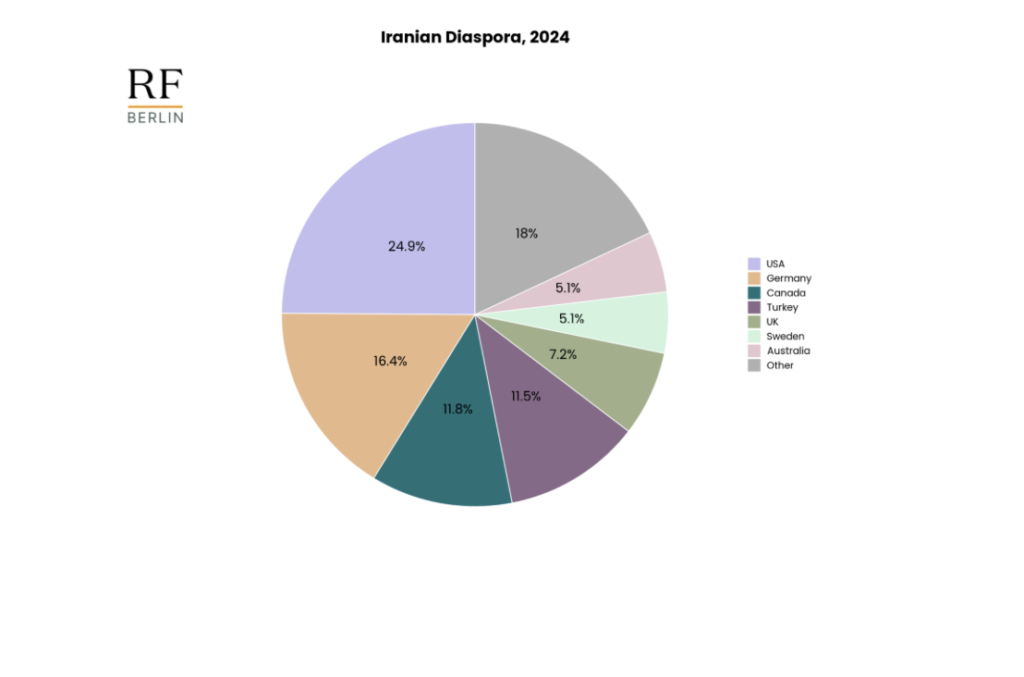
Source: Rockwool Foundation
Diaspora Identity as “Repositioning”
To analyze diaspora politics, one must understand that expatriate identity is neither fixed nor static. As diaspora studies scholar Halleh Ghorashi explains, diaspora identity is continuously “repositioned” through two intersecting forces: host-society treatment of immigrants alongside its geopolitical stance toward Iran, and the host society’s internal political culture, which shapes what becomes acceptable or desirable for exiles (Ghorashi, 2004, p. 333).
Consequently, a monarchist exile in Washington, D.C., and a leftist dissident in Berlin do not merely hold differing political opinions; they have formed different versions of what it means to be Iranian. Their identity itself has been reshaped by their experiences. Geography, therefore, acts as a structural force, though it requires intersection with generational variables to fully explain diaspora alignment.
First-generation diaspora members who fled Iran as adults between 1979 and 1990, a period that saw the U.S. Iranian-born population grow from roughly 130,000 to over 226,000 (Modarres, 1998), carry direct, lived memories of pre-revolutionary society. Conversely, the “brain drain” cohort arriving between 1995 and 2005 represents a different demographic. During this era, as the Iranian government struggled to integrate a surging number of university graduates, with unemployment rates for degree holders rising significantly to nearly 20% by the early 2010s, reflecting a long-term trend of overeducation (Habibi, 2012), young professionals and students increasingly looked abroad. This generation, which contributed to an estimated outflow of 150,000 skilled and educated Iranians annually by the mid-2000s (Mehdi, n.d.), departed for academic and career opportunities rather than explicit political asylum. They left an Iran that was already institutionalized as a post-revolutionary state; thus, their relationship to the Pahlavi era is mediated through parental narrative rather than personal recollection.
Within both North American and European spheres, these generational divides cause deep internal frictions. For instance, perspectives within the Iranian diaspora in Toronto regarding the U.S.-Iran agreement are notably divided. While segments of the population express relief at the prospect of reduced military hostility toward civilians, there is a skepticism concerning the ability of the framework to ensure institutional accountability for the Iranian government (Olsen, 2026).
Meanwhile, in London, internal fighting among opposition groups has created similar fractures, with clashes occurring between supporters of a return to the Pahlavi monarchy and those who oppose it (Boffey, 2026). Ultimately, the intensity of support for the 2026 military interventions has been demonstrably higher among older, first-generation exiles, highlighting a clear generational divide in political priorities.
Diaspora Expectations vs. Domestic Realities
As mentioned earlier, each group of diaspora based on their geography, generation, and ethnic identity had different expectations. It is crucial to mention that the internal divisions within the Iranian diaspora go beyond a binary opposition between monarchism and the current theological regime. Instead, the expatriate community fractures along a complex matrix of ideological axes: monarchist versus republican governance models, centralized versus federalist state structures, and as Roman (2026) highlights the structural divide between domestic (“inside”) and exiled (“outside”) populations.
Among these factions, the pro-monarchist movement enjoys the highest international visibility and is frequently framed externally as the primary opposition bloc. Supporters view the crown prince as a unifying figure capable of mobilizing the Iranian populace, whereas critics characterize him as an outsider disconnected from the socio-political realities of a nation he has not inhabited for over forty years (Roman, 2026).
Parallel to this is a second major bloc: a network of secular democratic coalitions encompassing civil society organizations and labor unions. This faction aims to transition Iran toward either a social democracy or a liberal democratic framework, emphasizing institutional human rights protections. Finally, a third distinct faction comprises pro-federalist networks representing ethnic minority groups. These organizations advocate for a decentralized, federalist restructuring of the Iranian state to ensure regional autonomy, with certain elements within the movement seeking outright independence from the central government (Roman, 2026).
Meanwhile, according to Márquez (2026), there was a faction of diaspora in Los Angeles who supported the joint US-Israeli airstrikes, which operated under a specific logical sequence: targeted, rapid strikes on military installations would cripple the Islamic Republic’s state apparatus, trigger an internal collapse, and pave the way for a transitional democracy spearheaded by the return of Reza Pahlavi. However, when external strikes fail to collapse the state apparatus, they risk triggering a rally-around-the-flag effect among the domestic population. Furthermore, aggressive rhetoric from Western leaders, such as former President Trump’s historic threats to target cultural sites, fundamentally shifts the calculus. By contrast, the European diaspora had more of a ‘mixed feelings’ to the joint attack, arguing that the people will be the most affected the 2026 strikes (Asharq Al-Awsat, 2026). They argued that foreign military intervention violates national sovereignty, degrades civil society, and actively consolidates the regime’s domestic grip by allowing it to frame all internal dissent as foreign espionage.
There remains a profound historical irony within these competing visions. In 1979, Ayatollah Ruhollah Khomeini arrived in Tehran via Air France to claim a revolution structuralized by organic, domestic mobilization on the ground. In 2026, the monarchist diaspora envisions a reverse trajectory, expecting that foreign air power can pave a path back to Tehran. Critics of this approach argue that such a strategy deeply underestimates the power of domestic nationalism and risks alienating the local population. Regardless of their stance on foreign intervention, however, the diaspora remains universally united by one immediate trauma: The fear for the safety of loved ones inside Iran, an anxiety systematically exacerbated by government-imposed internet blackouts (Márquez, 2026).
Ethnicity and Religious Pluralism
The Iranian expatriate community exists of overlapping ethnic groups including Kurds, Azeri Turks, Baluchis, Arabs, Armenians, and Assyrians and diverse religious minorities such as Jews, Baha’is, Christians, and Zoroastrians (Center for Iranian Diaspora Studies, n.d.). The political fragmentation of the diaspora is further complicated by Iran’s multi-ethnic and multi-religious fabric. While the dominant monarchist narrative relies heavily on a centralized, “all-Iranian” identity connecting it to the pre-Islamic Persian history and cultural secularism, this framework is viewed with deep suspicion by minority expatriate networks. For exiled organizations representing Kurdish, Balochi, and Ahwazi Arab communities, the struggle to overthrow the Islamic Republic is not viewed as a mandate for returning to Pahlavi-era structures, which these groups associate with historical policies of centralization, militarization, and the forced assimilation of non-Persian cultures. Kurdish communities, in particular, remain skeptical of royalist restoration, as they view the Pahlavi legacy as a period defined by the systematic suppression of their political rights and the restriction of their cultural and linguistic expression (Jadaliyya, 2026).
Consequently, cross-border minority networks, such as exiled Iranian-Kurds in Iraq, view the potential collapse of the central government in Tehran as an opportunity to return home and establish self-governance (Facsar, 2026). Stationed in Erbil, near the Iran-Iraq border, groups like the Kurdistan Freedom Party have been frequent targets of Iranian state drone strikes, illustrating how an exiled military force can become a volatile catalyst for geopolitical change. Similarly, the political alignment of Iranian religious minorities, including Jews, Baha’is, and Armenian Christians, varies drastically depending on whether their primary goal is securing global religious protections or preserving the territorial integrity of the Iranian state.
Conclusion
While the diaspora had some moments of visible unity, most notably during the “Woman, Life, Freedom” protests of late 2022, it is far from acting as a cohesive political community. These divisions are the result of the intersection of geography, generation, and identity.
There is a noticeable disconnect between the political vision of pro-intervention diaspora members and the material concerns of the population inside Iran. Their belief that foreign intervention can smoothly initiate a democratic transition ignores the volatile reality of domestic nationalism and the immediate material stakes of the population inside Iran. While exiled factions debate governance models from the safety of Western democracies, the people on the ground are facing hyperinflation, state repression, and the physical devastation of warfare.
Notes
Asharq Al-Awsat. (2026, June 22). Iranians in Europe share ‘mixed feelings’ on Israel offensive. https://english.aawsat.com
Boffey, D. (2026, May 25). Opposition divided: Battle among Iranian regime’s opponents plays out on London streets. The Guardian. https://www.theguardian.com
Center for Iranian Diaspora Studies. (n.d.). Background on the Center. San Francisco State University. https://cids.sfsu.edu/background-center
Dustmann, C., Frattini, T., & Piovesan, C. (2026, March). Migration aspirations, diaspora networks and refugee destinations from Iran and Lebanon (CReAM Report No. 2/26). Rockwool Foundation Berlin.
Emami, M. (2026, February 26). Reactionary politics in the Iranian diaspora and the crisis of international solidarity. Jadaliyya.
Facsar, F. (2026, May 3). Iranian Kurds in Iraq face war fears, exile https://www.dw.com/en/iranian-kurds-in-iraq-face-war-fears-exile/video-77019754
Ghorashi, H. (2004). How dual is transnational identity? A debate on dual positioning of diaspora organizations. Culture and Organization, 10(4), 329–340. https://doi.org/10.1080/1475955042000313768
Habibi, N. (2012). The employment crisis in Iran: A major challenge for the next decade. Brandeis University. https://www.brandeis.edu/crown/publications/middle-east-briefs/pdfs/1-100/meb89.pdf
Hakimian, H., Nakash, Y., Mojtahed-Zadeh, P., Bozorgmehr, M., Farr, G., Pahlavan, C., Boyce, M., & Zarrinbaf-Shahr, F. (2016, October 4). Diaspora, Iranian. In Encyclopædia Iranica (Vol. VII, Fasc. 4, pp. 370–387). Encyclopædia Iranica Foundation. https://www.iranicaonline.org/articles/diaspora/
Hakimzadeh, S. (2006, September 1). Iran: A Vast Diaspora Abroad and Millions of Refugees at Home. Migration Information Source. Migration Policy Institute. https://www.migrationpolicy.org/article/iran-vast-diaspora-abroad-and-millions-refugees-home
Lozano, A. V. (2024, May 12). As pro-Palestinian protesters and counterprotesters rally at universities across the country, some of the most vocal defenders of Israel are members of the Iranian Jewish community. NBC News. https://www.nbcnews.com/news/us-news/live-blog/university-protests-live-updates-rcna151741
Malek, A. (2023, June 29). On unity & fragmentation in the Iranian diaspora. Fieldsights, Society for Cultural Anthropology. https://culanth.org/fieldsights/on-unity-fragmentation-in-the-iranian-diaspora
Márquez, A. (2026, March 18). How Los Angeles’s Iranian diaspora is confronting the US war on Iran. Al Jazeera. https://www.aljazeera.com/news/longform/2026/3/18/how-los-angeless-iranian-diaspora-is-confronting-the-us-war-on-iran
Mehdi, A. (n.d.). Youth emigration and the brain drain from Iran: Reasons, trends and directions. CyberLeninka. https://cyberleninka.ru/article/n/youth-emigration-and-the-brain-drain-from-iran-reasons-trends-and-directions Cited by: 4
Modarres, A. (1998). Settlement patterns of Iranians in the United States. Iranian Studies, 31(1), 31–49. https://doi.org/10.1080/00210869808701894
Olsen, J. (2026, June 19). Canadian-Iranians respond to the U.S.-Iran peace deal with mixed reaction. CBC News. https://www.cbc.ca
Roman, G. (2026, January 28). After the protests: Who can lead Iran? A comprehensive assessment of the Iranian opposition and pathways to democratic transition. Middle East Forum. https://www.meforum.org/mef-reports/after-the-protests-who-can-lead-iran
Toossi, S. (2024, March 9). Why do some Iranian monarchists support Israel? Al Jazeera. https://www.aljazeera.com/opinions/2024/3/9/why-do-some-iranian-monarchists-support-israel