


First of all, a terminological clarification is required regarding Bab al-Mandab[1]. The Houthis do not legally ‘control’ all shipping, as the opposite shore belongs to Djibouti and Eritrea, and foreign forces are operating in the vicinity. However, their capture of Mokha, the Yemeni coast and the island of Mayyun/Perim affords them an unprecedented capacity for surveillance, selective interdiction and harassment of traffic using missiles, drones, mines, patrol boats and target designation[2].
New operational situation
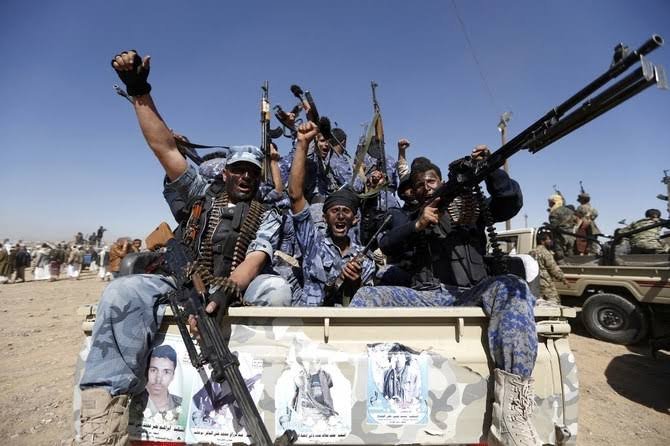
The September 2026 offensive shattered the relative calm that had prevailed since the 2022 truce. The Houthis seized Mokha, coastal areas and Mayyun, in the centre of the strait, whilst Saudi Arabia responded with air strikes and reinforced government forces from Aden. At the same time, the conflict spread to Saudi territory[3]: missiles and drones targeted bases and infrastructure in the south, including Sharurah, whilst a projectile caused casualties in Al-Tuwal, in the Jizan region.
Houthi control of the Yemeni shore does not, therefore, automatically mean the strait does not automatically close. Rather, it creates a capacity for gradual escalation: allowing the bulk of trade to pass through, designating certain categories of vessels as targets, and then expanding or reducing this list depending on the outcome of negotiations[4]. The Houthis currently claim to be limiting the ban to Saudi vessels, but their previous campaigns have shown that the identification of ships and the control of escalation remain imperfect[5].
Why Cairo is at risk
| Key issue | Implications for Egypt |
| Suez Canal | Any ship travelling between Europe and Asia via the Suez Canal must pass through Bab al-Mandab. By mid-October 2024, daily transits through the Suez Canal had fallen by around 55 per cent year-on-year[6]. |
| Currencies and the economy | Maritime insecurity is depriving the state of foreign exchange earnings and driving up the cost of imports, insurance, freight and energy. The Egyptian authorities had already estimated the loss of revenue in 2024 at over 7 billion dollars[7]. |
| Energy | Suez, SUMED and Bab al-Mandab form a single strategic system; SUMED can transport 2.5 million barrels per day, but it does not replace either containerised traffic or all maritime traffic[8]. |
| Saudi Alliance | Riyadh is a key political, financial and security partner. Visible Egyptian neutrality would weaken bilateral relations and undermine Cairo’s credibility as a Red Sea power. |
| Strategic autonomy | A ground-based military engagement would entail human and financial costs, expose Egypt to retaliatory strikes and make it dependent on Saudi military decisions. |
The precedent set in 2023–2025 shows that the Houthis do not need to physically close the Bab al-Mandab Strait to cause harm to Egypt. Oil flows through the strait fell from 8.7 million barrels per day in 2023 to 4 million in the first eight months of 2024, whilst ships were rerouted around Africa. The current crisis therefore threatens an Egyptian economy already familiar with the cost of a Red Sea perceived as a war zone[9].
Egypt’s strategic calculus
The interests of Cairo and Riyadh converge on three objectives: preventing a Houthi blockade, protecting Saudi energy infrastructure and preserving the recognised Yemeni government. They differ, however, on the acceptable level of commitment. For Saudi Arabia, it is also a matter of defending its border, its cities and its exports; for Egypt, the priority remains maritime traffic rather than altering the political balance of power in Sana’a.
This distinction explains Egypt’s caution. The Nasserist intervention of 1962–1967 remains associated with a war of attrition with no clear outcome, retrospectively described as Egypt’s “Vietnam[10]”. As early as 2015[11], Cairo had deployed mainly naval and air assets: at least four vessels and twelve F-16s were recorded as part of the coalition, with the primary mission of securing maritime routes. The likely doctrine in 2026 therefore remains: to defend the Red Sea without occupying Yemen.
Egypt now has better resources at its disposal than it did in 2015. The joint military base at Berenice[12], which comprises naval and air components, has the specific official remit of securing the southern coastline, investments and shipping in the Red Sea. It provides useful logistical depth for patrols, escort missions, intelligence, air defence, special forces operations and evacuation, but it does not eliminate either the distance from Bab al-Mandab or the vulnerability to low-cost missiles and drones[13].
Regional mobilisation
The theatre now hosts several layers of forces: the Saudi air force and air defence; Houthi forces equipped with missiles, drones and coastal positions; the Egyptian navy and air force; pro-government Yemeni forces; and American, French, Chinese, Japanese and Italian bases in Djibouti. This concentration increases surveillance and interception capabilities, but also the risk of misidentification, clashes between chains of command and the internationalisation of a limited incident.
A maritime security operation is more plausible than a large-scale amphibious landing. It could include escorting vessels, ISR surveillance, mine clearance, anti-drone defence, control of the approaches to Mayyun, intelligence-sharing and targeted strikes against systems directly threatening navigation.
However, regaining sustainable control of the island and the coastline would require credible Yemeni ground forces, sustained air cover and a political plan for the post-operation phase; without these, positions would simply change hands without resolving the conflict.
Six-month scenarios
| Scenario | Probability | Consequences for Cairo |
| Contained coercion: selective attacks, Saudi retaliatory strikes, reduced but sustained shipping. | Most likely | Reinforced Egyptian patrols, long-term losses in Suez, close coordination with Riyadh without entering into full-scale war. |
| Negotiated truce brokered by Oman and the UN. | Possible | A stalemate, partial guarantees for shipping and a gradual — not immediate — return of shipowners. Oman is regarded as the best-placed mediator[14]. |
| Regional escalation: expansion of Saudi and maritime targets, strikes against islands and the coastline. | Serious risk | Pressure on Egypt to provide naval vessels, air power and air defence; increased risk to Suez, SUMED and Bérénice. |
| Campaign to recapture Bab al-Mandab. | Less likely in the short term | Tactical success is possible, but there is a high risk of the conflict becoming bogged down and of indirect or direct ground engagement. |
The decisive factor will be the Houthis’ behaviour. A ban limited to Saudi vessels would allow for mediation, while repeated attacks on third-party vessels or a declared closure would escalate the bilateral crisis into a collective security issue. The second factor will be Saudi Arabia’s ability to combine air defence, limited military pressure, and a negotiated settlement, instead of pursuing a total victory that has become unattainable and a negotiated settlement, rather than seeking a total victory that has become out of reach after a decade of war.
Recommended course of action in Cairo
- Separate freedom of navigation from the Yemeni civil war: present Bab al-Mandab as an international public asset rather than merely an extension of the Saudi-led coalition.
- Strengthen the defensive posture: a visible but proportionate naval presence, mine clearance, surveillance drones, and the defence of ports, Berenice, Suez and SUMED, without announcing a regime-change mission.
- Make any use of force conditional upon a clearly attributed threat against an Egyptian vessel, Suez or national infrastructure, with limited objectives and defined rules of engagement.
- Avoid a major ground operation in Yemen; prioritise local Yemeni forces for any territorial security operations and reject an open Egyptian occupation.
- Simultaneously engage Oman, the UN and Djibouti to obtain notification of targets, deconfliction channels and a provisional arrangement guaranteeing civilian traffic. The UN envoy is already calling for a cessation of hostilities and a return to military coordination mechanisms.
- Prepare the economy for a protracted crisis: scenarios for Suez revenue, targeted support for importers, coordination with insurers and shipowners, and increased use of SUMED where it can absorb energy flows.
The most likely outcome is neither an immediate total closure nor a rapid return to normality, but a zone of permanent armed coercion. For Egypt, the best strategy is to make shipping safer, increase the cost of a direct attack and maintain the possibility of a diplomatic solution — without turning the defence of Suez into a new Egyptian war in Yemen.
Notes
[1] «Yemen’s Houthis take over strait vital to global shipping», France 24, 10/9/2026. https://www.france24.com/en/live-news/20260911-yemen-s-houthis-complete-takeover-of-bab-al-mandab-area-govt-official-to-afp
[2] «The Impacts of the Houthis’ Advance Could Extend Well Beyond Saudi Arabia », Andrew Leber et Lesley Anne Warner, Carnegie Endowment for International Peace, 23/9/2026. https://carnegieendowment.org/emissary/2026/09/houthis-bab-al-mandeb-impacts-saudi-arabia-somaliland
[3] « Yemen: Emergency Briefing», Security Council Report, 10 Sep. 2026. https://www.securitycouncilreport.org/whatsinblue/2026/09/yemen-emergency-briefing.php
[4] «Yemen’s Houthis close in on Bab el-Mandeb Strait in new threat to shipping », By Mohammed Ghobari, Nayera Abdallah, Eman Abouhassira and Yomna Ehab, Reuters, September 10, 2026. https://www.reuters.com/world/middle-east/saudi-says-no-danger-after-khamis-mushait-alert-amid-clashes-with-houthis-2026-09-10/
[5] «Red Sea nations watch as Houthis seize Bab al-Mandeb strait », Mohammad Mansour, Al Jazeera , 13/9/2026. https://www.aljazeera.com/economy/2026/9/13/red-sea-nations-watch-as-houthis-seize-bab-al-mandeb-strait
[6] « Suez and Panama Canal disruptions threaten global trade and development», UNCTAD, 22 October 2024.
[7] « Egypt and Yemen», State Information Service, 17 August, 2015. https://sis.gov.eg/en/international-relations/bilateral-relations/yemen/
[8] « Red Sea chokepoints are critical for international oil and natural gas flows», EIA, December 4, 2023. https://www.eia.gov/todayinenergy/detail.php?id=61025
[9] « Fewer tankers transit the Red Sea in 2024», EIA,October 11 2024. https://www.eia.gov/todayinenergy/detail.php?id=63446
[10] «Nasser’s Gamble: How Intervention in Yemen Caused the Six-Day War and the Decline of Egyptian Power.» Jesse Ferris. Princeton University Press, 2013. http://www.jstor.org/stable/j.ctt1r2gdh
[11] « 2015 Saudi-led Intervention in Yemen: Order of Battle», Charles Caris, Critical Threats. April 23, 2015. https://www.criticalthreats.org/analysis/2015-saudi-led-intervention-in-yemen-order-of-battle
[12] « Berenice Military Base», Presidency. https://shorturl.at/yub6y
[13] «Egypt’s biggest military base on the Red Sea in details », Egypt Independent, January 15, 2020. https://www.egyptindependent.com/egypts-biggest-military-base-on-the-red-sea-in-details/
[14] «Closing the New War Front in Yemen », International Crisis Group, 18 September 2026. https://www.crisisgroup.org/stm/middle-east-north-africa/yemen-saudi-arabia-iran/closing-new-war-front-yemen