


Introduction
Within European architecture, migration, security, and foreign policy are frequently managed as distinct policy cases. Across the Mediterranean, however, their interactions suggest a far more systemic dynamic. A migration crisis can become an election issue; its politicisation may reinforce anti-immigration forces; their progression can subsequently alter European policies regarding borders and external cooperation.
This analysis does not claim to establish a mechanical causal link between migration and the far-right. It examines a more limited mechanism: how the weakening of Tunisia’s capacity for political correction can amplify economic and social pressures, transform frustration into an “exit” strategy, and ultimately export that pressure towards the European border.
The Erosion of Institutional Mechanisms of Redress
On 25 July 2021, President Kais Saied dismissed the head of government, suspended the work of Parliament and assumed exceptional powers. The Parliament was dissolved in March 2022. The High Judicial Council was replaced by a provisional body, and several judges were removed[1]. The analytical stake is not merely on the degree of power concentration, but on the loss of institutional correction mechanisms. A democracy does not serve solely to select governing elites; it also provides institutionalised channels to contest, review and adjust public decisions. When these pathways narrow, ineffective policies may persist longer, while a security response may progressively replace a political response.
Reporters Without Borders ranked Tunisia 137th out of 180 in its 2026 World Press Freedom Index, down from 129th in 2025 [2]. In June 2026, human rights defender Saadia Mosbah was sentenced to eight years in prison in a case whose legal basis was contested by Amnesty International [3].
Taken in isolation, these elements do not encapsulate the Tunisian political system. Yet, their compounding illustrates the shrinking of spaces for contestation and the transformation of institutional mechanisms for correction.
From frustration to the “exit” strategy
This institutional transformation intersects with an already profound economic fragility. In the second quarter of 2026, the unemployment rate stood at 14.9%, rising to 35.4% among 15-24-years-olds, 26,6% among higher education graduates, and 35.6% among female graduates[4]. These figures reflect constrained social mobility: education generates aspirations of advancement that the economy struggles to translate into tangible prospects.
Data from the Arab Barometer introduce a political dimension. Only 24% of Tunisians report to be interested in politics, while 41% are considering emigration — a figure that rises 67% among young people. Among those considering leaving, 78% cite economic conditions. Yet, 67% continue to view democracy as preferable to any other forms of government[5].
This combination suggests a dissociation between commitment to democratic principles and perceptions of its effectiveness. The problem may therefore be less in the disappearance of the democratic ideal than the erosion of belief in the institutions’ capacity to produce results.
Albert Hirschman’s distinction between Voice and Exit allows to conceptualise this transition. The Voice design attempts to transform a system from the inside: vote, protest, organisation, and holding power to account. The Exit signifies withdrawal from the system. When Voice appears ineffective and economic opportunities contract, the Exit option can emerge as a rational alternative[6].
Migration is thus no longer only a geographical displacement or a wage-differential calculation. It can emerge as a response to a dual immobility: constrained social mobility coupled with what is perceived to be limited political efficacy.
The sequence can be formulated as follow:
Economic difficulties → block mobility → frustration → declining perceived political efficacy → diminishing hope → exit.
Securitisation and political entropy
A distinction is essential: regime control does not necessarily equate to state capacity.
A government can increase its ability to control the opposition without improving its capacity to create jobs, restore purchasing power, or reform public services. It can intercept boats without suppressing the roots that drive people to take the sea.
This dynamic points to securitisation: a political, economic or social issue is gradually reframed as a threat to be addressed primarily through security instruments. Migration becomes a border issue; protest, a matter of public order; opposition, a question of stability.
If the structural causes remain unchanged, the gap between control and correction can generate an accumulation of tensions: a form of political entropy.
Here, the concept is less thermodynamic than political: it refers to the progressive accumulation of problems that institutions are no longer able to absorb, arbitrate or convert into reforms.
European Externalisation
The European Union did not create the Tunisian political crisis. Yet, it intervened on one of its exterior effects: migration.
The EU-Tunisia Memorandum of Understanding, signed on 16 July 2023, comprises five pillars, including migration and mobility. The associated package notably included 105 millions euros for migration and border management, 150 millions euros in direct budget support, and a proposal for 900 millions euros in macroeconomic assistance[7].
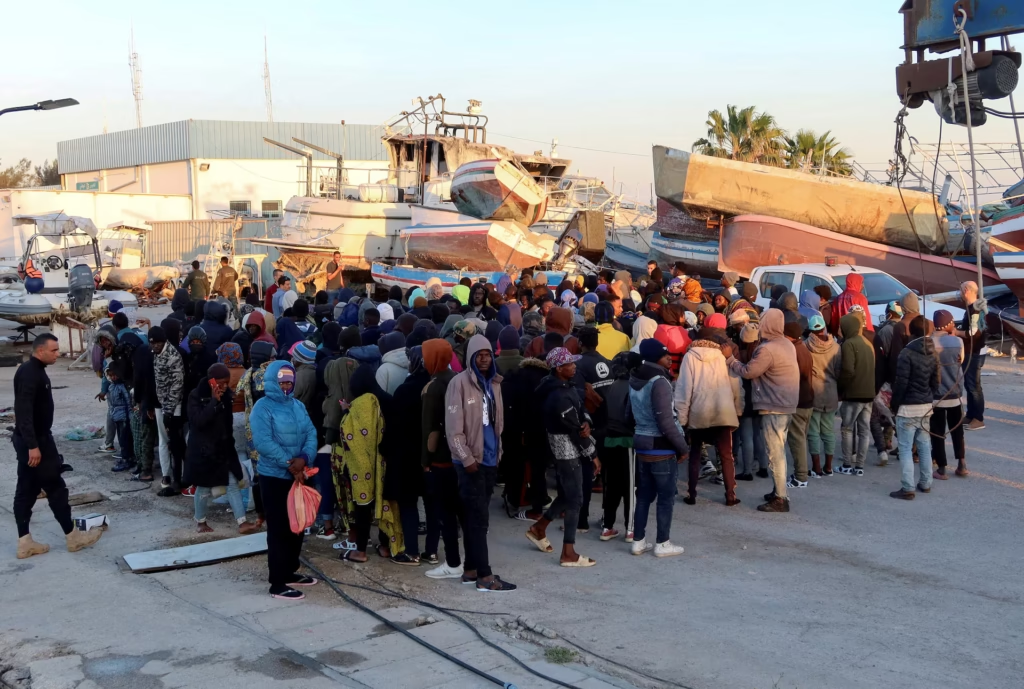
The migration aspect illustrates the logic of externalisation: part of the function of controlling the European border is transferred to upstream countries. The Tunisian coast thus becomes a component of the European containment architecture.
This policy may reduce departures in the short-term. However, it poses a strategic problem: what happens when pressure is contained without addressing its underlying political and socio-economic drivers?
Human Rights Watch has notably argued that European migration cooperation has bolstered Tunisian institutions implicated in documented abuses[8].
The paradox is therefore as follows: containment acts on the flows, whereas correction should act on the conditions that produce it.
Central Mediterranean and Systemic Risk
Tunisia also constitutes a hub in the Central Mediterranean. The IOM identifies Tunisia and Libya as the primary departure points for this route, which connects various African and Middle Eastern migratory zones[9].
UNHCR data on arrivals in Italy until June 2026 shows the diversity of flows: Tunisians represented 4.4% of maritime arrivals, alongside nationals from Bangladesh, Somalia, Sudan, Pakistan, Algeria and Egypt[10].
The European risk is therefore systemic rather than strictly national. A shock involving Tunisia would not necessarily entail a mass exodus of Tunisian; however, changes in routes, smuggling networks, or regional conditions could transform Tunisia into a focal point for multinational pressure.
Non-linearity is a decisive factor here. A system can build up pressure for years without any visible rupture, only to cross a threshold triggered by an economic, political, security-related, or regional event.
The sequence then become:
Pressure → accumulation → threshold → rupture.
Ceuta and the politicisation of the migratory shock
The Ceuta episode in July 2026 illustrates the rapidity with which a migratory phenomenon can become a political crisis.
A migratory shock does not automatically produce a success for the far-right. It does, however, create an opportunity structure. Radical groups can aggregate frustrations around a visible symbol: the border.
The sequence is simple:
Migratory shock → prescription of a loss of control → politicisation of the border → electoral mobilisation.
Another indicator of the progression of the far-right is the September 2026 elections in Saxony-Anhalt, where the AFD won around 44%[11].
This result cannot be attributed to a single factor. It nevertheless shows that questions of security, identity, and migration can be part of broader electoral dynamics.
The challenge is therefore less to present migration as the sole cause of the progression of the far-right than to understand its potential role as a political catalyst.
A scenario more than a prediction
If current trends are pursuing, several factors could converge: persistent economic difficulties, high young unemployment, migratory aspirations, weak political commitment and strengthening of European containment.
The device can operate as long as its control capacity remains greater than the departure pressure. But this stability remains conditional. An economic shock, a political confrontation, a new repressive sequence, a regional crisis or a transformation of migratory routes could quickly change the balance.
The scenario envisaged is therefore not that of a necessarily massive “new Ceuta”. It is that of a shock sufficiently visible to transform internal pressure into a European political crisis.
The mechanism would be more predictable than its form:
Internal crisis → increase in departures → border pressure → European politicisation → opportunity for the far-right.
This is a conditional scenario, not a deterministic prediction.
The feedback circuit and the European strategic issue
The system described includes a possible feedback loop.
Europe fears migration; it outsources controls; Tunisia is strengthening its security capabilities; the political and economic causes remain partially unresolved; the Voice is losing its attractiveness; Exit becomes more rational; new migratory pressure appears; Europe is undergoing a new political polarisation and is further reinforcing containment.
The loop can thus become:
Containment → temporary stability → accumulation of causes → new migratory shock → politicisation → hardening → increased containment.
This loop is not inevitable, but constitutes a strategic risk.
The challenge is therefore not only to prevent departures, but to reduce the probability that they will become necessary or attractive.
The democratic question here acquires a geopolitical dimension. A political system that can correct its policies has more opportunities to absorb tensions before they become a crisis. A system that can no longer correct itself risks, on the contrary, shifting these tensions to other spaces: the street, the economy, migration or border.
Conclusion
The next Ceuta will not necessarily be another Ceuta. It will not necessarily occur in Morocco, nor in the form of massive and sudden passage.
What matters is the mechanism.
When political correction mechanisms weaken, economic difficulties can produce a perception of immobility. When Voice seems ineffective, Exit becomes more attractive. When this Exit takes the form of migration, it reaches the European border. The border then becomes a security problem, then political, then electoral.
Several conditions likely to fuel it are, however, observable: institutional decline, low political interest, high unemployment, strong migratory aspirations, growing securitisation and European dependence on containment.
The strategic stake therefore consists of distinguishing two functions: containing a crisis and correcting the conditions which produce it. Containment can reduce a flow; it does not alone restore political effectiveness, social mobility or institutional trust.
For Europe, supporting this corrective capacity can thus be part of a logic of strategic prevention as much as a policy of values.
The least costly border, in the long-term, is not only the one that is better monitored. It is the one that individuals have less reasons to cross.
Notes
[1] International IDEA, Tunisia: Constitutional and Political Developments, documentation devoted to institutional developments since July 25, 2021.
[2] Reporters sans frontières, World Press Freedom Index 2026 — Tunisia. Tunisia is ranked 137th out of 180 in 2026, compared to 129th in 2025.
[3] Amnesty International, Tunisia: Antiracism Figure Facing Eight Years in Prison: Saadia Mosbah, March 26, 2026. The court of first instance in Tunis sentenced Saadia Mosbah to eight years’ imprisonment on March 19, 2026. An appeal procedure was then underway in June 2026. Amnesty denounced the conviction as unfair and based on unfounded financial accusations.
[4] National Institute of Statistics (INS), Employment and unemployment indicators, second quarter 2026, August 2026.
[5] Arab Barometer, Tunisia Country Report / Public Opinion Factsheet, données 2026. The data indicate in particular that 24% of Tunisians say they are interested in politics, 41% envisage emigration, a proportion that reaches 67% among young people, and 78% cite economic conditions as one of the reasons for their initial project, and that 67% consider democracy to be preferable to any other form of government.
[6] Albert O. Hirschman, Exit, Voice, and Loyalty: Responses to Decline in Firms, Organizations, and States, Harvard University Press, 1970.
[7] European Parliament Research Service, EU-Tunisia Memorandum of Understanding, September 2023. The memorandum was signed on July 16, 2023, and includes five pillars, including migration and mobility.
[8] Human Rights Watch, EU-Tunisia Migration Deal Worsens Rights Abuses, juillet 2026.
[9] International Organization for Migration (IOM), Central Mediterranean Route, 2026.
[10] United Nations High Commissioner for Refugees (UNHCR), Europe Sea Arrivals—Italy, data up to June 2026.
[11] Reuters, coverage of the regional elections in Saxony-Anhalt on September 6, 2026. The AfD won nearly 44% of the vote and 39 of the 83 seats.