

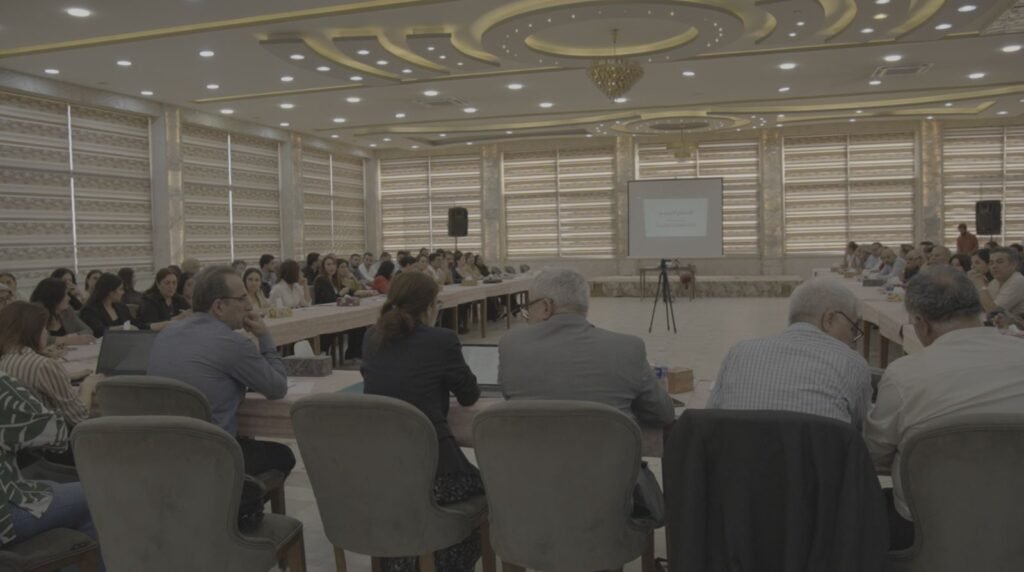

Dida Faridoon is one of the few journalists to have attended the meeting of Rojava’s political representatives held in Qamishli on August 29, 2026, with Mazlum Abdi and Ilham Ahmed among the participants. Reading her account, the meeting appears to have been a moment of truth. Away from the cameras, a difficult and at times painful debate unfolded among Kurdish leaders confronted with an existential question: what will remain of Rojava, the Syrian Democratic Forces, and the political and social achievements built over more than a decade? Through Dida Faridoon’s exceptional first-hand account, EISMENA offers access to the discussions behind closed doors, as well as to interviews she personally conducted with several senior figures about the future of Rojava, the SDF, and the Women’s Protection Units (YPJ). Her account takes us to the heart of the questions, concerns, and hopes currently shaping the thinking of Syria’s Kurdish leaders. Above all, it provides a rare inside view of what may prove to be a decisive new phase in the struggle of Syria’s Kurds.
—-
With the fight against ISIS, one of the most dangerous terrorist organizations in contemporary history, the Women’s Protection Units, known as the YPJ, emerged as a symbol of resistance. It was against this backdrop that I prepared to return to north-eastern Syria, the region known as Rojava. As a Kurdish journalist, and through my work on the documentary Miss Rojava, I have been following this revolution since 2020. I have witnessed the evolution of the conflicts: from the liberation of the region from ISIS alongside the United States to the fall of the Baathist regime in 2024 and the rise of the new administration led by Ahmed al-Sharaa. It is early in the morning, and we are waiting to cross the border at Semalka, from the Kurdistan Region of Iraq into Rojava.
You immediately sense that things have changed. Obtaining permission is no longer as straightforward as it once was, because the Kurds are no longer the only ones exercising authority here. On the road to Qamishli, my first stop, the Kurdistan flag can still be seen flying, while portraits of political party leaders and other flags have become less prominent. I am waiting to meet Ilham Ahmed, a representative of Rojava and north-eastern Syria, at her office in the Foreign Affairs Department. She has just returned from Damascus. As always, she is dressed simply yet elegantly. I often tell her, “You look like a French diplomat.” She laughs and replies, “Yes, but our circumstances are very different.” Perhaps, as feminists, we share the same vision, but our reality is that of the Middle East.
Her schedule has been changed because of a meeting planned for the following day with the majority of Rojava’s Kurdish political parties. They are due to discuss her meeting with the Syrian government.
29 August 2026 — Qamishli, Azadi Park
The meeting was led by Ilham Ahmed, a representative of Rojava and north-eastern Syria, and Mazlum Abdi, former commander-in-chief of the Syrian Democratic Forces (SDF), in the presence of the majority of Rojava’s Kurdish political parties. Its purpose was to discuss the latest meeting held in Damascus.
What happened?
The latest meeting in Damascus between representatives of the Kurds of north-eastern Syria — Rojava — led by Ilham Ahmed and Mazlum Abdi, and the Syrian government was intended to negotiate an agreement aimed at integrating the two administrations while seeking to secure certain fundamental rights for the Kurds. The discussions focused, among other issues, on the right to learn their mother tongue at school, what would happen following the dissolution of the SDF, and the future of the Women’s Protection Units, the YPJ. The agreement was not well received by many Kurdish parties, particularly because of the positions offered to Kurdish representatives. Mazlum Abdi, the former commander-in-chief of the SDF, would become an adviser to the Syrian president. Ilham Ahmed was also offered a seat in the Syrian Parliament, as she herself told me.
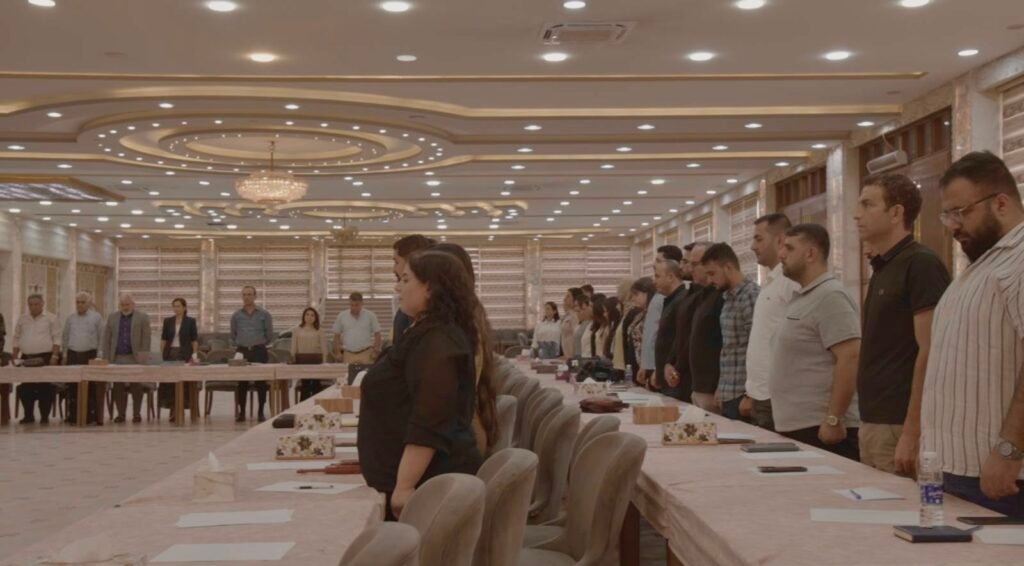
Source: Dida Faridoon for EISMENA
There was also a lengthy discussion about Kurdish-language education. In the end, only three classes in Kurdish were authorized in the Kurdish territories. We were in the meeting from 9 a.m. until 3 p.m. Afterwards, I had the opportunity to speak with Ilham Ahmed in her car as she was on her way to another consultation. On our way to the Foreign Affairs Department, where she works in Qamishli, she explained to me that following this agreement, she would move to Damascus to continue her work there.
I asked her:
“After all these conflicts, all this uncertainty, these advances and setbacks, is there still any hope?”
Ilham Ahmed replied:
“For our people, who deserve a better future, of course we must have hope. I know this is not what our people fought for all these years, but the reality is different today. We are still negotiating. Nothing is finished yet. And we also know that Syrian society is not yet ready to fully accept our vision of democracy or become accustomed to it.”
What about the YPJ?
“The YPJ will remain, but perhaps in a different uniform,” Ilham Ahmed told me.
Why does the YPJ matter?
The YPJ was founded in 2012 with an estimated 15,000 fighters. Their fighters took part in the war against ISIS, one of the most dangerous terrorist organisations in contemporary history. During the war, the YPJ became a symbol of resistance. For me, as a Kurdish woman, and for many women and girls around the world, the YPJ and the women’s revolution in this region known as Rojava have become symbols of hope. They also embody political and social achievements won through years of conflict and struggle. I watched them transform a region that had never previously existed in this form into a territory that came to be perceived as a land led by women.
For many of us feminists fighting for women’s rights, writing or demonstrating was one of the few ways available to express ourselves and defend our rights. In Rojava, the YPJ showed the world another way of protecting oneself and defending one’s rights, because they faced a very different reality. Most YPJ fighters joined their ranks at a very young age.
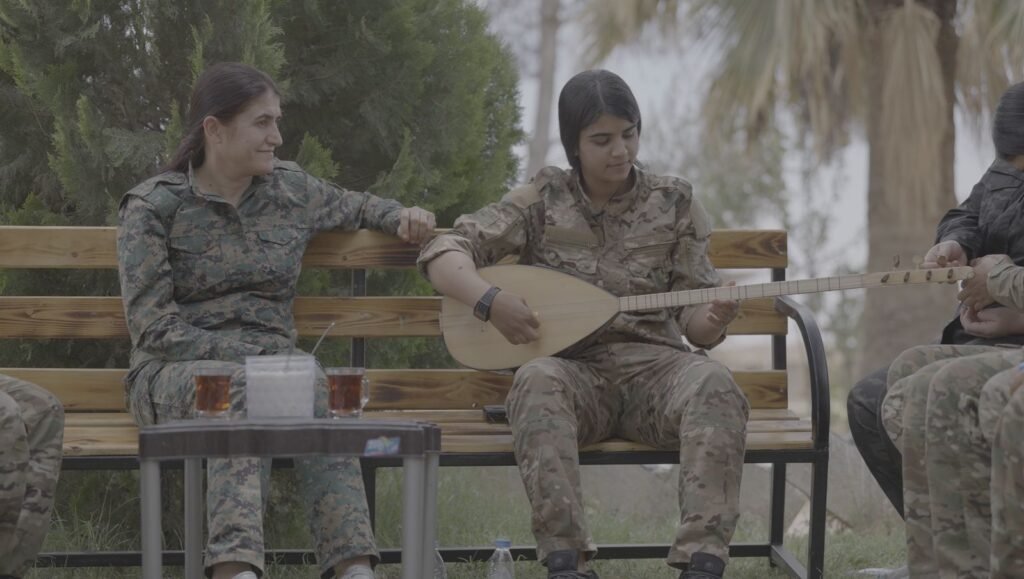
Source: Dida Faridoon for EISMENA
This was the case for YPJ commander Rohlat Afrin. During an earlier interview in 2025, at one of the training camps in Hasakah, exactly two months after the fall of al-Assad, I asked her about the new government.
She replied:
“We need to know who we are dealing with, who we fought against, and who we may have to face again.”
Her words led us to consider the ideology of the transitional government and that embodied by the YPJ as representing two profoundly different visions. Everything remains uncertain. But after following this situation for all these years, two things have long seemed clear to me: hope and resistance. After living for fifty years under a regime that imposed restrictions on women, these women became courageous fighters.
What the future holds for them remains uncertain. But one thing is clear: after more than a decade of war, revolution, and political upheaval, the women of Rojava have become actors whom no new Syrian political order will easily be able to ignore.