


Dr Firas Elias, an associate researcher at EISMENA and a specialist in security issues in Iraq, has extensive knowledge of the field, informed by substantial investigative work and a network of local sources. He conducted a particularly in-depth investigation into the presence of Yemen’s Houthis in Iraq, focusing notably on their presence and activities, networks, modes of operation, missions, as well as their training arrangements and military cooperation mechanisms.
Originally written in Arabic, this article provides a synthesis of this unique investigation, based largely on first-hand information gathered in the field. It thus offers unprecedented insight into how the Houthi presence in Iraq has been structured and how it has evolved.
— —
Introduction
The growing presence in Iraq of the Houthi movement “Ansar Allah” constitutes one of the least visible yet most significant transformations undergone by the architecture of the “Axis of Resistance” in recent years. This presence did not initially take the form of an organized military deployment. It developed gradually through political relations, fundraising campaigns, and contacts established with Iran-aligned Iraqi groups, before evolving into a considerably more complex network encompassing political representation, military training, financing, accommodation, transfers of expertise and technology, as well as operational coordination.
The central question, therefore, lies not so much in the number of Houthis present on Iraqi territory as in the strategic function assigned to this presence. The available data indicates that the Houthis are not seeking to establish a large, autonomous Yemeni military organization in Iraq. Rather, their objective appears to be the establishment of a form of “strategic depth” enabling them to mobilize the human, military, financial, and geographical resources offered by the Iraqi environment, while integrating them with Iranian networks and the other components of the “Axis of Resistance.”
First: When Did the Houthi Presence in Iraq Begin, and How Has It Evolved?
The evolution of the Houthi presence in Iraq can be divided into three main phases.
The first became more clearly apparent following the outbreak of the war in Yemen and the military intervention of the Arab coalition in 2015. At the time, the Houthis were seeking to expand their networks of political and financial support beyond Yemeni territory. Iraq consequently emerged as one of the environments most conducive to the development of their networks. Houthi delegations travelled to Baghdad, where they met with officials, political leaders, and leaders of armed factions, while fundraising campaigns were organized in Iraq to collect funds and assistance for the Houthis. During this first phase, Iraq essentially served as a source of political and financial support, while some Iraqi groups began sending experts and fighters to Yemen. Numerous sources subsequently indicated that, as early as 2015, Iraqi armed groups had begun sending experts and fighters to Yemen to oversee the training of the Houthis, facilitate transfers of military technology and, in some cases, fight alongside them.
The second phase, which took shape between 2016 and 2023, was characterized by a transition from occasional contacts to an organized presence. The movement established representatives and more stable communication networks in Baghdad; offices, operational premises, and accommodation facilities emerged, while relations with Iraqi factions, particularly those linked to the Hashd al-Shaabi, deepened. A particularly significant dynamic emerged during this period: the existence of two parallel channels for handling the Yemeni issue in Iraq. On the one hand, the Iraqi government continued to maintain relations with the internationally recognized Yemeni government through the Ministry of Foreign Affairs and the Yemeni embassy. On the other hand, the Houthi representative, Ahmed al-Charafi, operated within Iraqi security, factional, and political networks. In practice, this situation led to the emergence of a parallel Houthi channel alongside Yemen’s official diplomatic channel.
The third phase began following the outbreak of the war in Gaza in October 2023. The concept of the “unity of fronts” (wahdat al-sahat) then gradually moved beyond the realm of political discourse to become a mechanism for military cooperation. The war led to a considerable deepening of political and military relations between the Houthis and Iraqi groups, culminating in Abdelmalek al-Houthi’s announcement in June 2024 of the existence of military coordination with the “Islamic Resistance in Iraq.”
This trajectory can therefore be summarized as follows: from support to representation, from representation to an organized presence, and from an organized presence to operational coordination.
Second: Who Are the Main Actors in This Network?
At the heart of this network is Ahmed al-Charafi, known as Abu Idriss. His significance lies in the fact that his activities extend far beyond the traditional responsibilities of a political representative. The founder, in 2010, of the first Houthi military factory in Saada, northwestern Yemen, he is reportedly responsible in Iraq for procuring equipment required by the movement, organizing training sessions for Houthi fighters conducted by Iraqi factions, and preparing visits by Houthi officials to Baghdad.
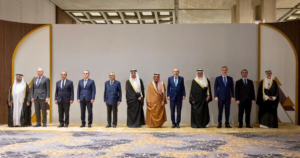
Al-Sharafi has also considerably expanded his network of contacts, which now includes leaders of armed groups, tribal leaders, and Iraqi officials. This development became particularly evident when, in June 2024, he met with National Security Adviser Qassem al-Araji, in the first publicly announced meeting at this level.
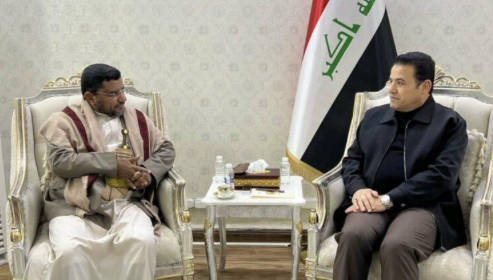
The Iraqi National Security Adviser meets with Ansar Allah’s representative in Iraq, Abu Idriss al-Sharafi, in Baghdad on May 8, 2024.
Field information collected as part of this study indicates that al-Sharafi has become the central figure in a broader network of contacts and that several members of his family are believed to have settled in Iraq. If this trend toward family settlement is confirmed, it would constitute an important indicator of the transition of part of the Houthi presence from the model of the “temporary envoy” to that of a long-term presence. The same information points to several other figures, including Abu Ali al-Izzi; Abu Taha al-Washli, who reportedly plays a coordinating role; Abu Hiba (Majid al-Buraq), who is reportedly responsible for security-related functions; Mohammed Abdel-Azim al-Houthi, who is not believed to reside permanently in Iraq; Fadl al-Sharafi; Abdelmalek Mortada (Abu Talib); as well as Abu Hussein al-Houthi, Kamal al-Houthi, Shadhi al-Hassani, Abdulghani Khanjar, Muadh al-Junaid, and Ahmed Abdelmalek.
Given the varying degree to which the functions attributed to these different figures can be verified, Ahmed al-Sharafi should nevertheless be regarded as the best-documented node in the network and as the figure around whom the activities of these various actors in Iraq are organized.
Third: Where Are the Houthis Established in Iraq?
The available data reveal a geographical pattern that appears far from random but rather corresponds to a functional distribution of locations.
Baghdad, and more specifically the neighbourhoods of al-Jadriya and al-Arasat, serves as the command centre and the main hub for political and security-related communications. Field information indicates that the movement’s presence has gradually evolved from clandestine offices located in al-Jadriya and al-Arasat to a more openly acknowledged representation. The same information points to the existence of a Houthi protocol office in al-Jadriya, as well as several residences used to accommodate individuals and families linked to the network. Najaf and Karbala, for their part, constitute a religious, social, and financial extension of the network. According to our field investigation, Fadl al-Sharafi established the al-Muwatin Charitable Foundation in Najaf, which is active in collecting donations. However, further investigation into the actual flow of funds is required before this institution can be regarded as a proven channel for organizational financing.
Jurf al-Sakhar (a historically Sunni-majority town located south of Baghdad) constitutes the most significant component of the network in security and military terms. The information collected points to the existence of a Houthi presence in this area. Even more significant is the training of Houthi fighters at the Behbahan training centre, located in Jurf al-Sakhar, reportedly including commanders from the “Alwiya al-Nasr” (Victory Brigades), deployed in the Yemeni cities of Hajjah and Hodeidah. It is also noteworthy that some sources report the training of Houthis at another camp located near the Saudi border. This information is particularly significant insofar as it establishes a link between military training and a geographical location of direct strategic value to the Houthis.
An initial functional mapping can therefore be established: Baghdad for administration and communications; Najaf and Karbala for social and financial depth; Jurf al-Sakhar for training and operational activities.
Fourth: Why Is Iraq Strategically Important to the Houthis?
Iraq’s importance does not lie solely in the political support that the Houthis can find there. It rests on five fundamental factors.
The first is geographical depth. Iraq shares borders with Iran, Syria, Jordan, Saudi Arabia, and Kuwait, thus placing the Houthis in a geographical environment close to northern and eastern Saudi Arabia, while Yemen constitutes the Kingdom’s southern front. It is precisely from this perspective that the concept of “strategic depth” takes on its full significance: the establishment of a capability or an allied network in Iraq could theoretically enable the Houthis to exert pressure on Saudi Arabia from several geographical positions, rather than confining such pressure to the Yemeni front alone.
The second factor lies in the existence of a pre-existing armed ecosystem. The Houthis do not need to build their own camps or protection networks from scratch, since Iraqi factions already possess headquarters, zones of influence, as well as security and economic networks. The third factor concerns training and technology transfers. This relationship does not operate in only one direction. While Iraqi and Iranian actors have transferred expertise to the Houthis, the latter have themselves accumulated particularly advanced expertise in missiles, drones, long-range strikes, and naval operations. They have thus become, in turn, a provider of military know-how to the other components of the Axis.
The fourth factor lies in financial and logistical depth, while the fifth is the possibility of using Iraq as a fallback theatre or reserve space to which personnel, expertise, and certain functions can be transferred when other theatres come under intense military or security pressure.
Fifth: What Networks and Methods Do the Houthis Rely On?
The Houthi model in Iraq is characterized more by its network-based logic than by its institutional dimension. Rather than building a large and autonomous Houthi apparatus, the movement’s members and representatives are integrated into structures already available to Iraqi factions. Kataeb Hezbollah appears to be the Houthis’ most important Iraqi partner. Field information confirms that the “Islamic Resistance in Iraq,” which has coordinated some of its activities with the Houthis, includes, among others, Kataeb Hezbollah, Kataeb Sayyid al-Shuhada, the Ansar Allah al-Awfiya movement, and Harakat al-Nujaba. The Badr Organization and Asaib Ahl al-Haq have also expressed support for the Houthis.
The information collected indicates that, during their movements, the movement’s representatives benefit from security protection provided by the Iraqi Kataeb Hezbollah environment, and that some of these movements reportedly take place in vehicles belonging to the 45th Brigade of the Hashd al-Shaabi, which is affiliated with Kataeb Hezbollah. Regarding the movement of individuals, some sources indicate that Houthi fighters may have used forged passports to enter Iraq. The frequency of such movements reportedly increased following the reopening of Sanaa International Airport in April 2022.
Our field investigation gathered information indicating that the Sultanate of Oman has gradually become one of the main transit corridors, as use of the Jordanian route has been reduced.
Sixth: Financing, Economic Fronts, and Support Networks
Four main financing mechanisms can be identified.
The first consists of donations. Several fundraising campaigns organized in Iraq have been documented, particularly those linked to Iraqi Kataeb Hezbollah. These include a campaign organized in 2022 under the supervision of Amir al-Moussawi, spokesperson for the “Sharia Youth Gathering.” The second mechanism relies on direct support provided by the factions. This support does not necessarily take a monetary form: it may consist of covering the costs of accommodation, protection, transportation, training, or the provision of premises.
The third mechanism concerns oil and fuel. Some sources indicate that the Houthis may have benefited from financial support originating from Iraq through oil shipments, although the research team was unable to establish the overall amount of this assistance. The fourth mechanism lies in commercial networks, charitable organizations, and money transfers. In this regard, information concerning charitable institutions and commercial activities conducted by individuals linked to the network is of clear interest to the investigation. However, commercial or charitable activity should not be equated with a channel for military financing in the absence of evidence precisely establishing the flow of funds.
The financing model thus appears to rely on a combination of cash, goods, services, and the direct coverage of expenses, rather than solely on centralized financial transfers.
Seventh: What Are the Political, Military, Ideological, and Logistical Objectives?
Politically, Iraq enables the Houthis to establish relationships across the Arab world beyond Yemen and provides them with a form of de facto legitimacy, even in the absence of official diplomatic recognition. Militarily, it offers opportunities for training and the exchange of expertise, as well as an environment in which certain capabilities can be tested and refined. One of the most significant elements revealed by field information is that some training programs recently organized in Iraq were reportedly intended to improve the precision of Houthi targeting of vessels in the Red Sea. This information is particularly significant because it indicates that training conducted on Iraqi territory can produce operational effects in a theatre located several thousand kilometres away.
Ideologically, Iraq serves as a laboratory for the “unity of fronts”: the relationship is no longer based solely on allegiance to or a shared proximity to Iran but is increasingly evolving toward a genuine sharing of roles, resources, and expertise. Logistically, finally, Iraq provides headquarters, meeting and accommodation facilities, training and financing capabilities, as well as facilities for movement and communication. In this sense, it functions as an external strategic rear for the movement.
Eighth: Operations and Military Cooperation
2024 marked a major turning point in this regard. In June, the Houthis and the “Islamic Resistance in Iraq” announced that they had carried out joint operations against Israeli targets in Haifa and Ashdod, while Abdelmalek al-Houthi raised the possibility of joint operations conducted from the Golan axis. Even more significant is field information pointing to the establishment in Iraq of an operations room bringing together representatives of several Iraqi groups as well as Houthi representatives. This development provides a particularly strong indication of a shift from primarily political coordination to the establishment of a joint military planning structure.
The strike on Jurf al-Sakhar on July 30, 2024, provided an additional tangible indication, with the death of Houthi commander Hussein Abdallah Mastour al-Shibl, known as Abu Jihad, alongside members of Iraqi factions. The presence of a specialized Houthi commander within the military environment of Jurf al-Sakhar confirms that the integration between the various components had already moved beyond the stage of mere contacts and visits. This dynamic became increasingly sensitive during 2026, with emerging indications suggesting a shift from a presence devoted to training and coordination toward the use of Iraqi territory for cross-border operations.
In late July 2026, several reports referred to drone attacks against Saudi installations and sites, alongside allegations that some of these attacks had been launched from Iraqi territory. On July 30, 2026, Reuters, citing regional officials, reported that Saudi assessments and those of regional partners had concluded that the Houthis had carried out attacks against Saudi Arabia from Iraqi territory, in coordination with Iraqi armed groups and under the supervision of Iran’s Islamic Revolutionary Guard Corps. The targets reportedly included oil facilities located in Saudi Arabia’s Eastern Province. These assessments, however, did not align with the official Iraqi accounts. Baghdad announced the opening of an investigation, while several Iraqi groups denied any responsibility for these operations.
These developments coincided with reports of the establishment of a Houthi operational headquarters in an area south of Baghdad under the influence of Iraqi Kataeb Hezbollah, tasked with coordinating activities with Iraqi factions. Some sources also report the death of a Houthi member alongside Iraqi and Iranian personnel during the strikes that followed the attacks against Saudi Arabia. This information reinforces the hypothesis of operational integration on the ground between the Houthis and their Iraqi partners, although the precise locations of the launch sites and the chain of command remain insufficiently documented and require further verification.
When these developments are considered alongside the data collected since 2024, a progressive sequence emerges: political presence and representation; training and exchange of expertise; establishment of an operations room and joint coordination; and, finally, the potential use of Iraq as a support platform, or even as a launch base for regional operations.
Ninth: The Relationship with Iran and the Other Components of the Axis of Resistance
The Iraqi case reveals an important transformation in the very nature of the Axis of Resistance. The model no longer rests simply on a vertical relationship that could be represented as follows: Iran → Iraqi groups linked to it. It is evolving toward a significantly more networked and horizontal architecture. The Quds Force of the Islamic Revolutionary Guard Corps retains a strategic coordination role, but direct relations are simultaneously developing between the Houthis, Kataeb Hezbollah, Harakat al-Nujaba, Kataeb Sayyid al-Shuhada, and other organizations. At the same time, Lebanese Hezbollah has extensive experience in training the Houthis and transferring organizational, media, and military expertise to them.
What is gradually taking shape could therefore be described as an “internal market for military capabilities” within the Axis: the Iranian component provides technology and expertise; the Iraqi component provides geography, infrastructure, resources, and combat experience; Lebanese Hezbollah contributes its organizational expertise and training capabilities; while the Houthis provide the know-how they have accumulated in the fields of missiles, drones, and naval warfare.
In the long term, this “horizontal integration” could prove even more significant than the relationship of dependence of each of these components on Iran. It enables cooperation to continue even when centralized chains of command are subjected to pressure or disruption.
Conclusion
The Houthi presence in Iraq has gradually moved beyond the framework of political representation and financial support. Since 2015, the relationship has evolved toward the establishment of increasingly structured networks, before expanding to training, the transfer of expertise and technology, and subsequently joint military coordination. The significance of this presence cannot therefore be measured solely by the number of Houthi members physically present on Iraqi territory. Rather, it must be assessed primarily in light of the functions that this network is capable of performing within the environment created by Iraqi armed factions. The Houthis appear to favour a model of “integration within the Iraqi structure,” rather than the establishment of an autonomous, distinct, and easily identifiable Houthi infrastructure. Their relations with Iran-aligned Iraqi factions enable them to benefit from protection, premises, training capabilities, resources, and communication networks, while reducing the costs of establishing a presence and increasing their freedom of movement as well as their capacity for deniability.
From this perspective, Iraq performs three interdependent functions for the Houthis: first, it provides strategic rear depth for training, financing, and protection; second, it serves as a hub connecting them with Iran and the other components of the Axis of Resistance; and finally, it provides potential operational depth capable of expanding the geographical scope of the movement’s activities beyond Yemen. Within this configuration, Jurf al-Sakhar is of particular importance because of its association, since 2024, with training and military cooperation activities, followed in 2026 by the emergence of indications suggesting an evolution in its operational function. Iraq therefore does not constitute an alternative to Yemen, but rather its strategic extension. The objective does not appear to be the establishment of a large-scale Houthi presence on Iraqi territory, but rather the creation of a network whose resources, geography, and relationships can be activated when circumstances require.
This is precisely where the substance of the observed transformation lies: the shift from a mere “Houthi presence in Iraq” to the emergence of an “Iraqi function within the Houthis’ regional strategy.” Finally, this evolution presents the Iraqi state with a growing challenge. The consolidation of such a network could lead to the increasingly deep involvement of Iraqi territory in regional conflicts over which Baghdad does not exercise full control over strategic decision-making. The fundamental question, therefore, is no longer whether the Houthis are present in Iraq, but rather to determine the extent to which this presence has evolved into a permanent operational infrastructure and, above all, who in Iraq holds the authority to decide when it is activated.