
Call for Contributions

Wikimedia commons

Author

EISMENA is pleased to announce the opening of its Call for Contributions.

We are looking for researchers, academics, practitioners, and regional experts who wish to contribute to our analysis and publications on the Middle East and North Africa.

From geopolitical and security developments to political, economic, social, and cultural transformations (and more), we welcome original analyses that bring forward new perspectives, grounded research, and informed insights into the dynamics shaping the region.

Whether you are examining a rapidly evolving regional crisis, a long-term political transformation, an overlooked social dynamic, or an emerging strategic issue, we are interested in hearing your perspective.

Interested in contributing? We invite you to submit your article to the EISMENA editorial team: contact-eismena@eismena.com

For detailed information regarding submission requirements, article format, length, sourcing, visual content, publication process, and editorial guidelines, please refer to the attached PDF document.

We look forward to discovering your research and perspectives!
To cite this article: “Call for Contributions” by EISMENA, EISMENA, 01/09/2026, [https://eismena.com/news/call-for-contributions/].

The information and opinion contained in the articles on the EISMENA website are solely those of the author(s) and do not engage the responsibility of the institute.

Share this article

What Does the Gulf Want From France in Return for Its Energy?

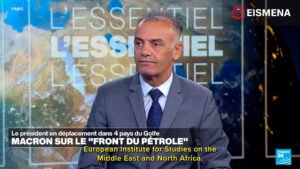
Speaking on France 24 on 19 October 2026, EISMENA Director Adel Bakawan explains the Gulf states’ demand for reciprocity: Europe may seek their oil and gas, but it must help secure the Strait of Hormuz and Bab el-Mandeb. He argues that France and the EU possess significant diplomatic and economic leverage—yet have failed to translate it into concrete action.

Read More »

The Middle East and North Africa : Structural Recompositions 

The Middle East and North Africa are undergoing strategic fragmentation, as declining traditional hegemonies and shifting alliances reshape regional power dynamics. Despite economic growth, the region faces structural challenges, including debt, inequality, youth unemployment, hydrocarbon dependence and climate pressures. Digitalisation creates opportunities but also expands surveillance, while ongoing conflicts and the absence of stable regional governance reinforce uncertainty. Fragmentation has become the defining feature of a fragile but emerging regional order.

Read More »

Related Articles

What Does the Gulf Want From France in Return for Its Energy?

Adel Bakawan

The Middle East and North Africa : Structural Recompositions 

Martin Raymond Willy Mbog Ibock

Why language and not borders? Understanding post-integration frustration in Rojava

Wisam Sedeeq

Yemen and Saudi Arabia: Renewed Strikes and the Risk of Regional Escalation

Lyna Ouandjeli

Egypt and the Saudi-Houthi crisis in Bab al-Mandab

Hichem Karoui

Hormuz, the Houthis and Iran’s Global Economic Leverage

Adel Bakawan