

Introduction
The tale of Rojava and the Democratic Autonomous Administration of North and East Syria (DAANES) was one of many interesting products of the Syrian civil war. It was a non-state actor with a Kurdish base, that grew out of its nationalist foundation and went on to control over a third of Syrian territory and a significant portion of its natural resources [1]. Those regions were controlled by the Syrian Democratic Forces (SDF), the armed forces of the DAANES, and were ideologically — at least — closely allied with Kurdistan Workers’ Party (PKK) [2]. However, after the fall of Assad’s regime in December 2024, the SDF leadership signed an agreement to integrate the SDF into the Syrian state. What followed was eleven months of unsuccessful negotiations as the two parties could not agree on the terms of the integration, as there still was a disagreement on the level of political and military autonomy of the SDF and DAANES in the new Syrian state[3][4]. After months of unsuccessful negotiations, however, the Syrian interim government launched a military offensive in January into the Kurdish-held areas in Aleppo and east of Euphrates. The fights went on until a ceasefire agreement and subsequent integration agreement were signed between the two parties on the 30th of January on terms harsher than what the Kurds and SDF leadership might have expected[5][6]. This marked the beginning of the SDF’s integration into the Syrian state, and a contraction of the political and institutional capabilities previously developed under autonomous administration. Most significant were: A, declaring Kurdish an official education language and limiting it to three hours per week; and B, integrating the SDF and Asayîş forces into the Defence and Interior Ministries, which has caused unrest among the Kurdish population. It is these two subject matters the Kurds have been protesting across Kobane, Dirbêsiyê, and Qamishlo over the last few weeks [7]. As the political environment of the Kurds in Syria shifted quite radically in mere months and the dissatisfaction is clearly demonstrated on large scale, a few questions impose themselves:
To what extent can the January offensive and terms of the 30 January integration agreement be understood as a case of progressive relative deprivation explaining the recent wave of protests in Kobane, Dirbêsiyê, and Qamishlo?
Why have the restriction of Kurdish to three hours per week as an “official education language” and security grievances become the central symbolic vehicle for broader grievances over political and military autonomy after the 30 January agreement, rather than the territorial losses themselves?
To understand the frustration
DAANES did lose its territory, but the Rojavan people do seem to be highly mobilized politically as we saw in the recent waves of protests [8]. To examine this phenomenon, we must turn to the American professors Ted Robert Gurr and James C. Davies and the concept of progressive relative deprivation. Gurr, in his book Why Men Rebel (1970) examines collective action and the circumstances that trigger the action which can lead to mass frustration or political violence [9]. There he argues that collective action emerges in the dynamic of high expectations, low outcome. That is, a large gap between what they believe they are entitled to and what they are actually able to attain. Gurr labels them as value expectations and value capabilities. Within this framework, Gurr distinguishes between decremental, aspirational and progressive deprivation, this paper relies on the third as it best explains and describes the historical context of Rojava. Historically, Kurds in Syria faced systematic marginalization including statelessness for many, Arabization policies, and restrictions on Kurdish-language use under Ba’athist rule. So after the civil war and years of autonomous rule, a sharp reversal followed a sustained rise in capabilities, rather than a gradual decline or a rise in expectations alone, as is the case with decremental and aspirational deprivation. Additionally, Davies’ J-curve theory also helps us understand the current events [10].
As described earlier, a population experiences progressive deprivation when a subsequent rise in both capabilities and expectations is experienced – the former usually leading to the latter– then capabilities sharply decline. Gurr builds on Davies’ J-curve theory here, which highlights similar events of sharp and sudden decline of material conditions or political capabilities [11]. As that happens, people do not psychologically return to their old baseline, their sense of what is justifiable has changed. The sense of deprivation depends on the reference points, what we used to have, what we could’ve had, or what other people have. This is where Rojava fits in: despite it being historically the least active politically of the Kurdish regions in the four states where they reside, after the start of the civil war they experienced an extraordinary case of de facto self-rule, that is rising capabilities. Indeed, the political reality imposed had its direct effects on Kurdish people’s material conditions and social lives. They experienced a level of cultural, economic and political freedom unseen before in that region, which was a product of this civil war and hence the high expectations that this reality– at least to some extent– would carry on to the post-Assad era of Syria.
Self-Rule to 30 January
To understand the frustration we can try and pinpoint what the population expected post-Assad Syria to look like, and why they fought in this war to begin with. To answer the latter, we use the fighters’ own answers. Amy Austin Holmes conducted a survey among 389 rank-and-file soldiers asking them “Why did you join the SDF?” the answer to that was overwhelmingly to protect their people/homeland, i.e. security [12]. It is worth noting that in another survey she conducted she found out that among 400 rank-and-file SDF members about 96% of them wanted to remain a part of Syria and did not seek secession [13]. As to what they expected a post-Assad Syria to look like, DAANES Foreign Relations Co-Chair Ilham Ahmed hinted at this saying “In exchange for the war waged against ISIS terrorists, the minimum right is the enshrinement of Kurdish rights in the Syrian Constitution” [14]. That was also one of the main topics the Kurdish Unity Conference talked about. These expectations, we may call Value Expectations as did Gurr, were also some of the biggest direct achievements of Rojava’s revolutions, that is, security in their Asayîş forces, cultural rights in their Kurdish education curriculum, and political representation in their existing parties such as PYD, alongside other achievements such as women’s rights. That reality was lived for over 14 years. The J-curve, as per Davies’ wording, happened when in January of 2026 the interim government launched its offensive first in the Kurdish neighborhood in Aleppo and then east of Euphrates, which ended in the January 30th agreement. The SDF integrated into the Syrian army as brigades, and the DAANES was –at least on paper– dissolved [15].
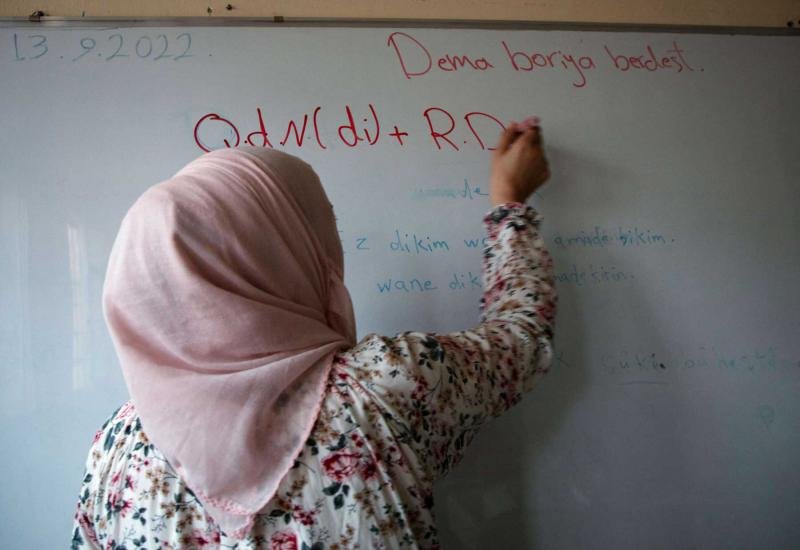
Beyond what has been formally agreed, several nuances of the deal remain unclear. For example, the fate of the YPJ hasn’t been settled yet. There’s much speculation on both the mechanism of the group’s integration and where exactly they will take their place as a force. Most reports indicate that they will work under the Ministry of Interior as a “special anti-terror” unit. It is still not clear what level of autonomy they will be granted. The same goes for the level of administrative autonomy the Kurdish regions will enjoy. A Kurdish governor has been set in place for the Al-Hasaka governorate, but so far no special administrative mechanism has been suggested for the predominantly Kurdish region of the country, that is, a mechanism to ensure that the Kurds will continue to govern themselves after the current governor leaves his post. Though initial steps of the agreed upon integration have been resolved, like the integration of SDF forces with the Syrian army, with the exception of the YPJ as no official agreement has been announced regarding that. The remaining issues still either haven’t been implemented, like the integration of the majority of civil institutions, or no formal agreement has been made, like the issue of higher education and the recognition of college degrees issued by DAANES universities. So, despite the fog of the January agreement, and all the unsettled issues, it still has had direct effects both on the Kurdish population’s psychology and material conditions. After all, one can assume safely that, though the Kurdish population of Syria has endured generations of systematic oppression, they would come to expect more in the post-Assad era, as they had just enjoyed their highest level of autonomy and mobilization. The losses may have started from territorial losses but they certainly did not end there. This happened in mere months, and the contraction is obvious. The sharp and sudden decline of capabilities of the Kurdish-led movement was met with expectations that were still high, as the people fought to maintain these achievements. The degree of discrepancy is quite noticeable between the full Kurdish curriculum for 14 years and 3-hours per week now. Between full Asayîş and a “special anti-terror unit.” This gap between still-high expectations and sharply contracting capabilities makes the mass frustration more understandable. Over the last few weeks and months, large protests were carried out in a number of Kurdish cities such as Kobane, Dirbêsiyê, and Qamishlo. Students, teachers, and public employees alike were seen at the protests; there were people whose entire social life could be altered by the latest change to education and public life. Participants carried placards reading “Ez kurdim, zimanê me Kurdî ye” (I am Kurdish, our language is Kurdish), “Zimanê me hebuna me ye” (Our language is our existence), and “Zimanê me nasnameya me ye” (Our language is our identity) [16]. In addition to the demonstrations, organized protests were carried out by students in September 2026. Hundreds of students boycotted classes in Hasakah and Kobane at the start of the school year, and sit-ins, marches and further boycotts continued through the month in Qamishlo, Dirbêsiyê, Derik, Amuda, Tel Tamr and Girkê Legê, with a Washington Kurdish Institute tracker describing Kurdish-language education as “the most visible dispute between Kurdish society and Damascus” that month [17][18].
Security grievances produce similar outcomes; the killing of a Kurdish former SDF fighter, Sipan Hizni, shortly after his integration into the Syrian army sparked demonstrations across several Kurdish-majority areas demanding accountability, and a subsequent security crackdown on protesters in Kobane was followed by a prison fire that killed at least nine detainees [19]. By contrast, even in the immediate aftermath following the loss of DAANES territories, a large demonstration held in Qamishlo in February 2026, led by mothers of fallen SDF fighters, centered its demands on constitutional recognition and language rights rather than any territorial claims [20]. This asymmetry is consistent with the argument, even if it does not conclusively prove. Gurr maps out the distinction between what he calls “welfare values” vs. “interpersonal values” and “security values.” The first is quite abstract, though DAANES lost most of its territory in the January clashes and dissolved later on, that did not spark as intense of frustration as the status of Asayîş and the Kurdish language. The latter two affect and determine a people’s status, communality and ideational coherence, hence the phrase “Our language is our identity.” Gurr argues intensity of relative deprivation varies with salience. Education and policing are encountered daily — they structure family life, school, and work— whereas oil fields and borders are not. The gap is therefore perceived as more acute because it threatens everyday collective value position, instead of a remote map. Perhaps that answers our question of “Why have the restriction of Kurdish language and security grievances sparked more intense frustration than territorial loss”.
Conclusion and what is to come
Here we saw the clear effects of the rapid shift in political capabilities and reality on the psychology of the Kurdish population of Rojava. Over a decade of self-governance and cultural freedom produced expectations that constitutional rights would be the minimum outcome of the post-Assad transition, as articulated by Ilham Ahmed. The sharp contraction of those capabilities into a 3-hour language provision and a “special anti-terror unit” under the Interior Ministry, without any special administrative mechanism beyond a single governor in al-Hasakah, left expectations intact, and the population deprived of what they felt entitled to after years of conflict. Using Gurr’s terminology, the deprivation is most intense where it touches security values and interpersonal values — status, communality and coherence — hence the slogan “Zimanê me nasnameya me ye.” This explains both the timing of the protests in Kobane, Dirbêsiyê, and Qamishlo and why language and security became their symbolic vehicle rather than territorial loss. As the masses stay mobilized —largely still under SDF/PYD affiliated camps— the response to these protests and this mass frustration largely depends on how accommodating Damascus will be to these demands. So far no clear timeline has been set when it comes to drafting a new constitution. A presidential decree by Al-Sharaa has ensured —though limited— cultural and linguistic rights to the Kurdish community. If those rights do become institutionalized in the new constitution and the Kurds become equals in the nation-building process, perhaps that will relieve the current grievances of the Kurdish community. If Damascus takes a hardline approach to the protestors, that is, further limitation to Kurdish autonomy and cultural rights, a plausible reading would be a sharp increase in frustration and, potentially, political violence, should the Kurdish population remain highly mobilized. Though with the limitations of this analysis, and its reliance on secondary reporting of protests and official statements by DAANES, SDF and PYD leadership, rather than interviews with rank-and-file protesters, students and Asayîş members, and the opaqueness of the details of the agreement between the two sides, drawing a precise conclusion or prediction becomes a hard task. And Damascus’ approach may fall somewhere between the two extremes. Limited institutionalized autonomy, with some cultural and linguistic freedom.
Notes
[1] « SDF controls about 40% of Syrian territory: Official », Rudaw, 7 December 2024.
[2] International Crisis Group, « الصعود الهش للحزب الديمقراطي الكردي PYD », 8 May 2014.
[3] « Syria’s interim president signs deal with Kurdish-led SDF to merge forces », Reuters, 10 March 2025.
[4] « SDF hands over detained Syrian government fighters as rival sides edge towards integration », The National, 21 October 2025.
[5] « Syria to launch military operation against SDF in Aleppo », Al Jazeera, 7 January 2026.
[6] « What the New Agreement Means for Kurds in Syria and Beyond », JINSA, 30 January 2026.
[7] « Demonstrations across Rojava demand mother-tongue education », ANF News, 6 September 2026.
[8] « Kobane protesters urge Damascus to reverse limits on Kurdish-medium education », Rudaw, 2 September 2026.
[9] Ted Robert Gurr, Why Men Rebel, Princeton, Princeton University Press, 1970, p.24.
[10] James C. Davies, « Toward a Theory of Revolution », American Sociological Review, 1962, pp. 5-19.
[11] Ted Robert Gurr, Why Men Rebel, Princeton, Princeton University Press, 1970, pp.52-56.
[12] Amy Austin Holmes, Statelet of Survivors: The Making of a Semi-Autonomous Region in Northeast Syria, New York, Oxford University Press, 2024, p. 114.
[13] Amy Austin Holmes, Statelet of Survivors: The Making of a Semi-Autonomous Region in Northeast Syria, New York, Oxford University Press, 2024, p. 3.
[14] « Kurdish Rights Constitutional Guarantee ‘Minimum Requirement’: Ilham Ahmed », BasNews, 2026.
[15] Syrian Arab News Agency, « Terms of the Ceasefire and Integration Agreement between Syria and SDF », 18 January 2026; Syrian Arab News Agency, « Comprehensive agreement between Syrian government and SDF for full integration », 30 January 2026.
[16] Syrian Observatory for Human Rights, « No life without language: Student protests intensify in Al-Hasakah and Kobani as schools face closures after Kurdish curriculum cuts », 6 September 2026; Mezopotamya News Agency, « Protests for Kurdish language education held in two cities », 2 September 2026.
[17] The Syrian Observer, « Hundreds of Kurdish Students Boycott Classes to Protest Cuts to Kurdish-Language Education », 8 September 2026.
[18] Washington Kurdish Institute, « Kurdistan Digest | September 2026 », 28 September 2026.
[19] Rudaw, « At least three killed in Kobane violence amid protests over Kurdish soldier’s killing », 12 September 2026.
[20] Rudaw, « Thousands march in Qamishli demanding Kurdish rights in Syria’s constitution », 11 February 2026.