

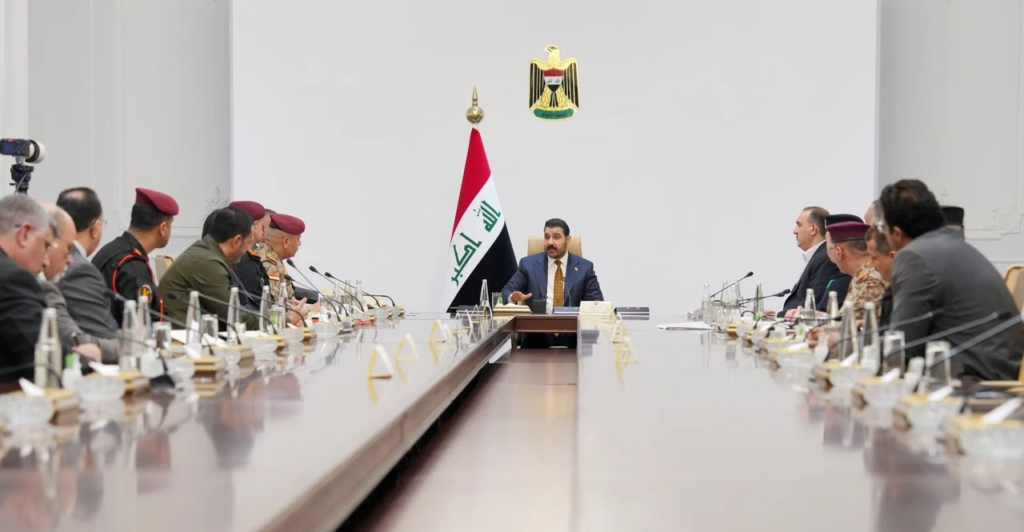

According to Dr Adel Bakawan, the question of Jurf al-Sakhar represents one of the first challenges facing Iraq’s new Prime Minister, Ali al-Zaidi. Speaking to Kurdistan 24 from Paris, the Director of EISMENA argued that the Prime Minister’s ability to intervene in the area will serve as a measure of his decision-making autonomy and effective authority vis-à-vis armed actors that exert decisive influence over the territory. Located in Babil Governorate, Jurf al-Sakhar has a distinctive demographic and political profile. Although the governorate is predominantly Shia, Adel Bakawan recalls that the town was historically a Sunni enclave. Its capture by the Islamic State in 2014 had notably disrupted territorial continuity between Iraq’s predominantly Shia southern regions and Baghdad. Recapturing the area therefore became a strategic priority for Shia forces, given its geographical significance and its role in securing the routes connecting the south of the country to the capital.
However, the recapture of the town did not restore the conditions necessary for its residents to return. Adel Bakawan states that, since 2014, approximately 129,000 people have retained the right to return to their homes but have been unable to exercise it in practice. He also claims that five Iraqi prime ministers were not even permitted to visit Jurf al-Sakhar. In his view, this situation illustrates the limits of government authority in a territory where security control partly lies beyond the reach of federal institutions. It is precisely this situation that makes Jurf al-Sakhar a test of credibility for Ali al-Zaidi. For Adel Bakawan, the Prime Minister must demonstrate that he can genuinely exercise the powers attached to his office, rather than merely represent a political system in which decisions remain constrained by the internal balance of power within the Shia Coordination Framework.
The researcher’s analysis takes on an additional dimension when he describes the power structures operating in the area. According to his statements, Kata’ib Hezbollah exercises effective control over Jurf al-Sakhar and maintains infrastructure beyond the supervision of the Iraqi government. He refers in particular to clandestine prisons of which government authorities are allegedly unaware, as well as underground facilities dedicated to the manufacture of drones and Shahed missiles. Adel Bakawan also claims that these facilities have been used to produce weapons systems involved in regional operations. He specifically refers to attacks against Saudi Arabia, including the strike targeting the East-West oil pipeline, which he attributes to missiles launched from Jurf al-Sakhar. He argues that the guidance and precision capabilities of these systems go beyond what might be expected of local armed groups. He further states that the United States, Israel and the European Union are aware of these activities.
These military capabilities would be accompanied by an economic dimension. The researcher refers to oil-smuggling activities whose annual value, according to an European Union report to which he alludes, would amount to nine billion dollars. Taken together, these elements would make Jurf al-Sakhar and its surrounding area a veritable “capital” of Kata’ib Hezbollah. He also stresses that the territory in question extends well beyond the boundaries of a single town, encompassing a much larger administrative area. These particularly serious allegations add another dimension to the challenge facing the Iraqi government. The issue is no longer limited to the resettlement of displaced populations or the restoration of administrative authority. It also involves the state’s ability to regain control over military infrastructure, economic networks and parallel security structures which, according to the researcher, have become entrenched beyond its authority.
Asked whether Ali al-Zaidi has the capacity to confront Kata’ib Hezbollah, Adel Bakawan draws an analogy to illustrate the limits of the Prime Minister’s political autonomy. He describes a television channel director who hires a journalist to present the news: could that journalist publicly criticise the person who appointed him? For the researcher, such a confrontation only becomes possible once the journalist has secured sufficiently strong support and the director has lost some of his power. Applied to the Iraqi context, this analogy directly raises the question of the conditions under which Ali al-Zaidi could exercise his authority against the actors who contributed to his rise to power. Adel Bakawan identifies several forms of power that would be necessary for such a confrontation: military, political and economic capital, intelligence capabilities and international support. The central question, therefore, is whether the Prime Minister currently possesses sufficient resources to confront the groups on which his political environment depends, at least in part. The researcher does not give an explicit affirmative or negative answer on this point.
Ultimately, the Jurf al-Sakhar issue exposes the contradictions of a political system in which institutional authority does not necessarily guarantee effective control over territory. The return of displaced populations, the restoration of control over security infrastructure and the fight against parallel economic networks are all dimensions of the same underlying problem: the sovereignty of the Iraqi state. For Adel Bakawan, Ali al-Zaidi’s ability to address this challenge will determine whether he can establish himself as a Prime Minister capable of exercising the powers of his office or whether his government will reproduce the limitations faced by its predecessors.
Link of his intervention: https://www.kurdistan24.net/ar/story/953432