


Lebanese territory constitutes a major strategic anomaly, as it is unable to administer its own geography. Historically perceived as a strategic crossroad, Lebanon has progressively transformed into a space where the monopoly on the legitimate use of violence is doubly contested by non state-actors, and by Israel, which has systematically made it the theater of its security doctrine. This double dispossession illustrates the acute tension between a structurally fragile national sovereignty and the influence of external powers with antagonistic and destabilizing logics: Iran’s instrumentalisation of Lebanon territory as an offensive outpost, and Israel’s determination to neutralize it as a space of threat.
This territorial dispossession reaches a critical threshold in the spring of 2026. Following the assassination of Ayatollah Ali Khamenei on February 28, 2026, Hezbollah unilaterally broke the cease-fire on March 2, 2026 (which had been in effect since November 27, 2024), precipitating the resumption of a war of attrition against Israel. Within this conflict, the Lebanese government finds itself relegated to the rank of bystander, and the territory is once again reduced to the status of a mere buffer zone. In the span of a few weeks, the implementation of a strategy of territorial destruction by the Israeli army has caused the forced displacement of over one million civilians, and since March 2, has resulted in the death of more than 3042 individuals and injured 9301 others (as of May 19). As of May 15, 2026, the Israeli army occupies 602 square kilometers of land north of Galilee, representing 6% of the country’s total surface area. This massive population movement threatens to disrupt the country’s demographic and sectarian balance. Based on these observations, how have half a century of foreign occupations and militia sanctuarisations led to the confiscation of Lebanese space, transforming it into a proxy battlefield ? Analysing this situation requires retracing historical roots marked by the emergence of autonomous militia enclaves (I). This vulnerability helps to highlight the 2006 turning point in Israeli military strategy through the theorisation of the “Dahiya doctrine”, at a time when a definitive regionalisation of Lebanese space was taking place to the benefit of external military strategies (II), paving the way for the 2026 war of reconfiguration, whose territorial stakes threatens to fragment the country (III).
Historical Roots: Occupations and the Birth of a State Within a State
The Roots of the Crisis : Artificial Borders and the Impact of the First Arab-Israeli Conflict
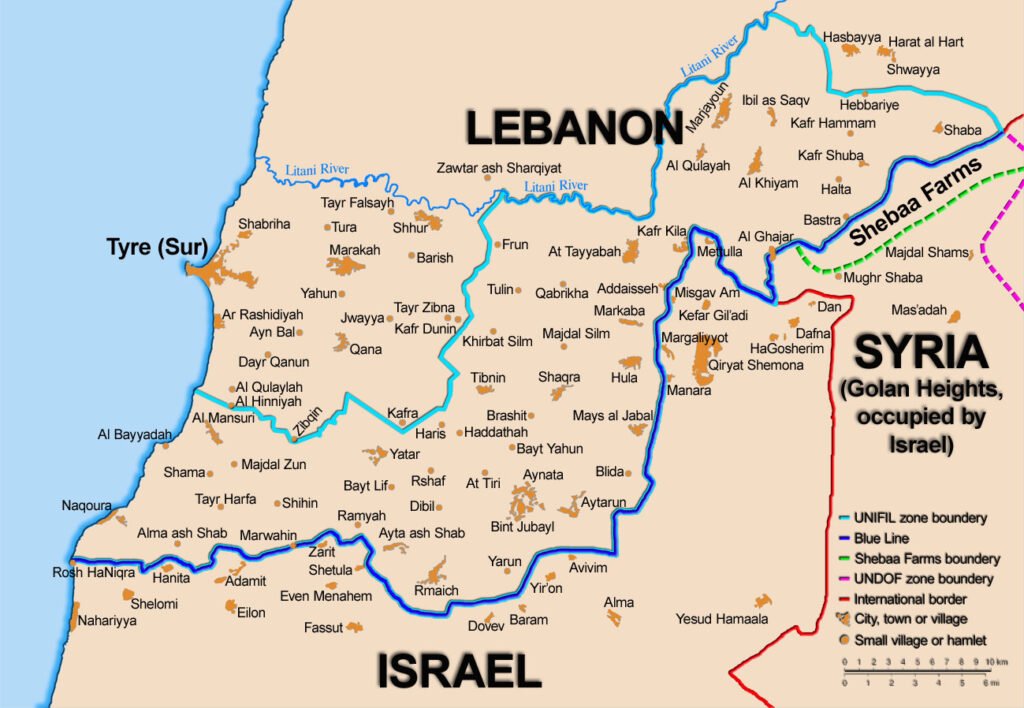
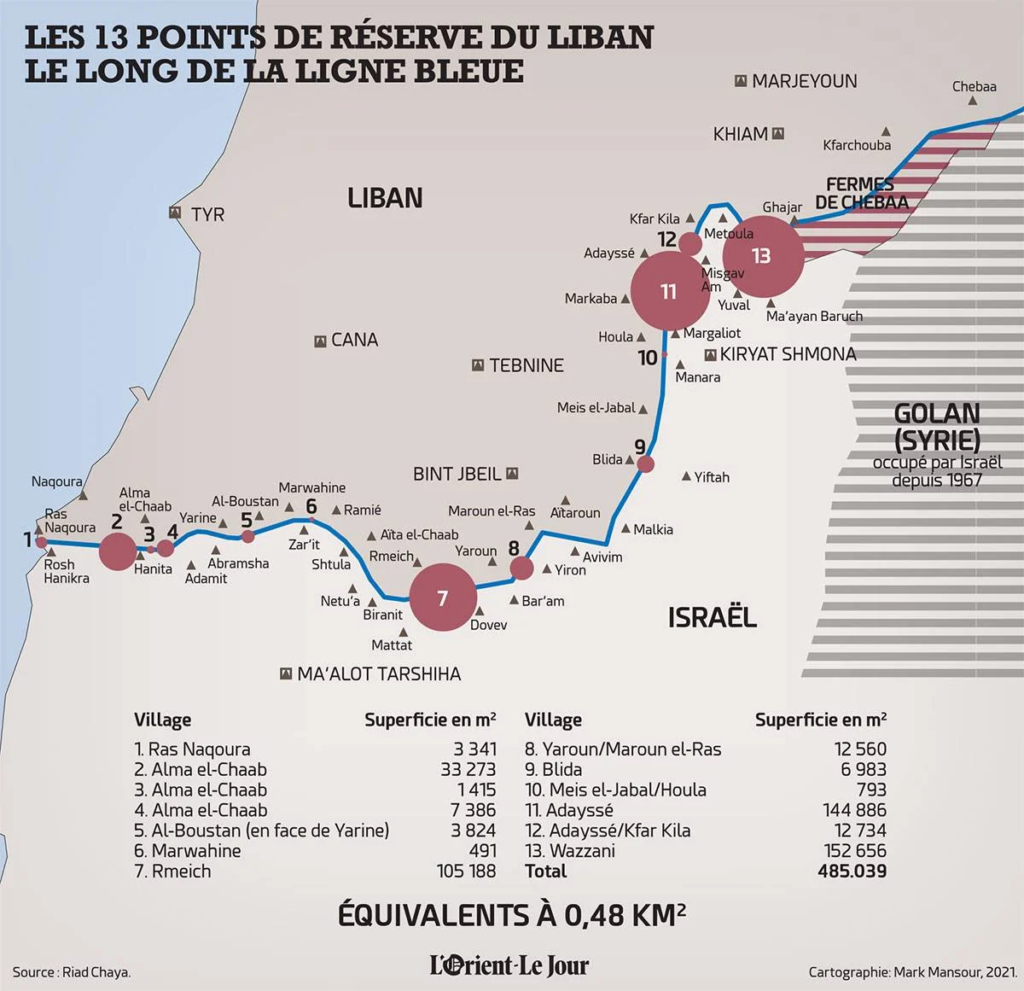
The Lebanese security crisis is rooted in the artificial design of its territory. Traced in 1923 by the mandatory powers (the Paulet-Newcome Agreement), the Israeli-Lebanese border ignores local demographic and topographical realities. Although Great Britain rejected the maximalist claims of the Zionist movement – which demanded the integration of the Litani River and the Hasbani River for their water resources – it nonetheless granted the creation of the “Galilee Panhandle”. This artificial geographical corridor arbitrarily separates tens of thousands of predominantly Shia inhabitants from their lands, to the detriment of Lebanese territory. This fracture was definitely militarised by the first Arab-Israeli war of 1948 and the 1949 armistice line. While this armistice line temporarily froze hostilities, it did not resolve the underlying territorial disputes, as evidenced by the UN “Blue Line” drawn in 2000 to ensure and confirm the Israeli withdrawal from Southern Lebanon, which remains disputed by Lebanon on 13 strategic points.
The successive flows of Palestinian refugees between 1948 (following the Nakba, which according to UN figures caused the displacement of 700,000 Palestinians) and 1970 transformed Lebanon into the epicenter of the Palestinian resistance. Within these refugee camps, political and paramilitary organizations, such as the Palestine Liberation Organisation (PLO, in 1964), were established. These camps served as military training bases and enabled operations against Israel from Lebanese soil. From that period onward, the Lebanese State found itself unable to prevent these militias from using its territory to attack Israel, drawing in return military reprisals from the Jewish State. This territory thus became a vital strategic stake for both the PLO and Israel. Founded in 1964 with the objective of creating a Palestinian state through armed struggle, the PLO made Lebanese territory a pivot of its resistance strategy. Southern Lebanon was a terrain suitable to guerrilla warfare, and its direct border with northern Israel offered an ideal rear base. The PLO established a genuine territorial autonomy there, relying on the refugee camps for military recruitment. This dynamic was institutionalized by the signing of the Cairo Agreement on November 3, 1969, in which the Lebanese State legally consented to share its monopoly on the legitimate use of violence with a non-state actor.
For Israel, Lebanon is perceived as both an existential vulnerability and a geopolitical opportunity. From a security perspective, the porosity of the border turns the north of the Jewish state into a permanent target. Strategically, however, Israel perceives an opportunity to reshape its regional environment. By exploiting the internal fractures of Lebanese society, the State of Israel initiated a rapprochement with Maronite Christian militias (the Phalanges, the Lebanese Forces, the South Lebanon Army) as early as 1975. The objective extends beyond mere self-defense : it aims to ally with these forces to crush the PLO, install an allied government in Beirut, and force the signing of a peace treaty guaranteeing the security of its northern border.
Securing Northern Israel: The “Buffer Zone” Impasse
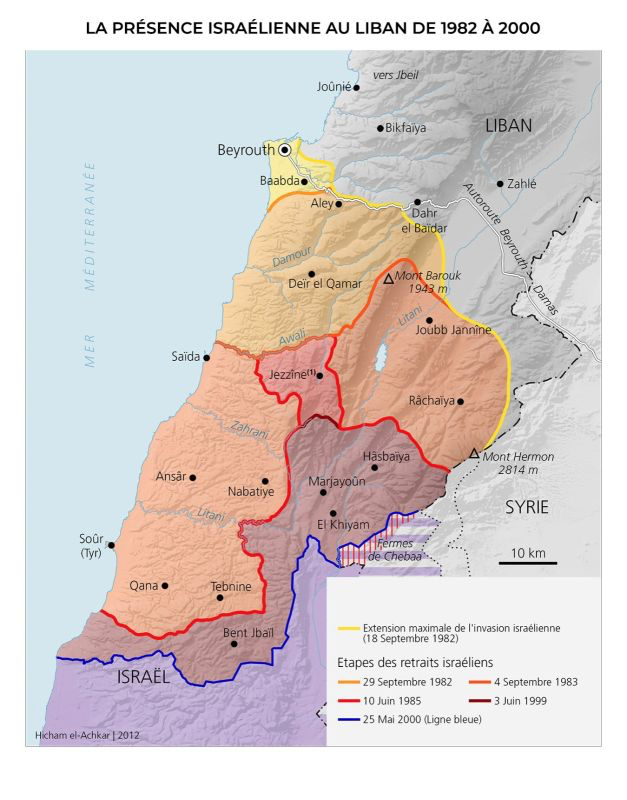
Faced with the sanctuarisation of the Palestinian presence in Southern Lebanon, Israeli strategy shifted toward a purely military response. During the 1978 invasion (Operation “Litani”), the army pushed into Lebanese territory to a depth of 40 kilometers. Despite the partial withdrawal of its troops and the deployment of the United Nations Interim Force in Lebanon (UNIFIL) in 1978, Israel maintained a security belt managed by allied local militias. However, the full-scale invasion launched in 1982 (Operation “Peace in Galilee”) revealed the limits of a purely military doctrine. During this operation the army advanced as far as Beirut to permanently eradicate the PLO and facilitate the installation of an allied Lebanese government. This project collapsed with the assassination of President-elect Bachir Gemayel Beirut’s abrogation of the 1983 peace treaty. Devoid of a reliable political proxy at the state level, Israel fell back on a strictly territorial approach – a strategy still in effect today. In 1985, the Israeli government formalised the creation of a self-proclaimed “security zone” in the southern most part of Lebanon, a strip approximately 15 to 20 kilometers deep, relying on the South Lebanon Army to administer and defend it.
This prolonged occupation would prove counterproductive. By entrenching itself in Southern Lebanon, the Israeli army became trapped in a war of attrition, while the evacuation of the PLO in 1982 left a major political and security vacuum that was swiftly exploited by new regional actors: Syria and Iran. The Israeli obsession – by weakening the Lebanese State and occupying the South – created the objective conditions for the emergence of a Shia resistance.
The Consequences of the Occupation : The Emergence of the Shia resistance
The trauma of Israeli operations and the massacres at the Sabra and Shatila camps (where between 800 and several thousand refugees were killed) acted as powerful catalysts for a new mobilisation dynamic within the historically marginalised Shia community. In this context of state collapse and dual occupation – the South controlled by Israel and the rest of the country under the tutelage of the Syrian army (the Syrian occupation lasting from 1976 to 2005) – Hezbollah emerged in 1982. Supported logistically and financially by Damascus and Tehran, the movement structured itself around the armed resistance against foreign occupation.
In 1990, the Taif agreement mandated the disarmament of Lebanese militias, including Hezbollah, in order to restore state sovereignty. However, Syrian tutelage allowed the organisation to retain its arsenal in the name of pursuing the “national resistance” against the Israeli occupation of Southern Lebanon. By compensating for the state’s deficiencies through social programs benefiting neglected communities, Hezbollah firmly entrenched itself in the Lebanese landscape. This strategy gave rise to a veritable “State within a State”, the culmination of which occurred in May 2000, with the unilateral Israeli withdrawal. The South then fell under the control of the Shia movement, a victory hailed by a majority of the political class. Capitalising on this withdrawal, Hezbollah refused to lay down its arms, maintaining that its deterrent force remained the only genuine security guarantee for Lebanon. Bolstered by this popular support, the movement formalized its transformation by officially joining the Lebanese government in 2005 while retaining its armed branch.
The Paradigm Shift: The 2006 War and the Theorisation of the Dahiya Doctrine
The 2006 War and the Dahiya Doctrine or Destruction as a Means of Deterrence
By crossing the UN “Blue Line” on July 12, 2006, to capture Israeli soldiers in order to force a prisoner exchange, the Shia militia unilaterally plunged Lebanon into a major conflict without the government’s consent. In response to this provocation, Tel-Aviv launched an offensive that marked the beginning of the “33-Day War”.
It was during this conflict that a paradigm shift in Israeli military strategy occurred with the theorisation of the “Dahiya doctrine”. This doctrine takes its name from the southern suburbs of Beirut (Dahiyeh), the militia’s stronghold, which was subjected to intense bombing at the time. This doctrine breaks away from the logic of territorial conquest. Instead, it relies on the use of a totally disproportionate retaliatory military force, aimed at the destruction of both civilian and military infrastructure. The objective is no longer to occupy land, but to make the physical space structurally uninhabitable. The strategic intent is dual : first, to empty the geography of its civilian population in order to deprive Hezbollah of its social base; second, to inflict a level of destruction so severe that rebuilding this vital space would take decades, thereby establishing deterrence through physical annihilation.
On the diplomatic front, the conflict ended with the adoption of United Nations Security Council Resolution 1701 of . This resolution aimed to restore the sovereignty of the Lebanese state by mandating the exclusive deployment of the regular army and the UNIFIL south of the Litani River, demanding in exchange the Israeli withdrawal and the total disarmament of Hezbollah in this area. However, while the militia emerged politically victorious in the Arab world to withstand Tsahal for 33 days, the Beirut government proved incapable of enforcing the UN resolution. Far from laying down its arms, Hezbollah reconstituted and modernised its arsenal with Iranian support.
The Regionalisation of Hezbollah Within the Iranian Axis of Resistance
Faced with this new Israeli military doctrine, Hezbollah made a strategic mutation. From the 2010s onwards, and notably from its intervention in the Syrian conflict, the movement imposed itself as an essential actor of the Axe of Resistance sponsored by Tehran. Under this impetus, Lebanese territory changed its function, transforming into an offensive outpost, organically linked to a land corridor connecting Iran to the Mediterranean, passing through Baghdad and Damascus. Within this strategy, Hezbollah’s role is to militarily keep Israel at a distance from Iranian territory[1].
This redefinition of the Lebanese space radically modifies the threat assessment within the Israeli security apparatus. The presence of Hezbollah at the northern border is no longer analyzed as a simple peripheral security problem or a local rebellion, but as an existential threat. For Tel Aviv, Southern Lebanon constitutes the advanced point of a “ring of fire”, a strategy of territorial encirclement directly orchestrated by the Islamic Republic of Iran. The military imperative is no longer to contain a guerrilla force, but to physically dismantle this Iranian bridgehead. It is the identification of this absolute threat, combined with the total militarization of the Lebanese space by the militia, that will determine the Israeli will to proceed with the neutralisation of this territory during the 2023 escalation and the 2026 war.
From the Support Front to the War of Attrition: The Reactivation of the Dahiya Doctrine (2023-2024)
The integration of Lebanon territory to regional dynamics crosses a new step on the next day of the attaque of October 7, 2023, when Hezbollah decides unilaterally to open a “support front” in Southern-Lebanon.
However, this forced regionalisation engenders a political cost that fractures the internal legitimacy of the movement. Historically, Hezbollah justifies the maintenance of its territorial autonomy through a defensive narrative, presenting itself as the shield of the national territory. This rhetoric clashes with the profound fatigue of Lebanese civil society. Already deeply impacted by the economic collapse of 2019 and the destruction of Beirut port in 2020, the population no longer possesses the material resilience necessary to absorb the cost of a new conflict. Consequently, the engagement of the national space in a war of reprisal for an external ally, modifies the perception of the militia. For a growing part of public opinion the movement is no longer perceived as a protector, but as an actor subordinating the physical and economic survival of Lebanon solely to the strategic imperatives of the Iranian agenda.
Facing this attrition war imposed from Lebanon, the Israeli response adopts a new strategy based on air superiority. One the one hand, it conducts a campaign of targeted assassination, eliminating the militia’s officers. These deep strikes (reaching Beirut’s suburbs and the Bekaa Valley) violate the entirety of Lebanese territory. On the other hand, Israel reactivates and intensifies the “Dahiya doctrine” along the border line (Operate “Northern Arrow”), aiming the return of northern Israeli families to their homes. The Israeli army applies a scorched-earth policy by carrying out daily bombardments aimed at razing villages and burning agricultural lands of Southern Lebanon (notably through the documented use of white phosphorus munitions), in order to make the space physically and economically uninhabitable through the destruction of agronomic and infrastructural resources.
The 2023-2024 period thus marks the culmination of a logic of total militarisation of the Lebanese space. By reactivating the Dahiya doctrine along the border line and conducting a campaign of targeted assassination deep within the territory, Israel transformed Southern Lebanon into a laboratory for a strategy of systematic destruction of Hezbollah’s human, agronomic and infrastructural resources. The ceasefire of November 27, 2024, does not put an end to this logic, but suspends it. The Israeli army maintains five forward positions in Lebanon territory and continues targeted strikes. The United Nations records more than 130 Lebanese civilian victims linked to these incursions, between the announcement of the ceasefire and the beginning of the year 2026.
In parallel, the Lebanese State attempts to initiate a partial reconquest of its sovereignty in the south of the Litani – destruction of weapons depots, establishment of checkpoints on the roads axes leading to the south – via a demilitarisation plan of this region. These measures, although insufficient to stop the Israeli offensive, demonstrates a will of the central State to break Hezbollah’s military enclave of. It is within this precarious balance, where neither military victory nor political normalisation is acquired, that the frontal rupture of March 2, 2026, occurs.
Lebanon in the Spring of 2026
Territorial Dislocation: The Total Application of the Dahiya Doctrine
On March 2, 2026 following the assassination of the Ayatollah (or Supreme Leader) Ali Khamenei, Hezbollah breaks the ceasefire in effect since November 2024 by targeting northern Israel. As early as March 4, 2026, Tel-Aviv unilaterally decrees a buffer zone in Southern Lebanon and orders successive massive evacuations : 180 border localities, the southern suburbs of Beirut, then the space between the Litani and the Zahrani. Before beginning ground operations on March 16, 2026. The intensification of this doctrine culminates on April 8, 2026, with simultaneous strikes on Beirut and its southern suburbs as well as in the Southern Lebanon and the Bekaa, causing the death of more than 300 people in less than ten minutes of bombardments. The Israeli air force also destroyed five of the six bridges spanning the Litani River, physically and logistically severing Southern Lebanon from the rest of the country.
These destructions aim at a strategic objective: by isolating the space controlled by the militia, Israel aims to render the local geography inoperative and to dismantle Hezbollah’s social base by striking the shia demographic fabric. What Lebanese experts term “domicide” materialised through the complete razing of localities in the “yellow zone”. The documented use of white phosphorus in at least 17 municipalities of the South since October 2023, confirmed by eight complaints filed by Lebanon with the Security Council, illustrates a policy of destruction of agronomic resources – this sector representing 80% of the economy of Southern Lebanon. This strategy of systematic destruction goes beyond the strictly military framework and extends to vital infrastructures. As evidenced by the placement under evacuation order of strategic hospital sectors, such as that of Jnah in Beirut, which threatens the continuity of care well beyond the conflict zone.
On April 17, 2026, a ceasefire comes into effect between Israël and Hezbollah. According to the terms of the agreement, Israel reserves the right to continue targeting Hezbollah in order to prevent “planned, imminent or ongoing” attacks. The Lebanese militia reserves the same right. Since this date, the two parties mutually accused each other of violating the agreement, justifying retaliations, weakening the ceasefire agreement from the outset. Starting April 19, 2026, the “yellow line”, namely an advanced defense line 5 to 8 kilometers deep under effective Israeli control (designed on Gaza model) establishes an Israeli military presence, the extension of which up to the Litani River is openly demanded by certain Israeli military officials.
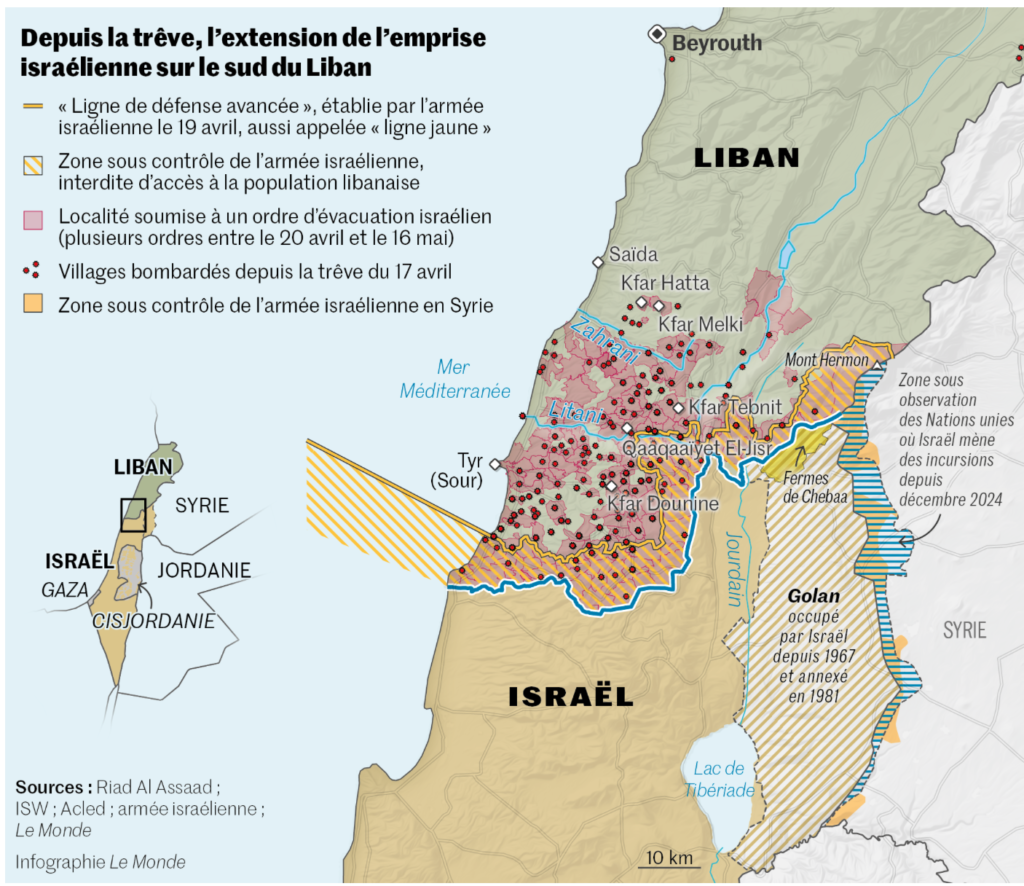
These operations caused the forced displacement of more than a million civilians, representing more than a fifth of the Lebanese population. This massive movement threatened to dislocate the demographic and confessional balance stabilised since the 1990 Taif agreement by precipitating Shia populations towards politically and confessionally distinct regions.
Political Recomposition: The Reaffirmation of the Lebanese State Facing Hezbollah and Facing Israel
Faced with this offensive, the Lebanese State operates a political rupture by dissociating itself from the opening of front by the militia, by withdrawing the regular army from the South and by decreeing the military activities of Hezbollah illegal while demanding its disarmament. Demonstrating the government attempt to dissociate the legitimacy of the State from the militia logic. This rupture extends to the diplomatic level, with the expulsion of the Iranian ambassador, the banning access to the territory for the Revolutionary Guards, and the suspension of visa exemptions for Iranians. These measures mark a will of sovereignty reappropriation, but collide with structural limits.
On the one hand, the Lebanese State remains incapable of stopping Hezbollah strikes, just as much as it is powerless to stop Israeli bombardments. The Lebanese army, dependent on external financing and historically constrained in its margins of action against the militia, does not constitute a credible substitution actor in the South. This state impotence materialises through institutional paralysis. The cancellation of the April 29 summit, intended to establish a unified national strategy, illustrates the government’s inability to reach a minimal consensus: the Speaker of the Parliament, Nabih Berri, also head of the Amal party, refused to provide his support for direct negotiations with Israel, depriving the process of any Shia validation essential to its internal legitimacy[2].
On the other hand, Hezbollah, isolated by the distancing of its traditional allies ( the Free Patriotic Movement and the Amal Party) and weakened by the death of Hassan Nasrallah (September 27, 20240 and the collapse of the Assad regime (December 8, 2024) which disrupted its land supply lines, refuses any bilateral negotiations and threatens the government with an internal armed conflict, foreshadowing a risk of civil war. The leadership of the militia explicitly externalises the Lebanese diplomacy by deferring to Tehran to negotiate a regional agreement with Washington including Lebanon, confirming that the national territory is for it only a component of a broader Iranian agenda.
This structural weakening does not, however, mean an operational neutralisation of the militia. Hezbollah’s use of fiber-optic drones, a technology proven on the Ukrainian front and particularly difficult to intercept by conventional defense systems, confers upon it an asymmetrical advantage against Israeli air superiority, as evidenced by the six Israeli soldiers killed by drone attacks during the supposed truce period. While Israeli strikes have caused more than 400 Lebanese civilian casualties since the beginning of the truce, according to an AFP tally based on official figures. This symmetrical result, where each party accuses the other of violation, illustrates the fictitious nature of the ceasefire and constitutes precisely one of the arguments advanced by Tel Aviv to refuse a withdrawal prior to any disarmament.
On the internal level, this polarization places the civilian population at an impasse. Exhausted by the annihilation of its vital space, a growing fraction of civil society aspires to a state-to-state diplomatic resolution. However, another part of the population remains sensitive to the militia narrative, which presents armed resistance as the sole bastion against Tel Aviv’s objective of pursuing a project of territorial expansion (“Greater Israel“). The national territory thus finds itself under a triple constraint: the Israeli military occupation in the south, the Iranian diplomatic confiscation, and the imminent risk of civil fragmentation in the face of the impotence of the central State. At the center of this tension, civil society remains the actor whose quest for institutional normalisation is systematically hindered by the repetition of conflicts[3].
The Diplomatic Fracture: Lebanon as a Regional Adjustment Variable
The impotence of the international community faced with this situation materialises through the decay of UN legal frameworks. Previous resolutions, supposed to guarantee territorial integrity and the state monopoly of force, remain unapplied. While UNIFIL, directly concerned by Israeli operations in the South, finds itself an observer of the situation without effective interposition capacity.
This diplomatic marginalisation is formalised by the recent bilateral American-Iranian ceasefire agreement, from which Lebanon is explicitly excluded. This exclusion confirms the relegation of the Lebanese space to the status of a strategic adjustment variable, depriving the State of any legal protection mechanism in the face of military operations on its soil. The talks of April 14 and 23 and of May 14 and 15, 2026 (the first direct talks between the two governments since 1993) crystallize the fundamental asymmetry of the positions: Beirut demands a complete ceasefire prior to any disarmament, considered an internal policy prerogative, a withdrawal of Israeli forces, and a refusal of any formal normalisation favoring a security agreement, given the cleavages within the Lebanese population. Conversely, the Israeli government approaches these discussions through the prism of a “peace by force“, excluding any immediate cessation of hostilities and demanding that the dismantling of the militia be treated as a bilateral precondition, establishing an asymmetrical balance of power that invalidates the holding of discussions on an equal footing. Also pushing for a normalisation of relations. Thus, the discussions of May 14 and 15 resulted in the establishment of a working framework, and a 45-day extension of the truce. A first session on the security aspect is scheduled for May 29, 2026, while the political aspect will be the subject of a second session on June 2 and 3.
This asymmetry of position is partly explained by an Israeli domestic context structurally unfavorable to compromise. Netanyahu’s decision to dissolve parliament on May 12, 2026, and to call early elections places the negotiation process under electoral constraint: with 69% of Israeli public opinion in favor of continuing operations against Hezbollah, independently of the situation in Iran, any territorial concession constitutes a political cost difficult to assume. Moreover, Israeli military officials openly advocate for the extension of the occupied zone up to the Litani River, considering that the current “yellow line” does not offer sufficient strategic depth against close-range fire and drones. The Litani River, as a natural barrier, would represent in their eyes a more defensible line of contact and a political lever in the negotiations. The statement by Foreign Affairs Minister Gideon Saar affirming on April 28, 2026, that Israel has no territorial designs in Lebanon thus contrasts with the ambitions expressed within the military apparatus itself, revealing a tension between official diplomatic discourse and operational logic on the ground.
On the regional level, the powers denounce a deliberate will to sabotage peace. Qatar firmly condemns the strikes and demands an urgent intervention by the international community. Egypt affirms that these military operations prove Israel’s premeditated intention to destroy de-escalation efforts in the region. In the same vein, Turkey warns of the dramatic aggravation of the Lebanese humanitarian crisis and demands the immediate protection of civilians. On a much harsher diplomatic register, the Pakistani Minister of Defense stands out by accusing the Israel of committing a genocide in Lebanon. On the other side, European diplomacies attempt to save the negotiations. France, Spain, Italy, and the United Kingdom unanimously condemn this new military escalation. Paris notably attempts to weigh on the peace process by officially demanding that Lebanon be reintegrated into the perimeter of the American-Iranian ceasefire agreement, from which it had been excluded. However, these positions do not translate into any effective pressure mechanism on the belligerents. Lebanon remains the space where a regional order is negotiated, by arms and by proxy, from which it is excluded as a full-fledged actor.
Conclusion
Half a century of foreign occupations, militia sanctuarisations, and successive state collapses has produced a territory whose sovereignty no longer exists except as a legal fiction. These events reveal the structural nature of the double constraint weighing on the Lebanese State: any attempt at sovereign reappropriation facing Israel requires a capacity for territorial control that Hezbollah renders impossible, while any attempt to disarm the militia requires an external security guarantee that Israel refuses to concede prior to this disarmament. These two logics mutually feed off each other and condemn the central State to impotence.
On the territorial level, different scenarios are emerging for the Israeli General Staff: the perpetuation of the military presence south of the Litani on the model of the occupied zone between 1978 and 2000, or else the establishment of a ten-kilometer no man’s land due to the difficulty of occupying this territory given its geography, which would require a long-term mobilisation of reservists. These options aim at the creation of a buffer zone designed to protect northern Israel and to neutralise Hezbollah’s infiltration capabilities. In all cases, these scenarios mean a physical retraction of Lebanese sovereignty over a significant portion of the national territory. The systematic destruction of infrastructures, agricultural lands, and the urban fabric of the South transforms this territorial amputation into a progressive fait accompli, independently of any diplomatic outcome. This spatial unravelling is accompanied by a health and energy crisis whose demographic and economic effects will be measured over several decades.
On the political level, the forced displacement of more than a million civilians poses a risk of confessional recomposition that the Taif Agreement had precisely sought to stabilise. This massive exodus generates sectarian tensions capable of reviving the fractures of 1975-1990 (Lebanese civil war). Simultaneously, the Israeli strategy of destroying Hezbollah’s Shia social base produces a paradoxical effect: by emptying the South of its population, it deprives the militia of its territorial foundation, but it fuels the resistance narrative upon which the movement has found its legitimacy since 1982. This is perhaps the contradiction that the spring of 2026 reveals: the two dynamics that could theoretically weaken Hezbollah – state reconquest and Israeli military pressure – mutually neutralise each other. The Lebanese State can only establish its authority within a ceasefire framework that Israel conditions on a prior disarmament that the militia refuses. And Hezbollah, logistically weakened and politically isolated, finds in the continuation of Israeli bombardments the justification to maintain its arsenal. The Lebanese territory thus remains the place where the contradictions of a regional order articulate themselves, without resolving; an order whose effects it suffers without mastering its terms.
Notes
[1] Therme Clément, Israël Iran la guerre idéologique, Tallandier, Paris, 2026, p99.
[2] Stephan Laure, “Le Liban, dans une impasse politique avant les négociations avec Israël”, Le Monde, 4 mai 2026.
[3] Therme Clément, Israël Iran la guerre idéologique, Tallandier, Paris 2026, p102