

This article follows a different logic for the order of references.
Since the escalation of the U.S.-Israeli confrontation with Iran, Palestine has receded further from the center of international attention. Yet the shift in regional focus has not produced calm on the ground. On the contrary, it has intensified a dangerous pattern: Gaza continues to endure severe humanitarian devastation, the West Bank is undergoing accelerated displacement and coercive fragmentation, and the political frameworks now proposed for Gaza’s future remain more coherent from the standpoint of external powers than from the standpoint of Palestinian legitimacy[1]. The central problem is not only the magnitude of suffering. It is also the political invisibility into which Palestine has once again receded. Regional diplomacy, military signaling, and media attention have increasingly moved toward the Iran file and its wider implications for the Middle East. Palestinian commentary has begun warning that this shift risks turning Palestine into a secondary casualty of regional realignment, not because conditions on the ground have improved, but because the diplomatic and media agenda has moved elsewhere[3].
This is not merely a problem of representation. It has material consequences. A recent report by the Palestinian Centre for Human Rights argues that roughly five months after the October 2025 ceasefire took effect, Gaza had seen no meaningful recovery in the foundations of civilian life. In its reading, the ceasefire reduced neither deprivation nor structural vulnerability in any durable way; instead, it left the population in a condition of managed hardship marked by strain in health services, shelter, food access, and humanitarian space. Even where the report uses sharper legal language than this article adopts, its factual value lies in documenting how the language of “postwar transition” has outpaced any real transition in lived conditions[2].
Any serious analysis of Palestine today must therefore begin from a simple premise: what is happening in Gaza and the West Bank is not merely a byproduct of wider regional escalation. It is part of an ongoing transformation of Palestinian life itself. In Gaza, this transformation is visible in the collapse of basic civilian systems, the destruction of housing and infrastructure, and the narrowing of humanitarian space. In the West Bank, it appears through intensified settler violence, displacement, and cumulative restrictions that hollow out Palestinian presence in vulnerable areas. In both places, the social capacity to preserve continuity, memory, and public life is being tested to the limit[1].
Gaza’s Humanitarian Deterioration Beyond the Headlines
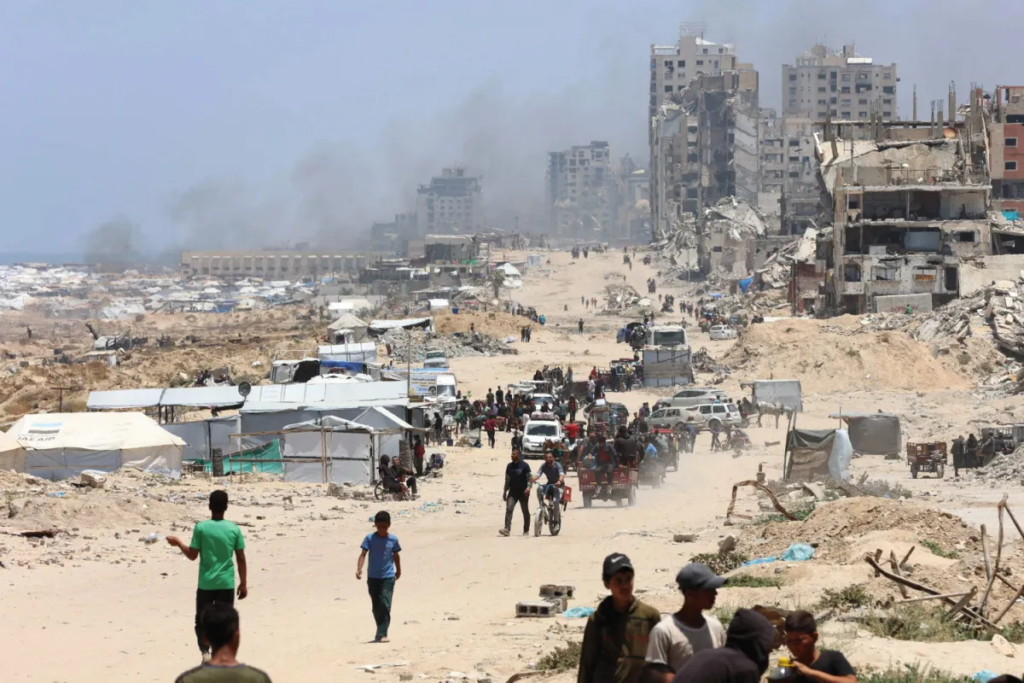
To describe Gaza simply as a humanitarian crisis is now almost inadequate. The phrase is accurate, but it can flatten what is taking place into the language of relief management, as though the problem were only one of aid delivery. In reality, Gaza is experiencing the prolonged destruction of the conditions that make organized civilian life possible. The issue is not only hunger, thirst, or exposure in the immediate sense. It is the erosion of shelter, sanitation, health care, education, local economic life, and the basic predictability on which a society depends[1]. What makes the present phase especially dangerous is that Gaza’s suffering is increasingly taking place under conditions of normalization. Even when it no longer dominates headlines, the structural drivers of deprivation remain in place. The PCHR report is useful here because it captures the post-ceasefire paradox with particular clarity: formal de-escalation did not produce substantive recovery. Instead, it records a setting in which military pressure continued at a lower but still deadly intensity, while the civilian environment remained too damaged and too constrained to support any genuine shift from emergency survival to recovery. A recent reflective Arabic essay is useful as a secondary framing device on this point: it argues that the current war did not create Palestinian precarity so much as expose and deepen a condition in which daily life had already been reduced to managing instability rather than living normally[14].
The same report strengthens the argument that Gaza’s distress cannot be understood only as a shortage problem. It is also a problem of restricted throughput and blocked recovery. PCHR records that aid arrivals fell far short of projected needs during the period under review and that fuel deliveries were even more limited. This matters because fuel is not a secondary commodity in Gaza’s current condition; it underpins water pumping, sanitation, health care, refrigeration, transport, and emergency response. When fuel flows remain sharply constrained, many other civilian systems remain trapped in dysfunction[6].
Shelter is another area where the report reinforces the broader argument of this article. PCHR describes a post-ceasefire housing landscape in which hundreds of thousands of people remained in damaged homes, schools, improvised encampments, or tents unfit for sustained winter conditions. It documents building collapses, deaths linked to cold weather, and the absence of meaningful reconstruction or even sufficient shelter materials. The analytical significance of this is straightforward: the shelter crisis is no longer just a byproduct of past destruction. It has become an active driver of present vulnerability[4].
Food insecurity must also be read through this wider lens. The question is not only whether some goods enter Gaza, but whether households can access them in a context of shattered income, distorted markets, fragile supply chains, and recurring restrictions. The PCHR report makes this point well by arguing that the partial inflow of goods did not translate into meaningful food security or economic recovery. This complements the broader humanitarian picture documented by OCHA and other agencies: Gaza is being sustained below the threshold of normal civilian life, not restored toward it[1].
The central point is that Gaza should not be understood as a temporary emergency awaiting a technical postwar fix. It is undergoing a sustained process of civilian attrition. Humanitarian actors remain indispensable, but humanitarian action alone cannot repair the destruction of social infrastructure, economic life, institutional capacity, and human dignity. The longer Gaza is treated primarily as an aid file, the more likely it is that the deeper political and societal consequences of this collapse will be misunderstood until they are even harder to reverse[12].
Palestinian Civil Society Under Siege: Survival, Memory, and Cultural Preservation
Palestinian civil society is often described through the language of resilience. That word is not wrong, but it is no longer sufficient. In Gaza and across the wider Palestinian arena, civil society is not operating under difficult but manageable conditions. It is functioning under sustained assault: materially, institutionally, and symbolically. Community networks, educators, journalists, cultural workers, and local initiatives continue to act, but increasingly from within a landscape shaped by bereavement, displacement, and infrastructural collapse. Much of Palestinian civil society now operates in emergency mode, with its horizon narrowed from development and advocacy to survival, documentation, and social preservation[1]. In Gaza, this emergency mode is visible in the substitution of formal systems by improvised community action. When public institutions are degraded and humanitarian access is erratic, social life does not vanish; it reorganizes downward, into families, neighborhoods, volunteers, temporary educational initiatives, and informal support mechanisms. This is often praised externally as proof of Palestinian endurance. But such endurance carries a cost. The more communities are forced to absorb the burdens of institutional collapse themselves, the less capacity remains for the slower work of public life: professional development, civic organizing, artistic production, legal advocacy, and strategic political thinking[12].
Culture and heritage form another front of this struggle. Damage to mosques, churches, museums, archives, historic buildings, and archaeological sites is not a secondary issue to be addressed after the emergency passes. It forms part of the emergency itself. Humanitarian collapse is not only about keeping bodies alive. It is also about whether a society can preserve memory, belonging, and the material traces of its own continuity. UNESCO’s documentation of damage to cultural sites in Gaza underscores the extent to which the war has also become a crisis of memory and continuity[8]. This matters for reconstruction. Rebuilding roads, utilities, clinics, and schools is indispensable, but rebuilding civic and cultural capacity matters just as much. A society can remain physically present while becoming institutionally thinner, culturally poorer, and more permanently trapped in emergency logic. That risk is now central to understanding the Palestinian condition[8].
The West Bank as a Parallel Arena of Dispossession and Escalation
The West Bank should not be treated as a secondary theater while Gaza remains the dominant humanitarian file. It is better understood as a parallel arena in which territorial fragmentation, coercive displacement, and political destabilization are advancing through different mechanisms. In Gaza, the crisis is concentrated in mass destruction and humanitarian collapse. In the West Bank, it is increasingly expressed through settler violence, land pressure, closures, raids, and the cumulative erosion of Palestinian presence in vulnerable areas[1].
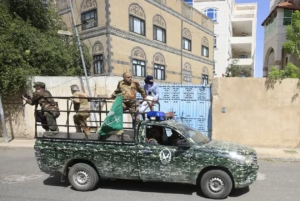
These dynamics matter not only because their scale is high, but because they reveal the character of the current moment. What is taking place in the West Bank is not a series of isolated incidents. It is a pattern of pressure that combines physical insecurity with progressive unviability. Recent Arabic reporting, drawing on Palestinian land-defense monitoring, has argued that the wider Iran confrontation has provided additional political cover for intensified attacks by armed settler groups on villages, agricultural land, and herding communities, particularly in the Jordan Valley and around Nablus and Ramallah. Used cautiously, this reporting is analytically helpful not because it settles legal questions, but because it captures how attritional coercion works in practice: communities are not only attacked; they are made harder to sustain[15].
The settlement issue therefore cannot be reduced to housing expansion alone. The deeper issue is the production of a coercive environment in which Palestinian life becomes less protected, less connected, and less governable. Settlement growth, escalating violence, mobility restrictions, and the hollowing out of vulnerable communities form part of one wider process. Whether one emphasizes the legal, humanitarian, or political dimension, the implication is the same: current incidents must be read as part of a structural pattern rather than as disconnected local clashes[9].
Movement restrictions are central to this process. Checkpoints, road gates, and closures are often discussed as security measures, but for Palestinians they also shape access to livelihoods, health care, family life, worship, and education. Over time, such restrictions do more than obstruct movement; they fragment social geography. Communities become harder to reach, daily routines grow more uncertain, and ordinary civilian life becomes permanently contingent. That kind of fragmentation is politically consequential because it erodes the territorial and social continuity on which any viable Palestinian future would depend[9].
The Board of Peace and the Politics of Conditional Reconstruction
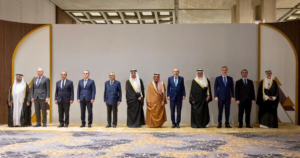
The emergence of the “Board of Peace” has given new visibility to postwar planning for Gaza, but it has not resolved the central political contradiction at the heart of reconstruction. On paper, the Board offers what many external actors have long sought: a framework linking ceasefire consolidation, disarmament, technocratic administration, international security deployment, and donor-backed rebuilding into a single sequence. From the standpoint of outside governments, this architecture has obvious appeal. It creates benchmarks, sequencing, and conditionality, and it reassures donors reluctant to finance reconstruction without guarantees that rebuilt infrastructure will not be pulled back into conflict. Yet recent analysis also suggests that the Board remains institutionally underdefined, with unclear financial oversight, concentrated decision-making authority, and unresolved questions about who will control pledged funds and under what accountability mechanisms[16].
Yet the Board’s strength as an external governance design is also its core weakness. It is highly legible to donor states and security planners, but much less clearly anchored in Palestinian political legitimacy. If reconstruction materials and recovery assistance enter only where demilitarization has already been verified, rebuilding risks being framed less as a social necessity than as a conditional reward. For a population already living through mass deprivation, that is politically fraught and socially destabilizing. The problem is compounded if reconstruction is routed through mechanisms that bypass established Palestinian planning frameworks and treat Gaza primarily as a standalone administrative file rather than as part of a wider Palestinian political and territorial question. Carnegie’s critique is useful here: the issue is not only whether money can be mobilized, but whether the structure governing it is transparent, accountable, and connected to a credible political horizon[16].
This objection is not only moral. It is analytical. Gaza’s humanitarian condition is already so severe that reconstruction cannot be treated as a downstream phase of a security process. Damaged shelters, degraded services, severe aid dependence, and high civilian vulnerability remain current realities. In that setting, sequencing reconstruction too rigidly behind disarmament may widen the gap between diplomatic planning and civilian survival. A framework intended to reduce future insecurity may, if applied inflexibly, deepen present instability by prolonging deprivation and uncertainty. And if donor funding is embedded in a governance model seen as opaque, overly centralized, or detached from Palestinian representation, implementation itself may become politically brittle[16].
None of this means the Board of Peace is irrelevant. On the contrary, it is the only offer currently on the table and one of the most consequential platforms shaping Gaza’s near-term future. It has mobilized serious attention, forced multiple actors to specify what “the day after” might entail, and created a more concrete discussion around administration, security, and financing. But process alone will not resolve the underlying issue of legitimacy. Without credible oversight, clearer accountability, and a political horizon that includes Palestinians rather than merely managing them, reconstruction risks becoming externally supervised administration of devastation rather than the beginning of a legitimate recovery [13].
Conclusion
An eclipse does not extinguish what it obscures. The light source continues to burn behind the intervening body. What changes is the observer’s capacity to see, measure, and respond. What Palestine demonstrates in this phase of regional war is not simply neglect, but the danger of strategic compartmentalization. Gaza is treated as a humanitarian emergency to be managed, the West Bank as a security problem to be contained, and reconstruction as a technical exercise to be sequenced behind disarmament and donor coordination. But these are not separate files. They are interconnected expressions of a single Palestinian crisis: one defined by mass civilian suffering, institutional attrition, territorial fragmentation, and the weakening of the social foundations on which any legitimate future would have to be built [12]. The central argument is therefore straightforward. Palestine should not be understood as a secondary casualty of a wider regional war. It is one of the arenas in which that war’s political meaning will be decided. The longer Palestine is pushed to the margins of diplomacy and media attention, the more likely it is that humanitarian collapse, civic erosion, and territorial fragmentation will harden into a new baseline. Reconstruction without legitimacy will remain fragile. Humanitarian aid without protection will remain insufficient. And any regional strategy that treats Palestine as something to be addressed later will only deepen the instability it claims to manage [13].
What rigorous analysis requires is the willingness to name what is happening without euphemism: not “humanitarian challenges” but engineered starvation; not “settlement activity” but ongoing annexation; not “governance transition” but a reconstruction framework excluding the people it purports to serve. It requires maintaining analytical attention across news cycle discontinuities. The sun behind the eclipse is still there. The question is whether our instruments, and our willingness to use them when spectacle points elsewhere, are adequate to the task of seeing it.
Notes
- United Nations Office for the Coordination of Humanitarian Affairs (OCHA), Humanitarian Situation Report, 27 March 2026.
- Palestinian Centre for Human Rights (PCHR), March 2026 report on humanitarian conditions in Gaza five months after the fragile ceasefire. The report argues that the ceasefire did not generate meaningful recovery and documents continued stress in health, shelter, food security, and humanitarian access.
- Hassan Asfour, “Will Palestine Become a Victim of the Iran War?”, Amad, 19 March 2026. Used here as a political commentary reflecting Palestinian concern that regional diplomacy and media attention are sidelining Palestine during the Iran war.
- PCHR, March 2026 report, sections on health, shelter, food insecurity, and humanitarian access.
- PCHR documents 573 Palestinians killed and 1,553 injured in Gaza between October 2025 and the end of February 2026, after the ceasefire took effect, alongside continued shelling, incursions, and demolitions. The figures are reproduced here as the report’s documented tally.
- According to the same PCHR report, only 31,178 aid trucks entered Gaza out of an anticipated 72,000 during the reviewed period, and only 861 fuel trucks entered out of 6,000 planned.
- According to the same PCHR report, around 1.5 million displaced people remained without adequate shelter, including approximately 137,000 families outside the coverage of local service bodies; it also records deaths linked to cold weather and shelter collapse during winter storms.
- UNESCO, damage assessment for cultural and heritage sites in Gaza, updated 24 March 2026.
- Office of the United Nations High Commissioner for Human Rights (OHCHR), statement/report on settlement expansion and displacement in the West Bank, 17 March 2026.
- Rami Mahdawi, “The Massacre Is Being Prepared…”, Wattan, 18 March 2026. The site could not be fetched directly by the browser tool, so only the indexed snippet was used. That snippet described repeated village attacks, incursions, vandalism, and direct threats to residents in a climate of insecurity. The article is used here cautiously, as reflective commentary rather than as the sole factual basis for any claim.
- Reuters, report on the Board of Peace disarmament and reconstruction proposal, 27 March 2026.
- Associated Press, coverage of the same proposal and of Hamas’s reservations regarding disarmament-first sequencing, March 2026.
- Reuters, report on UN cooperation with the Board’s structures, 21 March 2026.
- Rami Almeghari, “Hayat lam tumnah lana aslan..?!!” [A Life We Were Never Really Granted to Begin With], Sada News, 28 March 2026. Used here sparingly as a reflective Palestinian commentary reinforcing the article’s analytical distinction between chronic precarity and acute wartime collapse, especially in Gaza and, more briefly, in the West Bank.
- Amad, report citing Palestinian land-defense monitoring on intensified settler attacks under the wider regional war context, 28 March 2026. Used here to reinforce the argument that the West Bank has experienced not only isolated incidents, but a broader climate of repeated village-level pressure, land insecurity, and coercive fragmentation during the Iran escalation.
- Zaha Hassan and Charles H. Johnson, “The Board of Peace and Funding for Gaza Reconstruction: On Whose Account?,” Carnegie Endowment for International Peace, March 16, 2026.
Note on selected Palestinian commentary: Two March 2026 Arabic commentary pieces were used sparingly and only as framing sources: one to reinforce the argument that the wider confrontation with Iran has diverted attention while pressures in the West Bank continue to intensify; the other to reflect, in non-polemical terms, how prolonged deprivation reduces life to managed survival rather than ordinary civic normalcy.