


Alexandre Aoun is specialist in non-state movements and the transformation taking place in the Arab world, in this article he takes us behind the scenes of what is unfolding in Ali al-Taher. Based in Lebanon, where he experiences the consequences of this war on a daily basis, our researcher provides a particular insightful framework for understanding the military, political and geopolitical dimensions of the battle unfolding around Ali al-Taher.
—
In the space of a few months, the Ali al-Taher ridge has become one of the main focal points of the war in southern Lebanon. What is at stake now goes far beyond control of a few hilltops near the town of Nabatiyeh. Ali ai-Taher is the focal point of several simultaneous conflicts : the military confrontation between Israel and Hezbollah; the Lebanese state’s struggle to maintain control over an autonomous armed force; and the regional confrontation between Israel and Iran, with the alleged presence of revolutionary Guards fighting alongside the militants of the Lebanese Shia party. The situation evolved on 3 and 4 September. The Israeli army claims to have gained “operational control” of the ridge, both on the surface and in the underground networks. According to the army, certain Hezbollah fighters were killed and others fled. Benjamin Netanyahu stated that the position no longer posed a threat to Israel. However, Hezbollah has not confirmed this version of events, and there is as yet no independent verification to establish that the entire mountain range and its infrastructures are indeed under Israeli control.
A highly strategic position for Hezbollah
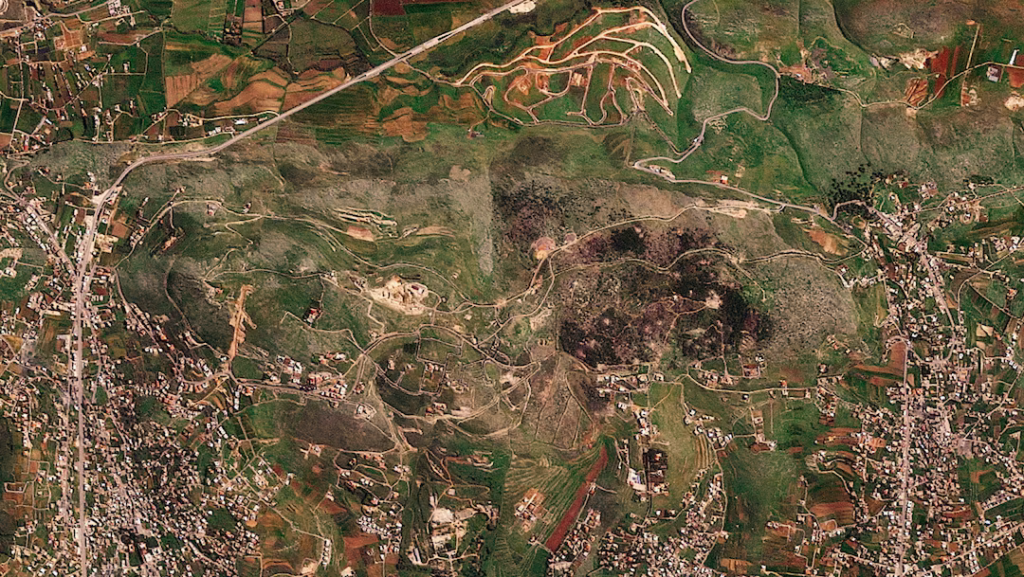
Ali al-Taher rises to a height of around 600 meters, some fifteen kilometres from the Israeli border. Situated to the east of Nabatiyeh, a town with a population of around 40,000 and to the north of the Litani River, the ridge overlooks the main routes towards Iqlim al-Tuffah and the access routes to the western Bekaa. Its position makes it a particularly important observation and control point. On the ground, its significance goes far beyond its topography alone. Ali al-Taher forms a junction between the southern front and the depth of Hezbollah’s defences. Its loss would effectively bring Israeli pressure closer to Nabatiyeh and its Shia hinterland, and push the movement’s line of defence further north. This is what gives the ridge military, territorial and psychological significance.
Hezbollah has always regarded Ali al-Taher as a key position to defend. The clashes in June had already demonstrated this, with several Israeli attempts to approach closer to the high ground being repelled by drones, anti-tank missiles and ambushes. But the stake is primarily political. The movement feared that handing the area over to the Lebanese army, under pressure from Israel, would set a precedent. After Ali al-Taher, other positions north of the Litani River, towards Rihane or Jabal Safi, could in turn come under attack. A local concession would then risk being perceived as the start of a gradual dismantling of its defences. It is probably this point that best explains Hezbollah’s intransigence. Within the movement’s political and social context, Ali al-Taher is no longer viewed as just one position amongst many. It has become a potential precedent. Surrendering this high ground under Israeli military pressure would amount to acknowledging that Israel can, position by position, push Hezbollah’s military presence further north. The question, therefore, is not merely whether the hill can be defended militarily, but how far the movement is prepared to retreat without giving the impression that its entire territorial structure is beginning to unravel.
The party also cites Resolution 1701, which stipulates that no armed forces other than those of the Lebanese State and the UNIFIL may be present between the Blue Line and the Litani River. As Ali al-Taher is situated north of the river, Hezbollah believes that Israel is seeking to extend its security demands beyond this area. This argument remains incomplete, as Resolution 1701 also reiterates the commitments relating to the disarmament of armed groups.
But this contradicts Beiruth’s policy
The domestic legal situation has changed significantly since the start of 2026. Last March, following Hezbollah first strikes against Israel in retaliation for the assassination of Ali Khamenei, the Lebanese Council of Ministers, decided to ban Hezbollah’s military and security activities, to require it to hand over its weapons to the state, and to instruct the army to implement the process of establishing a state monopoly on arms, including north of the Litani River. The continued existence of an autonomous military infrastructure at Ali al-Taher is therefore no longer merely a matter of a dispute over the interpretation of Resolution 1701. It directly contradicts the decision taken by the Lebanese government. Furthermore, in September 2025, the Lebanese army had presented the “Shield of the Nation” (Dir’ al-Watan) plan to the government with a view to establishing a state monopoly on weapons. It provided for the gradual recovery of weapons held by armed groups, primarily Hezbollah, across several geographical areas. The first phase concerned the area south of the Litani River, where the army extended its control, dismantled infrastructure and seized weapons. The second phase was to extend to the area between the Litani and Awali River. The subsequent phases are then to cover Beirut and its suburbs, followed by other regions of the country as far as the Bekaa Valley.
On the ground, this divergence between Beirut’s interpretation and that of Hezbollah now appears to be one of the central elements of the issue. The conflict is no longer simply a clash between Israel and the Shia party. It also lays bare the gap between a state that claims to want to regain control over the issue of weapons and an organisation that continues to regard certain positions as directly pertaining to its own security. Ali al-Taher thus serves as a barometer of the crisis of authority currently gripping Lebanon. The issue is no longer simply a matter of who controls a hill, but who has the legitimate authority to decide on its military use.
Presence of the Revolutionary Guards ?
The alleged presence of members of the Islamic Revolutionary Guards Corps is probably one of the most sensitive aspects of the battle. Several sources reported on 3 September that more than a dozen of IRGC members, including at least two senior officers, were present in the underground facilities alongside Hezbollah. However, this information has not been independently confirmed. Beyond its formal verification, the hypothesis is significant. In the Nabatiyeh area, it reinforced the idea that Ali al-Taher is not merely a Hezbollah position, but also a key link between the movement’s military infrastructure in Lebanon and its Iranian backing. Tehran’s stance shows, in any case, that Iran attached particular importance to the fate of the hill. Iran is said to have sent a warning to the United States via Oman in mid-August, stating that a large-scale Israeli offensive against Ali al-Taher would trigger a significant Iranian response. The very fact that Tehran raised the issue of Ali al-Taher to the level of its confrontation with Washington shows that the ridge goes beyond merely serving as a local defence for Hezbollah.
However, we must avoid reducing the possible presence of IRGC members to that of fighters who came to temporarily reinforce Hezbollah units. The very nature of the infrastructure described to Ali al-Taher suggests a different interpretation. If this were indeed a site combining command, communications, drones and underground capabilities, the Iranian presence would likely have been driven less by a desire for direct engagement than by a role of supervision, advisory support, and operational coordination. This is also what seems to be indicated by the changes in Hezbollah’s internal operations observed since early March 2026. The movement has reverted to a much more clandestine mode of organisation, characterised by greater compartmentalisation between its political and military structures and a reduction in the usual channels of communication.
From discussions and information gathered on the ground, it appears that the military branch operates around a more tightly knit command structure, within which Iranian officers seem to have regained a more direct role in the planning and coordination of operations.
The war of attrition imposed by Israel
For several weeks, Israel appears to have favored a strategy of attrition rather than a direct assault on the tunnels. Israeli forces have gradually tightened their control on the surrounding terrain and maintain heavy air and artillery pressure. Efforts have also been reported to isolate the entrenched fighters and make it more difficult to resupply the position. Topography helps to explain this timeline. Ali al-Taher is not easily taken quickly, especially if the enemy has tunnels, hideouts and routes for moving deep into the territory. What we are seeing in the conduct of the Israeli operation is more in line with a stratège of gradual attrition than with that of a decisive assault. The aim is to cut off access routes, monitor movements, maintain pressure, wear down the position and only launch a ground advance once the cost has become acceptable. This method also speaks to Israël caution when faced with a site which it suspected was both tactically valuable and politically sensitive.
That caution can also be explained by the cost of an underground battle, but also by the Iranian risk. If IRGC officers were indeed in the tunnels, their death or capture could have turned a battle between Israel and Hezbollah into a further direct confrontation between Israel and Iran. The warning conveyed by Tehran via Oman must be viewed in this context. Israel now claims to have succeeded in neutralising the main underground facility. However, ‘operational control’ and long-term territorial occupation are two different concepts. The complex geography of the mountain range, the routes of movement from Iqlim al-Tuffah and Hezbollah’s ability to carry out attacks from a distance mean that a one-off military victory does not necessarily guarantee the permanent securing of the area.
What about the post-Ali al-Taher era?
At this stage, Ali al-Taher appears to embody the current situation in Lebanon. For Hezbollah, the challenge is to maintain a line of defence and, above all, to prevent any local concession from being interpreted as the start of a wider dismantling of its structure. For the Lebanese state, the battle serves as a reminder that the monopoly on arms is no longer merely a political slogan, but an issue that is now being played out in concrete terms on the ground. For Iran, it tests the ability of its main ally in the Levant to hold on to positions deemed essential. And for Israel, it raises the question of how far to push its advance north of the Litani river without openly crossing the line into establishing a new security zone. For Hezbollah, retaining to reconquering Ali al-Taher would, first and foremost, enable it to maintain a dominant position in front of Nabatiyeh and Iqlim al-Tuffah. Preventing Israel from establishing a foothold there would also demonstrate that its advance into southern Lebanon is facing limits. On the other hand, the loss of the ridge would weaken one of the defence lines north of the Litani River and could increase pressures on other infrastructure controlled by the movement.
For Iran, the issue is different but related. If the IRCG’s presence and its involvement in the operation are confirmed, the loss of Ali al-Taher would constitute a setback for its strategic depth in Lebanon. The importance Tehran attaches to the site and the warning issued to Washington shows, in any case, that this is not merely an internal matter for Hezbollah. For Israel, a sustained occupation of Ali al-Taher would offer the clearest military advantage. It would enable it to consolidate control over several hilltops and bring its forces closer to Nabatiyeh and deep into Hezbollah’s territory. But this advance would also alter the political nature of the operation. The more the captured positions are incorporated into a permanent “security zone”, the closer Israel comes to establishing a new zone of occupation in southern Lebanon rather than merely conducting a campaign to destroy Hezbollah’s infrastructure.
This situation is in direct conflict with the other aspect of Resolution 1701. Whilst the resolution calls for the disarmament of armed groups and the deployment of the Lebanese state, it is also based on respect for Lebanon’s sovereignty and territorial integrity. The Lebanese army regularly asserts that Israeli incursions, bombings and occupations are hampering its deployment and preventing a return to a stable security situation. It is highly likely that the fate of the town of Ali al-Taher will be addressed during the forthcoming negotiation scheduled for mid-September.