

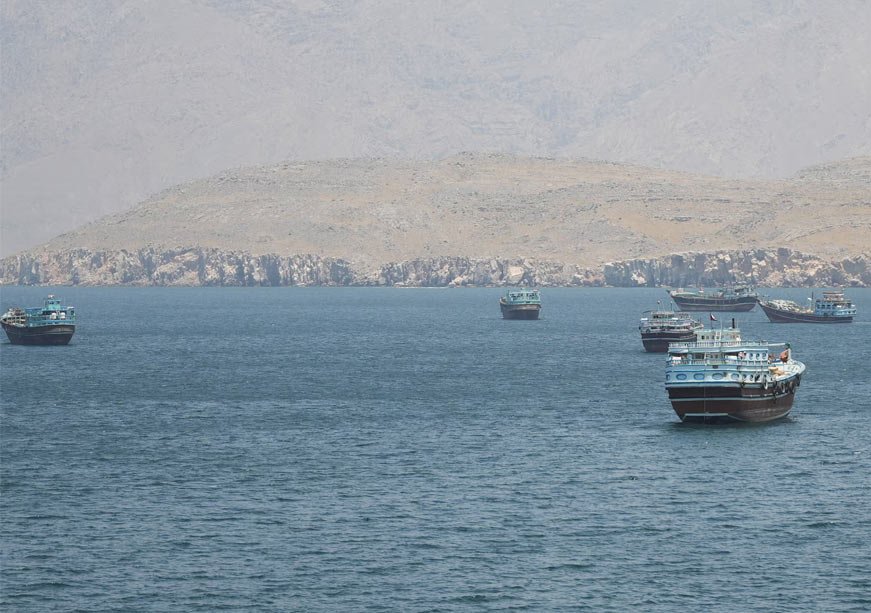

Since February 28, 2026, the Strait of Hormuz has become the theater of a confrontation in which the law of the sea appears, if not torn apart, at least to have its fundamental principles challenged. Iran’s closure of the strait, the American blockage of Iranian ports since April 13, the toll imposed by the Revolutionary Guards around the Larak Island, and the effective collection of the first taxes announced in mid-May by the new Persian Gulf Strait Authority[1]: this sequence of events has not only an economic cost – the price of oil has settled firmly above $95 a barrel – but it also undermines the legal structure patiently built up since 1958. It is, therefore, important to return to the texts, to examine Iran’s position, without complaisance, to define the tool and, above all, to consider a way forward.
I. THE APPLICABLE LAW : THE DUAL OF CONVENTIONAL AND CUSTOMARY FOUNDATION
Hormuz is, beyond serious dispute, a strait used for international navigation. Its geographical configuration, less than 21 nautical miles at the narrowest point, means that its waters fall entirely within the Iranian and Omani territorial sea, established at 12 miles since the entry into force of the United Nation Convention on the Law Of the Sea (UNCLOS) on November 16, 1994[2].
Two regimes coexist in theory. The first is that of transit passage, established by Parts III of UNCLOS (article 34 to 45)[3]. Article 37 makes it applicable to straits connecting two areas of the high seas or an exclusive economic zone – which is precisely the configuration of Hormuz, which connects the Gulf of Oman to the high seas of the Persian Gulf (the EEZs of Iran, Oman, the UAE). Article 38, paragraph 1, provides that transit passage “shall not be impeded”, Article 42 strictly limits the regulatory power of the bordering State (safety of navigation, pollution, fishing, custom), and article 44 prohibits any suspension thereof. Above all, Article 26 prohibits the levying of charges upon a foreign ship “by reason only of their passage” through the territorial sea, a rule that extends a fortiori to international straits[4].
The second regime, is that of innocent passage derived from the Geneva Convention on the Territorial Sea and Contiguous Zone of April 29, 1958 (Article 16, §4), taken up and expanded upon Articles 17 à 26 of the UNCLOS[5]. Originally, it was this regime that applied to strait, as confirmed by the International Court of Justice in the Corfou Strait case[6]: a bordering state cannot, in time of peace, prohibit the passage of foreign ships through a strait used for international navigation. The ICJ established therein a customary principle of universal scope.
Philippe Delebecque, professor emeritus at Paris-Panthéon-Sorbonne, recently recalled this in the international press: freedom of navigation, notably in straits, is an established principle of the law of nations that precedes UNCLOS[7]. Niki Aloupi, professor at Paris-Panthéon-Assas, observed last March in Les Echos that even assuming the entire conventional regime of straits does not have customary status, freedom of navigation itself indisputably does[8].
II. IRANIAN LEGAL FOUNDATION : A DEFENSIBLE, BUT NOT DECISIVE ARGUMENT
Tehran relies on a triple foundation. First, the absence of ratification. Iran signed the UNCLOS on December 10, 1982 but never ratified it. According to the principle pacta tertiis nec nocent nec prosunt (Article 34 of Vienna Convention of 1969)[9], it is therefore not conventionally bound.
Then the interpretative declaration deposited upon signature, based on Article 310 of UNCLOS. Where Iran affirmed therein that the rights derived from Part III, notably transit passage, were “contractual” rights, resulting from a negotiated package deal, which only States parties can avail themselves of[10]. For the others, particularly the United States, which are not parties either, Iran reserves the right to apply the prior regime of the 1958 Geneva Convention, that is to say, mere innocent passage.
Finally, the persistent objection. Iranian doctrine[11] asserts that Iran has constantly and publicly objected to the customary crystallisation of transit passage. This position is reflected in the Act on maritime areas of the Islamic Republic of Iran in the Persian Gulf and the Oman Sea of May 2, 1993, which subjects to prior authorization the passage of warships, submarines and nuclear-powered ships, as well as that of ships carrying dangerous materials, a category in which Tehran readily includes oil tankers. The Iranian Maritime Code of 1964, amended in 2012, is in the same vein[12].
The position is serious but it is also weakened. The near-unanimity of Western doctrine[13] considers that the transit passage regime today reflects customary law, or at the very least that freedom of transit does. Above all, the status of persistent objector requires a consistency and a notoriety of the objection that Iranian practice, oscillating since 1979, does not fully demonstrate. Finally, and this is the blind spot of Tehran’s argument, even within the sole regime of innocent passage, which it claims, the general and discriminatory suspension carried out since February is contrary to the Article 16, §4 of the 1958 Geneva Convention, which precisely prohibits any suspension in international straits[14]. Iran is therefore, conventionally or customarily, at fault with respect to the regime it invokes itself
III. THE LEGALITY OF THE TOLL : AN EDIFICE THAT DOES NOT STAND
The imposition of a toll, whether it be 2 million dollars per ship, one dollar per barrel, or operated for the benefit of the Persian Gulf Strait Authority, is legally untenable, and this under all invocable regimes.
Under the regime of transit passage, Article 26, §1 of the UNCLOS is unambiguous : no charge may be levied “by reason only of their passage”. Its paragraph 2 only authorises charges as remuneration for specific services actually rendered (pilotage, buoyage, rescue, assistance), and on the express condition that they be non-discriminatory. Transit passage being, therefore, “free and uninterrupted” by the effect of Article 38, any financial conditionality distorts its nature. Under the regime of innocent passage claimed by Tehran, the conclusion is identical: Article 18 of the 1958 Geneva Convention, taken up in Article 26 of UNCLOS, prohibits general charges, only authorizes charging for specific services, and imposes non-discrimination. Yet, the Iranian mechanism is discriminatory by design, since it excludes ships “linked” to Israel, the United States, and “aggressor” States. The note addressed to the IMO on March 24, 2026, acknowledges it expressis verbis[15]: this toll is selective.
The analogia with Suez or Panama, sometimes advanced by Tehran, is fallacious. These two passages are artificial canals, built by man, and are governed by specific conventional regimes, Constantinople (1888) for Suez, the Hay-Bunau-Varilla Treaty (1903) the the Carter-Torrijos Treaties (1977) for Panama[16], which authorize the collection of dues in return for investment and management. Hormuz is a natural strait: no human investment justifies its patrimonialization. It must be added that payments made to accounts controlled by Pasdarans, an organisation placed on American and European sanctions lists under counter-terrorism financing frameworks, expose shipowners to criminal prosecution and to the implication of their P&I clubs. Ian Ralby rightly points this out: to pay the toll is to risk sanctions on the entire fleet of a single group[17]. The toll is therefore both illegal and economically treacherous.
IV. TOWARD A « MONTREUX OF HORMUZ » ?
The return to the prior situation of February 2026 is improbable. Once broken, the trust is not rebuilt by the mere invocation of principles. The time has therefore come to conceive an ad hoc conventional regime, in the image of what the Monteux Convention of July 20, 1936 was for the Dardanelles and the Bosphorus.
Let us recall its overall structure. A Convention of 29 articles and four annexes[18], concluded at the initiative of Turkey to revise the status imposed by the 1923Treaty of Lausanne, it restored Turkish sovereignty over the straits while enshrining, in its Article 1, the principle of freedom of transit and navigation. It distinguishes between time of peace and time of war, merchant vessels (Article 2: complete freedom in time of peace) and warships (Articles 8 to 22: notification, tonnages, distinctions between riparian and non riparian powers of the Black Sea). Articles 19 grants Turkey a power of closure to belligerents when it is not itself a party to the conflict. And, a central point for our subject, Article 2 authorises the levying of strictly limited charges in respect of sanitary, buoyage, and rescue services, the rates of which are fixed in the annex. In short, an equilibrium.
The transposition to Hormuz would require difficult but legally feasible political choices:
- Confirmation of the principle of complete freedom of transit for merchant vessels, without flag discrimination, in time of peace;
- A special regime for warships, based on a mechanism of prior notification and tonnage, modeled on Articles 10 to 18 of Montreux
- Joint management by Iran and Oman, under the aegis of the IMO, of the traffic separation scheme and buy-page, with a conventional secretariat and a technical committee;
- The possibility, on a strictly compensatory and capped basis, of service charges (pilotage, signaling, anti-pollution treatment, compensation fund for accident victims), without any link to any passage “toll”;
- A neutralized clause: prohibition of any act of hostility in the strait and an obligation for signatory powers to collectively ensure free movement;
- A dispute settlement mechanism entrusted to the International Tribunal for the Law of the Sea or to ad hoc arbitration.
Such a convention would require that Iran find it beneficial-international recognition, service revenues, exit from ostracism-and that the United States accept a multilateral framework that they have always refused for UNCLOS. It would also require the signature of Oman, the Gulf littoral states, China, India, Pakistan, Russia, and the European Union. Difficult, certainly; impossible, no. Montreux was concluded in less than five weeks of negotiation.
The stakes go beyond Hormuz. If the Iranian toll were to be formalized, nothing would prevent China from attempting to impose a similar regime on the Taiwan Strait, Indonesia on Malacca, Morocco on Gibraltar. It is the freedom of the sea as a global commons that is at stake in the Persian Gulf. The return to stability will be achieved less through frigates than through a demanding legal diplomacy, which remains, for the time being , to be invented.
Notes
[1] Sur les faits de la crise, voir notamment : House of Commons Library, Israel/US-Iran conflict 2026: Reopening the Strait of Hormuz, Research Briefing CBP-10636, mai 2026 ; Lloyd’s List Intelligence, rapports sur le toll booth de l’IRGC autour de l’île de Larak, mars-avril 2026 ; NORTHAM (J), Iran implements new system to collect fees from ships in Strait of Hormuz, NPR, 14 mai 2026 ; Euronews, Iran sets up Hormuz transit authority to charge ships for passage, 18 mai 2026 ; Mer et Marine, L’Iran met en place un contrôle préalable du trafic dans le détroit d’Ormuz, 25 mars 2026.
[2] Convention des Nations Unies sur le droit de la mer (CNUDM), Montego Bay, 10 décembre 1982, NU, Recueil des Traités, vol. 1834, p. 3, entrée en vigueur le 16 novembre 1994.
[3] CNUDM, Partie III, articles 34 à 45 ; v. TANAKA (Y), The International Law of the Sea, Cambridge University Press, 4e éd., 2023.
[4] CNUDM, article 26 (« Droits perçus pour le passage de navires étrangers ») ; v. également, a fortiori, art. 38, §1 sur le caractère « libre et ininterrompu » du passage en transit.
[5] Convention de Genève sur la mer territoriale et la zone contiguë, 29 avril 1958, NU, Recueil des Traités, vol. 516, p. 205, entrée en vigueur le 10 septembre 1964.
[6] C.I.J., 9 avril 1949, Affaire du Détroit de Corfou (Royaume-Uni c. Albanie), fond, Recueil C.I.J. 1949, p. 4.
[7] DELEBECQUE (P), cité par The Associated Press (Frankfurt), repris notamment par PBS News, Iran’s proposal to collect tolls in the Strait of Hormuz violates trade norms, 8 avril 2026.
[8] ALOUPI (N), Détroit d’Ormuz : quel est le droit qui s’applique ?, chronique du Club des Juristes parue dans Les Echos, 25 mars 2026.
[9] Convention de Vienne sur le droit des traités, 23 mai 1969, NU, Recueil des Traités, vol. 1155, p. 331, article 34 (« Règle générale concernant les États tiers »).
[10] Déclaration interprétative de la République islamique d’Iran, déposée à la signature de la CNUDM, 10 décembre 1982, in Multilateral Treaties Deposited with the Secretary-General, ch. XXI, 6.
[11] V. notamment MAHMOUDI (S), Customary International Law and Transit Passage, Ocean Development & International Law vol. 20, n° 2, 1989, pp. 157-174 ; Iran’s Legal Strategy in Hormuz, Völkerrechtsblog, avril 2026 ; Human Rights Institute, The Strait of Hormuz in Light of the 1982 UN Convention on the Law of the Sea, avril 2026.
[12] Loi sur les zones maritimes de la République islamique d’Iran dans le golfe Persique et la mer d’Oman, adoptée par le Majlis le 12 ordibehesht 1372 (2 mai 1993) ; Code maritime iranien, 1964, amendé en 2012.
[13] V. notamment KRASKA (J), The Legal Vortex in the Strait of Hormuz, Virginia Journal of International Law vol. 54, n° 2, 2014, pp. 323-366 ; ORAL (N), Transit Passage Rights in the Strait of Hormuz and Iran’s Threats to Block the Passage of Oil Tankers, ASIL Insights vol. 16, n° 16, 3 mai 2012 ; TANAKA (Y), The International Law of the Sea, op. cit. ; ROSCINI (M), cité par AFP, mars 2026 ; NEVITT (M), Legal and Operational Issues in the Strait of Hormuz: Transit Passage Under Fire, Just Security, 15 mars 2026.
[14] Convention de Genève de 1958, op. cit., article 16, §4.
[15] Note iranienne adressée à l’Organisation maritime internationale (OMI), 24 mars 2026, sur les conditions de transit dans le détroit d’Ormuz ; Plan iranien en 10 points présenté lors des pourparlers d’Islamabad, avril 2026 (rapporté par le New York Times).
[16] Convention de Constantinople sur la libre navigation dans le canal maritime de Suez, 29 octobre 1888 ; Traité Hay-Bunau-Varilla, 18 novembre 1903 ; Traités Carter-Torrijos, 7 septembre 1977.
[17] RALBY (I), Auxilium Worldwide, cité dans NPR, Iran implements new system to collect fees from ships in Strait of Hormuz, 14 mai 2026.
[18] Convention concernant le régime des détroits, Montreux, 20 juillet 1936, SDN, Recueil des Traités, vol. 173, p. 213.