


In Yemen, Iranian-backed Houthi fighters seized control of the Bab el-Mandeb Strait on Friday 11 September. This marks a new upheaval in the region and for the global economy, which is already severely disrupted on the other side of the Arabian Peninsula, around the Strait of Hormuz. We explain the recent developments in the region with Adel Bakawan, Director of EISMENA and a specialist on the Middle East.
Ouest-France (https://www.ouest-france.fr/) Jérémy Breton
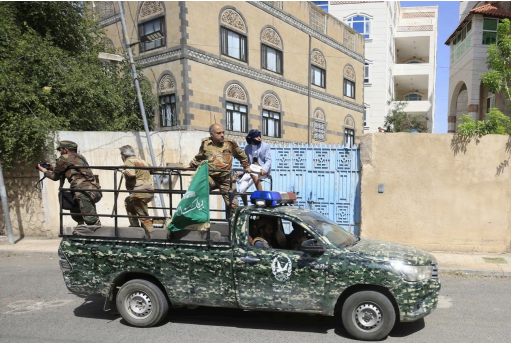
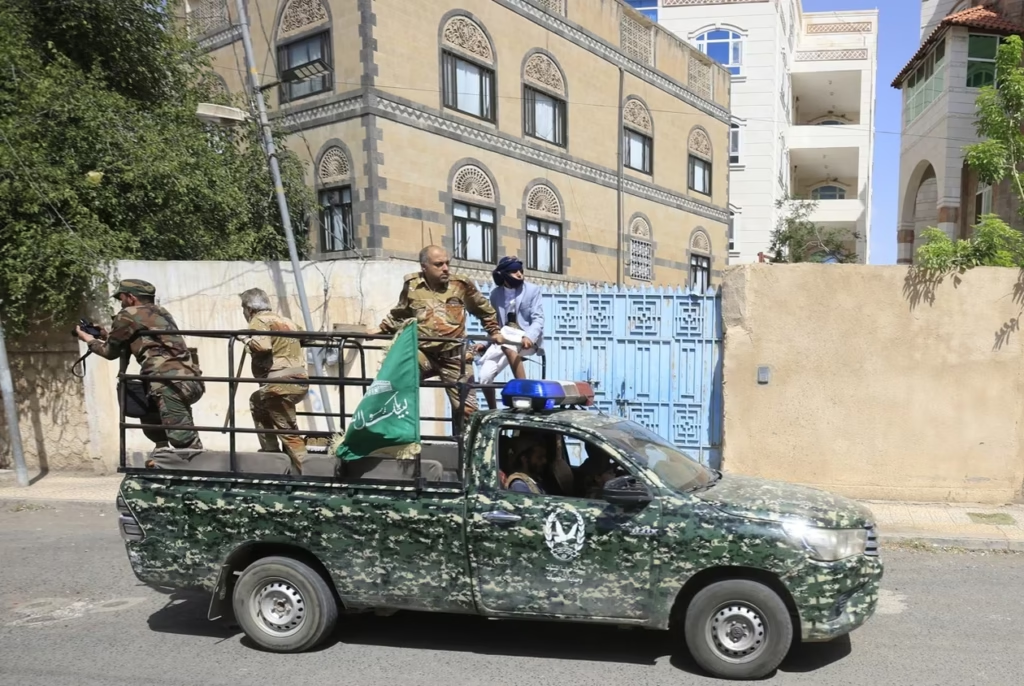
A Houthi police vehicle patrols a street in Sana’a, Yemen, on 10 September 2026, during a campaign to mobilise fighters as part of an offensive against government troops backed by Saudi Arabia. | EPA / YAHYA ARHAB
Yemen is being drawn deeper into the war in the Middle East. A country which has been divided and embroiled in a civil war [1] for over ten years, and has experienced further upheaval in recent days [2]. We take stock of the latest developments in five questions.
Who are the Houthis?
On Friday 11 September, the Houthis – an Iranian-backed group fighting Yemen’s internationally recognised government (supported by a coalition led by Saudi Arabia) – seized the Bab el-Mandeb Strait after taking control of the Yemeni coastline on the Red Sea and the islands at the heart of the strait. This situation led to the flight of Yemeni government forces and air strikes by the Saudi Air Force. The resurgence of fighting has also caused the displacement of nearly 86,000 people [3], the UN reported on Sunday 13 September 2026. In July, the Houthi rebels, who control the Yemeni capital Sana’a, announced a naval blockade in the Red Sea against Saudi Arabia and claimed responsibility for attacks on several of its oil tankers. This armed group is part of the Axis of Resistance, which includes Iran, the Islamist movements Hamas and Hezbollah, and pro-Iranian militias operating in Iraq.
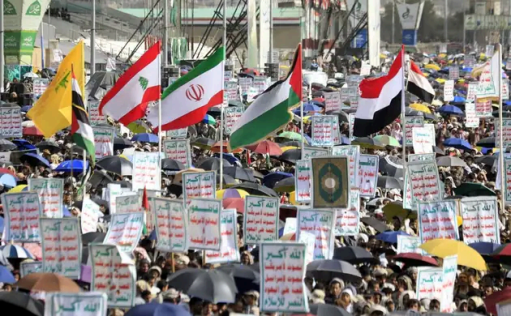
Houthi supporters hold up placards and wave flags of the Iran-backed Axis of Resistance during a demonstration against the United States and Israel in Sana’a, Yemen, on 11 July 2025. | ARCHIVE YAHYA ARHAB / EPA
The Houthi movement, which is Shia, owes its strength “to Iran’s direct intervention”, says Adel Bakawan, Director of the European Institute for Studies on the Middle East and North Africa (EISMENA). “There are senior officers from the Islamic Revolutionary Guard Corps on the ground [in Yemen, Ed.] who are passing on not only their expertise on ballistic missiles and drones but also spare parts” and, above all, “a great deal of money”.
“As such, Yemen has become a battleground for indirect confrontation between Iran and Saudi Arabia [4],” he explains. Following the Beijing agreement in March 2023, relations between Iran and Saudi Arabia normalised. But the war of 28 February, triggered by the Israeli-American offensive against Iran, has thrown the Middle East into turmoil. “One of the consequences of this war is the resumption of conflict in Yemen.”
Why is the Bab el-Mandeb Strait so strategic, and what are the consequences of the Houthis taking control of it?
“The Bab el-Mandeb Strait accounts for 15 per cent of the global economy,” explains Adel Bakawan. Whilst Iran already controls the Strait of Hormuz, situated on the other side of the Arabian Peninsula and through which 20 per cent of the world’s oil passes, the takeover of the Bab el-Mandeb Strait is “an invaluable means of exerting pressure for the Iranians and the Houthis”, according to the author of The Decomposition of the Middle East. Navigation through the Bab el-Mandeb Strait is “safe” for everyone except Saudi Arabia, the Houthis stated on Friday. Indeed, it is Saudi Arabia that appears to be the biggest loser in this situation. According to Adel Bakawan, “it is not in the Houthis’ interest to impose a blockade, but it sends a very important political message to the international community. They are saying: ‘We control 15 per cent of the global economy; you recognise a government that has no control over the Bab el-Mandeb Strait or the capital – the time has come to negotiate with us.’”.
Which actors might be called upon to intervene if the Houthis consolidate their position around the strait?
On 7 August 2026, Saudi Arabia, Pakistan and Turkey signed the Mecca Pact [5] in Islam’s holiest city. A regional security pact, of a defensive nature, which stipulates that its members must come to the aid of one of their own if attacked. A pact of little value, in Adel Bakawan’s view. ‘The Pakistanis and the Turks will never intervene against the Houthis, and by definition, the Iranians. Similarly, if Pakistan were attacked by India, Saudi Arabia would not intervene. No alliance has ever worked in the Middle East in terms of security and defence. A state must take responsibility for its own security; otherwise, it is a fragile state.”
What about the United States?
According to the American media outlet Axios [6], the Crown Prince and ruler of Saudi Arabia, Mohammed bin Salman, rang Donald Trump twice on Thursday to ask him to strike Yemeni fighters, but to no avail. The US President said on Saturday that the Houthis, who had been bombed by the US in 2025 for attacking commercial ships in the Bab el-Mandeb Strait in support of Hamas in its war against Israel, had asked him not to intervene in the war in Yemen. For Adel Bakawan, the situation is crystal clear: “The big loser in this story is Saudi Arabia” and “no country will intervene to defend it against the Axis of Resistance”.
What are the implications for the global economy?
The situation in the Middle East has led to a rebound in oil prices (Brent crude has risen back above $100 a barrel) and a rise in petrol prices at the pump for French motorists. At the time of writing, unleaded 95 has reached its highest level in 2026 at €2.12 per litre. Diesel has risen even higher, to €2.31 per litre. The International Energy Agency (IEA), which no longer believes the Strait of Hormuz will reopen this year, announced on Friday that it was further revising downwards its forecast for global oil demand in 2026. “The ongoing deadlock in negotiations between the United States and Iran is delaying the prospect of a normalisation of flows next year,” it said. Meanwhile, global production is falling by 1.6 million barrels per day, with “more than 10 mb/d of production halted in the Gulf due to security conditions”. Total oil supply “is expected to fall this year, with the anticipated recovery in the Gulf now pushed back to 2027”, according to the IEA. Prices at the pump are therefore unlikely to fall any time soon. A meeting is scheduled for Monday between several foreign ministers from Gulf countries to strengthen security cooperation in the Middle East.
Bibliography:
[1] Angevin Patrick, « Yémen. Quatre questions pour comprendre un conflit qui n’en finit pas », Ouest-France, 23 novembre 2018 https://www.ouest-france.fr/monde/yemen/yemen-quatre-questions-pour-comprendre-un-conflit-qui-n-en-finit-pas-6085416
[2] Ouest-France, « Les rebelles houthistes se sont emparés de l’ensemble de la côte yéménite sur la mer Rouge », Ouest-France, 11 septembre 2026, https://www.ouest-france.fr/monde/yemen/les-rebelles-houthistes-semparent-de-lensemble-de-la-cote-yemenite-sur-la-mer-rouge-b96a1026-adeb-11f1-b773-22a20d9d91fa
[3] Le Bloa Alan, « 85 000 déplacés à cause des combats : l’ONU alerte sur la crise qui s’aggrave au Yémen », Ouest-France, 13 septembre 2026, https://www.ouest-france.fr/monde/yemen/85-000-deplaces-a-cause-des-combats-lonu-alerte-sur-la-crise-qui-saggrave-au-yemen-3d6933f8-af7b-11f1-b773-22a20d9d91fa
[4] Chapleau Philippe, « Analyse. Téhéran face à Riyad : qui sera le champion du golf Persique ? », Ouest-France, 13 septembre 2026, https://www.ouest-france.fr/monde/iran/analyse-teheran-face-a-riyad-qui-sera-le-champion-du-golfe-persique-b7416cbe-af48-11f1-b773-22a20d9d91fa
[5] Boudignon Ceili, « L’Arabie saoudite, le Pakistan et la Turquie ont signé un accord de défense commun », Ouest-France, 7 août 2026, https://www.ouest-france.fr/monde/proche-orient/larabie-saoudite-le-pakistan-et-la-turquie-ont-signe-un-accord-de-defense-commun-f846dc88-924e-11f1-8bae-616c424ae7e0
[6] Barak Ravid, « Scoop: MBS urged Trump to strike Houthis amid Red Sea threat », AXIOS, 11 septembre 2026, https://www.axios.com/2026/09/11/houthis-yemen-saudi-trump-mbs-strikes