


A war between Iran and Israel in the Middle East was, sooner or later, inevitable–yet it began at a moment few anticipated. While many had long foreseen such a confrontation, the exact timing remained elusive. When it finally erupted with Israel’s surprise offensive on Friday, July 13, few paused to ask why the war broke out or what triggered the Israeli attack; the assumption was that the conflict had merely been waiting to ignite. Despite coming to a halt twelve days later under a ceasefire agreement, the deep-seated hostility between the two nations remains unresolved. During the campaign, Israel struck multiple Iranian nuclear facilities and military sites, and carried out targeted assassinations of senior military figures and nuclear scientists.
In fact, the conflict between Iran and Israel dates back to the aftermath of the 1979 Iranian Revolution. Immediately after the uprising, Iran began to perceive Israel as an occupying force in Palestine and repeatedly asserted that “Jerusalem must be liberated from Zionist enemies[1].” In October 1979, Syrian President Hafez al-Assad hailed the Iranian revolution for its anti-Israel stance, declaring: “the Iranian revolution is our revolution and its victory for the Arabs and the Muslims against Israel and Zionism[2]”. The leaders of the Iranian Revolution were well aware that the easiest way to gain sympathy in the Arab world was to support the Palestinians and adopt an anti-Israeli stance. Iranian Foreign Minister Ali Akbar Velayati stated: “…the only way we can fight the Zionist regime is through our aid to Syria, to the Palestinians and to the Muslim groups in Lebanon who are determined to fight on. If we fall on this we will be ridiculed all over the world as do-nothing phrase-mongers [3]”.
Even during the Iran-Iraq War, Iran’s stance on the Palestinian issue played a decisive role in maintaining good relations with Arab states such as Syria and Libya. In 1982, while discussing Iran’s relations with Syria and Libya, Iranian Foreign Minister Ali Akbar Velayati stated: “Our close relations with the regional progressive countries stem from their revolutionary, anti-imperialist, anti-Zionist and anti-reactionary stands. We are convinced that the ties and solidarity with Syria and Libya are a strategic bond[4]”. Following Israel’s invasion of Lebanon in 1982, Iran deployed a thousand members of its Revolutionary Guards to Lebanon in support of the resistance. Alongside this military presence, Iran also worked to strengthen ties between Syria and the Shiites in Lebanon, fostering an alliance with Hezbollah. From its inception, Hezbollah did not merely demand Israel’s withdrawal from Lebanon; like certain radical Palestinian factions, it advocated for the complete eradication of the Israeli state.
Of all the actors in the region, Iran has been the most vocal and uncompromising in advocating for the complete elimination of Israel. Following the Oslo Peace Accords of 1993, most Arab states and Palestinian factions gradually began to recognize the reality of Israel’s existence. Egypt had already signed a peace treaty in 1979, followed by Jordan in 1994. Nevertheless, Iran continued to threaten Israel with annihilation at every opportunity, openly declaring its intent to wipe the country off the map. Israel, in response to these threats, has repeatedly stated that it would not allow Iran to develop nuclear weapons.
From the 1980s through 2024, Iran held the psychological upper hand in the Iran-Israel war of attrition. During this period, Iran waged a relentless proxy war against Israel through its support of Hamas, Hezbollah, and the Houthis in Yemen. Iran was the most explicit supporter of the October 7 attacks. It is important to emphasize that the war which broke out in June 2025 should be regarded as a continuation of the conflict initiated by Hamas on October 7.
Shifting Balances
The collapse of the Assad regime in December 2024 marked a major turning point in the regional balance of power, but it was only one part of a broader shift that significantly strengthened Israel’s strategic position. In parallel, Hezbollah sustained heavy losses, weakening Iran’s most powerful proxy force on Israel’s northern border. With the fall of its key ally in Damascus, Iran’s ability to exert influence in the Levant–and to wage its long-standing proxy war against Israel–was severely compromised, though not entirely eliminated. Together, these developments dismantled a regional axis that had long constrained Israeli power and left Iran’s position in the region increasingly exposed.
In fact, direct military confrontation between Iran and Israel began in earnest in 2024. On April 13, Iran targeted Israeli territory, launching an attack on the Nevatim Air Base in the Negev Desert with 170 drones, 30 cruise missiles, and 120 ballistic missiles. On April 19, Israel retaliated by carrying out airstrikes that destroyed a Russian-made S-300 air defense battery tasked with protecting the nuclear facilities in Isfahan and Natanz[5]. After Iran responded with an attack involving 200 ballistic missiles on October 1, Israel conducted a massive air operation on October 26. Deploying around 100 fighter jets, Israel targeted air defense radars protecting Tehran, anti-aircraft batteries, and key facilities involved in the production of fuel for Iran’s ballistic missiles[6].
Following these strikes, Israel Defense Minister Yoav Gallant declared, “we have demonstrated that Iran is vulnerable.” Notably, Israel had previously considered a similar operation in 2012, but U.S. President Barack Obama reportedly persuaded Prime Minister Netanyahu to stand down at the time. In contrast, the current Israel offensive appears to have been closely coordinated with Washington. President Donald Trump openly stated, “two months ago, I gave Iran a 60-day ultimatum to reach an agreement. They were expected to comply. Today is the 61st day. I made it clear what they needed to do, yet they consistently failed to come to terms.”
The timing of Israel’s July 13 strike–on the 61st day–was clearly not coincidental. While the United States initially declared it would not intervene in the conflict unless Iran directly attacked its forces, this stance shifted rapidly in response to escalating hostilities and what appears to have been prior coordination with Israel. On July 21, 2025, the U.S. launched its own strikes on Iran’s nuclear facilities in Natanz, Isfahan, and Fordow. Though Washington stopped short of entering a full-scale war, these targeted attacks significantly weakened Iran’s nuclear infrastructure and bolstered Israel’s strategic position, signaling a de facto U.S. entry into the conflict on Israel’s side.
Within the first few days of the war, Israel successfully eliminated several of the top-ranking generals in Iran’s command structure and inflicted severe damage on the country’s defense systems. In many respects In both the Six-Day War and the 12-day war with Iran, it was Israel that struck first and hit the most strategic target on the opposing side. Unlike Israel, Iran did not possess a comparably powerful air fleet. Nevertheless, it held an arsenal of ballistic missiles—including Fateh-110, Shahab-3, Kheibar, and Sejjil—as well as drone squadrons. It was widely expected that Iran would inflict heavy damage on Israel using long-range cruise missiles and unmanned aerial vehicles. However, Israel succeeded in significantly diminishing Iran’s offensive capabilities within the first 48 hours of the conflict, effectively gaining control over Iranian airspace.
Israel’s primary objective has been to eliminate Iran’s capacity to develop nuclear weapons. Given that Iran’s nuclear facilities are located 90 to 100 meters(328 ft) underground, it was extremely difficult for Israel to neutralize them entirely through aerial or remote strikes alone. Nevertheless, it was widely believed that U.S. aircraft equipped with “bunker buster” munitions could inflict significant damage on these sites. Although the United States initially adopted a seemingly neutral stance during the early days of the conflict, it abandoned this position on the ninth day of the war by launching strikes on Iran’s nuclear installations. Just two hours after the attack, President Trump issued a statement declaring:
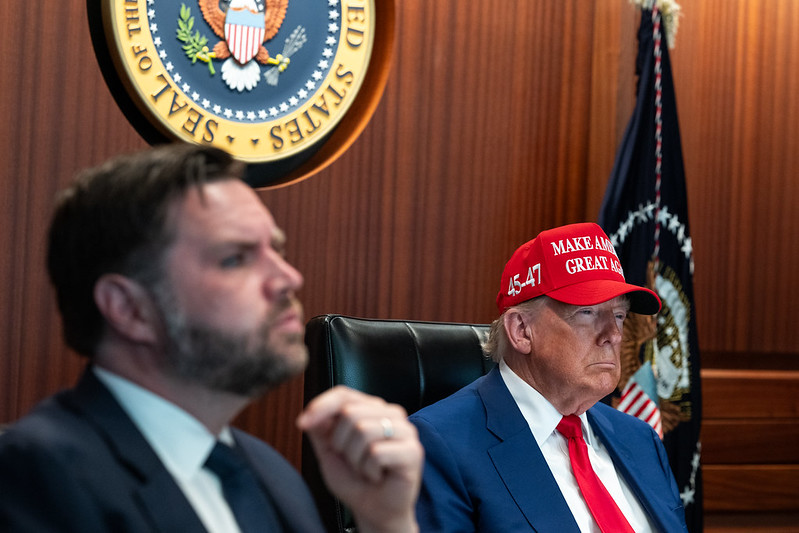
“Iran, the bully of the Middle East, must now make peace. If they do not, future attacks will be far greater and a lot easier.” Following Trump’s remarks, Vice President J.D. Vance further clarified the U.S. position during an interview with NBC News, stating:“We’re not at war with Iran. We’re at war with Iran’s nuclear program… The president has said he wants now to engage in a diplomatic process. … What would make sense is for them to come to the negotiating table, to actually give up their nuclear weapons program over the long term. And, again, if they’re willing to do that, they’re going to find a willing partner in the United States of America[7].”
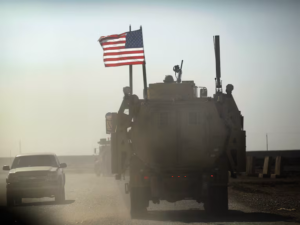
The three U.S. presidents who preceded Donald Trump had each considered launching strikes against Iran, yet for various reasons, none had followed through. Following the U.S. attack, there was curiosity about how Iran would respond. The United States maintains tens of thousands of troops and more than a dozen military bases across the Middle East. These bases have occasionally come under attack by Iran over the years. In January 2020, following the assassination of Qassem Soleimani, Iran launched 16 missiles at the al-Asad airbase in Iraq, injuring dozens of American soldiers. During the same period, Iran also carried out attacks on the U.S. base in Erbil. In January 2024, Iran fired missiles at Tower 22—a U.S. military installation near Tanf in Jordan—killing three American soldiers and injuring many others.
In the aftermath of Qassem Soleimani’s assassination in 2020, Iran’s retaliation was largely symbolic: it launched missile strikes on U.S. bases in Iraq but simultaneously signaled a desire to avoid further escalation. At the time, Tehran sought to demonstrate strength without triggering a broader conflict. The key question now was whether Iran would follow a similar path–or whether it would adopt a more aggressive approach by directly targeting U.S. military positions in the Gulf region and beyond.
A Legacy of Hostility
The U.S.-Iran conflict did not begin with the latest war. Its roots stretch back to 1979, when the Iranian revolution toppled the U.S.-backed Shah and culminated in the hostage crisis at the American embassy in Tehran. Since then, the relationship has been shaped by mutual distrust, punctuated by episodes of covert warfare, diplomatic standoffs, and proxy battles across the region. During the 1980s, while publicly claiming neutrality in the Iran-Iraq War (1980-1988), Washington gradually threw its weight behind Saddam Hussein–supplying intelligence, easing arms transfers, and encouraging Gulf allies to finance Iraq’s war effort. Iran, isolated and under siege, internalized this as an enduring betrayal. Its leadership increasingly saw the U.S. not only as a political adversary but as the architect of a regional order designed to contain, weaken, and, if possible, overthrow the Islamic Republic.
This decades-long animosity was further fueled by direct clashes–most notably the downing of Iran Air Flight 655 by a U.S. warship in 1988–and by Washington’s later designation of the Iranian Revolutionary Guards as a terrorist organization. Iran, in turn, invested heavily in asymmetric warfare through proxies like Hezbollah, and adopted an uncompromising anti-U.S. and anti-Israel posture across the region. Seen in this light, the current war is not simply the result of recent provocations or nuclear fears. It is the product of more than forty years of unresolved tension, mutual suspicion, and a long history of shadow conflict that has now come into the open.
Iran’s Retaliation Against the US
On the ninth day of the Iran–Israel war, following U.S. strikes on Iranian territory, the Iranian parliament voted on July 22, 2025, to close the Strait of Hormuz. A senior Iranian lawmaker, Esmaeil Kowsari, attributed the parliament’s decision to the U.S. attack and the international community’s silence in the face of it. He emphasized that the final decision would rest with the Supreme National Security Council, stating: “The parliament has come to the conclusion that it should close the Hormuz Strait, but the final decision lies with the Supreme National Security Council.”
Iranian Foreign Minister Abbas Araghchi stated on Sunday that the U.S. attack constituted “extremely dangerous, unlawful, and criminal behavior,” warning that it would have “lasting consequences.” One day after Araghchi’s remarks, Iran carried out a retaliatory strike targeting Al Udeid Air Base in Qatar. Iran launched 14 missiles at the base; 13 of them were intercepted mid-air, while one missile fell to the ground. President Trump asserted that the missile that landed was not deliberately intercepted, as it had struck in a “nonthreatening direction.[8]” Iran’s retaliation against the United States remained largely symbolic, much as it did during the Qasem Soleimani incident in 2020. Iran could not afford to engage in simultaneous conflicts with both the U.S. and Israel, as no regime willingly enters a war it knows it cannot win.
Indeed, when Iran’s Supreme Leader Ayatollah Ali Khamenei ordered strikes on U.S. bases in Qatar on Monday, June 23, he explicitly instructed that the attacks should not escalate into a full-scale war with the United States. Before the strikes, Iran had notified its close ally Qatar through intermediaries. In response, Qatar closed its airspace and warned the US to exercise caution. It is well known that Qatar, following the crisis with Saudi Arabia, Egypt, Bahrain, and the UAE between 2017 and 2021, sought closer ties with Iran and attempted to break the political and economic blockade imposed on it, often with mediation from both Turkey and Iran. Although Iran declared that it targeted the base in Qatar because it is the largest U.S. installation in the region and plays a key role in coordinating operations against Iran, the circumstances suggest a degree of tacit understanding between the parties involved[9].
On June 19, President Trump announced that he would give Iran a two-week ultimatum to terminate its nuclear program, stating that if Iran refused to agree to a deal, he would then decide whether to join a war in favor of Israel. Less than a week after this statement, the United States carried out strikes on Iran’s nuclear facilities. Immediately following the bombing, President Trump announced that Iran and Israel had reached an agreement on a ceasefire. President Trump announced on his social media account that Iran and Israel had reached an agreement on a ceasefire: “CONGRATULATIONS TO EVERYONE! It has been fully agreed by and between Israel and Iran that there will be a Complete and Total CEASEFIRE (in approximately 6 hours from now, when Israel and Iran have wound down and completed their in progress, final missions!), for 12 hours, at which point the War will be considered, ENDED! Officially, Iran will start the CEASEFIRE and, upon the 12th Hour, Israel will start the CEASEFIRE and, upon the 24th Hour, an Official END to THE 12 DAY WAR will be saluted by the World…[10]”
The New York Times reported that President Trump first held discussions with the Israeli side and, after securing Israel’s consent, called Qatar’s Emir Sheikh Tamim bin Hamad Al Thani. During this call, he informed the Emir that Israel had signed onto the U.S.-proposed peace plan and asked him to mediate in persuading Iran to do the same. As a result of intensive diplomatic negotiations, Qatar’s Prime Minister Sheikh Mohammed bin Abdulrahman Al Thani managed to convince the Iranian side to accept the terms of the ceasefire[11].
Reflections on the 12-Day War
In the aftermath of the Iran-Israel war, there remain numerous critical questions yet to be answered. One of the foremost questions is whether Israel and the United States succeeded in destroying Iran’s nuclear facilities. Before Israel’s attacks, American intelligence assessments indicated that Iran could build an atomic bomb within three months if it accelerated its efforts. Despite days of Israeli bombardment and the U.S. strikes on three facilities in Iran, experts closely following the issue—and even a report prepared by the Defense Intelligence Agency—suggest that all these operations may have merely delayed Iran’s nuclear program by several months[12]. Furthermore, there have been media reports indicating that Iran relocated a significant portion of its stockpile of highly enriched uranium to undisclosed locations before the strikes[13].
Nevertheless, President Trump and the Israeli Atomic Energy Commission assert that the facilities suffered severe damage and that it would take Iran years to rebuild its nuclear weapons capabilities. The Israel Atomic Energy Commission provided the following assessment: “The devastating U.S. strike on Fordo destroyed the site’s critical infrastructure and rendered the enrichment facility inoperable. We assess that the American strikes on Iran’s nuclear facilities, combined with Israeli strikes on other elements of Iran’s military nuclear program, have set back Iran’s ability to develop nuclear weapons by many years. The achievement can continue indefinitely if Iran does not get access to nuclear material.”
Iran’s ambition to acquire an atomic bomb dates back to the 1950s. The Shah of Iran regarded nuclear activities as an integral part of the country’s modernization efforts. In 1974, Iran established the Atomic Energy Organization and sent engineers abroad for training in nuclear sciences. That same year, Iran signed several agreements with the United States for the purchase of eight nuclear reactors. Also in 1974, Iran reached an agreement with Germany to construct a power reactor in Bushehr. In 1977, Iran entered into another agreement with France for the construction of two reactors in Darkhovin. Iran pursued such agreements not only with Western countries but also signed certain nuclear-related deals with South Africa within this context[14].
During the Iran-Iraq War, however, Iraq’s use of chemical weapons against both Iran and the Kurdish opposition prompted the clerical regime to revive its previously suspended nuclear program. This time, Iran sought to lure back nuclear scientists who had fled abroad, offering them incentives to return[15]. Since 1988, Iran has been working with full determination toward acquiring an atomic bomb. Iran’s aspiration to join the nuclear club is a strategic objective, and the regime is unlikely to abandon this goal easily.
If the aim of the United States and Israel is to prevent Iran from obtaining nuclear weapons, they must be prepared in the coming years to launch further strikes against Iran, because the Iranian regime will not relinquish its nuclear ambitions. In short, the U.S. and Israel face only two options: either accept a nuclear-armed Iran or, as in the case of Iraq, be compelled to launch a second Gulf War to topple a regime they failed to overthrow during the first Gulf War. There is no third alternative for the U.S. and Israel.
When considering the balance of power in the Middle East, it can be argued that, under current conditions, Washington firmly opposes a nuclear-capable Iran that could pose a threat to both Israel and American interests. However, the United States does not seek the collapse of the Iranian regime—so long as it refrains from pursuing nuclear armament—nor does it desire the disintegration of Iran. An Iran that is either excessively powerful or dangerously fragile does not serve American strategic interests in the region. The perceived Iranian threat has long been a primary factor underpinning the Gulf states’ security dependency on the United States. Should the existing balance of power be disrupted, this dependency could weaken, potentially prompting Gulf nations to seek closer ties with U.S. rivals such as China and Russia. Even China, which imports Iranian oil below market prices, is not in favor of lifting sanctions entirely or seeing Iran fully reintegrated into the international community, as it could undermine Beijing’s strategic leverage and economic advantages.
Another significant question is this: How would a war that weakens but does not topple the regime affect Iran? What kind of impact—positive or negative—might such a conflict have on the struggle for democracy within Iran? Is a democratic transformation in Iran even possible?
In 2022 and 2023, hundreds of people who took to the streets under the slogan “Women, Life, Freedom” were brutally massacred by the regime. How would Iran react under similar circumstances in the future? Historical experience shows us that foreign interventions which fail to overthrow a regime often result in that regime adopting even harsher domestic policies. For instance, the Korean War between 1950 and 1953 paved the way for the Kim Il-Sung family to establish a dynastic rule in the country. Since 1948, the Kim family has governed North Korea with an iron fist. Similarly, when the CIA’s Bay of Pigs invasion against Cuban leader Fidel Castro in April 1961 failed, Castro responded by instituting a rigid dictatorship, ruling Cuba until his death.
When external intervention results in the fall of a ruling regime, it often opens the door for the people—especially minority groups—to breathe more freely and establish their own systems of self-governance. NATO’s military intervention in 1999 ended Slobodan Milosevic’s rule in Yugoslavia, bringing an end to the civil war and allowing the peoples of the former Yugoslavia to determine their own destinies. Similarly, had Saddam Hussein not lost power in 2003 as a result of U.S. intervention, the Sunni minority dictatorship in Iraq would likely have remained intact, and a federal Iraq might never have emerged. In 2011, following a NATO-led intervention authorized by the United Nations, the Libyan people were liberated from the wrath of Gaddafi’s regime. In the aftermath, the Amazigh people—known as Berbers—established self-governance and began administering their own regions.
It is evident that the Iranian regime, weakened but not overthrown by Israeli and U.S. airstrikes, will adopt an even harsher stance toward its own people in the coming period. The immediate execution of three Kurdish prisoners accused of being Israeli agents, right after the ceasefire, signals the regime’s future domestic policies. A widespread witch hunt for so-called “Israeli agents” will now likely ensue throughout the country, with even ordinary dissidents facing accusations and potential death sentences under such charges. Since 1979, the regime’s most prominent slogans have been “Death to America” and “Death to Israel,” reflecting its strategic aims of expelling American imperialism from the Middle East and erasing Israel from the map. It seems clear that, for the time being, the regime will temporarily set aside these strategic objectives and focus instead on consolidating its domestic control. Nevertheless, it is almost certain that, at the first opportunity, it will resume pursuing its familiar path.
In short, this latest conflict has dealt a severe blow to Iran’s “Shia Crescent” ambitions and Neo-Persian geopolitical project. For years, the clerical regime has sacrificed the nation’s resources in pursuit of ideological goals. Since the 1980s, Iran has waged a proxy war against Israel through affiliated forces beyond its borders, but ultimately, the war was brought into its own territory.
The 12-day Iran-Israel war shook the prestige of the Iranian regime more deeply than the eight-year Iran-Iraq war. The long-held belief that Israel and the United States could not strike Iran on its own soil, and that any attack on Iran would prompt it to turn the world into a living hell through acts of terror, has been thoroughly shattered. Trump secured his place in history as the first U.S. President to launch a direct strike against Iran.
Notes
[1] R. K. Ramazani, R. K. (1983). “Khomeini’s Islam in Iran’s Foreign Policy”, Adeed Dawisha (Ed.), In Islam in Foreign Policy, Cambridge: Cambridge University Press, 1983, pp. 9-33.
[2] Mark L. Haas, The Clash of Ideologies, Middle Eastern Politics and American Security, Oxford University Press 2012, p.75.
[3] Jubin Moazami Goodarzi, The formative years of the Syrian Iranian alliance: power politics in the Middle East 1979-1989, Unpublished thesis, Department of International Relations the London School of Economics, 2002, p. 119.
[4] Jubin Moazami Goodarzi, The formative years of the Syrian Iranian alliance: power politics in the Middle East 1979-1989, p.163.
[5] Samuel Forey, “Israel-Iran conflict: How Israel gained air superiority over Tehran,” Le Monde, June 18, 2025.
[6] “100 jets, 20 targets: How Israel hit Iran’s military, drone facilities,” India Today, Oct. 28, 2024
[7] David Ignatius, “Trump’s Iran strike was clear and bold. The aftermath could be far messier,” The Washington Post, 22 June 2025
[8] “Israel and Iran said to reach cease-fire,” The New York Times, Tuesday June 24, 2025
[9] Franz Fassihi, “The Victor of Them All? Three Nations Say ‘Me,’” The New York Times, Wednesday June 25, 2025
[10] CBC News, June 24, 2025
[11] “Israel and Iran said to reach cease-fire,” The New York Times, Tuesday June 24, 2025
[12] “Israel- Iran truce in Place as Trump scolds them both,” The New York Times, Wednesday, June 25, 2025
[13] Max Boot, “Iran’s nuclear program is damaged, not obliterated,” The Washington Post, June 26, 2025
[14] Gawdat Bahgat, “Nuclear Proliferation: The Islamic Republic of Iran, Iranian Studies, Volume 3,September 2006
[15] Judith Perera, “Iranian Nuclear: The Battle of Bushehr,” Energy Economist,223 (2000), p.17-2