

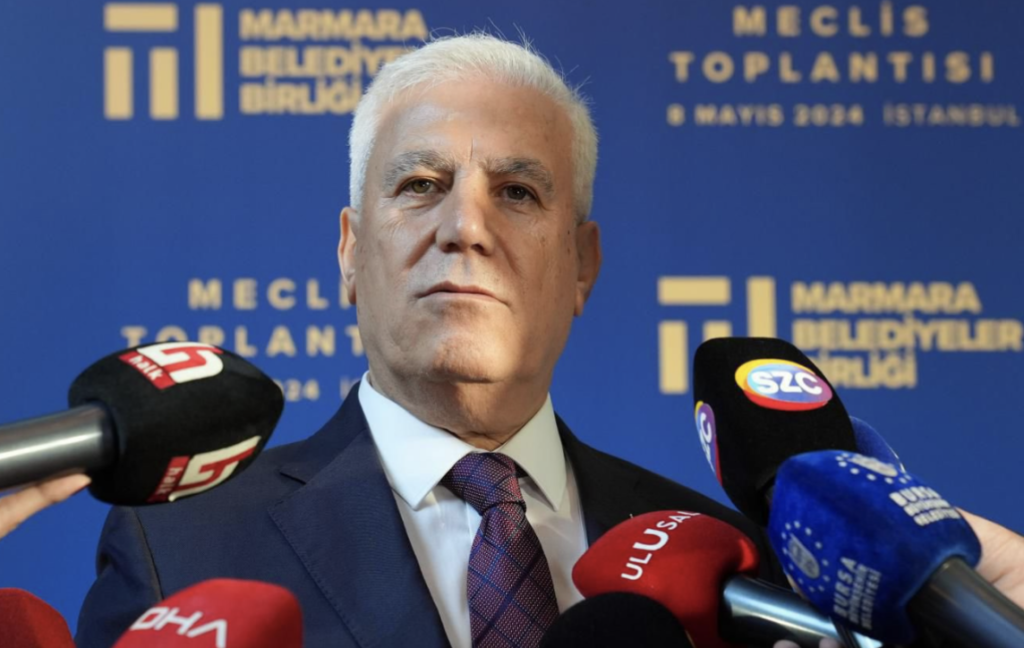

On April 4, 2026, Mustafa Bozbey, the mayor of Bursa elected in 2024 with 47% of the votes, was arrested and detained as part of an investigation for “leading a criminal organisation”. A few days later, on April 9, the municipal council of Turkey’s fourth-largest city elected Şahin Biba, an AKP-backed candidate, as interim mayor to replace him. The session was marked by a notable dynamic: the CHP, the main opposition party to which Mustafa Bozbey belonged, has refused to field a candidate.
While attention has long been focused on the arrest of Ekrem İmamoğlu, further shifts continue to unfold across the municipalities. Bursa is not an isolated case. During the same week, 59 individuals linked to CHP-run municipalities were simultaneously taken into police custody across four cities: Üsküdar (Istanbul), Yenişehir (Mersin), Bolu and Bornova (Izmir). Eleven of them were subsequently incarcerated. In a single week in April 2026, several major Turkish municipalities thus underwent a change in leadership without any election taking place. According to the municipal workers’ union Tüm Bel Sen, the overall toll since March 2024 is staggering : 85 municipalities have changed hands through trustee appointments, dismissals, arrests and municipal council flips.
İmamoğlu, the tree hiding the forest
In the early hours of March 19, 2025, around a hundred police officers surrounded the residence of Ekrem İmamoğlu, who was re-elected mayor of Istanbul in March 2024 with over 51% of the vote. Approximately 106 other individuals were simultaneously apprehended as part of the same operation led by the Istanbul Chief Public Prosecutor’s Office. The charges were manifold: leading a criminal organisation, corruption, rigging of public tenders, as well as providing alleged assistance to the PKK terrorist organisation. As part of this same investigation, Mehmet Murat Çalık, the mayor of Beylikdüzü, and Resul Emrah Şahan, the mayor of Şişli, were also targeted.
What is striking is that, beyond its media impact, İmamoğlu’s arrest is not an isolated incident, but rather the culmination of a sequence set in motion several months earlier. For instance, it is worth recalling that as early as October 30, 2024, Ahmet Özer, the CHP mayor of Esenyurt (Istanbul) elected with 49% of the vote, was arrested for “membership in PKK terrorist organisation”. The following day, the Ministry of Interior appointed the Deputy Governor of Istanbul, Can Aksoy, as a kayyum[1] Can Aksoy. On January 17, 2025, Rıza Akpolat, the mayor of Beşiktaş, was in turn incarcerated for “membership in a criminal network, rigging of public tenders, and illicit enrichment”. On March 3, 2025, Alaattin Köseler, the mayor of Beykoz, was remanded in custody for “rigging of public tenders and membership in a criminal organization.” His interim replacement, CHP councillor Özlem Vural Gürzel, would later resign from the party in September 2025 and defect to the AKP, leading to a political flip of the municipality without any election taking place.”
The dynamic extends far beyond Istanbul. On July 5, 2025, three mayors of major cities were arrested as part of the same investigation that had led to İmamoğlu’s incarceration. Zeydan Karalar (Adana, population 1.5 millions) and Muhittin Böcek (Antalya, population 2.7 millions) were incarcerated in the following days and immediately dismissed from office, replaced by CHP councillors elected in an emergency session by their respective municipal councils. The third arrested mayor, Abdurrahman Tutdere in Adıyaman, was released under judicial supervision and was able to resume his duties.
That same week, the former mayor of Izmir Tunç Soyer, was incarcerated over alleged irregularities in public tenders involving the municipal subsidiary İZBETON[2]. Two months earlier, on May 31, five other district mayors in Istanbul had already been arrested and dismissed from office in a single day as part of this same investigation : Hasan Akgün (Büyükçekmece), Hakan Bahçetepe (Gaziosmanpaşa), Utku Caner Çaykara (Avcılar), Kadir Aydar (Ceyhan) et Oya Tekin (Seyhan).
Yet, these examples provide only a glimpse, as the overall toll -as documented by the Turkish news portal T24 – is staggering: between March 2024 and the spring of 2026, twenty CHP mayors were incarcerated, nineteen were dismissed by the Ministry of the Interior, and three municipalities had a state-appointed trustee directly imposed upon them. However, while 85 municipalities have changed hands over the span of two years, this is also due to mid-term party switching: several mayors, elected under the CHP banner, have defected to the AKP without returning to the ballot box.
Adapt or disappear : Partisan Reconfigurations Under Coercion
Furthermore, faced with judicial pressure, it is also worth noting that a significant proportion of local opposition officials have opted to switch allegiance to the ruling party. According to data compiled by the daily Türkiye fifty-six mayors from various opposition parties joined the AKP between March 31, 2024 and August 2025.
The most high-profil defection was that of Özlem Çerçioğlu. Mayor of Aydin since 2009 and a national figure within the CHP, she had run under the party’s banner in 2024. On August 14, 2025, during the AKP’s 24th anniversary, she announced her resignation from the CHP and attended the ceremony at the party headquarters in Ankara: it was Erdoğan himself who pinned the AKP badge on her lapel. She stated: “From now on, under the President’s protection, I will continue to serve Aydin.” Alongside her, the mayors of Söke (Mustafa İberya Arıkan), Sultanhisar (Osman Yıldırımkaya), Yenipazar (Malik Ercan), Gaziantep-Şehitkamil (Umut Yılmaz), and Yalova-Altınova (Yasemin Fazlaca) followed suit, bringing the total number of defections that day to nine.
CHP leader Özgür Özel publicly claimed that Çerçioğlu had been subjected to a form of blackmail : “she was told that she had worked with Aziz İhsan Aktaş ; either she joins our party ; or she goes to prison”. Çerçioğlu herself neither confirmed or denied this account, citing instead “internal problems” with her party’s leadership.
When a mayor is arrested and dismissed from office, it is the municipal councillors that elect an interim replacement. Consequently, this is where a secondary mechanism for reclaiming control plays out. For instance, in Bayrampaşa (Istanbul), following the arrest of CHP mayor Hasan Mutlu in September 2025, a court invalidated the initial council vote won by the opposition, allowing the AKP to seize control of the district during a second ballot. From his prison cell, Hasan Mutlu commented: “The will of Bayrampaşa has been openly confiscated. We were illegally imprisoned because we refused to bow to pressure to join the AKP.
To cite another example, it is worth recalling that in Gaziosmanpaşa, following the dismissal of Hakan Bahçetepe (mayor of Gaziosmanpaşa) on June 5, 2025, AKP councillor Eray Karadeniz was directly elected interim mayor by the council on June 11. In this regard, Adana municipal councillor Sitki Keskin told AFP: “In certain places where mayors have been arrested, councillors have been coerced into resigning in order to surrender their majority to the AKP, thereby allowing it to dictate who will be appointed deputy mayor. It can take an even more radical form: that of the kayyum, a civil administrator appointed directly by the state, who wields the power to dissolve the council and overturn the political orientations chosen by the voters. Initially confined to pro-Kurdish municipalities in Southeastern Anatolia—where 160 such appointments have been made since 2015—this mechanism is now being extended to the CHP: Esenyurt in October 2024, followed by Şişli in March 2025, mark the first such instances in Turkey’s republican history. Where indictments center on corruption rather than “terrorism”, the sole legal basis for a kayyum in the strict sense, an AKP-controlled municipal council takes over, as seen in Gaziosmanpaşa or Bursa. In both scenarios, the political outcome remains identical: the will of the electorate is neutralized.
Beyond the arrest of Ekrem İmamoğlu and the public outcry it provoked, a far deeper reconfiguration of municipal power is underway. Coerced defections, flipped municipal councils, and the expansion of state-appointed trustees (kayyum) beyond Kurdish regions: the mechanisms are manifold, but their underlying logic is singular: to reduce the opposition to a mere formal presence devoid of any real grip on local territories. The 85 municipalities that have changed hands since March 2024 without a single election taking place serve as the starkest concrete measure of this phenomenon.
The timing of these events is not without context: the Trump administration’s complacency toward authoritarian leaders, international attention monopolized by the crises in Ukraine and the Middle East, and the peace process with the PKK may have emboldened the regime in its strategy. Yet, resistance has not collapsed: the spring 2025 protests, the largest since Gezi in 2013, along with the reactions of the Parliamentary Assembly of the Council of Europe and various European capitals, have partially curbed this shift. It remains to be seen what long-term scars these developments will leave, not only on the country’s institutional balance, but also on voters’ confidence in the true weight of the local ballot.
Notes
[1] Un kayyum est un administrateur nommé par l’État pour remplacer un élu local, généralement après sa destitution ou son arrestation, sans passer par une nouvelle élection.
[2] İZBETON est une société de travaux publics filiale de la mairie métropolitaine d’Izmir. Le parquet d’Izmir a lancé le 1er juillet 2025 une enquête pour “truquage d’appels d’offres et escroquerie qualifiée”, visant 157 personnes dont Tunç Soyer, maire d’Izmir de 2019 à 2024.