

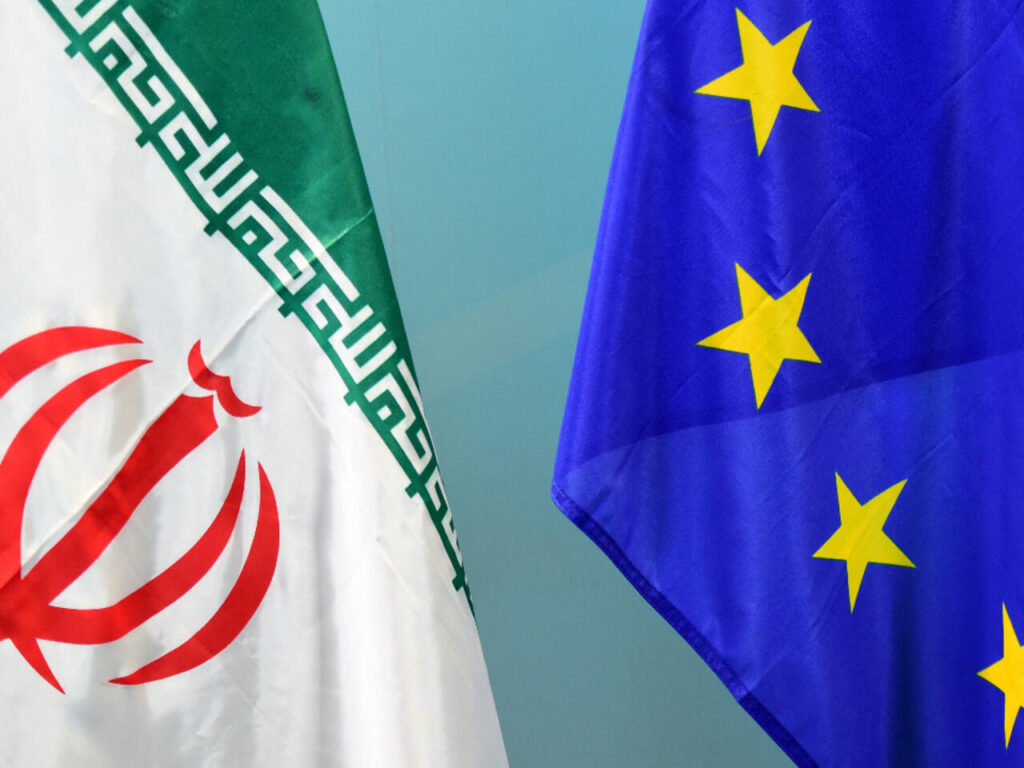

Operation Epic Fury has confronted the European Union with a crisis for which it has no institutional template: a major war launched by its most important security partner, without consultation, that has killed 168 schoolgirls in Minab, struck hospitals documented by WHO and the Iranian Red Crescent, destroyed six UNESCO World Heritage sites, and targeted water and power infrastructure serving millions of civilians. All without a single EU condemnation, ICC referral, sanctions package, or official statement naming these acts. This article analyzes EU policy through three complementary theoretical frameworks. Liberal Intergovernmentalism, Normative Power Europe, and Complex Interdependence across four empirical dimensions: the systematic double standards in EU responses compared to Ukraine; member state fragmentation; the NATO and strategic autonomy questions; and the energy security crisis. The central argument is that the EU’s silence on Iranian civilian casualties and infrastructure destruction does not merely represent a political failure. It constitutes the most damaging self-inflicted wound to European normative credibility since Rwanda, and one whose consequences for the EU’s claims to principled international leadership will outlast the current conflict by decades.
Three Frameworks, One Crisis
The EU’s response to the Iran war of 2026 cannot be adequately understood through any single theoretical lens. Liberal Intergovernmentalism explains why the Union cannot speak with one voice. Member states have incompatible national interests that Brussels cannot override. Normative Power Europe theory explains why the EU cannot endorse the war. Doing so would destroy the normative credibility on which its entire claim to international influence rests. Complex Interdependence explains why it cannot disengage. Overlapping dependencies on American security guarantees, Persian Gulf energy supplies, and institutional frameworks make clean geopolitical positioning structurally impossible. Nevertheless, none of these three frameworks adequately explains the EU’s most consequential failure. Its silence in the face of documented civilian mass casualties, hospital strikes, and cultural heritage destruction that would, if committed by Russia or any other adversary, have triggered the full machinery of European normative condemnation.
Andrew Moravcsik’s Liberal Intergovernmentalism holds that EU outcomes reflect bargaining between member states pursuing nationally defined interests, and that EU institutions cannot override state preferences. The theory generates a clear prediction for the current crisis. Incompatible member state interests will produce a lowest common denominator institutional response that obscures rather than resolves underlying divergences. This prediction is empirically confirmed. Kallas’s formulation “this is not our war” is not a strategic choice but a declaration of institutional incapacity dressed in the language of principle. The March 4 emergency foreign ministers meeting produced no condemnation of the strikes, no mention of Minab school, no discussion of civilian casualties because Germany would not sign such a statement and the EU requires consensus. The intergovernmentalist framework explains the silence structurally. It is the price of institutional cohesion among states with irreconcilable preferences.
Ian Manners’s Normative Power Europe concept holds that the EU’s distinctive influence derives from promoting norms like rule of law, multilateralism, human rights, rather than military or economic power. This framework illuminates the depth of the EU’s self-inflicted credibility wound. The Union has built its entire claim to international leadership on the consistency and universality of its normative commitments. When Russia killed civilians in Bucha, the EU responded within 72 hours. When US-Israeli strikes killed more than 168 students in Minab, the EU said nothing. Manners’s framework does not merely predict this inconsistency it identifies it as categorically self-defeating. A normative power that applies its norms selectively, according to the identity of the violating state rather than the nature of the violation, has ceased to be a normative power. The global South, the Arab world, and Iran’s population have noticed and the credibility cost will be measured in decades.
Keohane and Nye’s Complex Interdependence framework captures the EU’s energy and security traps with precision. Europe is simultaneously energy-dependent on Persian Gulf States, security-dependent on NATO, and institutionally committed to the rules-based order that Epic Fury has violated. These overlapping dependencies make clean geopolitical positioning structurally impossible. However, interdependence does not justify silence on mass civilian casualties. The EU’s energy dependence on Qatar does not explain why it has not condemned the Minab killings. Its security dependence on Washington does not explain why it has not requested an ICC preliminary examination of the hospital strikes. These silences are choices, not structural necessities and they are choices whose long-term costs to European credibility exceed any short-term benefit from avoiding friction with Washington.
The Double Standards: A Systematic Comparison
The most analytically and morally consequential dimension of EU policy in the current crisis is the systematic divergence between its response to comparable acts committed by adversaries primarily Russia and its response to the same acts committed by allies in the current conflict. This divergence is not a matter of degree but of categorical difference.
Table 1: Response to Comparable Acts, Russia/Ukraine vs. US-Israel/Iran
| Incident | EU response: Russia/Ukraine | EU response: US-Israel/Iran 2026 |
|---|---|---|
| School children killed | Bucha massacre (Russia, April 2022): EU imposed sweeping sanctions within 72 hours. ICC referral. Asset freezes on 1,000+ officials. Von der Leyen visited Kyiv personally. Named as war crime in 14 subsequent EU Council conclusions. | 168 schoolgirls killed in Minab by US-Israeli airstrike, March 3, 2026: No EU sanctions. No ICC referral. No emergency session. Kallas described Iran as primarily responsible for the escalation three days after Minab. No EU official visited affected families. |
| Hospitals struck | Russian strikes on Ukrainian hospitals (2022-24): EU condemned as war crimes at every UNSC session. Established damage registry. Funded WHO emergency response. Used as primary evidence for ICC jurisdiction argument. | Strikes on Iranian hospitals documented by WHO and Iranian Red Crescent across Tehran, Isfahan, Ahvaz, Khorramabad (Feb-March 2026): No EU condemnation. No damage registry. No emergency WHO funding. Not raised at March 4 foreign ministers emergency session. |
| Civilian infrastructure | Russia strikes on Ukrainian power grid (winter 2022-23): EU activated emergency energy solidarity mechanism. Designated strikes as war crimes. Funded IAEA monitoring missions. Led international coordination of emergency generator supply. | US-Israeli strikes on Iranian water, power, and fuel infrastructure serving civilian populations (March 2026): No EU war crimes designation. No IAEA monitoring request. Macron called for moratorium only after Iran retaliated against Persian Gulf energy, not after Iranian civilian infrastructure was first struck. |
| Violation of international law | Russia invasion of Ukraine: EU declared violation of UN Charter. Expelled Russia from Council of Europe. Referred to ICJ. Cut SWIFT access for major Russian banks. Imposed 14 rounds of sanctions including oil embargo. Froze 300 billion euros in sovereign assets. | Operation Epic Fury (no UNSC authorization, launched during active diplomacy): EU legal services confirmed violation of international law internally. Public EU statement: expressed concern about Iran. No sanctions. No ICJ referral. No SWIFT action against US or Israel. |
| Cultural heritage | Russia destroys Ukrainian cultural sites (2022-24): EU established UNESCO-coordinated damage registry within weeks. Funded emergency conservation. Raised at Security Council as potential war crimes. Named in EU sanctions justifications. | Six UNESCO World Heritage sites damaged including Golestan Palace, Chehel Sotoun frescoes, Falak-ol-Aflak Citadel (Blue Shield emblem present at strike): No EU statement. No UNESCO emergency meeting called. No damage registry. |
The Minab massacre demands particular analytical attention because it is the single most morally legible incident of the conflict and the one whose silence most directly indicts EU normative credibility. On March 3, 2026, a US-Israeli airstrike on the southern Iranian city of Minab killed 168 students. The incident was documented by independent journalists, verified by the Red Crescent, and reported across international outlets from the New York Times to Al Jazeera. In the 48 hours following the Bucha massacre in April 2022, EU foreign ministers issued a joint statement, the European Council called an emergency session, von der Leyen visited Kyiv, and the EU began designing what became its fifth sanctions package against Russia. In the forty-eight hours following the Minab massacre, no EU institution issued any statement naming the incident. Foreign policy chief Kallas described Iran as “primarily responsible for the escalation” and delivered three days after 168 children were killed by allied strikes. This represents a moral and political failure of historic proportions.
The hospital strikes deserve equally careful documentation. WHO field teams and the Iranian Red Crescent confirmed damage to medical facilities in Tehran, Isfahan, Ahvaz, and Khorramabad in the first two weeks of the conflict. Under International Humanitarian Law specifically Article 18 of the Fourth Geneva Convention and Rule 28 of the ICRC Customary IHL Study, attacks on medical facilities are prohibited unless they are being used for military purposes incompatible with their humanitarian function. The US and Israel have not claimed the struck hospitals were used for military purposes. EU legal services confirmed internally that the strikes appeared to violate IHL. No public statement was issued. By contrast, the EU has raised Russian strikes on Ukrainian hospitals at every UN Security Council session since February 2022, included them in its war crimes documentation framework, and used them as primary evidence in its ICC jurisdiction argument. The legal standard is identical. The response is categorically different.
The cultural heritage silence is perhaps the most historically ironic of the EU’s omissions, given that cultural heritage protection is explicitly coded into EU treaty law through Article 167 TFEU. Six UNESCO World Heritage sites have sustained documented damage. The Falak-ol-Aflak Citadel was struck despite carrying the Blue Shield emblem that the 1954 Hague Convention designates as the cultural property equivalent of the Red Cross. In Ukraine, the EU established a verified cultural heritage damage database within weeks of the Russian invasion, coordinated with UNESCO on emergency conservation, and raised the issue at the Security Council as a potential war crime. In Iran, not a single EU institution has issued a statement on cultural heritage damage as of Day 29.
The explanations offered for this asymmetry that Iran’s nuclear program posed an existential threat, that the IRI had violated human rights, that Iran attacked European military assets do not survive analytical scrutiny. None of these considerations were absent in the Ukraine context, where Russia’s nuclear arsenal, domestic repression, and attacks on NATO-adjacent infrastructure did not prevent the EU from applying its normative framework consistently. The selective application of norms according to the identity of the violating state, rather than the nature of the violation, is the definition of double standards and the EU has applied it with a completeness in the Iran crisis that leaves no analytical ambiguity.
Member State Fragmentation: The Intergovernmentalist Landscape
Table 2: EU Member State Positions and Silences
| Country | Condemned strikes? | Hormuz coalition? | Key position and silences |
|---|---|---|---|
| Germany | No: Merz met Trump at White House. | Rejected explicitly. | NATO is a defensive alliance, not interventionist. Merz. Complete silence on Minab, hospital strikes, cultural heritage. Questioned added value of European frigates. |
| France | Criticized as lacking legal basis. Framed Iran as primarily responsible. | Partial proposed Hormuz coalition on European terms. | – 10 warships, Charles de Gaulle, Rafale. Called for moratorium on infrastructure strikes only AFTER Iran retaliated on Persian Gulf not after Iranian hospitals and Minab. – Accused by Araghchi of double standards charge unanswered. |
| Spain | Yes: explicit. No to war. | Rejected. Frigate with French carrier only. | Only EU leader to raise Minab schoolgirls and civilian casualties as policy argument. Expelled US aircraft from Rota/Morón. One cannot condemn a regime and simultaneously ignore how civilians die Sánchez. |
| Italy | Expressed concern. Offered Rome mediation. | Rejected explicitly. | Italy is not involved in naval missions Tajani. Silent on civilian casualties. 30% LNG from Qatar: Ras Laffan 5-year repair timeline declared structural crisis. |
| EU institutions | No: Kallas said this is not our war. | Aspides only framed as fastest way. | Von der Leyen announced new EU security strategy. No mention of Minab, hospitals, or cultural heritage destruction in any official EU statement. |
Spain is the only EU member state to have explicitly connected the double standards critique to its policy positioning. Sánchez’s government has raised the Minab students killings, the hospital strikes, and the cultural heritage destruction as substantive arguments against European complicity in the war connecting the normative critique to the policy conclusion in a way that no other European government has attempted. This demonstrates that the double standards are not invisible to European political actors: they are seen, and they are being instrumentalized by governments whose political configurations make normative consistency electorally advantageous. That Spain stands alone in making this argument that Germany, France, Italy, and EU institutions have chosen not to reflects the intergovernmentalist reality that normative commitments are applied where they serve and suppressed where they cost.
France’s position merits specific attention. Macron’s March 19 call for a moratorium on strikes targeting energy and water infrastructure issued after Iran retaliated against Persian Gulf energy installations, not after Iranian civilian infrastructure was first struck was precisely the behavior that Araghchi’s public accusation identified. France has ten warships in the region, has confirmed shooting down Iranian military assets, and has suffered its first combat death. all while framing its mission as strictly defensive and calling for respect for international law. The gap between this framing and the absence of any French condemnation of the Minab massacre, hospital strikes, or cultural heritage destruction is the specific form that French double standards take: not silence, exactly, but a selective invocation of humanitarian norms that activates when allied interests are threatened and deactivates when allied conduct is in question.
IV. NATO, Strategic Autonomy, and Energy: Structural Constraints
The NATO question has produced the most institutionally consequential European response of the crisis. Trump’s demand that European allies join the Hormuz reopening coalition, accompanied by the threat that refusal would be “very bad for the future of NATO”, generated near-unanimous European refusal expressed in terms that invoke a principled distinction between alliance territorial defense obligations and participation in offensive operations launched without allied consultation. Merz’s formulation “NATO is a defensive alliance, not an interventionist alliance”, reproduces the essential distinction with unusual clarity, even as his government has otherwise maintained maximum accommodation toward Washington. The European refusal to join the Hormuz coalition is the single most significant assertion of independent European judgment in the NATO framework since France’s 1966 withdrawal from the integrated military command.
The energy security dimension reveals the deepest structural constraint on European policy. Qatar’s declaration that Ras Laffan gas facilities will take up to five years to repair is the most consequential energy announcement of the crisis for Europe transforming a temporary supply shock into a structural supply gap that requires the complete rewriting of the post-Russia diversification strategy.
Table 3: European Energy Exposure to the Hormuz
| Country | Qatar LNG share | Persian Gulf oil exposure | Crisis impact |
|---|---|---|---|
| Italy | 30% | High | Qatar declared up to 5 years to repair Ras Laffan. Italy faces structural LNG shortage, not temporary shock. Emergency energy session called March 10. |
| France | ~30% | Medium | TotalEnergies major Qatar investor. Brent at $112-119 raises refiner costs. Post-Russia diversification disrupted at its primary alternative node. |
| Germany | ~15% | Medium | Less exposed due to Norwegian pipeline access. However, industrial gas above 50 euros/MWh threatens manufacturing competitiveness. |
| EU average | ~20% | Medium-High | Post-Russia diversification was built on Qatari LNG as primary alternative. Ras Laffan 5-year repair timeline means the entire diversification plan must be rewritten from scratch. |
Macron’s March 2 nuclear speech at Ile Longue represents the most ambitious expression of the strategic autonomy project since Charles de Gaulle. Announcing plans to expand France’s nuclear arsenal and extend its deterrent umbrella to eight EU allies with Germany’s participation breaking what the Financial Times calls “a major taboo” the speech uses the crisis to advance a structural project whose political conditions the crisis has created. European NATO members increased defense spending twenty percent in 2025. A coalition-of-the-willing format bypassing both NATO and EU consensus requirements is emerging as new institutional architecture. These are real advances in European strategic capacity. They do not, however, address the normative credibility deficit that the double standards analysis has identified. A Europe with more missiles but no more consistent principles is not the normative power that Manners’s framework describes or that European diplomatic influence requires.
Conclusion: The Credibility Cost of Selective Conscience
The European Union has demonstrated that its normative commitments are conditional on the identity of the violating state rather than the nature of the violation. This is the central analytical finding of this article. A union that invokes international humanitarian law when Russia kills civilians in Bucha and falls silent when the same law is violated in Minab has not merely failed a political test. It has answered, for a global audience already skeptical of Western double standards, the question of whether European normative power is a genuine principle or a geopolitical instrument. The 168 schoolgirls of Minab, the hospital patients of Isfahan and Ahvaz, the visitors to the Chehel Sotoun Palace who will find its Safavid frescoes cracked and its mirror pool shattered none of them received a statement from Brussels. Russia’s victims in Bucha received sanctions within 72 hours.
The three theoretical frameworks converge on a sobering conclusion. Liberal Intergovernmentalism explains why the EU cannot produce a unified condemnation: German interests prevent it, and consensus is required. Normative Power Europe theory identifies this as categorically self-defeating: a normative power that applies norms selectively has ceased to be one. Complex Interdependence explains why disengagement is impossible: energy, security, and institutional dependencies bind Europe to the conflict regardless of preference. What none of the frameworks predicted is the degree to which the EU’s entire post-Cold War normative architecture would be revealed as structurally dependent on American compliance with the rules it was built to promote.
The path to rebuilding European normative credibility runs through choices the EU has so far refused to make: a formal statement acknowledging the Minab killings and hospital strikes; a request for ICC preliminary examination of the cultural heritage destruction; a public acknowledgment that the same IHL standards apply to allied and adversarial conduct alike. These are not utopian demands. They are the minimum requirements for the claim to normative power to retain any meaning. Whether European governments have the political courage to make them, against the combined pressure of American alliance management and domestic political constraints, is the question on which the EU’s long-term credibility as a principled international actor ultimately depends. On current ceasefire & after 40 days war, the answer is disturbingly clear: they do not.