


Western Sahara occupies a marginal place on the world map, yet it sits at the intersection of some of the most enduring and consequential dynamics in contemporary international relations. Formally classified by the United Nations as a non-self-governing territory, it remains the last unresolved decolonisation case on the African continent. However, Western Sahara is far more than a territorial dispute inherited from the colonial era. It is simultaneously a regional power struggle, a test case for international law, and the symptom of an increasingly fragmented global order in which principles, interests, and power asymmetries collide.
Often described as a “frozen conflict”, Western Sahara appears deceptively static when observed through the lens of military developments on the ground. Since the 1991 ceasefire between Morocco and the Polisario Front[1], large-scale hostilities have largely ceased, and territorial control has remained broadly unchanged. Morocco exercises de facto administrative, economic, and military authority over most of the territory, while the Polisario Front controls a sparsely populated eastern strip beyond the Moroccan-built sand wall, “the Berm”. Yet this apparent stagnation masks a different reality. Diplomatically, the conflict has never been more active. Far from being marginalised, Western Sahara has become increasingly embedded in broader geopolitical calculations involving regional rivalries, great power competition, energy security, migration management, and the credibility of multilateral institutions.
This contrast—between military immobility and diplomatic motion—is central to the understanding of why Western Sahara continues to resist resolution. On the ground, the conflict is managed; internationally, it is continuously renegotiated. States have recalibrated their positions not necessarily in response to developments within the territory itself, but in light of shifting strategic priorities elsewhere. Recognition policies have evolved, alliances have been reconfigured, and silence or ambiguity have often replaced explicit legal positions. This article examines why Western Sahara persists as a conflict through the lens of strategic ambiguity and actor alignment in international relations and politics.
Diplomacy Upshifting
The adoption of United Nations Security Council Resolution 2797 on October 31st, 2025, illustrates this dynamic with particular clarity. The resolution extended the mandate of the United Nations Mission for the Referendum in Western Sahara (MINURSO) until October 31st, 2026, while reaffirming the need for
“the parties to engage in these discussions without preconditions, taking as the basis Morocco’s Autonomy Proposal, with a view to achieving a final and mutually acceptable political solution that provides for the self-determination of the people of Western Sahara”.
The vote itself was revealing. While the resolution passed comfortably, it did so without consensus: China, Russia and Pakistan abstained, and Algeria did not participate in the vote at all, both as a political signal of protest and as a way to avoid formal isolation within the Council. This position underlined Algiers’ unease over how openly the negotiation framework now appears to favour one side, and over the inconsistency with decolonisation principles and the right to self-determination of the Sahrawi people.
Substantively, Resolution 2797 marked a shift in tone rather than in legal substance. It did not formally endorse Moroccan sovereignty, neither altered Western Sahara status under international law, nor abandoned the principle of self-determination. Yet by explicitly framing Morocco’s autonomy proposal as the basis of negotiations, the resolution introduced an inherent tension: if autonomy under Moroccan sovereignty constitutes the basis of talks, how—and to what extent—can self-determination remain a meaningful option? This ambiguity is not accidental. Rather, it reflects a broader international inclination to preserve diplomatic flexibility, avoid direct confrontation, and prioritise stability over legal clarity. However, in international law such diplomatic framing does not in itself change the legal status of a territory. Security Council resolutions do not create precedent on sovereignty, political practice does not automatically generate new legal rules, and recognition by individual states does not alter a territory’s formal status.
This shift is also significant from the standpoint of negotiation theory. By defining Morocco’s Autonomy Plan as the starting point for talks, Resolution 2797 introduced a process of anchoring, setting a reference point that shapes all subsequent negotiations. This creates path dependency: once a framework is accepted, alternative options become harder to bring back into the discussion. The result is theoretically labelled as asymmetric bargaining, where one party enters negotiations with its core demand already treated as legitimate, while other outcomes are gradually pushed into the margins of the negotiation.
Nowhere was this shift in perception more evident than in Morocco itself. On the night Resolution 2797 was adopted, the streets of Rabat filled with celebration—car horns, flags, and chants more commonly associated with a major football victory. For much of the Moroccan public, the resolution was widely interpreted as a diplomatic triumph: further confirmation that international momentum is moving irreversibly in Morocco’s favour. This reaction speaks more to the symbolic value of the resolution than to its legal content. It reveals how international ambiguity, when sustained over time, can be domestically reframed as recognition. It also shows how incremental diplomatic gains accumulate into a narrative of inevitability. Whether this confidence reflects strategic realism or nationalist overoptimism rooted in a long-standing vision of territorial grandeur remains an open question.
The reaction in Rabat reflects a broader transformation in how Western Sahara is processed internationally. The conflict’s persistence is no longer driven primarily by unresolved legal questions or local dynamics. It is driven by an international environment in which ambiguity has become a structural feature. Over time, incremental diplomatic signals have reinforced a realist logic: stability, balance, and strategic alignment are prioritised over legal resolution. With actors seeking to preserve predictability, Western Sahara is structurally suspended. It is maintained through a convergence of interests that renders resolution conceivable in principle, yet politically inconvenient in practice.
Understanding how this equilibrium emerged requires returning briefly to the conflict’s formative period.
From Spanish Colony to Unfinished Decolonisation
The contemporary dispute over Western Sahara is often presented as the product of an unresolved colonial legacy. While this is formally correct, history alone does not explain the persistence of the conflict. Rather, historical developments established a structural framework—legal, demographic, and political—within which later the situation got stuck in a deadlock for a long time. In strategic terms, this structural framework emerged at the intersection of three (non-exhaustive) forces: 1) The global wave of decolonisation, 2) competing regional state-building projects in North Africa subsequently, 3) an international legal system that articulated principles of self-determination but lacked enforcement mechanisms. This combination created a setting of divergence between legal clarity and political feasibility.
Spain formally colonised Western Sahara in 1884, incorporating it into what became known as the “Spanish Sahara.” Prior to colonisation, the territory did not constitute a sovereign state in the modern legal sense, but was inhabited by Sahrawi tribes linked through cultural, religious, and economic ties extending across present-day Morocco, Mauritania, and southern Algeria. These precolonial linkages would later be invoked—selectively—by competing claims to sovereignty. These claims illustrate a constructivist dynamic in territorial disputes. In essence, identity, memory, and historical interpretation become political resources used to legitimise contemporary claims to sovereignty.
By the mid-twentieth century, Sahrawi political mobilisation had emerged in parallel with broader decolonisation movements across Africa. In 1973, the Polisario Front was founded with the explicit aim of achieving independence, quickly receiving support from Algeria. Two years later, as Spain prepared to withdraw under mounting international pressure, both Morocco and Mauritania advanced territorial claims over Western Sahara, framing them as historical restitutions rather than annexations.
The turning point came in 1975. At Morocco’s request, the United Nations sought an advisory opinion from the International Court of Justice. Although non-binding, this piece of judicial advice carried a certain legal authority. The Court concluded that while certain Sahrawi tribes had historical allegiances to the Moroccan Sultan and to Mauritania, these ties did not amount to territorial sovereignty and did not negate the right of the Sahrawi people to self-determination. In this context, ‘self-determination’ was understood as a procedural right to the free and genuine expression of will, in line with UN General Assembly Resolution 1514. As per the historical allegiances, crucially the Court rejected the notion that Western Sahara had been terra nullius prior to Spanish colonisation, while simultaneously refusing to recognise it as part of an existing sovereign state. The advisory opinion therefore clarified the legal framework, but did not resolve the political conflict.
On November 6th, 1975, Morocco organised the Green March, sending hundreds of thousands of civilians across the territory’s northern border. Days later, on November 14th Spain signed the Madrid Accords with Morocco and Mauritania, withdrawing from the territory without organising a referendum and temporarily dividing administrative control between the two claimants. These accords were never recognised by the United Nations as transferring sovereignty, marking the effective abandonment of Spain’s responsibilities as the administering power.
In geopolitical terms, the Madrid Accords illustrate how decolonisation processes can be reshaped by regional power dynamics. Rather than following the UN’s preferred pathway of supervised self-determination, the withdrawal created a power vacuum that neighbouring states moved quickly to fill. Thus, armed conflict followed. The Polisario Front proclaimed the Sahrawi Arab Democratic Republic (SADR) in 1976 and waged war against both Morocco and Mauritania. Mauritania withdrew entirely from the conflict in 1979: the war had become militarily unsustainable for this state already facing a crippling economy, institutional instability, and a coup d’état. The prioritisation of regime survival by Nouakchott led to it renouncing its territorial claims, which was followed by Morocco extending its control into the vacated zone. This action was criticised by the United Nations at the time. By the late 1980s, the conflict had reached a military stalemate, consolidated geographically by Morocco’s construction of a fortified sand wall separating the territory it controlled from the eastern areas held by the Polisario Front.
The UN-brokered ceasefire formally came into effect on September 6th, 1991, with the intention of marking a transition rather than an endpoint. It was accompanied by the creation of MINURSO on April 29th, 1991, which mainly committed to monitoring the ceasefire and organising a referendum on self-determination. In this context MINURSO strived to deploy unarmed military observers, civilian administrative and political staff, and a small police component supporting the mission’s mandate, but the referendum never took place. Disputes over voter eligibility—exacerbated by population movements, settlement policies, and the absence of consensus on who constitutes the Sahrawi electorate—became a permanent obstacle. What was conceived as a temporary transitional arrangement gradually solidified into a long-term political equilibrium.
From the perspective of international relations theory, this outcome reflects the limits of institutional conflict resolution when there is no consensus among major powers. MINURSO succeeded in deescalating the military dimension of the conflict but lacked the political power to impose a definitive settlement. This illustrates how international institutions may shift from conflict resolution to conflict management when enforcement capacity is weak. The historical record, therefore, reveals a pattern in which legal clarity has collided with geopolitical constraints. The result is a situation in which the absence of resolution has become structurally embedded.
A Territory Without a Final Status
Today, Western Sahara exists in a legal and political limbo that is both well-defined and deeply contested. Under international law, it remains a non-self-governing territory, with no recognised transfer of sovereignty since Spain’s withdrawal. Morocco nevertheless exercises extensive de facto control over a great majority of the territory: administering it as an integral part of the kingdom through civil institutions, security structures, and large-scale public investment. The resulting duality, with a legal non-recognition of Moroccan sovereignty combined with practical integration with Moroccan administration, lies at the heart of the current impasse. From a legal positivist perspective, the longer Moroccan control persists without formal legal resolution, the more the distinction between de facto authority and de jure status becomes politically blurred, both domestically and internationally[2]. In practice, the question is not whether Morocco governs Western Sahara, but under what terms—and with what degree of international acceptance—that governance is sustained.
MINURSO, originally established to organise a referendum, has gradually evolved into a mechanism for managing stability rather than enabling self-determination. Its mandate remains among the most limited of UN peace operations, notably excluding human rights monitoring. This evolution underscores a broader legal-political tension: while the territory’s legal status remains unchanged, the institutional framework surrounding it has adapted to accommodate an enduring absence of resolution. From a legal positivist standpoint, this adaptation reflects political pragmatism rather than legal transformation. In this sense, the UN’s role in Western Sahara has shifted from guarantor of a political process to custodian of a frozen equilibrium.
This evolution has been reinforced by the emergence of Morocco’s autonomy proposal, first presented in 2007. Framed as a compromise between independence and full integration, the plan offers extensive local self-government while preserving Moroccan sovereignty. For Rabat and its supporters, autonomy represents a realistic and forward-looking solution that reflects geopolitical realities. For the Polisario Front, it constitutes a redefinition of self-determination that excludes the very option—independence—that international law is meant to protect.
What emerges, therefore, is not a legal vacuum, but a politically sustained ambiguity. Western Sahara’s status remains unresolved because the consistent application of legal principles would require political choices that the international community has little incentive to make. This exemplifies a broader trend in contemporary international relations: the management of disputes through ambiguity, rather than their resolution through law.
The ambiguity is unsurprising considering the stakes are too varied among the different international actors. The following section will analyse the diverging interests each of the most relevant actors has in the question of Western Sahara as well as the role they play in its diplomatic negotiation.
Morocco: Sovereignty, National Legitimacy, and Strategic Depth
For Morocco, Western Sahara is not a peripheral foreign policy issue but a foundational element of national identity and state legitimacy. Across political parties and institutions, sovereignty over the territory constitutes a non-negotiable red line. It has been embedded in a national narrative of territorial integrity, domestically framed as the completion of a historically fragmented national space. This narrative has been progressively internalised across political and social spheres, leaving little room for compromise without significant political cost.
Beyond symbolism, Western Sahara serves concrete strategic purposes. It provides Morocco with territorial depth, access to Atlantic maritime routes, and a platform for projecting influence into sub-Saharan Africa. It also serves commercial interests in the fisheries sector; with Morocco generating 590 million euros in 2022 for the export of catches in Sahrawi waters; and in fertiliser production; with phosphate extracted from Sahrawi land accounting for 10% of Moroccan phosphate exports. Rabat’s sustained investment in infrastructure, renewable energy, ports, and public services in the territory reflects not only a development strategy but a state-building logic: to consolidate both material control and political legitimacy. In constructivist terms, these policies reinforce sovereignty not only through presence and capacity, but through the normalisation of authority and governance as socially accepted facts.
The 2007 Autonomy Plan crystallises this approach. By offering extensive local governance while retaining sovereignty, Morocco seeks to reconcile international demands for self-determination with its own strategic imperatives. Internationally, the plan has gained traction due to its perceived pragmatism, and because it has increasingly been framed within diplomatic discourse as a credible and legitimate solution. This process also reflects a constructivist dynamic: repeated diplomatic endorsements shape expectations about what outcomes are considered realistic or legitimate.
Crucially, Morocco cannot afford to lose Western Sahara politically. Any outcome perceived domestically as a retreat would undermine regime legitimacy, disrupt embedded narratives of national unity, and weaken Morocco’s regional posture. The country has tied its political legitimacy and national consensus, considerably but not exclusively, to the defence of territorial integrity and the incorporation of Western Sahara.
The SADR and the Polisario Front: International Legitimacy Without Territorial Leverage
The Sahrawi Arab Democratic Republic (SADR) and its political-military backbone, the Polisario Front, face a structurally constrained strategic environment. While the SADR enjoys recognition by a number of states and membership in the African Union, it exercises effective control over only a limited, sparsely populated portion of the territory. Its political and social centre of gravity lies not in Western Sahara itself, but in the refugee camps around Tindouf (Algeria).
This disconnect between the Polisario’s international legitimacy and territorial control has long been present. The movement’s core claim—independence through a UN-supervised referendum—rests on strong legal foundations but weak enforcement mechanisms. Over time, the gap between normative entitlement and political feasibility has widened, particularly as international support has shifted toward Morocco’s autonomy framework.
There have been recent Polisario signals that suggest openness to submitting autonomy proposals to a referendum, provided independence remains an option, which reflects their recognition of diminishing leverage. Yet such flexibility does not resolve the movement’s central dilemma: without Algeria’s backing, the Polisario lacks diplomatic weight; with it, it risks being perceived primarily as a proxy rather than an autonomous national movement.
The key question, therefore, is not whether the Polisario’s claims are legally sound. The question is whether it retains sufficient strategic autonomy to adapt to a changing international environment, without losing its core constituency or political relevance.
Algeria: Western Sahara and the Logic of Regional Positioning
For Algeria, Western Sahara occupies a central place in its regional outlook and foreign policy identity. Officially, Algiers frames its position as principled support for self-determination and anti-colonial norms. This normative framing has remained remarkably stable over time and continues to structure Algeria’s diplomatic discourse at the United Nations and within the African Union.
At the same time, Western Sahara carries clear strategic significance for Algeria’s regional posture. The conflict intersects with Algeria’s relationship with Morocco, shaping balance, influence, and leadership in North Africa. Support for the Polisario Front —political, diplomatic, and material—has therefore served not only as an expression of normative commitment, but also as a means of sustaining Algeria’s relevance in the region considering Morocco’s increasing diplomatic momentum (as shows Resolution 2797). The durability of Algerian support to the Polisario Front reflects the importance attached to its broader strategic calculus.
While Algeria is sometimes portrayed as seeking Atlantic access through an independent Western Sahara, this consideration is not an empirically evidenced strategic goal. The country’s maritime trade and export infrastructure remains firmly Mediterranean-oriented. Thus, references to Atlantic access are better understood as a geopolitical narrative than as a demonstrated economic objective.
Algeria’s decision not to participate in the vote on UN Security Council Resolution 2797 was emblematic of its current predicament. It signaled strong opposition to the emerging diplomatic framing while simultaneously highlighting Algeria’s limited capacity to alter it. As international momentum shifts toward pragmatic accommodation with Morocco, Algiers risks increasing diplomatic isolation. In this context and despite King Mohammed VI’s call for “new relations based on trust, fraternal bonds, and good neighbourliness”, Algiers has not reciprocated this gesture.
All in all, Western Sahara remains for Algeria both a matter of principle and a vector of regional positioning—more about the configuration of power and legitimacy in North Africa than about the territory itself.
Spain: From Administering Power to Strategic Bystander
Spain’s role in Western Sahara is shaped by a paradox. As indicated by the UN Under-Secretary-General for Legal Affairs in 2002, “The Madrid Agreement did not transfer sovereignty over the Territory, nor did it confer upon any of the signatories the status of an administering Power”. In this context, Spain remains the former administering power under international law, yet has progressively withdrawn from any active responsibility for resolving the conflict. The hurried nature of Spain’s withdrawal in 1975 left a legacy of legal ambiguity that continues to reverberate, but contemporary Spanish policy is driven far more by immediate strategic considerations than by historical accountability.
Madrid’s decisive shift came in 2022, when the Spanish government publicly endorsed Morocco’s autonomy plan as the most realistic basis for a solution. This repositioning followed the 2021 diplomatic crisis with Morocco over a COVID treatment for the Polisario leader in a Spanish hospital. The cost of this repositioning was reflected largely in Spain’s deteriorating relationship with Algeria, including economic repercussions in the energy sector that year.
Spain’s current posture prioritises bilateral stability with Morocco over normative consistency, partly due to the strong cooperation between them. Spain is the first trading partner of Morocco, with a volume of bilateral exchange of more than 22,500 million euros per year. Other forms of cooperation, such as energy security, migration management or counterterrorism, are also a key pillar of the relational stability, not only for Spain but for the rest of EU/Schengen countries too. However, Spain’s current administration is characterised by the will to put respect for international law at the base of all foreign policy. For the case of Western Sahara, this translates into a sustained support for the right to self-determination. This is well appreciated by the Polisario Front and Algeria, but not by Rabat. Thus, ambiguity serves Spain in order to maintain two clashing objectives alive. In this context, Spain has effectively ceded any residual leadership role in the decolonisation process.
The United States: Strategic Alignment Over Legal Formalism
The United States has played a decisive, if often indirect, role in shaping the trajectory of Western Sahara since the Cold War. During the 1970s, Washington viewed the conflict primarily through the lens of superpower competition, seeking to prevent Soviet-aligned Algerian influence from gaining a foothold along the Atlantic coast of North Africa. This strategic calculus contributed to tacit support for Morocco during Spain’s withdrawal.
The 2020 US recognition of Moroccan sovereignty over Western Sahara marked a qualitative shift. While formally controversial, the decision reflected a broader US preference for reinforcing key regional allies, ensuring stability, and integrating North Africa into wider Middle Eastern diplomatic frameworks. This is reflected in US-Morocco military cooperation: not only in their joint security operations (notably the ‘African Lion’ US-led training programme hosted primarily by Morocco), but also in the 8.5 billion dollars’ worth of military equipment purchased by Morocco from the United States. It is equally reflected in the figures for trade of goods and services: 9.2 billion dollars in 2024.
At the same time, this alignment has not translated into a breakdown of relations with Algeria, a key Polisario-aligned actor. Washington continues to engage pragmatically with Algiers, which is reflected in their bilateral trade of 3.9 billion dollars in 2024. As opposed to the aforementioned diplomatic clash between Algeria and Spain in 2022, the Algerian ambassador to the US declared that “there is no limit to our bilateral cooperation”.
From Washington’s perspective, all in all Western Sahara is a variable within a larger strategic equation. The United States views Morocco as a reliable partner, while maintaining pragmatic engagement with Algeria, and treats Western Sahara as an issue best managed through pragmatic compromise rather than juridical resolution.
The United Nations: Managing a Conflict It Can No Longer Resolve
The United Nations occupies an increasingly constrained position in Western Sahara. Initially envisaged as the guarantor of a decolonisation process culminating in a referendum, the UN has gradually shifted toward conflict management and ambiguity preservation. From a liberal institutionalist perspective, this evolution reflects the tendency of international institutions to adapt their functions to political constraints imposed by member states, rather than to impose outcomes they lack the power to enforce. MINURSO’s limited mandate, the repeated postponement of substantive political progress, and the cautious language of Security Council resolutions reflect institutional adaptation to political realities.
Rather than enforcing a clear legal pathway, the UN now functions primarily as a stabilising presence—maintaining ceasefire arrangements and providing diplomatic cover for incremental negotiations. This evolution has preserved peace but at the cost of eroding the organisation’s normative authority and credibility. Western Sahara thus exemplifies the limits of multilateralism in an era where consensus among major powers is thin (as reflected in the vote for Resolution 2797), and enforcement mechanisms are weak.
Israel: Strategic Alignment Through Shared Sovereignty Narratives
Israel’s engagement with the Western Sahara issue is indirect but strategically consistent with its broader regional posture. While Israel has no material or territorial interest in Western Sahara itself, its support for Morocco’s sovereignty claim reflects a deeper political affinity rooted in similar perceptions of territorial sovereignty, security, and state legitimacy. Israel’s own experience with protracted territorial disputes—particularly in relation to Palestine—has fostered a diplomatic approach in which sovereignty claims framed as existential are treated as non-negotiable. From this perspective, Morocco’s position on Western Sahara is not framed within Israeli diplomatic discourse as an anomalous case of decolonisation. It is framed as a familiar type of sovereignty claim over territory deemed vital to national integrity and security.
This understanding materialised with the Abraham Accords and Israel’s formal recognition of Moroccan sovereignty on Sahara territory in 2023. By endorsing Morocco’s stance, Israel signals more than diplomatic alignment. It affirms a common logic of conflict management based on incremental consolidation rather than final-status resolution. This identification helps explain why Israel views Moroccan sovereignty over Western Sahara as both legitimate and stabilising, even in the absence of a definitive legal settlement. At the regional level, this alignment strengthens Israel’s partnership with Morocco and enhances security and intelligence cooperation. Indirectly, it counters actors that are diplomatically hostile to Israel, notably Algeria.
Domestically within Morocco, Israel’s support on Western Sahara also mitigates the political cost associated with the normalisation of diplomatic relations. This political cost is associated to the societal sensitivities and support for the Palestinian cause, especially in view of the military cooperation between Morocco and Israel. Over half of the defence missiles supplied to Morocco are coming from Israel, and the two countries have recently held their third Joint Military Committee. Moreover, Israel has taken part in the aforementioned ‘African Lion’ military training; a US-led programme primarily hosted by Morocco; being the only country that is neither African nor part of NATO. This underscores the relational importance Israel and Morocco have for each other. In this context, Western Sahara becomes not a peripheral issue in Israel-Morocco relations. It is a strategic and symbolic point of convergence shaped by shared experiences of contested sovereignty.
Other Actors: Peripheral Stakes, Cumulative Impact
Several additional actors shape the Western Sahara equation, even if indirectly.
China and Russia have adopted positions of strategic abstention, avoiding full endorsement of either camp while signalling scepticism toward Western-led diplomatic framing. Their approach reflects broader contestation over global governance rather than specific interests in the territory itself.
Mauritania, often overlooked, occupies a delicate position. Having withdrawn from the conflict in 1979, it seeks neutrality while remaining sensitive to shifts that could destabilise its borders or internal cohesion.
The African Union, which lists the SADR as a ‘member state’, embodies the continent’s limitations. While the AU provides symbolic legitimacy to Sahrawi claims, it lacks the cohesion and leverage necessary to drive a resolution, underlining the limits of African multilateralism in resolving inherited colonial disputes.
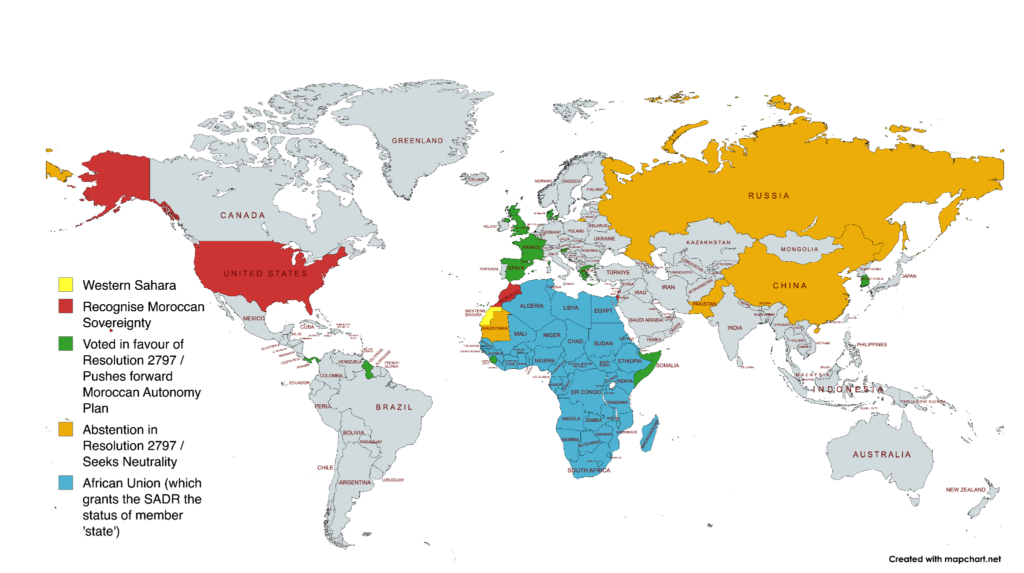
*Source: Author’s own elaboration. The map highlights only the countries mentioned in this article and does not constitute an exhaustive representation of all states worldwide or of their respective positions on Western Sahara.
Conclusion: Ambiguity as a Global Norm
The conflict in Western Sahara endures because the existing equilibrium—however imperfect—aligns sufficiently with the strategic preferences of the relevant international actors. It does not endure because its legal status is unclear, but because ambiguity has become politically functional. The conflict remains formally framed as an unfinished decolonisation process, yet it is increasingly managed as a question of stability, alignment, and regional balance. Over time, the gap between legal principle and diplomatic practice has widened.
UN Security Council Resolution 2797 encapsulates this evolution. The resolution did not alter Western Sahara’s legal status, nor did it formally endorse Moroccan sovereignty. Its significance lies instead in tone: by calling for negotiations taking as the basis Morocco’s Autonomy Proposal while reiterating self-determination, it shows a growing tendency to privilege pragmatic frameworks over juridical clarity. The split vote—and Algeria’s non-participation—highlighted that the issue is increasingly reinterpreted through geopolitical positioning.
As this article has argued, the ambiguity is not merely accidental: it serves the strategic interests of different actors. For Morocco, it allows the gradual consolidation of administrative and diplomatic control: a softer ‘slow but steady’ approach with less risk of provoking strong international opposition. For the Polisario Front, the sustained reference to self-determination preserves the legal basis in their claim and so maintains room for diplomatic manoeuvre. For Algeria, this same room for diplomatic manoeuvre enables them to continue their regional positioning, while avoiding greater diplomatic isolation in a context of increasing momentum in favour of the Moroccan Autonomy Plan. For the United Nations, ambiguity offers a way to maintain regional stability, without jeopardising multilateralism nor disrupting institutional consensus. For Spain, support for self-determination signals its commitment to international law, while support for the Moroccan Autonomy Plan avoids putting at risk the diplomatic relations with its land neighbour, Morocco; a key partner for multi-sector cooperation. For the many international actors that remain willingly neutral, ambiguity allows them to camouflage their lack of positioning, without putting at risk partnerships. For all these aforementioned actors, the equilibrium remains in finding a pragmatic solution that simultaneously preserves cooperation with Morocco, while avoid becoming the culprit of Western Sahara losing rights covered under international law (self-determination).
The United States and Israel appear, at first glance, as partial exceptions to this logic given their explicit support for Moroccan sovereignty. However, both continue to benefit from a degree of ambiguity: it allows them to sustain alignment with Morocco while preserving flexibility in their global diplomacy. Even these actors, characterised by a low commitment to multilateralism, may strive to avoid setting rigid precedents that could constrain their positions elsewhere.
In this context, ambiguity is politically sustainable. It becomes a stabilising factor within the international system. With the current strategic interests of different actors, international diplomacy may prioritise management over resolution. Thus, the conflict’s trajectory will reveal not only the fate of a territory, but the limits of law and legitimacy in an increasingly interest-driven global order. In essence, Western Sahara functions as more than a territorial dispute. It is a measure of how contemporary geopolitics absorbs unresolved conflicts: not by resolving them, but by managing them through calibrated ambiguity.
Notes
[1] The ‘Polisario Front’ is a Sahrawi nationalist movement founded in 1973 that seeks the self-determination and independence of Western Sahara. It represents the Sahrawi Arab Democratic Republic (SADR) internationally and administers the Sahrawi refugee camps in Tindouf, Algeria.
[2] De jure refers to situations that are officially recognized by law, while de facto describes practices that exist in reality regardless of their legal status.