


It was a discreet visit. No photo or official statement from Esmaïl Qaani, commander of Iran’s Quds Force, emerged from the meeting room in Baghdad on October 25. But amid the campaign for Iraq’s parliamentary elections, scheduled for November 11, the purpose of the trip is clear: to prevent the Iraqi Coordination Framework – a coalition of pro-Iranian Shiite factions that brought the current government to power – from splintering. “There is a real question about the future of alhakymyt alshayeiy, Shiite governance in the Middle East,” says Adel Bakawan, director of the European Institute for Studies on the Middle East and North Africa (EISMENA). Intra-Shiite rivalries do play a major role on Iraq’s political chessboard, and Tehran is deeply concerned about their impact on its ability to maintain influence and safeguard its interests in Baghdad.
An Indispensable Asset
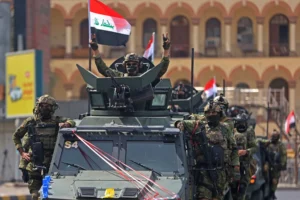
With the decapitation of the “axis of resistance” in Lebanon and Gaza and its weakening in Syria and Yemen, Iraq now appears to be the last intact branch fully connected to Iran’s political-military project. “The Islamic Republic still possesses all the resources necessary to assert its own interests in Iraq, which forms an integral part of its national security,”explains Adel Bakawan, noting that the two countries share 1,500 kilometers of common borders. Although Iraq’s Hashd al-Shaabi militias – most of which are linked to the Islamic Revolutionary Guard Corps (IRGC) – did not intervene during last June’s twelve-day war against Israel, their presence on Iraqi soil nonetheless remains a national security issue for Tehran. “Ideologically, the fact that Iraq is a vast country of 46 million inhabitants is highly significant for Iran, especially since Iraqi elites largely share the worldview of responsible Iranian officials,” the researcher continues. Under intense pressure since the activation of the “snapback” mechanism on September 27 and the reinstatement of UN sanctions, the Iranian economy has become even more dependent on Iraq, through which billions of dollars’ worth of Iranian oil, disguised as Iraqi crude, are smuggled to international markets.
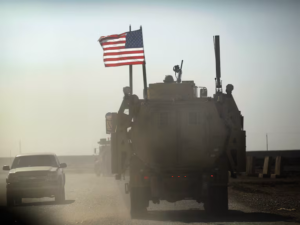
The day of Esmaïl Qaani’s visit to Baghdad, U.S. Secretary of State Marco Rubio called the Iraqi Prime Minister, in the middle of his campaign, to reiterate “the urgency of disarming Iran-backed militias,” according to an official statement from the U.S. State Department. “It is unlikely that this pressure on Baghdad will cease, but the outcome of the elections will likely influence Washington’s medium- and long-term success,” assesses Aniseh Bassiri Tabrizi, an analyst at Control Risks, as U.S. President Donald Trump recently appointed a new special envoy to Iraq. While Iraqi Prime Minister Mohammad Shia al-Sudani has so far managed to maintain a balanced stance between the influence of Tehran and Washington, there is no guarantee that the next head of government will be willing or able to do the same. The new government will furthermore have to revive the draft law redefining the status of the Hashd al-Shaabi, which was removed from Parliament’s agenda under U.S. pressure after its second reading on July 16, and which could elevate the organization to an institutional level comparable to that of the Ministries of Defense and Interior.
Shiite Governance
“With Esmaïl Qaani’s visit, Iran is striving to minimize the perception of fragmentation among Shiite parties while ensuring a degree of unity in the process of forming the next government,” says Aniseh Bassiri Tabrizi. According to several Iranian state media outlets cited by al-Monitor, the Quds Force commander met with several militia leaders and political representatives of the Coordination Framework, urging them to avoid any action that might weaken the bloc’s dominance. Within the Shiite coalition, however, three major groups are locked in a power struggle fueled by personal rivalries: that of the current Prime Minister, aiming for at least 60 seats and supported by Hashd al-Shaabi leader Faleh al-Fayyad; a second front led by Nouri al-Maliki; and a third, the Badr Organization, led by Hadi al-Amiri. “It is highly unlikely that Qaani will succeed in repairing relations between these fiercely opposed figures,” comments Adel Bakawan. “The message he conveyed was probably this: “Do whatever you want – run against each other, fight it out in the political arena. We will be here to fund and support you. But never endanger Shiite governance.” Iran’s demand of the Shiite factions is to build a post-electoral consensus for a renewed national unity government.”