


On January 7, 2025, the U.S. Treasury Department imposed sanctions on Mohammad Hamdan Daglo Mousa (Hemedti), the leader of the Rapid Support Forces, as well as seven companies based in the United Arab Emirates that conduct business with the RSF. These sanctions underscore the role the UAE is playing in the Sudanese conflict.
Between the UAE and the RSF, a Long-Term Economic–Military Partnership
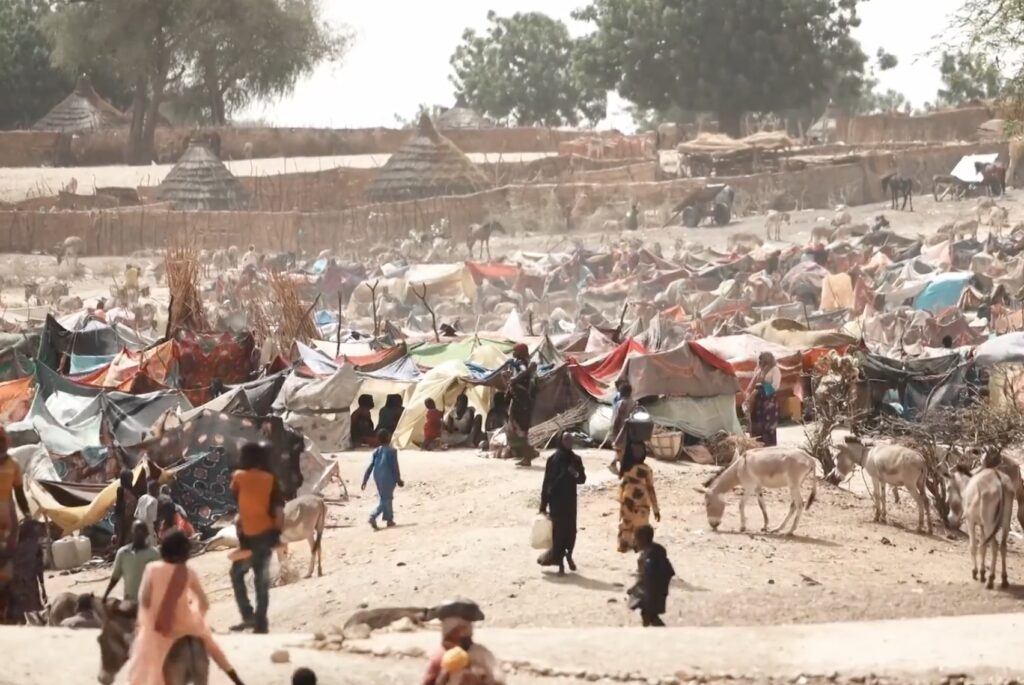
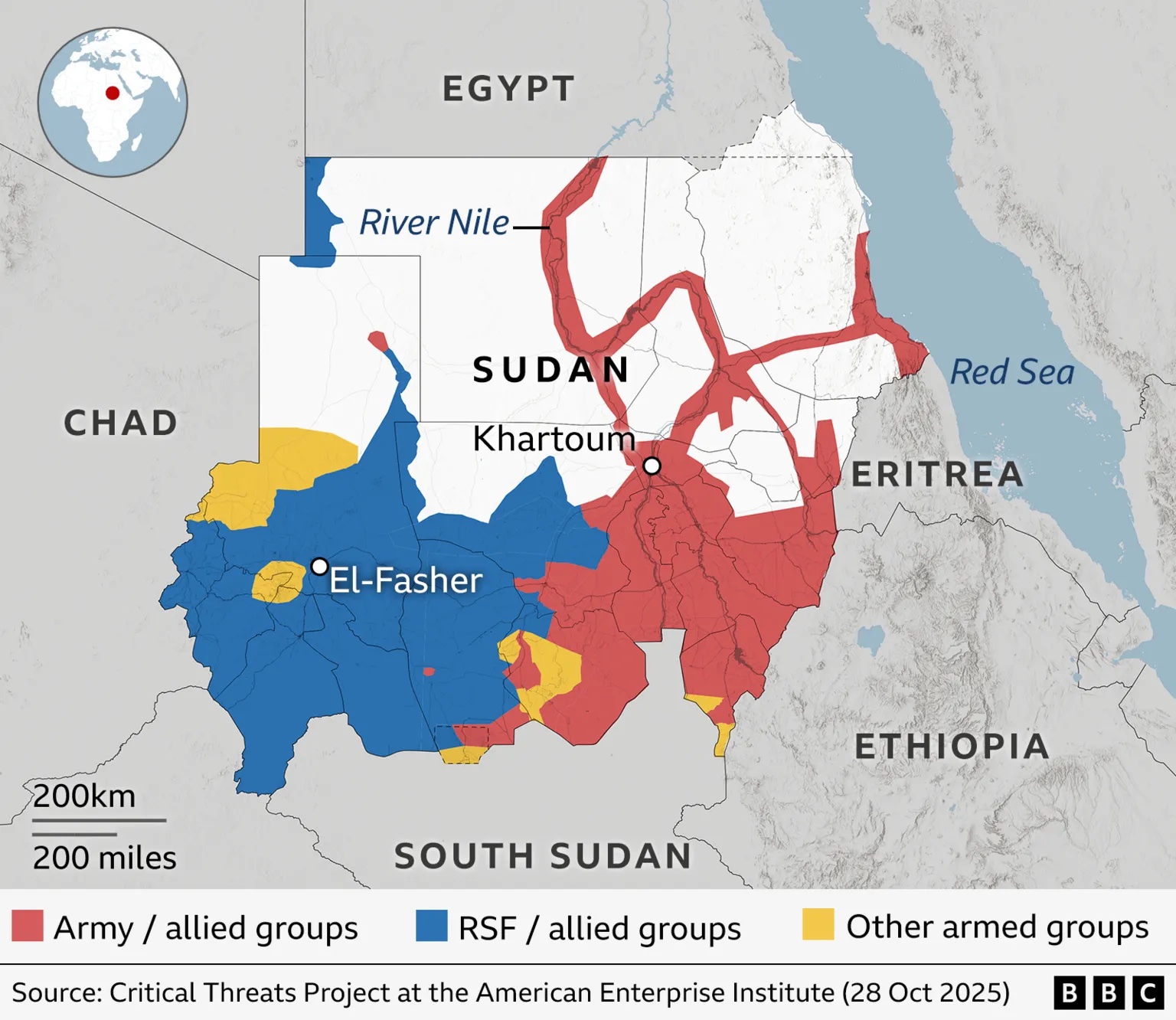
Triggered in April 2023, this conflict has become a regionalized civil war that has produced more than 13 million internally displaced people and over 4 million refugees in just two years. General al-Burhan, head of the army, and General Hemedti, head of the Rapid Support Forces (RSF), the country’s largest militia, are locked in a war marked by mass atrocities and famine.
Behind the scenes, the United Arab Emirates (UAE) plays a key role, despite officially denying it. From 2023 onward, this Gulf state threw its support behind the RSF. It acts as both their supplier and their financier—providing weapons as well as fighters. The RSF’s heavy weapons supply originates from the UAE. Cargo planes from Abu Dhabi, often transiting through the airports of Bosaso in Somalia and Berbera in Somaliland, land in eastern Libya and Chad as well as at Nyala airport, the capital of South Darfur, controlled by the RSF. As early as 2023, the UAE delivered weapons to the RSF by air through the airport of Amdjarass in Chad, under the guise of a so-called humanitarian aid mission. Beginning in November 2024, Colombian mercenaries known as the “Desert Wolves” were reported fighting alongside the militias. In all likelihood, they were recruited by Emirati authorities, who have previously employed Colombian mercenaries in other conflicts (Yemen, Libya, Somalia). Since early 2025, the RSF have launched long-range drone attacks far from their bases and targeting cities as far as Port Sudan as well as infrastructure (dams, etc.). The long-range Chinese drones they use appear to have been supplied by the UAE, as were the air-defense systems that allowed them to cut off aerial resupply to the stronghold of El-Fasher and to seize it at the end of October this year. Despite the UN arms embargo, the UAE continues to equip one of the belligerents with weapons and military expertise.
While the UAE–eastern Chad supply route was crucial at the beginning of the conflict, two additional logistical corridors have since opened: UAE–eastern Libya and UAE–South Darfur (Nyala). These RSF supply routes are made possible by the UAE’s network of regional allies. General Haftar, who controls eastern Libya, was also backed by the UAE against the Tripoli government, and the UAE secured the Chadian regime’s agreement to transport weapons in exchange for payment. The UAE is also believed to have approached the Central African government to use Birao airport, which lies not far from the South Darfur border. Beyond military support, the UAE hosts entities responsible for the RSF’s digital propaganda. Troll farms behind RSF online messaging had been identified in the Emirates even before the war, and Facebook removed some accounts that violated its policies.
Far from being merely military, the relationship between Emirati authorities and the RSF has long been and remains economic. First, the gold smuggling that built General Hemedti’s wealth and power has, for decades, passed through Dubai. Second, on the basis of this trade, the RSF leader and his family have built a sprawling business empire with the UAE as its nerve center. Before the war, several reports highlighted the flourishing gold trade between Dubai-based companies, the Sudanese gold-trading firm Al Gunade (controlled by Hemedti’s family), and artisanal mining zones under RSF control (the Jebel Amer mines, North Darfur, and South Darfur). Moreover, Hemedti’s commercial empire stretches from Sudan to the UAE. Their Sudanese companies have subsidiaries and partners in the Emirate. A complex network of companies linking the UAE and Sudan enables the concealment of financial movements between the two countries. In all likelihood, the Hemedti family’s war chest is held in banks in the UAE. Thus, the general is not only a military ally of Mohammed bin Zayed against a Sudanese army perceived as influenced by the Muslim Brotherhood, but also a business partner.
Denouncing the UAE and Disrupting RSF Aerial Resupply
From the very beginning of the war, the Sudanese army publicly accused the UAE of supporting the RSF. Drawing on its own intelligence, confirmed by UN and other reports, it attempted to have Abu Dhabi condemned by the UN Security Council in March 2024. It also called on neighboring countries to block the RSF’s military resupply. These efforts failed, largely due to the UAE’s considerable influence relative to al-Burhan, as did the polite pressure exerted by the Biden administration on Emirati authorities. Despite overwhelming evidence, the UAE continues to deny any involvement in the conflict while supplying the RSF.
Given its failure on the diplomatic front, General al-Burhan adopted diplomatic, financial, and military retaliatory measures. He severed diplomatic ties with the UAE in May 2025, as well as with Chad and Kenya, and cancelled the $6 billion contract signed in 2022 by Abu Dhabi Ports Group and Invictus Investment to build a new port on the Sudanese coast. He rejects the Quartet as a mediator. The Quartet—composed of Egypt, Saudi Arabia, the United States, and the UAE—recently proposed a ceasefire, which the Sudanese army rejected on the grounds that the UAE cannot be “judge and party” to the conflict—conveniently overlooking Egypt’s role on its side. Symbolically, on 9 November, the Sudanese delegation walked out of the UN World Tourism Organization conference after a UAE representative was elected secretary-general. Sudanese authorities have also initiated proceedings against the UAE before the International Court of Justice in The Hague for complicity in genocide.
But the pressure is rising most noticeably on the military front. After the 2024 bombing of the (empty) residence of the Emirati ambassador in Khartoum, the Sudanese army has been attempting to reduce RSF aerial resupply. In 2025, at least three cargo planes were shot down near Nyala airport. In early May 2025, the Sudanese army claimed to have killed Emirati officers in a strike on a cargo aircraft. Similarly, on 6 August 2025, a cargo plane that had just landed at Nyala airport was shot down by Sudanese army jets. According to the army, the aircraft was carrying Colombian mercenaries and military equipment originating from the UAE. Disrupting the RSF’s air supply has clearly become one of the Sudanese air force’s primary objectives.
Conclusion
The massacres that followed the RSF’s capture of El-Fasher have rekindled international attention on the war and cast a harsh light on its Emirati sponsor. Calls are now emerging to boycott the UAE because of its role in Africa’s largest ongoing war. Yet nothing guarantees that such pressure will be enough to alter its position. The reasons for its support to the RSF leader remain unchanged: he is an economic partner and a military ally in the UAE’s campaign against a Sudanese army they view as infiltrated by the Muslim Brotherhood.
Paradoxically, the cargo fleets supplying both Sudanese belligerents operate largely out of the UAE. Many air freight companies are based in the Emirates or have located their fleets there. Very often, the same company delivers weapons to both sides—demonstrating that the UAE is not enforcing the UN arms embargo on Sudan and is allowing the arms trade to thrive from its territory.