

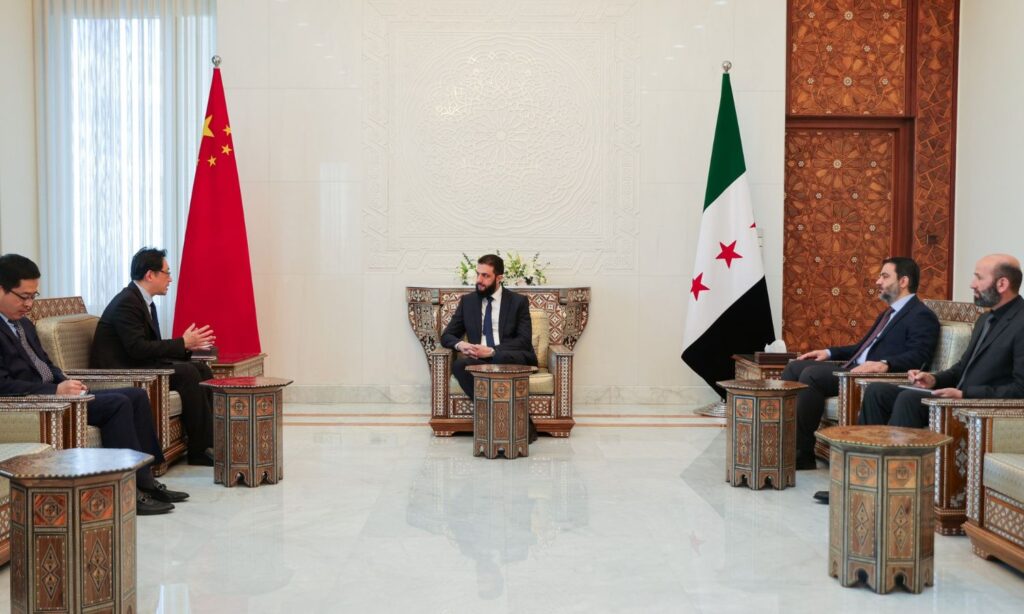

China maintained a strong relationship with the Assad regime. When the former regime collapsed last year, the Sino-Syrian relations faced a period of uncertainty and concern for its security, its geopolitics, its economic and political memory. Following the fall of Damascus, China closed its embassy and relocated to Lebanon, according to Ashhad Salibi, deputy director of the Russia and Eastern Europe Department at the Syrian Ministry of Foreign Affairs. Almost a year later, on November 17th, Syrian post-Assad, foreign minister Asaad al-Shibani visited Beijing. One of the immediate outcomes of this visit was the agreement to reopen China’s embassy in Damascus early next year. Interestingly, the reopening coincides with the seventieth anniversary of the Sino-Syrian relationship, as the two countries established their relationship in August 1st, 1956. It is expected that the Syrian president might visit Beijing to follow the embassy’s reopening. As countries such as Turkey, Israel, the USA, and several Gulf states have taken the lead in Syria’s diplomatic efforts, China has stayed in the background. However, as rebuilding is the main challenge Syria is facing, China might play a big role in that regard.
Decoding the statement
After Asaad al-Shibani met with Chinese Foreign Minister Wang Yi, the two sides issued a joint statement. Analyzing it, we can see the main issues and efforts of cooperation between Syria and China. Both sides expressed their willingness to explore collaboration in areas of common interest, such as the economy, development, Syrian reconstruction, capacity building, and improving the livelihood of Syrians. Although not in the same urgency, China is willing to actively consider participating in Syria’s economic reconstruction and contribute to the country’s social development and improvement of Syrian’s living conditions. These areas all have to do with China’s economic rise and the Chinese model. This economic aspect is at the core of Damascus reconstruction and Syria’s future. Arguably Syria’s recovery cannot be achieved without China’s involvement.
However, this economic relationship is not straightforward. A closer reading of the statement might shed further light on the complexity of the issue. As China had close ties with the former Assad regime, its return to the country will not be without complications. When Damascus fell on December 8th 2024, people looted the Chinese embassy as a way to express their anger. The issue of security, terror, and Uyghurs are all compacted within the ‘need to combat terrorism’ in the statement. In fact, in the case of Syria, one can argue that ‘adherence to the one-China principle’ is less about Taiwan and more about the Turkistan Islamic Party (TIP), the movement that largely advocates for the independence of the Chinese province of Xinjiang. In fact, immediately after the meeting, various media outlets rushed to declare that “Syria’s Uyghurs May Be Heading Home—Whether They Like It or Not.”
While this conclusion might seem logical, especially considering the history of the region and how easily people have been abandoned by their backers after conflicts/wars, it is nevertheless premature and overlooks the realities on the ground. The Uyghur population will not become a point of contention between China and Syria, at least in the near future, for several reasons. First of all, the Uyghur are the largest foreign militia force but now have been absorbed into Syria’s national army and are deeply integrated into Syrian society, according to Uyghur observers. This integration may provide them a new life with little attachment to their homeland. As Omar Diaby, a French-Senegalese jihadi in Syria, put it: “Why should we go back to France? Honestly, we don’t miss anything from France… except the cheese.” Secondly, the Uyghurs have been naturalized and intermarried. Hence, they’re citizens, and the Syrian state should be responsible for their action. Thirdly, as Syrian citizens and loyal garrisons of al-Sharaa, they prioritize the Syrian project. From China’s perspective, the regime has always preferred order over chaos making the current Syrian regime a preferable partner to potential chaos. Furthermore, the US nodded to Syria to bring foreign jihadist ex-rebels into the army, which was consented by Beijing.
China, in order to make the Syrian government responsible, made the latter ‘recognize the Government of the People’s Republic of China as the sole legal government representing the whole of China.’ This clearly solidifies the view that Damascus has to avoid harboring and supporting any group that jeopardizes the One China policy, including the TIP. This becomes clear as elaborated in the next sentence of the joint statement. ‘Syria supports China in safeguarding its national sovereignty, unity, and territorial integrity, resolutely opposes any interference in China’s internal affairs, and supports all efforts made by the Chinese government to achieve national reunification.’ These all indicate that the al-Sharaa government has agreed to China’s demands when it comes to security. ‘Syria attaches importance to China’s security concerns and pledges that Syria will not become a source of threat for any country and will not allow any entity to use Syrian territory to engage in activities that harm China’s security, sovereignty, and interests.’
We can deduce that the Syrian government has assured Beijing in regard to the Uyghur issue. This is in preparation for China’s return to Syria. This concession comes as the country cannot rebuild itself withoutChina’s intervention and support. Hence, economic considerations and financial constraints leave al-Sharaa with little but no choice to abide by Chinese demands. There are obviously other factors that reinforce Beijing’s position, such as China’s veto in the UNSC and the Belt and Road Initiative (BRI).
Affordability: the name of the relationship
When it comes to the China-Syria relationship, affordability has many aspects. On one level, it reflects the needs of the population that requires goods and services at accessible prices. It also entails the existence of an economy that can produce at a comparatively cheaper price, with no or little compromise on quality. On a second level, in the Syrian context, affordability is also intertwined with war, international sanctions, and the hope of reviving and rebuilding. Chinese-made goods are available in abundance at a relatively affordable price, and difficult for other countries to match this path. It makes China indispensable for Syria not only for reconstruction but also for survival.These economic realities leave Syrians with little alternative but to rely on Chinese products, ensuring that Syria cannot afford to distance itself from Beijing. The Al-Sharaa government redefined its relationship with China immediately after the fall of Damascus. It builds on trade ties that Beijing maintained with Al-Sharaa in Idlib under the regime of Bashar al-Assad.
In the post-Assad era, China was waiting for the right moment to re-engage. As the Syrian government and Syrian people need China, the latter also wants to be in Syria.
China-Syria: post-Assad trajectory
Soon after the fall of the regime, the new Syrian President Ahmed al-Sharaa met China’s ambassador to Damascus on February 21. A few months later, on May 1st he received a delegation of businessmen from the People’s Republic of China, headed by Mr. Zhou Lijiang, General Manager of AOJ-TECHNOLOGY in the Middle East. In May 2025, the Syrian General Authority for Land and Sea Ports signed two Memoranda of Understanding with Fidi Contracting, a Chinese company, to invest in free zone areas exceeding one million square meters. One of them was located in Hasya in the Homs Governorate, covering an area of approximately 850,000 square meters; the other was in Adra in the Rif Dimashq Governorate.
On the October 1st, Queen Vivian, a commercial ship, arrived at the Port of Tartus from Shanghai, China, carrying more than 16,000 tons of iron. This illustrate that both trade and diplomacy are emerging in parallel. Therefore, when Syrian foreign minister al-Shibani told the state-run Alikhbaria TV that “we have redefined our relationship with China,” despite its political support for the former regime of Bashar al-Assad, it was not surprising. It is expected the relationship will expand very rapidly. On the 27th of November, ‘Syria’s General Company for the Manufacturing and Marketing of Cement and Building Materials held talks with an investment delegation from China’s BITEC on expanding technical, commercial, and investment cooperation in the cement and construction materials sector according to Syrian media.
‘The Chinese delegation said BITEC was keen to expand its footprint in the Syrian market, expressing readiness to provide technical expertise, modern technology, and industrial support to help raise production quality and capacity.’ The cement sector is regarded as a strategic pillar in Syria’s reconstruction, as demand for construction materials continues to rise. This is important as China’s construction sector is suffering from a crisis, and data from the National Bureau of Statistics showed that cement production in July 2025 reached 146 Mt, down by 6% year-on-year and the lowest July level since 2009. This security and economic combination is enhanced by similarity in the political visions. While al-Sharaa may have jihadi origins, he shares certain perspectives with China’s leadership, particularly regarding democracy and relations with the West. Beijing has redefined democracy; accordingly, “the whole-process people’s democracy is the defining feature of socialist democracy.” “It is democracy in its broadest, most genuine, and most effective form.”
Through this form of democracy, the public’s participation has remained selective and exclusively stimulated by the authorities, especially local people’s congresses and CCP grassroots organizations. It is just a new form of socialist democracy not very different from the previous one since it remains under the strict control and leadership of the CCP. While for al-Sharaa democracy is not even worth lip service. According to Radwan Ziadeh, the al-Sharaa administration does not believe in democracy. In fact, he has refrained from uttering it so far. As I highlighted in al-Sharaa’s profile.
To conclude
It is expected that the al-Sharaa government will control the Uyghur groups. This will prepare the ground for a strong economic relationship between China and Syria. This relationship will be enhanced by anti-democratic sentiment and suspicion toward the West by both Chinese and Syrian elites. As the embassy will open soon, Chinese soft power will commence in Syria also. Soon we should see delegations from Syria travelling to China to attend a variety of courses on China’s development model. Syria might urgently need reconstruction and development, but after the Assad regime, the country should value humans and dignity, as the early Syrian revolution was calling for. This is only happening when democracy, pluralism, and diversity are made the core of the governance. More alarmingly, maybe, China’s enhanced role in Syria will not benefit the cause of various minorities as they demand a decentralized Syria. China is a staunch advocate of the strong centralized state.