
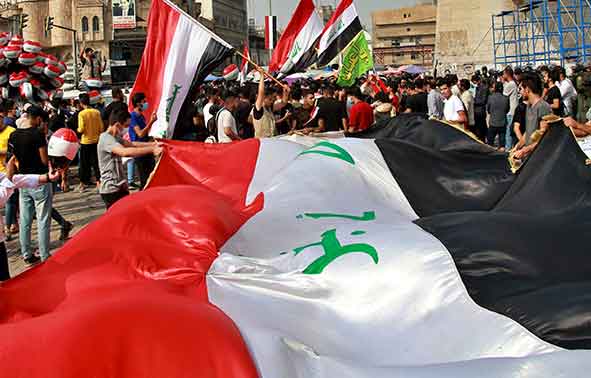

The Iraqi state officially turns 100 this year! Yet, the country suffers from the same issues as in 1921, during its creation. The state suffers from its inability to integrate Kurds, but also Sunni, Shia and Christians, etc. within the narrative of an “inclusive iraqicity”. Since the country’s victory against the Islamic State towards the end of 2017, the discourse around the construction of an “Iraqi nationalism” is poignant. The state should lead the way with a serious state building project that would take “Iraqicity” as its reference and using it as the principal factor for the direction of its strategy. As for the authors of this narrative, they can be found simultaneously on the national, regional and international level.
The base of this narrative gives itself as an objective, the “rapid exit from sectarianism” and “a quick entry into Iraqicity” which can be introduced in the following way: national fractures, Iraqi sectarian conflicts will disappear once an Iraqi bourgeoisie internalises liberal democracy norms and enters the globalised market. Deploying this supra-communitarian market economy is highly effective to develop “interdependencies” and “interactions” between the “components” of the Iraqi society with the goal to create an “Iraqi nation” on the principle of common interests. Nevertheless, it is evident that the Iraqi reality is still far from the state’s imagined ideal and is shaped by actors with plural antagonistic interests.
It is from 2003 onwards that sectarian build-up, far from being communitarianism ultimate effort, started to reveal its well-concealed reality. By utilising such ideological discourses, this unrestrained sectarianism shocked all that believed in the «Iraqi dream». In this key moment of Iraqi history, the world discovered a profound fracture between the Shia, Sunni and Kurds. A destitute country deprived of all that could constitute a society but also entering a phase of purification of the nation, using terms such as “De-baasification” and “de-sunnification”.
This Iraqi national fracture jeopardises the work of actors that gambled on the exhaustion of sectarian efforts, through a century of Iraqi state construction. Starting from a field observation, it is clear that Iraqi sectarianism is far from being in its final phase. To the contrary, it deploys itself within the microcosms of the smallest entities within society and becomes the main pillar of collective and individual practices.
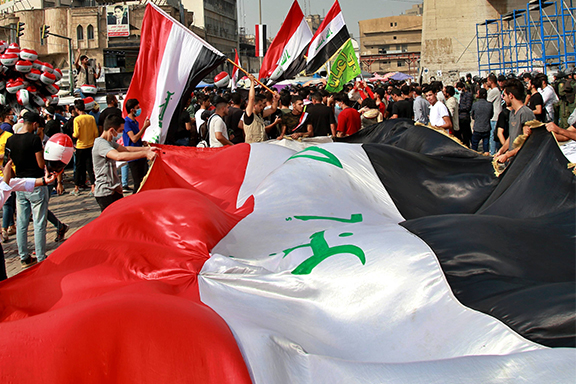
Protesters hold Iraqi flags in the Tahrir Square during a protest demanding that the government resigns in Baghdad, Iraq, Sunday the 8th of November 2020 © Khalid Mohammed/AP/SIPA
Rival Identities
Nonetheless, it is important to remind ourselves that these exclusive Iraqi identities – Shia, Sunni and Kurdish – are not structures that are fixed in time and history. They are also not responsible for structuring the impenetrable institutions but instead are entities that are constantly in a permanent state of construction. Thus, each identity’s community possess its own territory as well as its own functioning system, its symbols and leeway to manoeuvre. Yet, this ensemble draws up the limits of this system and enables itself to orchestrate its differentiation, uniqueness and thus own imagined exclusivity.
It is in this setting that the feeling of belonging to the « same group » exists in only few instances. Thus, on the 31st of March 2019, Sami al-Askari, one of the Shia leaders requested from the Iraqi government to change the name of a wide avenue in Baghdad, because it beared the name of Harun al-Rashid (765-809) – held accountable for the assassination of Musa al-Kazim (745-799) the seventh Shia imam. Yet, the same Harun al-Rashid is considered by the Sunni Iraqis as the symbol of their pride, representing for them the caliph from the tales of the Arabian nights. In this case, it is interesting to observe through what means both these actors instrumentalise their power dynamics through exclusivity and the mobilisation powers these narratives stir up.
By concentrating on the specificities of the Shia and Sunni identities and by accentuating them, the elites of these Iraqi communities mobilise considerable resources in order to reinvent the history of their communities and to give them a crucial legitimacy, thus weighing in for their monopolistic aspirations. In doing so, promoting the Shia, Sunni or Kurdish identities is in line with sectarian fabrication logic. Since it finds its origins in myths or tangible realities, the discourse of this actors, engaged in searching for the purity of a Kurdish, Shia or Sunni identity, finds its origins in this field.
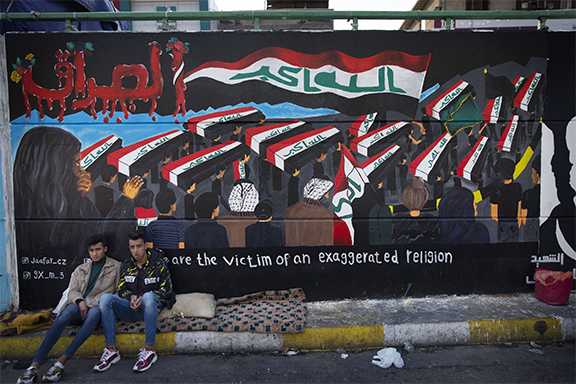
Two protesters are seated close to a mural painting where we can read it Arabic “Iraq”, on Tahrir Square in Baghdad, Wednesday 8th of January 2020 © Nasser Nasser/AP/SIPA
“Iraqicity”, a project who’s very foundations tremble
Regardless of the Iraqi situation, how can the Shia, Sunni, Kurds but also other « components » of Iraq, find a way to become Iraqi and identify to a common group with a national identity and united through a shared calling?
To escape sectarianism, which is qualified as the first illness of the Iraqi state and to build this “inclusive iraqicity” – an ideal currently unobtainable – the recent emergence of contestation movements in Basra, Mosul and Sulaymaniyah do not suffice. Quantifying common attitudes through social networks is not a guarantee either. Even the existence of common values such as religion in everyday life practices is not a necessary precondition. To the contrary, without an inclusive political project elaborated by actors in this logic, the presence of these indicators “far from eroding identitarian demarcations, contribute actively to reinforcing them”, to cite Alain Dieckhoff.
“Iraqicity” as a project for the Iraqi nation to build can only be the result of interactions between Shia, Kurdish and Sunni actors. Yet, they find themselves in a situation of social, cultural and territorial rupture without a common language. The transition from a sectarian identity to an open and inclusive national one which manages to merge “Kurdicty” and “Arabicity” towards “Iraqicity” requires a slow process. Far from the brutality that characterises the history of Iraq, of a state that is disconnected with its society.
The ideal scenario that remains the only feasible one currently to reach this “Iraqi dream”, is to leave the Iraqis build it little by little themselves, through interactions between the various “components” that make up the Iraqi society. By following such a process with a new vision, the “impossible Iraqi state” could transform itself into a “possible Iraqi state”. Nonetheless, there still lies a long path ahead before this “Iraqi dream” could transform itself into a reality.