

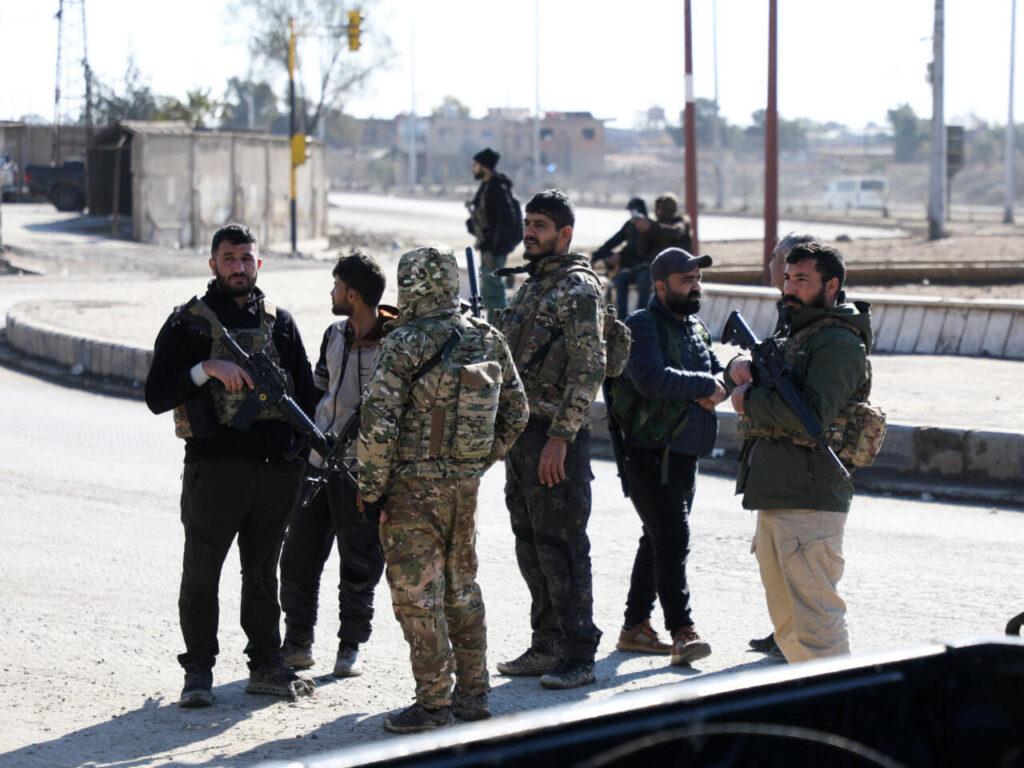
The Syrian Kurds, long considered the West’s spearhead in the fight against the Islamic State group, have seen their hopes of creating a sovereign state shrink dramatically. Between 2011 and 2024, the Syrian Democratic Forces (SDF), the armed wing of the Kurdish autonomous administration, managed to establish an autonomous zone in northern and northeastern Syria: Rojava (“west” in Kurdish), officially known as the Autonomous Administration of North and East Syria. With the fall of Bashar al-Assad, the new Syrian leadership now intends to integrate the Kurds into a centralized state. President Ahmed al-Charaa has given them until Saturday, January 24, to propose a plan for the peaceful integration of this province into the Syrian state.
Driven out of Aleppo in January after violent fighting, and then from the provinces of Raqqa and Deir Ezzor last weekend, the SDF—who until then controlled 30% of Syrian territory—have retreated to their strongholds of Hasakah, Qamishli, and Kobane. The Kurds have lost the historic support of the United States, which had nevertheless helped create the SDF in 2015. “The SDF’s initial mission as the main anti-ISIS force on the ground has largely come to an end, as Damascus is now ready to take over security responsibilities, particularly the control of ISIS detention centers,” said the U.S. envoy for Syria, Tom Barrack, on Tuesday on X.
Why have Syrian Kurds found themselves so cornered by Ahmed al-Charaa’s power?
According to Adel Bakawan, director of the European Institute for Studies on the Middle East and North Africa (Eismena) and author of The Decomposition of the Middle East: Three Ruptures That Changed History(Tallandier), the SDF have very little room for maneuver against Damascus. During the Syrian civil war (2011–2024), around 105 groups were fighting, sometimes against one another. This is where ISIS (acronym for the Islamic State in Iraq and the Levant) emerged, born from a split with Al-Qaeda. The United States and Europeans then chose to arm, train, and support the Kurds to wage war against ISIS. The SDF pushed as far as Raqqa and Deir Ezzor for this purpose—areas controlled by Arab tribes.
On December 8, 2024, Ahmed al-Charaa came to power thanks to his Gulf network: Saudi Arabia, Qatar, and also Turkey. When he was received in Riyadh, Mohammed bin Salman convinced Donald Trump to normalize relations with Syria, lift sanctions, and integrate it into the international coalition against ISIS. The SDF thus lost their anti-ISIS leverage. When the new Syrian state joined the international coalition, the Kurds also had to hand over management of the prisons where thousands of ISIS leaders and fighters are detained. Next, the Americans asked Arab tribes that had been part of the autonomous administration of northeastern Syria to cut ties with the SDF and join Ahmed al-Charaa’s new army. The Kurds could not wage war against their former allies and the Syrian army. Cities therefore fell very quickly. Finally, they lost control of oil and gas fields that financed their economy, as well as dams of major geostrategic and geopolitical importance.
What room for maneuver remains for Syria’s Kurds?
They do not have many pressure levers, except through Iraqi Kurdistan, with which they nevertheless had disagreements during the thirteen years of Rojava’s governance. There was strong international lobbying, and Donald Trump personally called Charaa to tell him not to enter Rojava, the Kurds’ historic area. Kurdish fighters withdrew from Aleppo and Raqqa. There was no war. They still possess a very powerful army—an ideological, trained, armed organization that will not capitulate. That is a means of pressure.
What future for Rojava? Is this the end of the dream of a Kurdish state?
We are entering a gray zone. Being abandoned by the Americans was predictable and had been anticipated. But the Kurds of Rojava are also being abandoned by the Israelis, who had nevertheless helped the Druze. They will not intervene to defend them against the Syrian army because they are in a normalization process. This is an existential question. In 2017, in the context of emerging from the war against ISIS, Iraqi Kurds—who had played a major role in the fall of the caliphate in Mosul—organized a referendum on independence. Ninety-three percent voted in favor, but the international community was fiercely opposed, and all the territories were retaken. In 2019, when Syrian Kurds were at the height of their power in the Afrin area, the Americans gave the green light to pro-Turkish militia groups to occupy this zone, which was extremely strategic for Syrian Kurds. It was a tragedy.
Is this the end of the dream of independence? On a Middle Eastern scale, the Kurds are the largest stateless people—between 50 and 60 million individuals. How can one stabilize, secure, and develop a Middle East in which 60 million people are abandoned and betrayed? If the international community wishes to secure and stabilize this region, there must be a Palestinian state and a Kurdish state. But at the moment when the dream of independence is weakening in Rojava, it is becoming much more plausible in Iraqi Kurdistan.
What impact does this have for Turkey, particularly regarding the peace process with the PKK?
From his prison, Abdullah Öcalan sent a letter to the PKK asking it to dissolve, lay down its arms, and no longer demand independence, federalism, autonomy, or even decentralization. The stated objective is the struggle for a democratic society in Turkey. The Turks believe that this call does not concern only the PKK in Turkey but all its branches in Iraq, Syria, and Iran. This is a point of disagreement on which Abdullah Öcalan has not clearly taken a position.
Turkey strongly encouraged and supported Charaa’s offensive on Kurdish-controlled territory while asking him to integrate the Kurds into the new Syria. To implement Turkey’s grand strategy in the Middle East, they need “eternal brotherhood.” Twenty years ago, Turkey did everything it could to undermine the Kurdistan Regional Government. Today, its most reliable ally in the region is the Kurdistan Regional Government of Iraq.
The Kurds were relied upon for years to fight ISIS. Can the Syrian army really take over?
Ahmed al-Charaa has undergone a “de-radicalization.” He is pragmatic and understands international dynamics. A Qatari communications firm even advises him on the choice of his ties and the length of his beard. What interests me is the militant base—the one that must fight ISIS, the Kurds, the Alawites, and the Druze. When I analyze videos, accounts, and discourse on the ground, I do not really see a major difference with ISIS between 2014 and 2019. Charaa abandoned Al-Qaeda for ISIS and created the Syrian branch with the authorization of caliph Abu Bakr al-Baghdadi. His entire militant base has absolutely not changed. Their entire lives have been shaped by radical ideology. For example, the Kurd is identified as a pig, an apostate who must be killed. Why? Because it is exactly the same ideology.
Personally, I believe the international community will regret transferring the fight against ISIS from the SDF to HTS (Hayat Tahrir al-Sham, the Islamist rebel group led during the war by Ahmed al-Charaa). How can one control its militant base? Beyond that, the new Syrian army entrusted with this fight against ISIS is not homogeneous. There were roughly 500 armed groups fighting Bashar al-Assad. Their loyalty ranges from the Syrian state to Turkey or Saudi Arabia. It is therefore a very, very risky gamble.