

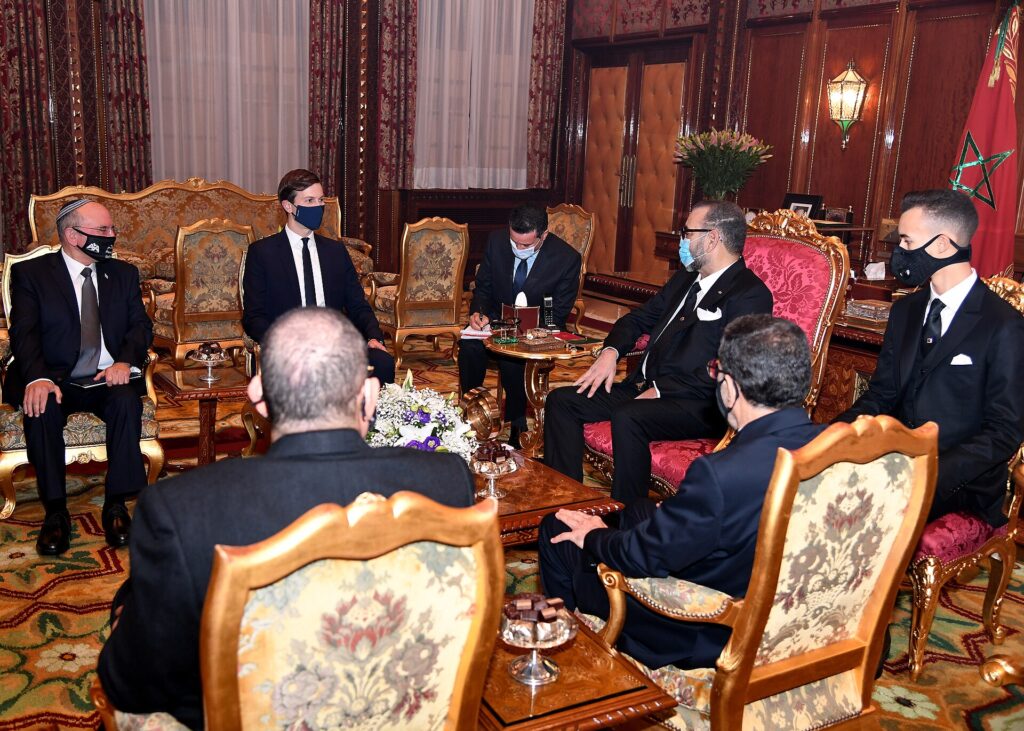

December 22, 2025 marked the fifth anniversary of the signing of the Tripartite Declaration between Morocco, the United States, and Israel, which inaugurated Israeli–Moroccan normalization. The weekend preceding this anniversary, several demonstrations opposing the Abraham Accords erupted in around ten Moroccan cities, including Rabat, Tetouan, Tangier, and Meknes. Despite its unpopularity among part of the Moroccan population and Morocco’s balancing act regarding the Palestinian question—particularly since the onset of the genocide in Gaza—Israeli–Moroccan normalization has continued to develop over the past five years. Initially under intense media spotlight, with lavish coverage celebrating visits by Israeli officials and the signing of bilateral agreements, cooperation has since proceeded more discreetly following October 7, 2023. This cooperation spans military, economic, security, cultural, and academic spheres. Indeed, significant strategic stakes are attached to it—stakes of no small importance for the Kingdom.
Strategic Stakes: Western Sahara, Military-Security and Technological Cooperation
Unlike the first normalization between the Kingdom and the Hebrew State in 1994—which was severed in 2000[1] following massive demonstrations in support of the Second Intifada—the Abraham Accords have endured, despite Israel’s genocidal military operation in Gaza. This resilience can be explained by the transactional nature of Israeli–Moroccan normalization, conceived by the Trump administration: in exchange for U.S. recognition of Moroccan sovereignty over Western Sahara, the Kingdom agreed to officially normalize relations with Israel, the United States’ foremost ally in the Middle East. American support for Morocco’s autonomy[2] plan enabled significant advances in favor of Moroccan sovereignty over the Saharan territory. From 2021 onward, a large number of countries, particularly European ones—including Spain, France, and the United Kingdom—voiced support for the Moroccan initiative. Some even opened diplomatic representations in the cities of Dakhla and Laâyoune, such as Bahrain, the United Arab Emirates, and Chad. The Kingdom’s diplomatic victory was further cemented with the adoption of UN Security Council Resolution 2797 on October 31, 2025. Drafted by the United States, the resolution endorses the Moroccan autonomy plan as the normative framework for future negotiations between the parties to the conflict, while renewing for one year the mandate of the United Nations Mission for the Referendum in Western Sahara (MINURSO).
Beyond diplomatic gains on the Saharan issue, rapprochement with Israel has opened new avenues of cooperation aimed at developing Western Sahara. Since the early 2000s, the Kingdom has pursued an ambitious development policy in its “Southern Provinces” through massive investments. Between 2021 and 2022, agreements were signed with Israeli companies Ratio Petroleum, NewMed Energy, and H2Pro for hydrocarbon exploration off the Atlantic coast of the Sahara and for green hydrogen production. Technological cooperation has also been prominently promoted since 2020, particularly in agriculture, renewable energy, and water management, led by Israeli giants Netafim, Gandyr, and NewMed Energy throughout Morocco. Meanwhile, trade exchanges have continued to grow significantly since 2020.
However, it is primarily in the military-security domain that cooperation between the two states has been most extensive, dating back to the very beginnings of their relations. Israeli–Moroccan ties were forged shortly after Morocco’s independence in 1956 and took on a distinctly security-oriented dimension under King Hassan II from 1961 onward. This included the organization of Moroccan Jewish emigration[3] and cooperation between Moroccan intelligence elites and the Israeli Mossad against Morocco’s left-wing opposition[4]. In return, the Kingdom supplied Israeli intelligence services with strategic information, notably during the 1965 Arab Summit in Rabat. The Abraham Accords merely reinforced and publicly exposed this long-standing military-security cooperation, materialized through the signing of a defense agreement in 2021, joint military exercises, and increased purchases of Israeli weapons technologies.
Ambitions of “Warm” Normalization
Beyond security and economic considerations, the Abraham Accords also aim to establish a “warm” normalization between the societies of the Arab signatory states and Israel, seeking to overcome the perceived failures of the Egyptian and Jordanian normalizations, often described as “cold.” The Trump administration’s vision of a new Middle East rests on a region in which Israel is no longer perceived as an enemy. In Morocco, Judeo-Moroccan ties have been mobilized to lend an emotional dimension to normalization[5]. Initially, normalization was presented as an opportunity for Morocco to reconnect with the Israeli community of Moroccan origin, estimated at nearly 700,000 people. The goal was both to encourage Israeli tourism through the rehabilitation and promotion of Moroccan Jewish heritage and to legitimize, in the eyes of Moroccans, rapprochement with a state previously viewed primarily through the lens of the Israeli–Palestinian conflict.
Accordingly, Morocco has leveraged its newly affirmed plural identity—Amazigh, Arab, Hebrew, Hassani—enshrined in the 2011 Constitution[6], in support of a carefully crafted narrative emphasizing dialogue, intercultural openness, and tolerance toward Israelis of Moroccan origin. In parallel, an educational strategy aimed at familiarizing Moroccans with Judeo-Moroccan coexistence has been implemented at multiple levels. Since September 2020, school curricula have incorporated Moroccan Jewish history, previously overlooked. Numerous Israeli–Moroccan academic partnerships have emerged, accompanied by academic exchanges. Civil society organizations promoting cultural pluralism have also been mobilized, organizing trips to Israel and encounters between Moroccan and Israeli youth through cultural, artistic, and sporting activities.
Popular Opposition and the Palestinian Question
Opposition demonstrations began the day after U.S. President Donald Trump announced American recognition of Moroccan sovereignty over Western Sahara and the official normalization of diplomatic relations between the Kingdom and the Hebrew State in his December 10, 2020 tweet. Initially discouraged through a restrictive climate imposed by Moroccan authorities, these demonstrations have since been tolerated—and even encouraged—since the outbreak of the Gaza war. During these protests, the Abraham Accords are denounced as a betrayal of the Palestinian cause. Protesters also criticize the asymmetrical nature of military and economic cooperation with Israel, highlighting that Israel exports its technological expertise to Morocco. The Israeli–Palestinian conflict remains central, complicating efforts to foster “warm” relations between Moroccans and Israelis. The nascent Abraham Accords were first shaken by the Sheikh Jarrah affair in Jerusalem and the May 2021 Gaza war. Official rapprochement was further strained by the intensification of Israeli violence in the Occupied Palestinian Territories in 2023, particularly following the electoral victory of Israel’s far right. However, it was the genocide in Gaza that definitively shattered efforts to build “people-to-people” ties between Moroccans and Israelis. According to Arab Barometer, only 7% of Moroccans supported the Abraham Accords in 2024, compared to 31% in 2022.
To be sure, the Kingdom has continued to display consistent solidarity with the Palestinians. Cultural and social initiatives carried out by the Bayt Mal al-Qods Agency[7], chaired by King Mohammed VI and directed toward Palestinians in Jerusalem, are widely publicized in Morocco. Moreover, the massive solidarity demonstrations in Rabat in support of Gaza residents serve to underscore unwavering national backing for the Palestinian cause. At the outset of normalization, several Moroccan officials and media outlets claimed that rapprochement with Israel would enable Morocco to act as a mediator on the Palestinian issue, drawing on its privileged ties with its Israeli diaspora. In March 2024, the Kingdom even welcomed its role as the first country to deliver humanitarian aid to Gaza by land, facilitated through cooperation with Israeli authorities. However, while Morocco has multiplied condemnations of Israel since the start of the Gaza war, it has simultaneously deepened its strategic partnership with Israel in a discreet manner. In 2024, Israel became Morocco’s third-largest arms supplier, according to the Stockholm International Peace Research Institute. Trade exchanges reached nearly USD 240 million that same year. The Moroccan BDS movement also revealed the docking of Maersk ships transporting weapons to Israel at the port of Tangier in 2024 and 2025. In November 2025, direct flights between the two countries—suspended since October 2023—were resumed.
Conclusion
Israeli–Moroccan normalization remains a deeply contentious issue in Morocco. Opposition is driven by left-wing activists and Islamist movements and is expressed sporadically, often in response to developments in Palestine, within a climate that discourages overt opposition to the Abraham Accords. For many Moroccans, diplomatic gains on the Western Sahara issue—the Kingdom’s foremost national cause—along with the strengthening of Morocco’s military capabilities through Israeli technologies in a context of growing rivalry with neighboring Algeria, are viewed positively, rendering normalization with Israel a form of “necessary evil.”
Meanwhile, ultranationalist circles close to the Makhzen promote the slogan “Taza before Gaza,” emphasizing the primacy of national interests, particularly through a strong presence on Moroccan social media. Yet recent civil protest movements led by Generation 212 demonstrate that for many young Moroccan citizens, the Abraham Accords retain a deeply negative imprint. Their social demands intertwine calls for dismantling corruption and ending normalization, seen as two sides of the same coin.
Notes
[1] Morocco has so far aligned its official position toward Israel with that of the Arab League, which since 2002 has made the normalization of relations with the Hebrew State conditional on withdrawal from the Occupied Palestinian Territories (OPT) captured in 1967 and the establishment of a Palestinian state, in accordance with King Abdullah Al Saud’s Peace Initiative.
[2] Proposed by Morocco in 2007 to the UN General Assembly, it includes administrative autonomy for the Saharan territory under Moroccan sovereignty.
[3] The Moroccan authorities, in connection with the Hebrew Immigration Associated Service, facilitated the emigration of Moroccan Jews to Israel in exchange for substantial financial compensation. For further reading, see: Bensimon, Agnès, Hassan II et les Juifs, Éditions Seuil, 1991.
[4] Notably during the assassination of the Moroccan opposition figure Mehdi Ben Barka in Paris in 1965.
[5] Friang Thomas, L’impensé des accords d’Abraham Rapport et Entretiens, Open diplomacy, 2023
[6] In the preamble of the 2011 Constitution, promulgated following the February 20th movement, it states that the unity of the country is “forged from the convergence of its Arab-Islamic, Amazigh, and Sahrawi-Hassani components, enriched and nourished by its African, Andalusian, Hebrew, and Mediterranean influences.”
[7] Founded in 1997 by King Hassan II, it is affiliated with the Al-Quds Committee, which is part of the Organization of Islamic Cooperation (OIC).