

When normality becomes the exception
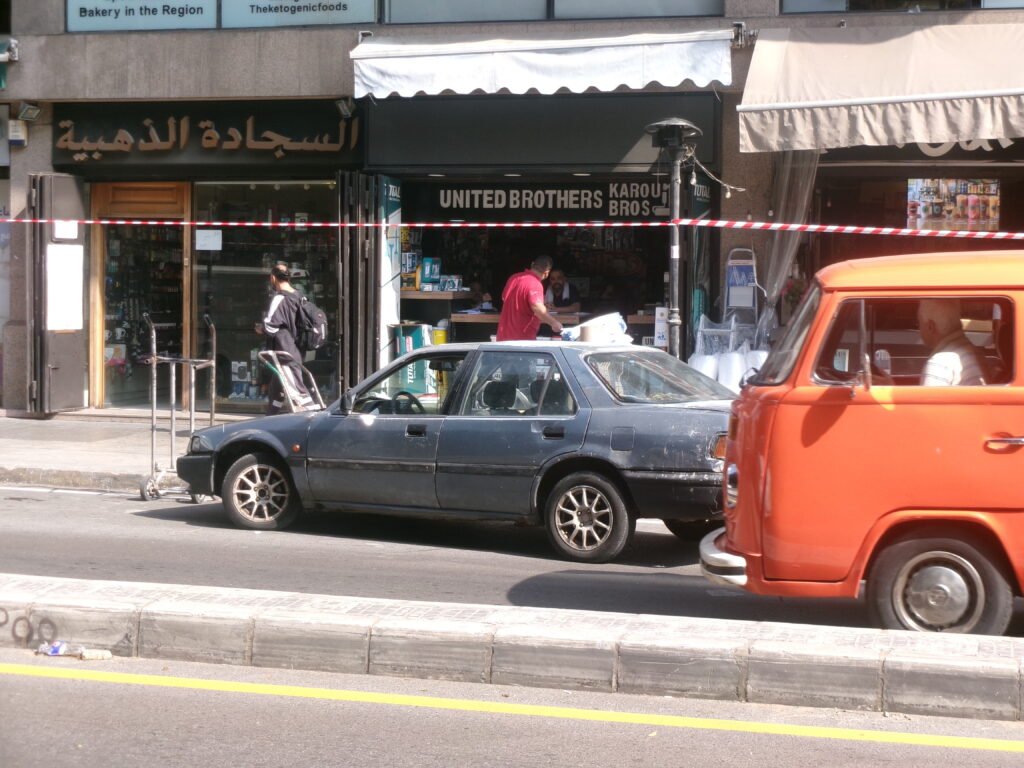
In Beirut, life appears to have resumed its course. Restaurants are busy, terraces remain lively and traffic fills the streets. In some neighbourhoods, businesses continue operating just a few streets away from damaged or abandoned buildings. At times, the city gives the impression that it has absorbed the latest violence and returned to a degree of normality. Yet this apparent continuity conceals a much more fragile reality. Electricity cuts remain frequent, access to hot water is irregular, and internet disruptions complicate everyday activities. Buildings still bear the marks of previous fighting from the civil war up to this day, while drones have reportedly resumed flying over the capital following a period of relative calm. The coexistence of economic activity and deteriorating living conditions was one of the first contradictions to emerge from my observations in Lebanon between 22 and 29 October 2026. The city has not stopped functioning, but the conditions in which its residents live and work remain deeply precarious. The resumption of daily activities does not necessarily signal a return to normality; it also reflects the need to carry on in the absence of lasting guarantees.
During the interviews, this led me to question a term frequently used to describe Lebanon: “resilience”. Employed by international organisations, humanitarian actors and the media, it has become a familiar way of characterising the Lebanese population’s ability to overcome wars, economic crises and successive waves of displacement. It is generally associated with solidarity, adaptability and the perseverance of a society that continues to move forward despite adversity. Yet several people I spoke to challenged this portrayal. They did not deny the population’s capacity to adapt, but rejected the idea that this capacity should become a way of normalising living conditions that ought never to be considered acceptable. During an interview on 23 and 27 October, Christian Taoutel, associate professor at l’Université Saint-Joseph, explained precisely why he no longer wished to use the word “resilience”. In his view, it has become a fashionable term for describing the Lebanese ability to overcome successive crises. Lebanese people do not necessarily want to be resilient, he argued; “above all, they aspire to live in a normal society, where successive crises are not a permanent feature of everyday life.” He would rather speak of “fatality”, a term he considers more reflective of a population compelled to accommodate an instability that has become structural.
The distinction matters. Resilience implies the ability to overcome an ordeal. In Lebanon, however, the ordeals never seem to end. Just as one crisis begins to subside, another undermines the prospect of a return to stability. Adaptation consequently becomes less an exceptional response than an everyday necessity. What some external narratives present as a collective strength can also be experienced by residents as an obligation: the obligation to keep working, moving, supporting relatives and rebuilding, because there is no alternative.
Carrying on working, even when the conditions no longer allow it
This contradiction becomes particularly tangible in the accounts I collected in Beirut. On 22 October, I met a taxi driver named Hosain, a father of two, who had lost a leg following an accident in a tunnel plunged into darkness by electricity cuts. Despite his disability, he quickly returned to work to provide for his family. His story could easily be presented as an illustration of Lebanese resilience: that of a man who refuses to give up despite an exceptionally difficult ordeal. Yet such a reading raises another set of questions. Why did he have to return to work so quickly? Under what economic and social conditions can an amputee resume employment without necessarily having access to adequate support? And what does his experience reveal about the consequences of infrastructure failures as seemingly ordinary as electricity shortages?
His testimony struck me as particularly revealing of the ambiguity surrounding the term. This is not about diminishing his determination, but about refusing to treat individual endurance as an adequate response to a situation that also involves collective responsibility. One person’s courage should not absolve anyone from examining the circumstances that forced him to continue working under such conditions. Other observations in Beirut point to the same need for constant adaptation. Taxi drivers must contend with rising fuel prices, fares that do not always reflect increasing costs and irregular demand. Some increasingly rely on direct customers to reduce their dependence on booking platforms and secure more predictable income. Residents reorganise their journeys, spending and professional activities around constraints that, in a more functional institutional environment, should not occupy such a central place in everyday life.
The economic crisis that began in 2019 has not disappeared with the return of military tensions. It continues to shape daily life, even when public attention shifts towards security concerns. Several people I spoke to described a society in which the middle class has been severely weakened and the gap between the wealthiest and the most vulnerable has widened. War has therefore been added to a crisis that was never genuinely resolved.
Southern Lebanon: returning home without recovering one’s life
It is in accounts of southern Lebanon, however, that the limits of resilience become most apparent. Successive waves of displacement have profoundly altered people’s living conditions, far beyond the loss of their homes. Residents are sometimes forced to choose between remaining in exposed areas, moving to places where accommodation is becoming increasingly unaffordable, or returning to villages where infrastructure and livelihoods have been destroyed. During my interview with the director of L’Œuvre d’Orient, Vincent Gelot, on 23 October, particular attention was given to the villages of Rmeich, Aïn Ebel and Debel. In these communities near the border, some residents refused to leave for fear that they might never be able to return. Others attempted to go back despite the destruction and continuing security uncertainties. Access to certain areas nevertheless remains difficult, sometimes requiring military coordination and prior authorisation. Residents cannot always reach their agricultural land, while the risk posed by unexploded ordnance and surrounding destruction further complicates the resumption of economic activities.
This situation gives return a different meaning from the one sometimes conveyed by humanitarian assessments. Returning does not necessarily mean recovering acceptable living conditions. Some families go back because they can no longer afford accommodation elsewhere, because their financial resources are insufficient, or because prolonged displacement has become unbearable. Return may therefore reflect the exhaustion of alternative options as much as the restoration of normality. The consequences are particularly significant in a region where livelihoods depend heavily on agriculture, livestock, olive groves and small businesses. The destruction of a home is only part of the problem when land is no longer accessible, harvests have been lost and the infrastructure needed for production has ceased to function. A family may return to its village without recovering the resources that once made life there possible.
My interview with Ali Mourad, researcher and professor at the Beirut Arab University, which focused on the social and political consequences of the war, provided further insight into this issue. He described the destruction of a neighbourhood in his village of origin, comprising approximately twenty to thirty houses belonging to several generations of his family. Residents were dispersed across Lebanon, often according to where accommodation was available. For him, the destruction extends far beyond buildings: it also dismantles neighbourhood relationships, family solidarities and the economic and educational networks that once structured local life. He highlighted, for instance, the consequences of displacement for local professions. A doctor practising in Tyre or Nabatieh depends on a local patient base and an economic environment that cannot simply be recreated by rebuilding a medical practice. Children, meanwhile, attended schools bringing together families from several neighbouring villages. The dispersal of residents therefore weakens relationships that extend well beyond individual households.
His testimony led me to consider displacement as something more than a temporary interruption of everyday life. When a population is scattered, the very conditions that sustain collective life are affected. Families may gradually rebuild their routines elsewhere, while the ties that connected them to their village weaken. Even when houses are reconstructed, there is no guarantee that residents will return together, that economic activities will resume or that social relationships will recover their former structure. Material reconstruction, therefore, does not automatically translate into social reconstruction. This distinction is essential to understanding why the number of people who have returned to their villages is not, in itself, sufficient to measure the recovery of displaced communities.
Genuine solidarity, increasingly under strain
A recurring theme in my interviews was the growing role played by associations, humanitarian organisations and religious institutions in addressing the population’s needs. In Lebanon, these structures do not intervene solely during emergencies. For decades, they have provided part of the social, educational and healthcare services that the state has been unable to deliver adequately. L’Œuvre d’Orient described how schools, religious congregations and local associations mobilised to accommodate displaced families. Educational institutions opened their doors, organisations arranged distributions of essential goods, and local networks helped maintain a degree of solidarity between host communities and those forced to leave their homes. This mobilisation is indispensable, but it cannot be treated as an inexhaustible resource. Associations are now facing declining funding, inflation and continuously rising needs. Some institutions are still waiting for public subsidies, while their operating costs have increased considerably. Organisations providing services of public interest are consequently being weakened by the very state failures they are expected to compensate for.
The interview also highlighted growing fatigue among civil society actors. Displacements continue, needs evolve and organisations are repeatedly required to redirect their activities. Some have already had to adapt their operations several times since the beginning of the latest cycles of violence. In Tibnine, a school mentioned by L’Œuvre d’Orient had itself been displaced several times before being able to resume its activities in a location that remains close to an increasingly sensitive area. Solidarity remains an important feature of Lebanese society, but it is being exercised under increasingly difficult conditions. It cannot indefinitely replace coherent public policy or compensate for the absence of institutional guarantees. Presenting this mobilisation as yet another example of resilience risks obscuring the fragility of the organisations that make it possible.
This contradiction is particularly visible because displaced populations are not the only ones bearing the consequences of the crisis. Host communities must also contend with their own economic and security difficulties. Prolonged displacement can create tensions, especially when accommodation facilities lack resources or residents have no clear indication of when families will be able to return. This does not necessarily reflect a rejection of displaced people; rather, it points to a situation in which solidarity is being demanded beyond the limits of available resources.
A political crisis inseparable from everyday living conditions
Throughout the conversations, it also became difficult to separate social fatigue from political questions. War, destruction and displacement are not experienced solely as external events striking an already weakened society. They revive longstanding debates about state sovereignty, power relations between communities and the role of armed actors in political decision-making. Ali Mourad, in particular, emphasised the difficulty of challenging Hezbollah’s position within the Shiite community. In his analysis, the rapprochement between Hezbollah and Amal, particularly since 2005, has contributed to narrowing the space for internal political contestation. The defence of communal unity can sometimes be invoked to discredit criticism, which is portrayed as a form of betrayal or a threat to the group’s cohesion. He argues that this dynamic has helped consolidate political hegemony and restrict the expression of certain dissenting voices.
Christian Taoutel also described what he sees as profound changes within the Shiite community, which he believes is undergoing a period of reassessment following the destruction, Hassan Nasrallah’s death and the weakening of the movement’s narrative of invulnerability. He nevertheless stressed that the extent of these internal changes remains difficult to measure, particularly when public criticism is perceived as taking a position against the community itself.
These interpretations must be situated in their context and attributed to their authors. They do not justify treating the Shiite population as a homogeneous group, nor conflating citizens’ aspirations with Hezbollah’s decisions or Iran’s regional policies. They do, however, demonstrate that the country’s reconstruction cannot be separated from a broader discussion of how its institutions function and the conditions under which military and political decisions are made.
The question of responsibility is central. Civilians cannot be reduced to the strategies of armed actors, just as residents of southern Lebanon cannot be held collectively responsible for Hezbollah’s decisions. At the same time, criticism of those decisions cannot be dismissed in the name of communal solidarity or the need for reconstruction. The challenge is precisely to address the protection of civilians, the return of displaced populations, reconstruction and the restoration of state authority capable of making decisions on behalf of the entire country. This political dimension is particularly important in border communities, where the possibility of returning home depends on security conditions largely beyond residents’ control. Destruction, restrictions on access and uncertainty surrounding the Israeli military presence cannot be treated as merely temporary obstacles. They raise questions about the long-term presence of communities on their land and the Lebanese state’s ability to guarantee their security and return.
Palestinian camps: a precarity that is no longer an emergency
The question of resilience also arises in Palestinian camps, where precarity is embedded in a different timeframe. During my interview with L’Œuvre d’Orient, the situations in Mar Elias and Dbayé were discussed in particular. Although security conditions are now relatively calmer than during certain periods of previous decades, the social and humanitarian situation remains extremely difficult. High population density, inadequate infrastructure, restrictions on access to certain professions and limited economic prospects continue to affect residents. In Dbayé, the absence of a UNRWA school represents an additional challenge for families. In Mar Elias, an associative support network helps address some needs, but does not alter the structural constraints facing residents.
The war in Gaza and regional developments have brought the Palestinian question back to the forefront of international attention. Yet this visibility has not necessarily translated into an improvement in the everyday conditions of Palestinian refugees in Lebanon. Concerns about Hezbollah, Iran and regional security also occupy a prominent place in Lebanese public debate, while the social difficulties facing the camps remain largely entrenched. Here again, the language of resilience becomes problematic when it turns prolonged precarity into an assumed capacity for adaptation. Residents are not simply facing a temporary emergency: they live in an environment where uncertainty about the future, employment opportunities and the political status of refugees is passed from one generation to the next. The question is therefore not merely how humanitarian organisations can respond to their needs, but why those needs continue to be reproduced without a lasting political horizon.
Stop asking the Lebanese to endure
By the end of this week of interviews and observations, what stood out was not an absence of solidarity or a lack of determination to carry on. Rather, it was the contradiction between residents’ ability to maintain their everyday lives and the conditions under which they are forced to do so. In Beirut, businesses remain open despite electricity cuts and security uncertainties. In the South, residents return to villages where livelihoods have been destroyed. Associations continue their work despite shrinking funding. Families accommodate displaced people while facing economic difficulties of their own. These situations demonstrate considerable individual and collective resources. But they should not be turned into proof that Lebanese society is naturally capable of absorbing repeated crises. The ability to carry on does not mean that living conditions are acceptable; solidarity does not mean that organisations can indefinitely replace the state; return does not mean that displaced populations have recovered their livelihoods; and rebuilding houses does not guarantee the restoration of communities.
The term “fatality”, used by Chrisitan Taoutel, captures part of this exhaustion. It reflects an awareness of a political and regional environment that seems to condemn the country to successive crises, without necessarily implying a renunciation of its future. Yet fatality is not, in itself, a sufficient explanation. It should not lead to the assumption that instability is an immutable feature of Lebanon. Crises have causes, actors and responsibilities. Identifying them remains essential to avoiding a reduction of residents’ experiences to a simple capacity for endurance. Ultimately, rejecting resilience is less about denying the strength of Lebanese society than about asserting a demand for normality. The people I spoke to are not asking to be celebrated for their ability to live with uncertainty, work despite infrastructure failures or rebuild after every destruction. They want to be able to live in their villages, access their land, practise their professions, send their children to school and plan for the future without constantly anticipating another crisis.
The question, therefore, is no longer how much longer the Lebanese can endure, but how much longer they will be expected to do so. A society should not have to turn survival into a collective identity. It should be able to rely on institutions, security guarantees and economic conditions that finally allow it to live without constantly waiting for the next ordeal.