


Reconsidering a Particular Status
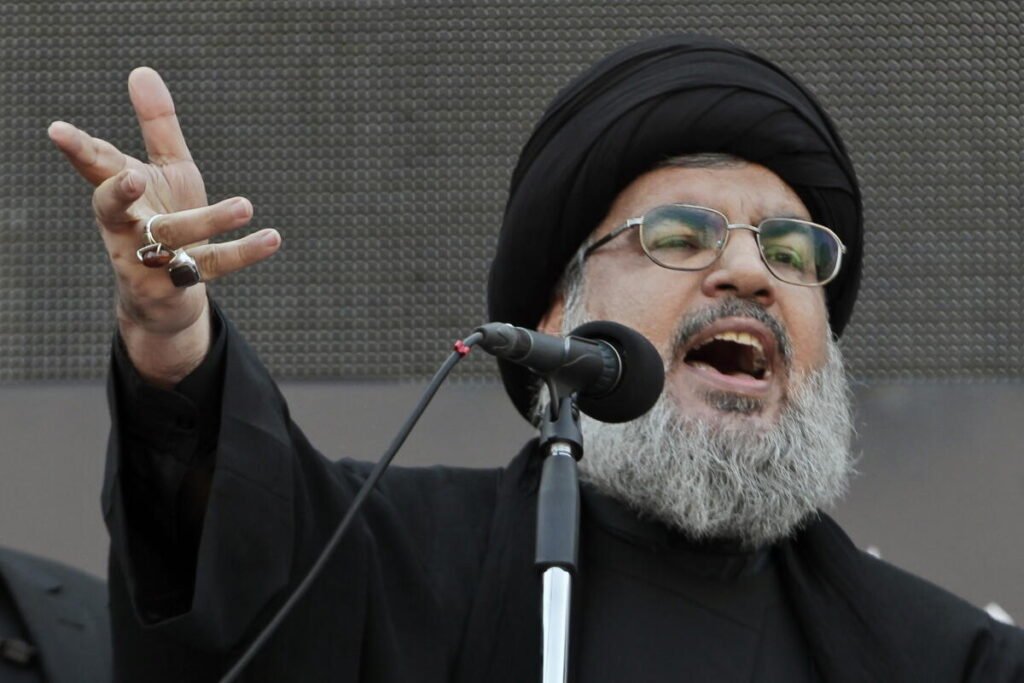
In Beirut, signs of Hezbollah’s presence remain visible. In certain neighbourhoods and near checkpoints, portraits of Hassan Nasrallah continue to occupy a prominent place in public spaces [However, the Lebanese people who accompanied me throughout this mission asked me to be careful when photographing these portraits. Nearby, men sitting on plastic chairs kept watch over the posters and made sure that no one photographed them with what might be considered disrespectful intent, damaged them or removed them. Their presence appeared to constitute a form of informal surveillance around these representations of Hassan Nasrallah.]. These portraits bear witness to a political and symbolic attachment that did not disappear with the death of the former Secretary-General. Yet, behind this visible presence, the balance of power that had hitherto shaped part of Lebanese political life appears to have been profoundly shaken.
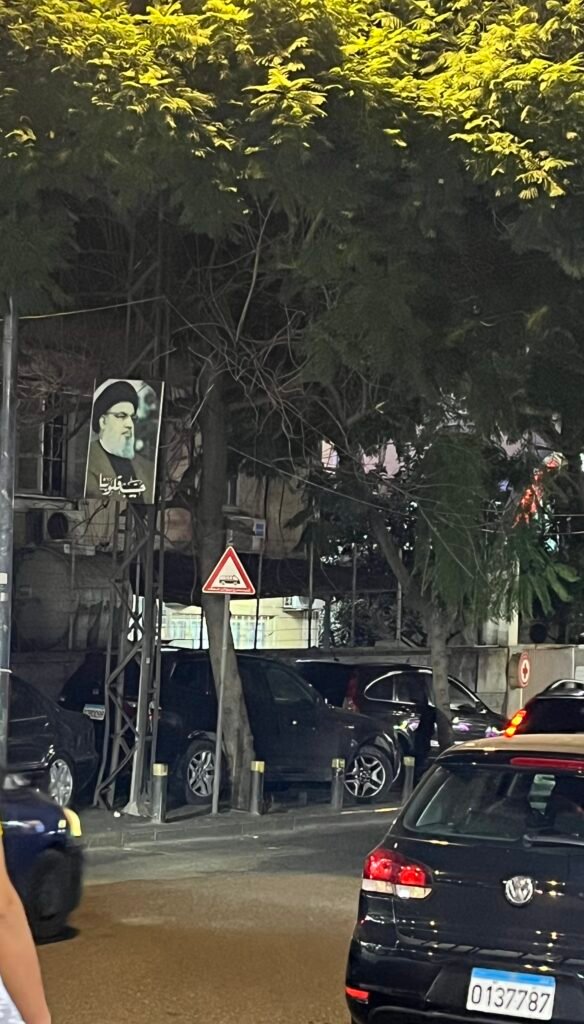
Photo taken during my research mission in Beirut, in October 2026. The men were next to first the car.
During my mission, one question gradually emerged in the interviews: what place did the Shiite community occupy within Lebanon’s political balance, and how is that position now being called into question? Several interlocutors described a period during which Hezbollah had acquired such military power, particularly through the symbolic significance of the 2006 war against Israel, that the group also gained considerable political and symbolic influence. As a result, some of its supporters may have felt that they enjoyed a particular status within the state. This feeling did not stem solely from ideological support for the movement. It was also linked to its ability to influence institutional decisions and intervene in regional power dynamics. However, it would be excessive to suggest that this perception was uniformly shared by the entire Shiite population, as the interviews clearly illustrate this dichotomy. Rather, it was a sense of pre-eminence that developed among certain segments of the Shiite community, particularly among the movement’s most committed supporters, as Hezbollah consolidated its position. This perception could create the impression that the ordinary rules of the state did not always apply in the same way to its representatives and networks, or that the movement’s power enabled its political base to enjoy a position that other components of the country did not possess.
It is precisely this configuration that now appears to be weakening. The war, the destruction in the South, the death of Hassan Nasrallah and the weakening of Hezbollah’s capabilities have profoundly altered the conditions under which this power was perceived. The Shiite community remains an essential component of Lebanon, but the movement that claimed to protect it can no longer assert with the same certainty that it is a dominant actor and guarantor of its security. The issue, therefore, is not merely Hezbollah’s military decline. It concerns the questioning of a relationship with power that had gradually extended beyond the movement itself and affected the way in which some of its supporters viewed their place within the Lebanese political system.
From Military Power to Political Pre-eminence
During my interview with Ali Mourad, this development was discussed through the history of Hezbollah’s political trajectory and its relationship with Lebanese institutions. According to him, the rapprochement between Hezbollah and Amal, particularly since 2005, contributed to narrowing the space for political competition within the Shiite community. Communal unity gradually became a principle of political legitimacy, to the point that criticism of the movement could be interpreted as a challenge to the cohesion of the group. This consolidation was not built solely on military strength. It also rested on a particular history: the historical marginalisation of Shiite populations in a region where domination has been predominantly Sunni in character, resistance to Israeli occupation, and the emergence of a movement capable of providing services and resources in territories where the state was often absent, as a result of successive waves of instability, war, occupation and periods of economic hardship. For part of the population, Hezbollah thus embodied both a capacity for defence, a form of political recognition and an instrument of communal protection.
However, as the movement strengthened its position, this representative function could also become a mechanism of political domination. Ali Mourad, as well as another activist interviewed who wishes to remain anonymous, considers that Hezbollah gradually consolidated a form of hegemony that made it difficult to express dissenting views within the community. He argues in particular that the movement’s military weight enabled it to exert influence far beyond its electoral standing and to shape the functioning of national institutions. This military power and hegemonic consolidation expanded considerably when Hezbollah, having emerged victorious from the 2006 war against Israel, refused to surrender its weapons. This development helped reinforce a perception of pre-eminence: that of a political force that no longer considered itself merely one component of the Lebanese system, but rather an actor with a particular capacity to determine its balance of power. The question of military autonomy is central to this configuration. When a movement retains the ability to decide to enter into war without a national institutional mandate, it wields power that exceeds that of other political actors and undermines the principle of shared sovereignty.
Christian Taoutel offers a similar interpretation, emphasising the sense of invulnerability that Hezbollah is said to have cultivated over several years. According to him, the movement gradually constructed an image of collective strength, in which its military capabilities, political influence and regional presence reinforced the perception that the community enjoyed exceptional protection. This representation may also have fostered, among some of its supporters, the idea that Hezbollah occupied a position that other political forces could not challenge. This did not necessarily amount to an explicit claim of confessional superiority. Rather, this pre-eminence manifested itself in the movement’s relationship with institutions, its ability to impose decisions and the belief that it could safeguard communal interests independently of the state’s ordinary mechanisms. The feeling of being protected by an autonomous military force could thus translate into a perception of political power and particular status.
When Power No Longer Protects
The observations gathered during the mission provide another dimension to this development. In Beirut, the presence of Hezbollah and Hassan Nasrallah’s symbols in public spaces coexists with the traces of a war that has profoundly affected the territories and populations associated with the movement. This juxtaposition reveals a gap between the persistence of symbolic attachment and the questioning of Hezbollah’s ability to protect those on whose behalf it claims to act.
The interview with Ali Mourad helps convey the scale of this rupture. He told me about the destruction of a neighbourhood in his home village, where between twenty and thirty houses stood, several of which belonged to different generations of his family. Residents were dispersed across Lebanon, and the social, family and economic relationships that structured local life were profoundly weakened. The destruction therefore extends beyond housing, as it affects the very conditions that sustain a community. This testimony echoes observations reported by L’Œuvre d’Orient regarding localities in the South, particularly Rmeich, Aïn Ebel and Debel. In these border villages, residents must contend with access restrictions, security risks linked in particular to the presence of Israeli troops and Hezbollah, mines on several roads, damaged infrastructure and the inability to resume certain agricultural activities, notably because of the razing of villages and the use of gas. Some have refused to leave for fear that they may never be able to return; others are attempting to reclaim their homes despite the absence of guarantees regarding their safety and livelihoods.
These situations highlight a fundamental contradiction: the military power intended to protect the community did not prevent destruction or displacement. The sense of invulnerability described by Christian Taoutel is thus confronted with an especially brutal material reality. The Shiite community, like the country’s other components, remains exposed to the consequences of political and military decisions taken within a regional environment that extends beyond its control.
Nevertheless, Hezbollah’s weakening does not automatically imply a break with the movement. Several people emphasised how difficult it is to assess internal changes within the community. Some supporters may be deeply shaken by the consequences of the war while retaining an ideological or emotional attachment to Hezbollah. Others may question its strategy without rejecting its historical role in resisting Israel. Still others may wish for political change without having the necessary conditions to express their disagreement publicly. This diversity of positions makes it impossible to consider the war a uniform turning point. The movement’s loss of power does not automatically translate into the disappearance of its social and symbolic influence. It nevertheless opens a period of uncertainty in which the foundations of its authority may be increasingly challenged, beginning with the question of its disarmament and integration into Lebanese society as a whole.
Confrontation with Other Components of Lebanese Society
To understand the questioning of this pre-eminence, it is also necessary to consider how it is perceived by the country’s other communities. During the interviews, several interlocutors described a growing sense of weariness with Hezbollah’s ability to impose strategic choices whose consequences affect the entire country. The movement’s military autonomy, its involvement in regional conflicts and its influence over institutions have gradually fuelled the perception that some political actors do not enjoy the same room for manoeuvre. This perception should not be confused with opposition to the political presence of Shiites within the state. Rather, it concerns the questioning of a balance of power considered unequal. In a system based on confessional power-sharing, the consolidation of an actor with an independent military force has helped alter the conditions of political competition. Other components of society could therefore feel that institutional mechanisms were no longer sufficient to regulate the movement’s decisions.
On the ground, this tension is not expressed solely through political debates. It also appears in relations between displaced populations and host communities. The interview with L’Œuvre d’Orient, in particular, brought to light concerns expressed by certain organisations that had hosted displaced families, in a context where the presumed presence of Hezbollah members could be perceived as a risk factor in the event of Israeli strikes. These concerns do not mean that displaced people are systematically associated with the movement. Rather, they show how the war has made it increasingly difficult to distinguish between communal belonging, political affiliation and security exposure.
However, it would be inaccurate to portray relations between host and displaced populations as systematically confessional in nature. Families and institutions belonging to different communities have welcomed people displaced from the South, while certain localities have sought to preserve their civilian character and avoid any association with military activities. Solidarity therefore remains real, but it is exercised in an environment where political mistrust and security concerns have become more pronounced. This clash of perceptions reveals a central challenge for Lebanon: how can the political and military pre-eminence of a movement be challenged without calling into question the rights and place of the population it claims to represent? Criticism of Hezbollah must not become a form of exclusion of Shiites, just as the defence of Shiite rights must not serve to shield the movement from all criticism.
The End of a ‘Particular Status’ or the Return to Shared Citizenship?
Hezbollah’s weakening thus raises questions about the nature of Lebanon’s political compact. For several years, the movement may have appeared, in the eyes of its supporters, as a force capable of protecting the community and securing a dominant position for it within national power dynamics. According to some testimonies, certain Shiites may have considered themselves ‘supra-citizens’ [a term that should be treated with caution, as it does not represent the entire Shiite community, but rather a notion that was repeated on several occasions by different interlocutors]. This position rested on a combination of historical legitimacy, military power, institutional influence and regional support. However, the 2023 war (2024 and 2026) has profoundly weakened the foundations of this representation. Christian Taoutel considers that the Shiite community is going through a period of reassessment, even if this remains difficult to observe publicly. He particularly stresses the need to distinguish the political and social rights of Shiite citizens from the particular privileges Hezbollah enjoyed as a result of its military autonomy. In his view, the end of a system in which an actor can exercise authority parallel to that of the state should make it possible to restore the principle of shared citizenship.
This distinction echoes the concerns expressed by Ali Mourad. According to him, reconstruction must neither result in the collective punishment of the Shiite population nor allow previous relations of domination to be restored. Residents of the South must be able to return to their villages, land and economic activities without access to aid or reconstruction being conditional on their political positions. However, reconstruction must also take place within a national framework that is transparent and overseen by public institutions. The challenge is considerable. The questioning of political pre-eminence may be experienced as a loss of status by those who identified with the movement’s power. It may also be perceived by other components of society as an opportunity to rebalance power relations. In both cases, the risk is that one form of domination will be replaced by another, or that a crisis of sovereignty will turn into a conflict over communal legitimacy.
The objective should therefore not be to determine which community should now occupy a dominant position, but to put an end to the logic whereby the security, representation and political influence of a population depend on the power of an armed actor. Restoring shared citizenship requires that Shiite citizens be able to exercise their rights fully without being conflated with Hezbollah, just as the country’s other components must be able to challenge its decisions without being accused of hostility towards a community.
A Weakened Pre-eminence, but an Uncertain Transformation
At the end of this mission, the field observations and interviews do not allow us to conclude that there has been a definitive break between the Shiite community and Hezbollah. The movement’s symbols remain present in public spaces, political and emotional attachments persist, and opinions within the community remain difficult to grasp in all their diversity. Hezbollah’s military decline does not necessarily mean the disappearance of its social or ideological influence. However, the destruction, displacement and loss of certain strategic capabilities have profoundly shaken the sense of power that accompanied its rise. What is being called into question is not only the movement’s ability to defend its positions, but also the idea that its power guaranteed the community it represents a form of protection and pre-eminence within the Lebanese system.
The current divide therefore lies as much in the Shiite community’s relationship with its own political representative as in the perceptions that the country’s other components hold of it. The challenge will be to turn this reassessment into a debate about institutions, sovereignty and citizenship, rather than allowing it to become another confessional confrontation.
Lebanon is thus facing a question that goes beyond Hezbollah’s future alone: can it move from a system in which certain political positions rest on communal and military power dynamics towards an order in which every citizen enjoys the same rights, the same protections and the same obligations? The end of a sense of pre-eminence will constitute progress only if it paves the way for shared citizenship, rather than a new form of exclusion.