

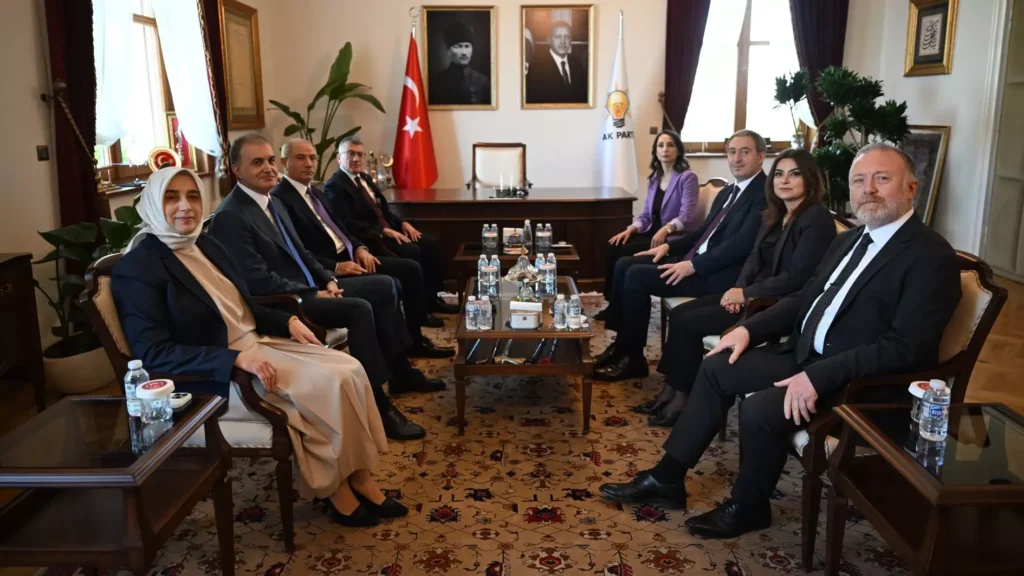
On November 28, 2024, a delegation from the DEM Party [1], the Kurdish parliamentary party in Turkey, met with the leader of the PKK, who has been serving a life sentence since the beginning of the millennium on İmralı Island, off the coast of Istanbul. This event is somewhat of a surprise, as it follows a series of signals—both domestic and international—that, despite their contradictions, suggest that the Turkish government has reintroduced the search for a political resolution to the Kurdish issue. Let us first revisit these events, recalling the previous attempts at resolution initiated by the AKP [2], before examining how these developments fit within the politically challenging domestic context for the Turkish government and the broader situation created at Turkey’s borders following the fall of Bashar al-Assad’s regime.
Nearly twenty years after Ahmet Türk’s gesture, Devlet Bahçeli extends his hand…
But what got into him? One might have been tempted to think that age was starting to take a toll on the far-right leader, Devlet Bahçeli, when on October 1, 2024, at the start of the autumn parliamentary session, he publicly shook hands with Tuncer Bakırhan, the leader of the Kurdish group, stating his belief that the Kurds were part of the national community and should work toward better integration. For if any political party had consistently and often radically opposed the pursuit of a political resolution to the Kurdish issue in Turkey, it was certainly Devlet Bahçeli’s MHP [3]. However, veteran observers of Turkish political life were reminded of the hand extended by Ahmet Türk, the leader of the first Kurdish parliamentary group, in a similar yet opposite manner to Devlet Bahçeli at the beginning of the parliamentary session in August 2007. Knowing that the two men maintained a relationship and that the MHP leader had intervened on behalf of the former leader of the DTP, who was regularly a victim of the repression targeting Kurdish elected officials, one is inclined not to dismiss the symbolic weight of this gesture. This is all the more relevant given that Devlet Bahçeli has often played the role of a herald, signalling important political and constitutional turning points ardently desired by the AKP. In this regard, one could recall his constitutional initiative in January 2008 to end the ban on headscarves in universities, his decision to support the constitutional amendment in 2017 that allowed the AKP to transform Turkey into a presidential system, his call for early elections following this reform in 2018, and even his recent desire to see the constitution amended to allow Recep Tayyip Erdoğan to run for the presidency again (a wish that, if realised, will once again prove to be prescient, of course).
Bahçeli’s Kurdish initiative was reinforced by consensual statements from Erdoğan,9 who called for “a different style and discourse in politics,” and, most notably, by an even more dramatic move. On October 22, 2024, after a series of rumors and anticipatory statements, the historical leader of the Turkish nationalist party directly invited Abdullah Öcalan himself to come to parliament and announce the abandonment of armed struggle and the dissolution of his organisation, the PKK (which has been waging a guerrilla war since 1984 in southeastern Turkey).
However, there were reasons to believe that Bahçeli’s call might falter when, the following day, an attack claimed by the PKK struck Turkish Aerospace Industries (TAI), one of the pillars of Turkey’s defense industry, in Kahramankazan, near Ankara, resulting in several casualties. Nevertheless, the DEM continued to take the MHP leader at his word, submitting a request to the Ministry of Justice to meet Abdullah Öcalan in his prison in İmralı. By October 24, Öcalan was granted permission to see his nephew (who, notably, is a DEM member of parliament), even though he had not received any family visits since 2021. The Turkish Ministry of Justice’s acceptance of the DEM’s request and the delegation’s visit to Abdullah Öcalan thus seemed to reconnect the threads of a process that had been interrupted in the spring of 2015, shortly after Recep Tayyip Erdoğan, then in the midst of an electoral campaign, claimed that there was no Kurdish problem in Turkey—essentially contradicting statements he had made ten years earlier. Indeed, the AKP leader had been the first Turkish head of state to officially acknowledge the existence of this issue, in an emblematic statement made in Diyarbakır in 2005.
This illustrates just how long and complex the history of attempts to politically resolve the Kurdish issue is in Turkey, particularly since the beginning of the millennium and the rise to power of the AKP. Starting in 2007, after his first re-election, Recep Tayyip Erdoğan made it one of the spearheads of an offensive aimed at effectively consolidating his power by dislodging the military (and more broadly the Kemalist political-military establishment) from its dominant position within the state apparatus. At that time, the management of the Kurdish issue was largely beyond the control of the government, as it fell, like other sensitive matters (largely military and diplomatic affairs), under the sole purview of the military. As a result, the AKP government seized every opportunity to exploit the blunders, setbacks, or failures of the military in its struggle against the PKK guerrilla, in order to denounce its sidelining and intervene in the Kurdish issue.
The three unsuccessful attempts by the AKP to resolve the Kurdish issue.
Thus, during the summer of 2009, at a time when the positions of the politico-military establishment were weakening and a Kurdish parliamentary group had now emerged, Recep Tayyip Erdoğan, after formally welcoming its leader, Ahmet Türk, to the government headquarters, launched the “Democratic Opening” (Demokratik Açılımı). This process, the objectives of which remained unclear, aimed to initiate a debate in parliament with the goal of putting the first concrete reforms related to the Kurdish issue on the agenda. However, before the end of 2009, the initiative faltered due to two setbacks. On the one hand, the symbolic return of PKK fighter groups (grandiosely called “peace groups – Barış Grubu”) to lay down their arms on the Turkish-Iraqi border turned into a pro-Kurdish demonstration broadcast live by the media, which had a highly negative impact on public opinion and caused alarm within the AKP. On the other hand, the Constitutional Court, still largely dominated by judges close to the secular politico-military establishment, dissolved the DTP, the Kurdish parliamentary party at the time. As a result, the repression resumed in the southeast…
This first setback, however, did not discourage the AKP, which, in 2010-2011, initiated a new approach to resolving the issue, involving direct negotiations with the PKK, entrusted to the Turkish intelligence services (MIT) and conducted secretly in Oslo, Norway. Once again, the uncertain content of the negotiations and the emergence of external events quickly disrupted the progress of an operation now known as the “Oslo Process” (“Oslo Görüşmeleri”). Indeed, the Gülen movement, which was beginning to come into conflict with the AKP, exposes the secret talks and even denounces them when prosecutors sympathetic to the movement begin legal proceedings against MIT members involved in the negotiations. The government is forced to abruptly intervene, sparking controversy and scandal.
The most comprehensive and significant attempt, for understanding the ongoing events, is what is known as the “Resolution Process – Çözüm Süreci,” which began at the end of 2012 when Recep Tayyip Erdoğan mentioned its launch in a speech. This process involved indirect negotiations between the Turkish government and Abdullah Öcalan himself, with Kurdish parliamentary party members (now the HDP) meeting with the PKK leader and acting as intermediaries with the Turkish authorities, and even with other entities if necessary. In January 2013, delegations of two or three Kurdish deputies began visiting Abdullah Öcalan on İmralı Island. Accompanied by other initiatives, these visits led to initial results. During the celebration of Kurdish New Year (Newroz) in Diyarbakır, a peace appeal from the PKK leader was read by the two deputies who had become the key players in the negotiations (Sırrı Süreyya Önder and Pervin Buldan). A first decision seemed to be reached: the withdrawal of PKK troops from Turkish territory to their rear bases in Iraq.
Yet, in May 2013, the Gezi events [4] pushed the “Resolution Process” to the backburner of the AKP’s political agenda and permanently stalled it, as the political developments of late 2013 and 2014 were particularly intense (the public revelation of the conflict between the Gülen movement and the AKP, leading to the first purges in the police and judiciary, the 2014 presidential campaign and elections, and the intensification of the civil war in Syria with numerous repercussions for Turkey…). However, as the parliamentary elections drew closer, the “Resolution Process” was revived in February 2015, and visits to İmralı Island resumed. These even led to a new peace appeal from Öcalan in the spring of 2015. But the atmosphere was no longer the same. In two years, the context had changed profoundly. Domestically, Turkey had become, due to the first direct presidential election, a sort of semi-presidential regime where President Erdoğa began to disagree with his Prime Minister, Ahmet Davutoğlu. After distancing himself from the “Resolution Process” during the electoral campaign, the head of state, who faced a setback in the June 2015 parliamentary elections, began to outright renounce it. On the international front, the clashes between ISIS and the Syrian Kurds of the PYD-YPG had significant repercussions in Turkey (Kurdish solidarity movements during the siege of Kobané, protests, clashes between pro- and anti-PKK groups…). In the second half of 2015, the guerrilla warfare resumed in the southeast of the country, even leading to unprecedented urban uprisings that were harshly suppressed. The hope for a resolution to the Kurdish issue seemed to recede permanently. To pursue his reforms (especially the establishment of an authoritarian presidential system) and broaden his electoral base, the AKP sought and obtained the support of the MHP, the party most resolutely opposed to any negotiated solution to the Kurdish problem.
Resumption of an interrupted process or a new paradigm?
After ten years in purgatory, is the “Resolution Process” rising from its ashes? A number of signs seem to indicate this. First, the mode of operation appears to be similar, based on visits to İmralı by Kurdish deputies, particularly those who became symbols of the process between 2013 and 2015, Sırrı Süreyya Önder and Pervin Buldan. Next, it is noticeable that official circles, particularly pro-government media outlets, are keen to highlight this resumption, without, however, treating it as a decisive event just yet. Finally, despite the repressive setbacks experienced in recent years, Kurdish forces, whether legal (DEM) or illegal (PKK), seem willing to give the experience another try. However, two phenomena must be taken into account to understand the reasons behind this and assess the chances of success for this event.
Firstly, Turkey’s domestic political agenda is that of a regime seeking a new lease on life. In the spring of 2024, during local elections, the AKP suffered a significant defeat for the first time, being outpaced by the CHP[5], the main opposition party. This setback confirmed the erosion of the ruling party’s influence, which has been grappling for several years with a deteriorating economic situation. Moreover, Recep Tayyip Erdoğa finds himself in a deadlock, as under the current Constitution, he will not be able to run again for the presidency in 2028. Therefore, it is imperative for the AKP to find ways to disrupt the upward momentum of the opposition and amend the Constitution to allow its leader to run for the highest office once more. In this context, reviving a process aimed at politically resolving the Kurdish issue could serve to undermine the opposition’s capture of the Kurdish vote, or even divide the CHP, within which opinion on the issue is far from uniform.
Secondly, since Devlet Bahçeli’s initiative, it is important to remember that the international context has changed due to the fall of the Ba’athist regime (on December 8, 2024), an event that solidified Turkey’s position in Syria. As the primary partner of the new regime that is taking shape, the Turkish government finds itself in a position of strength against the Syrian Kurdish militias of Rojava. During the military operations that ousted Bashar al-Assad from power, these militias were forced to evacuate the Manbij district, on the western bank of the Euphrates, by the Syrian National Army, which is supported by Ankara. However, the Turks will likely face difficulty in convincing Hayat Tahrir al-Sham (HTS), the main component of the forces that took power in Damascus, to put an end to Rojava and the de facto existence of an autonomous Kurdish region. Nevertheless, this region, led by the Syrian branch of the PKK, is now under pressure, especially as a change in U.S. administration looms, which could also alter the situation. Thus, Ankara believes that this new regional and transnational geopolitical landscape will only encourage the PKK to negotiate.
The implications of the DEM Parti’s visit to the island of İmralı
If one seeks to synthesise the results of the DEM delegation’s visit, it is striking to observe that, even though the event warrants attention, the caution displayed by the main stakeholders involved leads to a tempering of its significance. The DEM deputies who visited İmralı were primarily keen to emphasise that Abdullah Öcalan remained a genuine interlocutor, after a quarter-century of incarceration. “His health was good, and his morale quite high,” they notably declared, while remaining discreet about the follow-up and content of the negotiation. The Turkish political class, for its part, has maintained a certain reserve. The most marked optimism came from the MHP, the initiator of the process, whose leader spoke of “the momentum of a promising start,” but without failing to underline that the threat of separatism persists. Without denouncing the initiative authorised by the Turkish government, the AKP emphasised the need to continue the fight against terrorism, while the Kemalists of the CHP called for the process to be “transparent” and placed “under parliamentary control,” reminding everyone not to forget the “families of martyrs” and the “veterans” who fought against the PKK. Finally, the İyi Parti [6], which has been highly critical of this initiative from the outset, protested against negotiations being conducted with “a murderer.”
Ultimately, the positioning of the Turkish political class remains tactical. On the government side, Devlet Bahçeli seeks to convince his camp of the utility of his supportive role by demonstrating that he can offer solutions to the issues facing the current regime. However, he has taken the lead in a process that the AKP has not yet fully committed to. On the opposition side, suspicion prevails, with the CHP fearing that this initiative could cost it Kurdish voters that it needs to win, while the İyi Party engages in nationalist rhetoric in an attempt to halt a decline in its influence, which, however, seems inevitable.
In such a context, it is still the Kurdish side that appears the most optimistic and committed. Asserting that they have “the competence and determination to make the necessary positive contribution to the new paradigm supported by Mr. Bahçeli and Mr. Erdoğan,” Abdullah Öcalan stated that he was “ready to take the necessary positive steps and issue a call,” emphasizing that, for it to succeed, the process must involve all political forces, including those of the opposition. For his part, Idris Baluken, the former leader of the Kurdish group in parliament (2014-2016), who had been deeply involved in reviving the “resolution process” in 2015, even participating at that time in the last visits to İmralı Island alongside Pervin Buldan and Sırrı Süreyya Önder, believed that in order for the recently created “new paradigm” to materialise, a “negotiation mechanism must be established” and that both Turkish and Kurdish civil societies must participate in the process.
However, the path remains narrow for the Kurds, as by engaging in this uncertain process, they move closer to the current government (particularly its more nationalist circles) and inevitably distance themselves from the opposition, which is concerned about the tactical implications of a phenomenon from which the AKP could ultimately be the biggest beneficiary. On December 31, 2024, in the opposition online daily Bir Gün, DEM party deputy Meral Danış sought to reassure the opposition, explaining that while her party would not miss an opportunity to resume the search for a political solution, it would not abandon the core of its struggle, which is to demand respect for democracy and the rule of law in Turkey.
Political consultations and the hesitations of the CHP
The outcome of the visit to İmralı on December 28, 2024, is therefore of crucial importance. On January 2, 2025, members of the DEM delegation (Sırrı Süreyya Önder and Pervin Buldan), joined by Ahmet Türk (which is no coincidence), began a series of political talks aimed at bolstering the credibility of their approach. They first met with Numan Kurtulmuş, the AKP president of the parliament, and notably made a visit to Devlet Bahçeli, which was described as ‘historic’ by the Hürriyet newspaper. Seeing a delegation from the DEM Party (a party far to the left on the Turkish political spectrum) being received by the leader of the Turkish far-right had something surreal about it.
Following the weekend, this type of approach was extended to other political formations. On January 6th, the same DEM delegation held discussions with representatives of the Gelecek Partisi [7], the AKP, and the Saadet Partisi [8], during meetings that were described as courteous and positive by all parties involved. As expected, the meeting with the CHP proved more challenging to arrange. In an interview with Daily Sabah on January 2nd, the president of the Kemalist party, Özgür Özel, cautiously endorsed the ongoing process, reiterating the need for ‘sincerity and transparency,’ along with the requirement for parliamentary consultation. However, he concluded significantly, mentioning once again the fate of the victims of the PKK: ‘Whatever I do, I will do it while looking into the eyes of the families of martyrs and veterans.’ On January 6th, the executive committee of the Kemalist party finally gave its approval for the meeting, which took place the following day.
At the end of a meeting that was the longest among those the DEM Party held with different Turkish political formations (1 hour and 40 minutes), the CHP confirmed its general support for the search for a political solution. However, it is known that the CHP expressed criticism regarding the operational approach. It called for real involvement of the parliament in the process, the formation of a commission that would include not only political parties but also associations and major unions, and for the sincerity of the government to be properly tested. Özgür Özel emphasized that his party would not engage in an operation ‘led for the benefit of one person and their political career.’ This pointed remark obviously refers to suspicions that see Devlet Bahçeli’s Kurdish initiative as a maneuver to undermine the rising opposition and to promote a constitutional reform that would allow Recep Tayyip Erdoğan to run for president again.
In conclusion…
We can say that both domestic and international contexts are creating favorable conditions for the search for a political solution to the Kurdish issue in Turkey. However, previous experiences advise caution regarding a process that is inherently fragile, as it depends on external events (The evolution of the situation in Syria, among other factors) and the complex internal political challenges (as demonstrated by the CHP’s hesitations) that could abruptly end it. If it turns out that the Kurdish initiative attempting to take shape since last fall in Turkey is primarily motivated by the search for short-term gains by the current government, it is likely to meet the same fate as those that preceded it. The stakes are considerable and far exceed immediate political contingencies: the goal is, in fact, to achieve a genuine national reconciliation within a rapidly changing regional geopolitical context.
Notes
[1] The DEM Party (an acronym for Halkların Eşitlik ve Demokrasi Partisi – Party of Equality and Democracy of the Peoples) is currently the latest iteration of legally recognized Kurdish parties in Turkey, regularly dissolved by the Constitutional Court (or having dissolved themselves) since the 1990s (HEP, DEP, ÖZDEP, HADEP, DEHAP, DTP, BDP, HDP, DEM). In terms of parliamentary representation, it is the third-largest party in Turkey, following the AKP and CHP.
[2] The AKP – Adalet ve Kalkınma Partisi, or the Party of Justice and Development, is the party of Recep Tayyip Erdoğan, currently in power and founded in 2001.
[3] The MHP – Milliyetçi Hareket Partisi, or the Nationalist Movement Party, is an ultranationalist far-right party founded in 1969, with Devlet Bahçeli as its leader since 1997. Although allied with the AKP, it does not participate in the government.
[4] This protest movement against the AKP government began on May 28, 2013, and continued intensely for at least a month. It opposed the redevelopment of Istanbul’s Taksim Square, particularly the destruction of the tree-lined Gezi Park. The protests quickly spread across Turkey (though they found little traction in Kurdish provinces, for obvious reasons!). Due to its slogans and modes of operation, it was at the time compared to the Arab Spring, the Indignados movement, and even May 1968.
[5] CHP – Cumhuriyet Halk Partisi (Republican People’s Party), a party founded by Mustafa Kemal Atatürk in 1923, currently the main opposition party, led since 2023 by Özgür Özel.
[6] İyi Parti (The Good Party), a small nationalist party founded in 2017 as a breakaway from the MHP, allied with the Kemalists of the CHP.
[7] Gelecek Partisi – The Future Party, a conservative party founded in 2019 by Ahmet Davutoğlu, former Minister of Foreign Affairs (2009-2014) and former Prime Minister (2014-2016) under Erdoğan. It was he who personally received the DEM delegation. This party joined the opposition coalition led by the CHP in the last general elections (2023).
[8] Saadet Partisi – The Felicity Party. Founded by the historic leader of Turkish Islamism, Necmettin Erbakan, in 2001, it is the latest iteration of the Islamic and Islamist parties created in the wake of the Milli Görüş movement (1969), which have been regularly dissolved by the Constitutional Court. However, this movement was abandoned by its modernizing wing under the influence of Abdullah Gül and Recep Tayyip Erdoğan, who founded the AKP before the 2002 elections. This party also joined the opposition coalition led by the CHP in the last general elections (2023).