

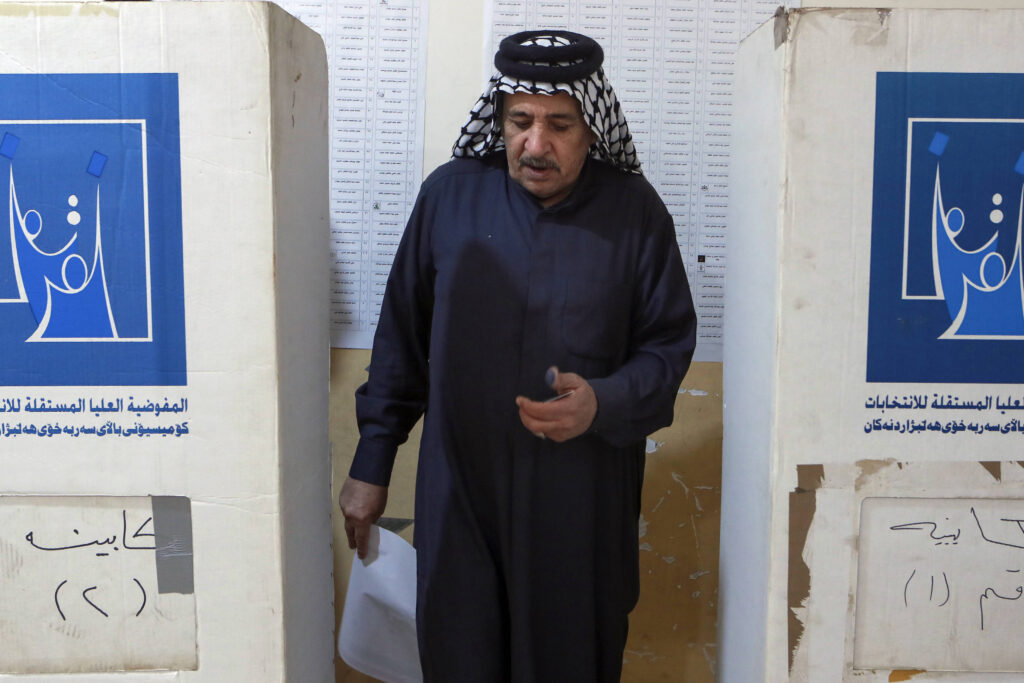

As Iraqis head to the polls, it is worth asking: What is the state of democracy after two decades of elections?
According to the Independent Higher Election Commission (IHEC), parties, electoral lists, and individuals can register for the upcoming November elections until June 24 for the November election. Much can still happen before then, particularly given the current state of affairs in the Middle East. Nonetheless, this election marks the twentieth anniversary of Iraq’s first post-dictatorship vote in 2005. Over the years, several defining features have emerged that now characterize Iraq’s democratic experience.
Since Sunnis and Kurdish populations are politically fragmented minorities who typically join the Shia-led coalition government, this analysis will focus primarily on the “Shia House”. Over the past two decades, Iraq’s democratic experience has developed several unique characteristics. The 2005 elections occurred amid a climate of violence and optimism. Many candidates were assassinated during the campaign, and female candidates were frequently targeted across the country. These patterns have since then nearly vanished. Another important feature of the 2005 vote was the Sunni boycott, reflecting their discontent with the post-2003 political order. In their eyes, Iraq was a country that they once ruled – after being “invented” by British hands in the 1920s – and now felt alienated from.
Despite repeated elections since 2005, democracy has not improved[1]. In fact, according to a former Iraqi president, the Americans were initially reluctant to push for elections and democratic procedures. They preferred a handpicked elite to lead the country’s transition. It was Grand Ayatollah Ali al-Sistani who initially pushed for an election under the banner of democracy. Not only did he advise the Coalition Provisional Authority, but he also employed Shi’ite religious symbolism to push for elections and democracy. His message resonated deeply; he did not mobilise men alone, but also women. “Truly, women who go forth to the polling centers on election day are like Zaynab, who went forth to [the field of battle at] Karbala.” These words[2], attributed to Sistani, adorned posters and flyers throughout Shia-majority areas, accompanied by his image.
Ayatollah Sistani is not known as a democratic theorist, but his advocacy must be understood in the specific Iraqi context. For the religious elites in Najaf, it was essential for the Shia majority to take control of the state. Democracy, during this period, was a means to achieve that goal, one that the neoconservative Americans could not easily reject. If the Najaf seminary’s support for democracy may have lacked democratic reason, others were even less genuine in their democratic commitment. According to prominent Iraqi intellectual Kanan Makiya, Ahmad Chalabi, the politician who persuaded and lobbied Washington to intervene in Iraq, held royalist views. He came from an esteemed family under the monarchy, and he left Iraq after the 1958 anti-royalist coup. He believed the country should again be led by an elite. Others, such as former finance minister Ali Allawi, were, in Makiya’s view, sectarian in orientation.
Ironically, the political infighting among exiled figures, such as Chalabi and Allawi, contributed to the rise of other figures, including Muqtada al-Sadr, the bête noire of Shia politics. The latter defies the widespread assumption that political inclusion leads to moderation by giving a group a greater stake in the system. Though currently outside the formal political structure, he maintains a strong influence and continues to benefit from the system. He is currently fighting for religious authority. If he succeeds, he may achieve wilayat al-faqih, a fusion of politics and religion, as practiced elsewhere in the region (notably Iran), which is incompatible with democratic governance. Wilaya means having responsibility for, acting on behalf of, and having jurisdiction over the affairs of others. The general public is viewed as incapable of making pious decisions and is therefore unable to exercise control over public affairs. Hence, the public has no say in how the wali, or the one who has the authority over them, exercises power. Wilaya implies guardianship over the public, who are deemed incapable of managing their own affairs. As a result, under this ideological concept, the public lacks the power to hold rulers or wali accountable.
The absence of a cohesive national identity among Iraqis, civil war, sectarian strife, a rentier economy, and persistent foreign interference have produced a fragmented political system dominated by families, personalities, and militias, each with conflicting interests for the same constituencies. Borrowing from Middle East expert Ghassan Salamé, Iraq today is yet another case of “democracy without democrats[3]”.
As the country prepares for the November elections, debates are not focused on social, political, and environmental issues, nor on planning how to deal with these issues and offering visions for the future of the country. The focus is rather on political alliances and rivalries. Then, the key question is how the new map of group relations is set along the personalities and their small power based? Undoubtedly, party leaders and candidates want to win votes and seats, not to implement coherent agendas, but to secure more parliamentary seats and government positions, which means access to state resources.
Currently, Prime Minister Muhammad Shia al-Sudani is seeking to form a joint electoral list with the Governor of Karbala, Nassif Jassim al-Khattabi, whose own list is named “Creativity of Karbala”, as well as the Popular Mobilization Forces (PMF) chairman Falih Al Fayyadh and others. Their campaign will focus on services and infrastructure, under the banner: Coalition of Reconstruction and Development. Sudani comes from the same background as Nouri al-Maliki, suggesting they may become bitter rivals or potential allies after the vote, if necessary.
The Prime Minister’s ambition for a second term is not surprising. Like every prime minister before him, once in power, the desire for continuity sets in. This aspiration presents a dilemma, highlighted by politician and militant leader Qais al-Khazali: is it better to remain in power by running for office or by trying to be a successful general manager? Haider al-Abadi attempted it through elections, while Mustafa al-Kadhimi tried by not running for reelection, but neither succeeded. One of the fundamental aspects of Iraq’s post-2003 political system is its ability to block newcomers, particularly those who aim to build strong state institutions. The entrenched elite see such figures as a threat.
Hadi al-Amiri and Qais al-Khazali will each have their own election lists as the Coordination Framework is not contesting the election as a single bloc. A potential campaign theme for al-Khazali is the unresolved Baghdad-Erbil disputes. Al-Khazali is currently in a strong position as he has his Parliamentary bloc (21MPs), he has ministries in the government, with influence over the ministries of finance and higher education, the Communications and Media Commission (CMC), and command over at least three Popular PMF brigades with a strong backing from Iran. As the country heads toward a heated summer of campaigning, Parliament itself appears weak. According to MP Majid Shangali it is a passive institution. This term has seen three different parliamentary speakers, highlighting the ongoing instability.
What is left among the Shia electorate is the Tishreenis, a loosely defined movement that opposes the current system but lacks the power to change it. It is unlikely they will present a unified electoral list. Nevertheless, there will be many parties, and independent candidates will seek to capitalize on their legacy, among them, the popular political satirist Ahmed Albasheer. This upcoming election will be similar to previous ones: low youth turnout, no decisive winner, and a post-election coalition government headed by a compromise prime minister.
Moreover, the regional context is shifting. The fall of Assad in Syria has shaken the Iraqi Shia elites, making them less confident in their power. In addition to economic uncertainty and Iran’s unpredictable future. The return of Donald Trump may be perceived as a threat to Shia elites, but his administration’s disinterest in democracy, human rights, and corruption efforts may serve the interests of Iraq’s entrenched elite.
Notes
[1] Marsin Alshamary, “The Iraq Invasion at Twenty: Iraq’s Struggle for Democracy,” Journal of Democracy, vol. 34, no. 2, Johns Hopkins University Press, April 2023.
[2] Ahmed H. al-Rahim, “The New Iraq: The Sistani Factor,” Journal of Democracy, vol. 16, no. 3, Johns Hopkins University Press, July 2005.
[3] Ghassan Salamé, “Introduction: Where Are the Democrats?” in Ghassan Salamé (ed.), Democracy without Democrats? The Renewal of Politics in the Muslim World, I.B. Tauris, 1994.