

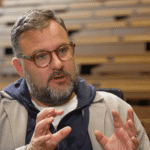
[Alexandre Chatillon] My name is Alexandre Chatillon. Four years ago, I co-founded, along with two others, the French NGO Super-Novae, which operates in crisis-affected areas. Our mission is to support young people living in particularly vulnerable environments. We are active in Libya, Yemen, Syria, Sudan, and Mayotte. Our work is driven by a strong conviction which is that providing employment opportunities to youth in crisis zones empowers them to become agents of peace, rather than letting them fall into cycles of violence or join militias out of desperation. This is at the heart of our commitment. In addition, I have worked for the Ministry of Foreign Affairs as well as various United Nations bodies.
[Lyna Ouandjeli] How would you describe the current situation in Gaza, particularly regarding access to essential needs such as water, food, and healthcare?
[Alexandre Chatillon] I carried out two missions in Gaza last year. For the past three months, Israeli authorities have prohibited our NGO from entering the Gaza Strip to continue our activities there. However, we are fortunate to rely on a local team, thanks to which 1,000 children continue to attend school every day, and 1,000 women receive daily psychological support in the camps. Our work continues, but under extremely difficult conditions. To illustrate the severity of the situation, I can say that in the course of my work, I have been involved in many crisis zones, but Gaza is undoubtedly the most harrowing territory. In most conflicts, civilians have the possibility to flee. In Gaza, this is impossible: the inhabitants are trapped, prevented from escaping by Israeli authorities. It is essential to make a clear distinction between the civilian population of Gaza and Hamas. The latter cannot and must not be defended. Israeli hostages must be released: they are living in unbearable conditions, just like the two million civilians confined in the Gaza Strip.
To give a very concrete example, last week I received a video showing a two-month-old infant starving to death. I did not share it, but I posted a message describing the gravity of the situation. This scene deeply affected me, especially since I am a father of two myself. As a humanitarian, I face these realities, but it remains unacceptable for a baby to die due to lack of powdered milk. The distribution of essential goods is chaotic, crowds are large, and resources are insufficient. In Gaza, children are dying not only from the bombs but also from hunger. This is the current reality on the ground.
[Lyna Ouandjeli] As a humanitarian, how do you reconcile maintaining neutrality on the ground with condemning war crimes?
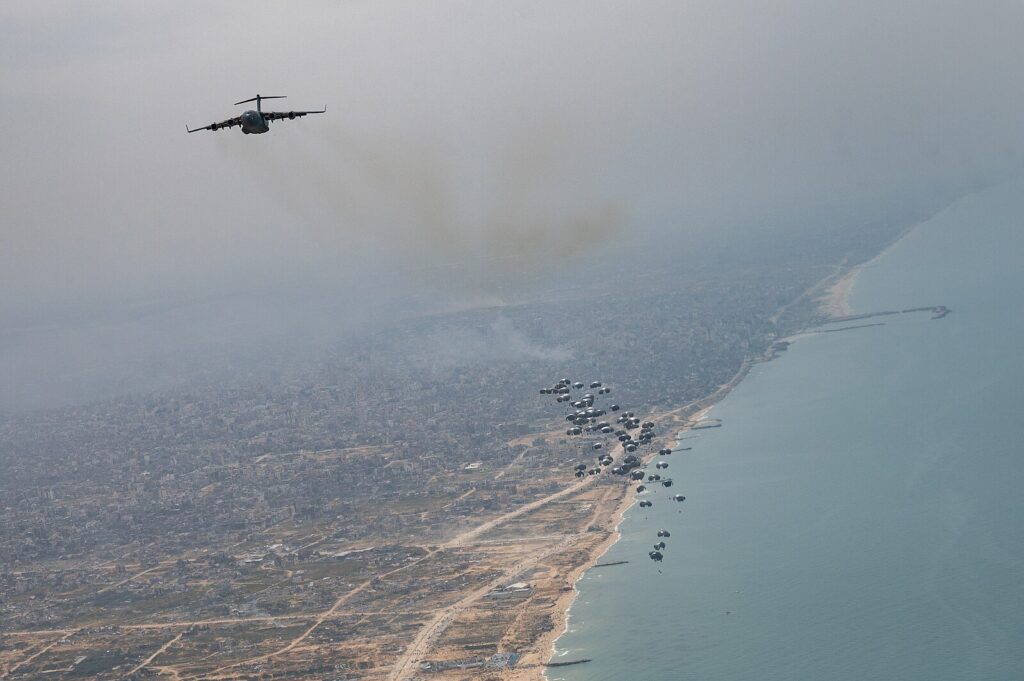
[Alexandre Chatillon] The situation is extremely difficult. Our organization was founded with a focus on action centered on individuals, for individuals, inspired by the principles of international humanitarian law, among which neutrality is a core value. However, in light of what is happening in Gaza today, it becomes impossible to remain silent. We are directly affected by the unilateral decisions of the Israeli authorities, particularly regarding the entry of humanitarian convoys. Before October 7, 2023, around 500 humanitarian trucks entered the Gaza Strip daily. Today, in the midst of a humanitarian emergency, only about thirty are allowed in each day. This figure is not due to a lack of resources but is a political decision made by the Israeli authorities, who arbitrarily set quotas.
This makes our work nearly impossible. We continue to act, but under conditions that prevent us from properly fulfilling our mission. And it is becoming increasingly difficult not to speak out about it.
[Lyna Ouandjeli] Is international humanitarian law still an effective tool in the face of conflicts of such intensity, or is it becoming symbolic? Does the current situation in Gaza, in your view, constitute a case of starvation being used as a weapon of war?
[Alexandre Chatillon] Violations of international humanitarian law (IHL) occur daily in Gaza. These include bombings targeting civilians, obstruction of humanitarian aid delivery, and blocking access to healthcare. One only has to follow the news to grasp the scale of it. Ending this Israeli strategy does not depend solely on Israel—it also plays out in Washington, in the Oval Office. As long as Donald Trump continues to support Benjamin Netanyahu—whether for reasons of realpolitik, strategic interests, or commercial ones such as arms sales—any lasting solution will require a shift in the American position.
Netanyahu is currently supported by the Israeli far right. One month after the January ceasefire, abuses resumed, the bombings started again, and the entry of humanitarian aid was once more blocked for a month and a half. On the very day the convoys were finally allowed in, far-right activists lay down on the road to block the trucks at the entrance to Gaza. This is the electorate Netanyahu seeks to appease. These abuses continue daily, with the support—or at least the complacency—of Donald Trump, whose unilateral vision of international relations has helped undermine multilateral norms. With his rise to power, diplomatic principles based on respect for international law have collapsed: withdrawal of UN funding, hostility toward Iran, and disregard for traditional channels of negotiation between states.
Today, in Gaza, international law seems suspended, and everything appears to be permitted.
[Lyna Ouandjeli] Do you believe that the ICC or other international courts are capable of addressing the violations observed in Gaza, or are we effectively facing a legal vacuum?
[Alexandre Chatillon] The International Criminal Court (ICC) was seized early on by South Africa to pursue charges against Benjamin Netanyahu. However, this move has so far had no tangible effect. The ICC, like other international institutions such as the WHO or various UN agencies, relies on the voluntary cooperation of the states that are party to the Rome Statute. If the United States—which has not ratified the Statute—chooses not to abide by international law, nobody can truly compel it to do so. Today, the United States exercises a de facto monopoly on legitimate violence at the global level, with little regard for international law or the core principles of international relations.
As of June 2025, it is unlikely that these institutions will be able to enforce their decisions in the short term. But I dare to hope that in the longer term—perhaps in ten years—those responsible for the thousands of deaths caused by these policies and actions will be held accountable before a court of law. The timeline of justice is often out of sync with the timeline of events, but that does not mean it does not exist. I hope that the ICC will eventually bring Benjamin Netanyahu to justice, and that he will one day be detained for his crimes.
[Lyna Ouandjeli] How do the single-parent families you have encountered survive in such a context? What are their priorities, fears, and hopes?
[Alexandre Chatillon] In the countries where we operate, most of which are Arab-Muslim, we observe a much stronger social solidarity than what is seen today in Europe. This solidarity is familial, communal, territorial, but also intergenerational. Although our actions do not specifically target single-parent families, they are often the ones who bear the heaviest burden in conflict settings. We carry out comprehensive interventions at the societal level.
In Gaza, for example, we provide psychological support to women and carry out awareness campaigns about violence against women in the camps. Conflict situations, ongoing tensions, and overcrowding foster the emergence of violent behaviors. Through this work, we hope to help ease tensions, alleviate the suffering of women, and, by extension, that of single-parent families and communities as a whole.
[Lyna Ouandjeli] How are your missions logistically prepared to provide aid specifically to these single-parent families? How do women, often having become heads of households, manage to ensure the survival of their children under these conditions?
[Alexandre Chatillon] We currently do not have a program specifically dedicated to single-parent families in Gaza. In fact, it is very difficult to distinguish women from families in this context, as the entire population is in need of assistance. However, taking a step back, this was an area of work we developed in 2022 and early 2023. At that time, we ran a targeted support program for women heads of households (about 200 women). It included a skills assessment, an analysis of the local job market, followed by a tailored training program to match the participants’ existing skills with identified needs. This project, implemented in the Gaza Strip, had supported 200 women. Unfortunately, it had to be halted following the events of October 7, 2023.
Despite this, some encounters remind us of the meaning behind our commitment. Last March, while I was visiting a displaced persons camp in Gaza to assess local needs, a woman recognized the name of our NGO on our vehicle. She approached us to thank us because she was one of the 200 beneficiaries of our program the previous year. In such a tragic situation, moments like this give meaning to our work and remind us that what we do remains valuable.
[Lyna Ouandjeli] What parallels do you draw between the humanitarian situation in Gaza and that in other war-torn regions in the MENA region, such as Yemen, Syria, or Sudan?
[Alexandre Chatillon] The situation in Libya is in no way comparable to that of Gaza. It is not a humanitarian crisis in the strict sense. The country faces persistent economic fragility, despite steady growth over the past decade, as well as a real security risk. But from a humanitarian perspective, the situation remains relatively contained. In Yemen, on the other hand, the humanitarian crisis is very real, especially in areas controlled by the Houthis, such as the Hadramout region. The country is facing significant structural economic fragility. Many international funds are mobilized to meet humanitarian needs, but despite their scale, the situation cannot be compared to that of Gaza. I do not wish to rank human suffering. But, to speak frankly, I would prefer to be Yemeni today rather than Gazan, given how inhumane the living conditions in Gaza have become.