


The Middle East continues to bear the consequences of a transactional U.S. foreign policy combined with Israel’s aggressive military posture. The ongoing war in Gaza, along with Israeli operations extending into Lebanon, Iran, Syria, Yemen, and even Qatar, has had significant strategic repercussions across the region. Against this backdrop, it is worth asking whether the Abraham Accords—one of the few tangible achievements of the first Trump administration in the Middle East and a recurrent point of pride for him—might now be at risk, even as they mark their fifth anniversary.
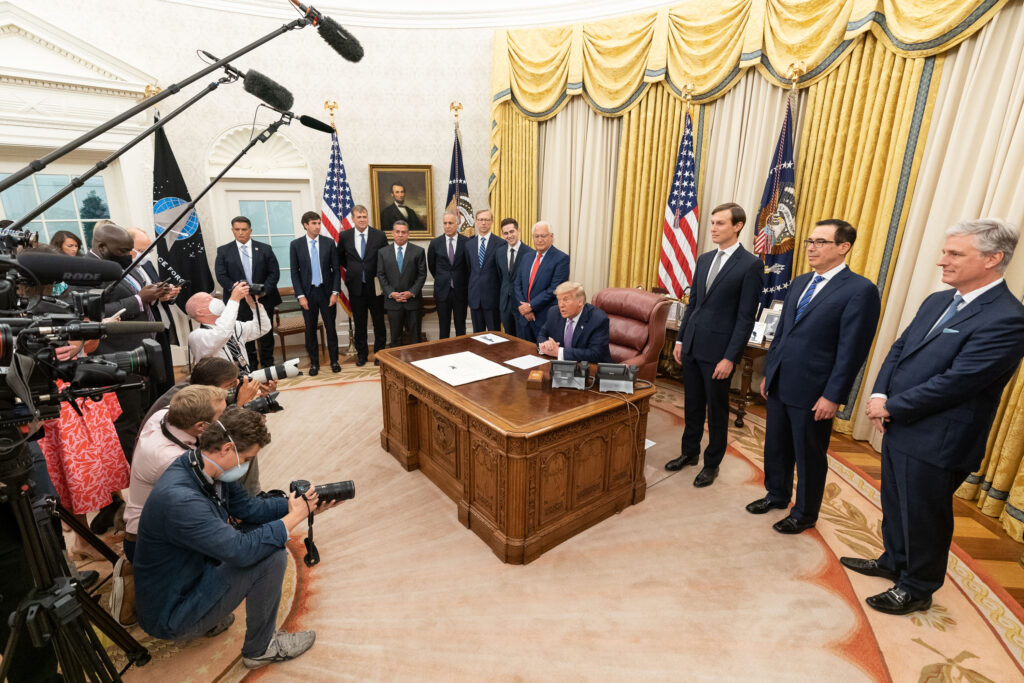
In 2020, the United Arab Emirates and Bahrain established diplomatic relations with Israel in order to bolster their security against Iran, which at the time appeared to be the region’s primary threat. Morocco later joined for different reasons linked to preexisting bilateral relations with Israel, while Sudan did so to be removed from the U.S. list of state sponsors of terrorism. Israel thus achieved greater political acceptance in the region and opened new economic and commercial horizons with the Gulf monarchies.
Washington and Israel presented these accords as a step toward peace through economic, cultural, sporting, and tourism ties. In reality, Israel’s economic relations with the oil monarchies deepened rapidly, accompanied by visits from senior Israeli officials. Initiatives such as the inauguration of a synagogue in Abu Dhabi and the creation of a $10 billion Emirati investment fund in Israel illustrate this growing rapprochement between Israel and its Arab partners.
However, with Iran’s relative decline in influence, Israel itself now appears to many as a source of regional instability due to its repeated military interventions. The state’s use of military and technological superiority—such as the targeted strike against Hamas officials in Doha—has raised concerns among Gulf states regarding the reliability of U.S. security guarantees and the overall stability of the Middle East.
The monarchies’ options remain limited: neither China nor Russia can, for the time being, replace the strategic backing provided by the United States and Israel. The humanitarian toll in Gaza, which has continued to worsen after two years of conflict, has pushed the Abraham Accords signatories to focus primarily on humanitarian aid and public denunciations. The UAE, in particular, has become deeply involved in initiatives such as desalination plants, humanitarian convoys, airdrops, and field hospitals.
Under different circumstances, one might have expected stronger diplomatic reactions—even the suspension of the accords. Possible retaliatory measures could have included the severing of diplomatic relations, the recall of ambassadors, or the expulsion of Israeli representatives. Yet none of these steps have been taken. This restraint, also evident among other Arab states that normalized relations with Israel, underscores the limited room for maneuver these governments have when it comes to the Palestinian question. Nevertheless, the West Bank annexation projects, championed by extremist factions within Netanyahu’s coalition, are causing deep concern in Abu Dhabi, where several officials have reiterated that such a move would cross a “red line.”
Israeli media have reported that this warning was conveyed directly to Prime Minister Netanyahu during a meeting with the Emirati foreign minister on the sidelines of the UN General Assembly. During the original Abraham Accords negotiations, Netanyahu had reportedly pledged to suspend settlement expansion in the West Bank—an assurance he no longer honors. These Arab concerns have been relayed to Washington, where President Trump publicly stated that he would not accept any Israeli annexation of the West Bank. Meanwhile, Netanyahu faces mounting domestic pressure to adopt retaliatory measures against countries that have recently recognized the State of Palestine. The prime minister thus finds himself torn between preserving his governing coalition and maintaining both the Abraham Accords and Israel’s strategic alliance with the United States.
Israel, for its part, has been weakened by the economic and political costs of its military operations over the past two years. The country is increasingly isolated on the international stage. In this context, calling the Abraham Accords into question would be counterproductive. The Gulf monarchies, lacking any credible alternative to their partnerships with Washington, have no desire to jeopardize these strategic ties. For them, maintaining the accords continues to provide tangible economic and diplomatic benefits.
In conclusion, barring any unforeseen developments—always possible in such an unstable regional environment—the Abraham Accords are likely to endure. The prospect of a West Bank annexation remains a decisive factor: should this “red line” be crossed, the concrete consequences for the durability of the accords would need to be closely observed. For now, the absence of progress on the Palestinian issue sustains an atmosphere of mistrust. The recent 20-point American peace plan submitted to Israel and Hamas notably omits any reference to the West Bank—raising questions as to whether this was a deliberate omission or an implicit signal of tolerance toward continued settlement expansion.