


Results and Context
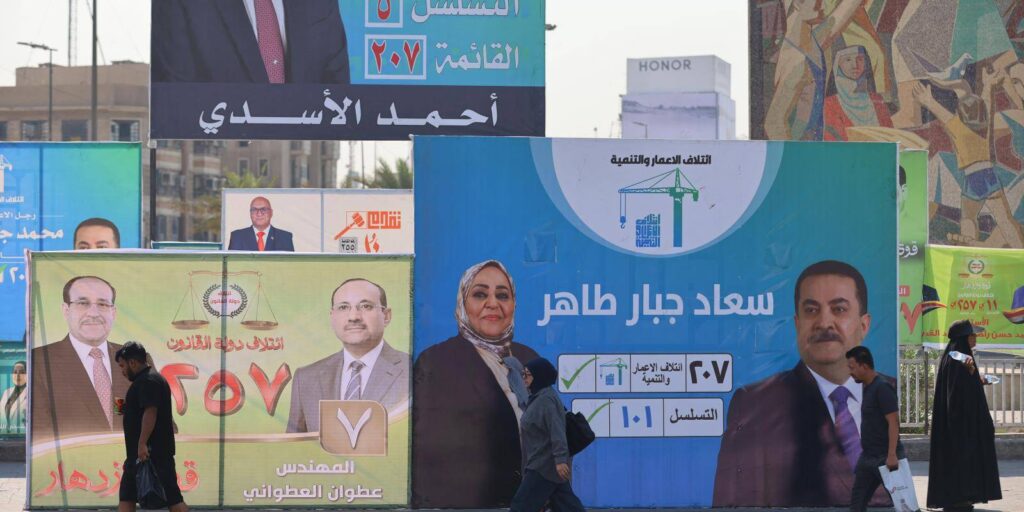
On Tuesday, November 11, 2025, Iraq held its sixth democratic parliamentary elections since the fall of Saddam Hussein in 2003. The Shiite list Coalition for Reconstruction and Development (Al-Ima’ar wal Tanmiya), led by Prime Minister Mohammed Shia al-Sudani, came first in eight provinces, including Baghdad and Najaf, consolidating its base within Shiite Iraq. This outcome makes it highly likely that the outgoing coalition, centered around the Shiite Coordination Framework, will remain in power. Unsurprisingly, the results reflect the identity-based, ethnic, and sectarian distribution of Iraq’s governorates, a reflection of the ethno-sectarian order institutionalized after 2003. Al-Sudani dominates the Shiite South and Baghdad; the Sunni party Taqadum (Progress Party) remains the main force in the Sunni West; and the Kurdistan Democratic Party(KDP) and Patriotic Union of Kurdistan (PUK) continue to share control over the Kurdistan Region, with the KDP maintaining dominance over the PUK. The internal balance between the two Kurdish parties remains unchanged in terms of geographic and political distribution: the KDP holds majorities in Duhok, Erbil, and Nineveh, while the PUK leads in Sulaymaniyah and Kirkuk.
Despite these relatively predictable outcomes, the electoral campaign which was supervised by the Independent High Electoral Commission (IHEC), was competitive, with significant sums invested by various political blocs. The IHEC made a particular effort to ensure transparency and restore credibility to an electoral process weakened by previous contests. Twenty years after the first free elections of 2005, popular enthusiasm has waned. From nearly 80% turnout in 2005, participation fell to 41% in 2021, during the early elections called in response to the October 2019 protest movement, marking a continuing erosion of public trust in the ability of Iraq’s elites to reform the system. For the 2025 elections, however, the IHEC announced a turnout exceeding 56%, or about 12 million voters out of 21 million registered, whereas forecasts had predicted around 30%. Yet, according to Shafaq News, this calculation only considered voters who had updated their biometric data, while the total number of registered Iraqis reached nearly 30 million—meaning the actual turnout would be closer to 40%. Roughly 9 million citizens without biometric cards were excluded from the denominator, thereby mechanically inflating the official rate. This controversy echoes that of the 2021 elections, when the IHEC initially reported an electorate of 25.2 million before reducing it to 22.1 million by counting only holders of biometric or electronic cards. That methodological choice had already caused an artificial increase in turnout from 36% to 41%. In 2021, the reduction of the electorate, combined with the cancellation of expatriate voting and the requirement for biometric documents, significantly limited the effective voting base, calling into question the representativeness of IHEC’s published rate. In 2025, the controversy revolves around the calculation method and the implicit exclusion of non-biometrically registered voters.
Many Iraqis voted based on clientelist logic, influenced by financial or material incentives, reinforcing the perception that voting remains, for much of the population, an exercise in institutionalized corruption rather than a genuine democratic choice. Amid popular disillusionment, persistent sectarian divides, and identity-driven rhetoric used by elites to mobilize their bases, the 2025 elections unfolded in a climate of deep contradiction. Although the legal framework formally bans the political participation of armed groups, Iraq’s system remains dominated by militia-parties—illustrating the structural limits of its democracy. Observers regularly note that as long as sectarianism, corruption, and the blurred boundary between state authority and militia power persist, elections cannot serve as a true vehicle for transformation.
Muqtada al-Sadr’s decision to withdraw his Sadrist movement, a major Shiite Islamist political current, from the electoral process and to boycott the elections in protest against their legitimacy and the corruption of political figures contributed to lower turnout in his strongholds in the Shiite South and Baghdad. In the 2021 elections, his bloc had won 73 of 329 seats before collectively resigning in protest against the inefficiency and corruption of the political system. The Sadrist current, supported by a broad popular base, presents itself as nationalist, independent, and opposed to any foreign interference—both Iranian and American.
The Electoral Process
In this election, 7,768 candidates—divided among 31 coalitions, 38 political parties, and 75 independents—competed for 329 seats distributed across the country’s 19 governorates (including 71 for Baghdad) and within 83 electoral districts. Deputies, elected for four years, sit in the Council of Representatives, Iraq’s unicameral parliament and primary legislative body. It is important to recall that the formation of Iraq’s executive branch follows a particularly structured institutional and political sequence, based on a system of community-based power sharing (muhasasa ta’ifiyya). Though not enshrined in the Constitution, it remains politically binding. The process begins with the election of the Speaker of Parliament, traditionally a Sunni Arab—a step requiring prior internal consensus within the Sunni camp. Next comes the election of the President of the Republic, a position de facto reserved for a Kurdish representative and requiring a qualified majority of 220 deputies. This stage can only be reached after a sufficiently strong Kurdish compromise is reached to be presented before Parliament. Only then does the President designate a Shiite Prime Minister to form a government, in accordance with the custom established since 2005. This final phase also requires consensus among Shiite forces to ensure the viability of the future coalition. The electoral system guarantees a minimum quota of 25% for women and reserves nine seats for religious and ethnic minorities—including Christians, Sabian-Mandaeans, Yazidis, Shabaks, and Fayli Kurds.
The main parties and coalitions participating in this election now reflect not so much an ethno-sectarian divide between Shiites, Sunnis, and Kurds, but rather internal divisions within each of these three communities. Leading with 45 seats is the Alliance for Reconstruction and Development, led by Prime Minister Mohammed Shia al-Sudani and including his own party, the Al-Furatayn Movement, founded in 2021. In second place, the conservative Shiite bloc State of Law Coalition—stemming from the Islamic Dawa Party and led by former Prime Minister Nouri al-Maliki (founded in 2009)—remains one of the dominant poles with 30 seats. Third is the Kurdistan Democratic Party (KDP), founded in 1946 and led by Massoud Barzani, former president of the Kurdistan Region and historical figure of Kurdish nationalism and conservatism. Notably, with 1.1 million votes, the KDP obtained 27 seats, while al-Sudani’s party, with 1.3 million votes, secured 45 seats. This discrepancy results from the modified Sainte-Laguë method adopted in Iraq’s electoral law since 2021, which tends to penalize small lists and independents while amplifying the weight of large coalitions. Among Sunni parties, the Progress Party (Al-Taqaddum Movement, TAK), led by former Parliament Speaker Mohammed al-Halbousi and created in 2019, ranked fourth with 27 seats—ten fewer than in the previous elections, when it dominated Parliament with 37 seats, advocating a liberal and modernizing stance. The Al-Sadiqoun Alliance (Alliance of the Faithful), led by Qais al-Khazali, head of the pro-Iranian militia Asaib Ahl al-Haq (AAH, founded in 2014), also belongs to the conservative Shiite camp and ranks fifth with 26 seats. It is followed by the Badr Party, led by Hadi al-Amiri, Secretary General of the Badr Organization—founded in 1982 as the armed branch of the Supreme Council for the Islamic Revolution in Iraq (SCIRI) and today a key component of the Popular Mobilization Forces (PMF)—which holds 19 seats. The moderate Shiite camp is represented in seventh place with 18 seats by the National State Forces Alliance, emerging from the merger between the Wisdom Movement (Al-Hikma) and the Victory Coalition (Al-Nasr), founded in 2021 and led by Ammar al-Hakim. The PUK, the second Kurdish party, ranks eighth with 18 seats, followed by the Sunni centrist Azem Alliance (Resolution for Iraq), founded in 2021 to indirectly challenge TAK’s influence and led by Muthanna al-Samarrai, then the Sovereignty Alliance led by prominent Sunni businessman and politician Khamis al-Khanjar with 9 seats. Next come the independent reformist movement Ishraqat Kanoon with 8 seats; Tasmim Alliance, a local non-ideological, non-militia Shiite coalition from Basra with 7 seats; the Al-Asas Iraqi Alliance, a new civic reformist bloc led by First Deputy Speaker of Parliament Muhsin al-Mandalawi with 7 seats; and finally the Hoquq Party (Harakat Hoquq), political arm of the pro-Iranian PMF militia Kataib Hezbollah, led by Hussein Muenis.
Meanwhile, the Shiite Coordination Framework, the main coalition of the outgoing government, brings together the principal pro-Iranian Shiite formations, both institutional and militia-based. Though a political structure, several of its members retain organic links with the PMF. These include the Badr Organization, the State of Law Coalition, the Al-Furatayn Movement, and the Wisdom Movement (Al-Hikma), a moderate Shiite formation led by Ammar al-Hakim. The Framework also includes the Al-Sadiqoun Party, political wing of AAH, and maintains close ties with other pro-Iranian factions outside Parliament, such as Kataib Hezbollah—whose political branch, Hoquq, was founded in 2021—and Harakat Hezbollah al-Nujaba, a major component of the Shiite security apparatus.
Internal and External Challenges
The new Iraqi government faces numerous domestic challenges: persistent unemployment, worsening drought, and endemic corruption deeply rooted in the state’s structures. The most immediate challenge, however, remains the formation of the new government—an outcome still uncertain. The early parliamentary elections of October 2021 resulted in a government only a year later, in October 2022, with the appointment of Mohammed Shia al-Sudani as Prime Minister after over twelve months of political deadlock. His cabinet was finalized only in December 2022—illustrating the slowness and complexity of interparty negotiations. The choice of the next Prime Minister is therefore still open and will involve complex political bargaining—potentially including the Sadrist movement. Meanwhile, U.S. approval remains contingent upon several tacit but explicit demands: the gradual disarmament of PMF militias (Hashd al-Shaabi), the dismantling of financial networks linked to Iran’s Islamic Revolutionary Guard Corps (IRGC), and granting privileged access to American investors in strategic sectors, particularly oil. In this context, outgoing Prime Minister Mohammed Shia al-Sudani appears as the frontrunner, thanks to his ability to maintain a fragile balance between Washington and Tehran while preserving internal consensus within the Shiite Coordination Framework.
The renewed American focus on Iraq poses a major challenge for national elites, particularly through pressure from the Trump administration to disarm pro-Iranian Iraqi militias—especially within the PMF—reflecting Washington’s intent to curb what remains Tehran’s main stronghold of regional influence. The recent creation by the United States of a Special Envoy for Iraq, assigned to Mark Savaya, a businessman close to Donald Trump, while no ambassador has been appointed to Baghdad since his second term, appears to confirm that Iraq is returning to the forefront of U.S. priorities. This renewed American interest is also evident in the comeback of U.S. oil companies in Iraq. Symbolizing this reinvestment after nearly two years of absence, energy giant ExxonMobil signed a preliminary agreement with Baghdad in October 2025 for the development of the Majnoon oil field, located near the Iranian border and adjacent to the Azadeganfield—often accused of being used by Tehran to bypass international sanctions. This challenge forms part of a broader issue for the new Iraqi government: maintaining a fragile balance between Iran and the United States. The visit of Esmail Qaani, commander of Iran’s Quds Force, on October 25, 2025, ahead of the elections—aimed implicitly at preventing the fragmentation of the Shiite Coordination Framework—illustrates Tehran’s determination to preserve its influence against its American rival, despite the significant weakening of the Iranian “Axis of Resistance.”
Other major geopolitical challenges await the new government—chief among them, water management. Iraq faces a structural risk of a major water crisis, marked by the gradual drying of the Tigris and Euphrates, on which the country depends for 70–90% of its water resources. Both rivers originate in Turkey before flowing through Syria, placing Iraq in a position of acute geopolitical vulnerability. Affected by climate change, Iraqi waterways also suffer from the impact of Turkish dams built upstream over the past four decades as part of the Southeastern Anatolia Project (GAP)—notably the Ilısu Dam on the Tigris. Added to this are Iranian dams on several eastern tributaries, including the Diyala (Sirwan), the Little Zab, and the Alwand, which worsen shortages in border provinces and the Kurdistan Region. The recent signing of a Framework Agreement for Cooperation between Iraq and Turkey—granting Ankara a greater role in managing Iraq’s hydraulic infrastructure for five years in exchange for immediate economic benefits to Baghdad—has reignited internal debate. The agreement raises new questions about Iraq’s water sovereignty amid growing dependency on its neighbors.
Conclusion
The November 11, 2025 elections primarily confirm the relative stability of Iraq’s political landscape, ensuring continuity more than renewal. They reaffirm the dominance of traditional forces and reveal that political divisions are no longer structured primarily along Shiite, Sunni, or Kurdish lines, but increasingly within each component—signaling deepening intra-communal fractures. They also illustrate the exhaustion of the post-2003 model, marked by clientelism, sectarian fragmentation, and popular distrust toward institutions. Finally, their outcome extends a fragile geopolitical balance between Washington and Tehran, while leaving the future government facing a series of major internal and external challenges—from the water crisis and economic dependency to endemic corruption and the government’s very formation—highlighting Baghdad’s continuing struggle to assert fully autonomous sovereignty in the face of regional and international pressures.