

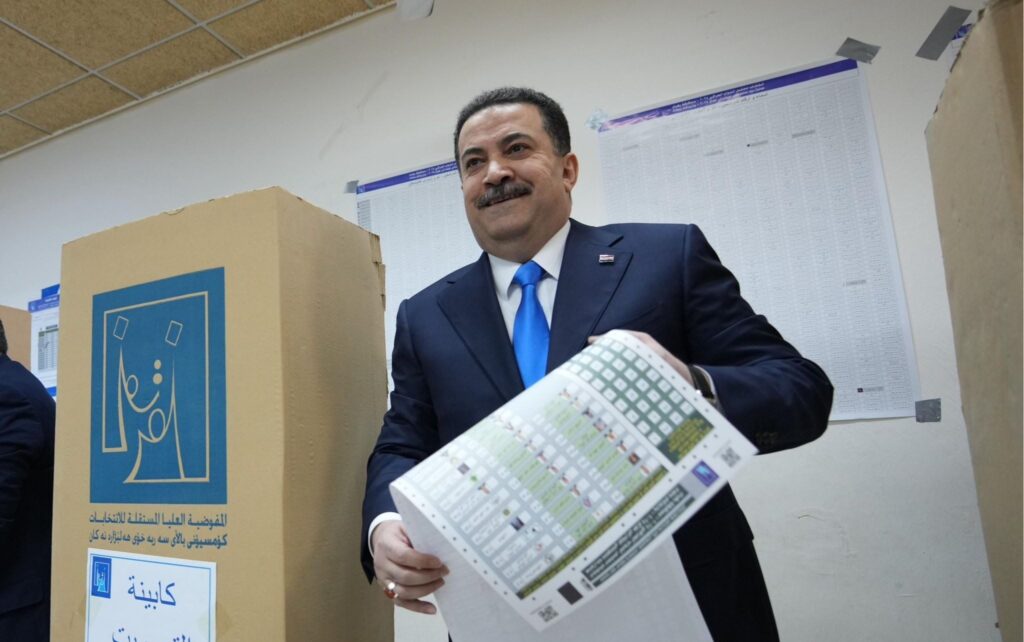

Outgoing Prime Minister al-Sudani Between a Positive Record and Political Fragility
While his Coalition for Reconstruction and Development (Al-Ima’ar wal-Tanmiya) came out ahead in terms of seats, Mohammed Shia al-Sudani is seeking a second term as prime minister. Iraqi society certainly nourishes deep mistrust toward the state and its political elites, regularly accused of poor governance and corruption, but overall, his record is widely perceived as positive. Domestically, public services have improved, and he is credited with launching major urban, economic, and cultural development projects, particularly in Baghdad: the renovation of historical heritage sites, the construction of high-end buildings, and large-scale projects such as the “Iraq Mall,” expected to become the largest shopping center in the Middle East with 600,000 m² now under construction, as well as the “Jadat Baghdad” complex near Baghdad International Airport, financed by Saudi Arabia, which will include a major commercial center and several thousand housing units. He is nevertheless criticized for directing the majority of public funding toward roads and bridges in the capital at the expense of infrastructure, schools, and hospitals in the provinces.
Al-Sudani can especially claim to have maintained a relative balance between the United States and Iran, two rival powers whose interference in Iraq is hardly in doubt. He has managed to navigate a regional storm shaped by escalating confrontation between these two poles of influence, even as Iraq has long been, geographically and historically, a potential stabilizing or destabilizing arena for the entire Middle East. Despite this environment, his government has so far kept the country at the margins of regional tensions heightened after 7 October 2023, including during the twelve-day war between Israel and Iran, throughout which Baghdad managed to avoid direct military escalation. According to Iraqi officials, Israel considered striking Iraq on nine occasions, but Prime Minister al-Sudani and Foreign Minister Fouad Hussein intervened with Washington and Tel Aviv to dissuade any attack.
The role of the Coordination Framework and the Fragmentation of the Shiite Camp
In Iraq, however, winning the largest number of seats is one thing, being reinstated as prime minister is another. The final results show indeed that no list secured the absolute majority of 165 seats out of 329 required to form a government alone. Within the Shiite Coordination Framework, seats are distributed among several forces: al-Sudani’s Alliance for Reconstruction and Development (46 seats); the more conservative State of Law coalition (29 seats), linked to the Islamic Dawa Party and led by former Prime Minister Nouri al-Maliki; and Ammar al-Hakim’s National State Forces Alliance (18 seats), representing a more moderate Shiite trend. Three additional components are closely tied to the Popular Mobilization Forces (PMF): the al-Sadiqoun Alliance, affiliated with Asaib Ahl al-Haq (AAH), with 28 seats; the Badr Party, political wing of the Badr Organization, with 21 seats; and the Hoquq Party, linked to Kata’ib Hezbollah, with 6 seats.
The Coordination Framework, traditionally responsible for selecting the Shiite prime minister, claims to have already formed the largest parliamentary bloc, without, however, guaranteeing that it will reappoint the outgoing head of government, al-Sudani. Reservations appear to come primarily from within the “Shiite camp” itself, whereas major Kurdish and Sunni parties seem more open to a second term for al-Sudani. His coalition, formed in May 2025, includes influential figures such as Faleh al-Fayyad (head of the PMF), Labor Minister Ahmed al-Asadi, Karbala governor Nassif al-Khattabi, as well as his own party, the Al-Furatayn Movement (created after his split from Dawa in the wake of the 2019 protests), alongside powerful tribal leaders and around fifty outgoing MPs. Many of these actors, however, remain opportunistic and are willing to side with whoever offers them the greatest financial incentives and political leverage in the next government. Meanwhile, Moqtada al-Sadr, who withdrew entirely from the electoral process and called for a boycott, has made it clear that he will not negotiate any form of participation or support for the Coordination Framework in the formation of the new cabinet.
U.S. Pressure, Iranian Resistance: What Future for Iraqi Governance?
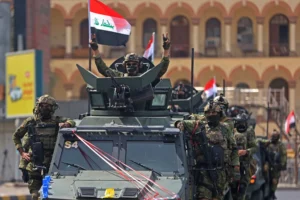
On the surface, the elections suggest a degree of political stability, however, in reality, their real stake lies in how their results will shape the future government: will they confirm the continued dominance of pro-Iranian factions, or instead signal a gradual decline in their influence? This question is all the more critical in the post-7 October 2023 context, marked by growing U.S. pressure on Baghdad to dismantle the Iraqi pro-Iranian militias within the PMF, the last structured bastion of the Iranian “Axis of Resistance.” The weight of Iranian influence within Iraqi society and state institutions, greatly expanded after the 2003 U.S. invasion and further consolidated during the fight against ISIS (2014–2017), has been seriously challenged, notably by the 2019 protest movement and its violent repression by the PMF, with the complicity of segments of the Iraqi state. Yet, the stakes for the Islamic Republic of Iran remain high, as illustrated by the October 2025 visit of Esmail Qaani, commander of Iran’s Quds Force, to both Baghdad and Erbil, aimed at preserving and adjusting Iranian influence in a context of accelerated political realignment on the eve of the elections.
This tension between U.S. pressure and Iranian resistance is thus at the heart of the government-formation process. According to Foreign Minister Fouad Hussein, the United States has demanded that six Iraqi armed groups, likely Kata’ib Hezbollah, Harakat al-Nujaba, Kata’ib Sayyid al-Shuhada, Asaib Ahl al-Haq, Harakat Ansar Allah al-Awfiya, and Kata’ib al-Imam Ali, all central pillars of the PMF, be excluded de facto from any future Iraqi government; Washington justifies this demand as necessary to reinforce Iraq’s sovereignty and diplomatic credibility. This request aligns with U.S. designations under the “Foreign Terrorist Organizations” (FTO) list: KH and AAH, but also, more recently, Harakat al-Nujaba, Kata’ib Sayyid al-Shuhada, Harakat Ansar Allah al-Awfiya, and Kata’ib al-Imam Ali. The al-Sadiqoun Alliance, AAH’s political wing led by Qais al-Khazali, won 28 seats, while the Hoquq Party (Harakat Hoquq), led by Hussein Muenis, secured 6. Notably, the Badr Organization, led by Hadi al-Ameri, the oldest Shiite faction in Iraq and a central pillar of the PMF, does not appear on the American FTO list; its political wing, the Badr party, won 21 seats during the elections.
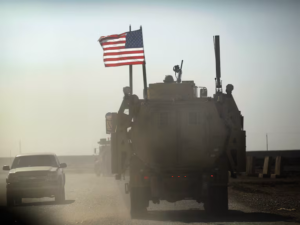
In this context of American pressure, the PMF has very limited visible room for maneuver and cannot realistically consider any open military retaliation, having so far avoided direct U.S. and Israeli strikes by maintaining relative discretion. A particularly explicit American warning was also delivered recently during an uncompromising phone call from U.S. Secretary of Defense Pete Hegseth to his Iraqi counterpart, Defense Minister Thabet al-Abbasi. Hegseth reportedly warned Baghdad against any interference by armed factions in upcoming U.S. military operations near Iraqi territory, ending with a final ultimatum. In Baghdad, this exchange is widely interpreted as a sign that Washington’s strategic patience has run out: factions must now either align with the state and accept disarmament or face possible targeted strikes. These successive threats have placed the outgoing Prime Minister al-Sudani, and will likewise place his successor, whoever that may be, in a particularly delicate position, since the political base, the Shiite Coordination Framework, includes several factions now explicitly targeted by Washington. He is thus caught between the demands of Iraq’s primary strategic partner, the United States, and the internal realities of a political system dominated by armed groups linked to Iran. During the same call, discussions also touched on bilateral cooperation on drones, a security and intelligence memorandum, and the planned delivery of Bell helicopters to Iraq. This dual approach, pressure on one side, incentives on the other, signals to Baghdad that a strategic choice must be made between closer alignment with U.S.-led international partners, and continued tolerance of powerful Iran-aligned militias. These latest warnings appear to transform months of gradual but repeated pressure into a true red line, one that could profoundly reshape calculations around government formation and challenge the very structure of Iraq’s existing political order.
Who, then, will form the next government and designate the prime minister? Since 2005, no candidate who finished first in terms of votes has directly acceded to the position. The most recent case is that of Moqtada al-Sadr: in 2021, his bloc won the largest number of Shiite seats, but his rivals managed to form a government with al-Sudani as prime minister, even though the latter’s Al-Furatayn Movement had won only a single seat. The appointment of the head of government is indeed less tied to electoral performance than to the internal balances within the “Shiite camp”. Al-Khazali’s (AAH) 2022 statement, according to which the prime minister is merely a “director general”, an administrative manager rather than an autonomous political decision-maker, clearly illustrates the fragmentation of a state order marked by structural hybridity and the multiplication of entry points for Iranian influence: the head of government, he insisted, must not monopolize state decisions but should return to the Coordination Framework for all decisions, whether political, security-related, or economic. In an interview on November 8, al-Khazali reiterated that a second term for al-Sudani would depend on “Shiite consensus,” referring to the Muhasasa system in place since 2006 (the post of prime minister going to the Shiites, the presidency to the Kurds, and the speakership of parliament to the Sunnis). Moreover, Nouri al-Maliki, who came in second among the Shiite lists, has no intention of facilitating al-Sudani’s reconduction, accusing him of having broken his 2022 promise not to seek a second term.
Between Washington and Tehran: Al-Sudani’s Balancing Act
Al-Sudani has so far oscillated between Iranian and American interests: under his tenure, the PMF, composed mainly of militias heavily supported by Iran, are said to have grown from around 120,000 to nearly 240,000 members, and he recently submitted to parliament a draft law aimed at expanding their prerogatives and consolidating their status, a text ultimately withdrawn under American pressure. At the same time, the PMF’s economic arm, the al-Muhandis Company, expanded its influence into multiple sectors through opaque contracts, before being targeted by U.S. Treasury sanctions. Al-Sudani may nevertheless hope that the recent awarding of major contracts to American companies, most notably the preliminary agreement signed in October 2025 with ExxonMobil for the development of the Majnoon oil field, located on the Iranian border and adjacent to the Azadegan field, long accused of being used to circumvent sanctions, will help rebalance the perception of his government in Washington.
The next phase of government formation will reveal whether Tehran succeeds in maintaining its influence through its political-military proxies, or whether Washington will be able to take advantage of regional shifts and the relative weakening of the axis of resistance to reshape the balance of power in Iraq and reassert itself in the Iraqi political arena.