


A youth in motion, a Morocco in transition
A decade after the Arab Spring, Morocco is witnessing a new form of social contestation. This time, the catalyst is not a revolutionary spark, but the slow accumulation of frustrations among a digitally connected generation that faces rising costs of living, deteriorating public services, and persistent unemployment. This emergence aligns with a broader international pattern of youth-led contention, visible from Nepal to Madagascar, Peru, and Indonesia. While Morocco entered the 2020s with macro-economic stability and ambitious nation-branding initiatives, culminating in the co-hosting of the 2030 FIFA World Cup, such achievements stand in contrast to the lived realities of many young Moroccans. Their collective perception of a distant and unevenly shared progress has prompted a shift from material grievances toward demands for dignity, voice, and meaningful political inclusion.
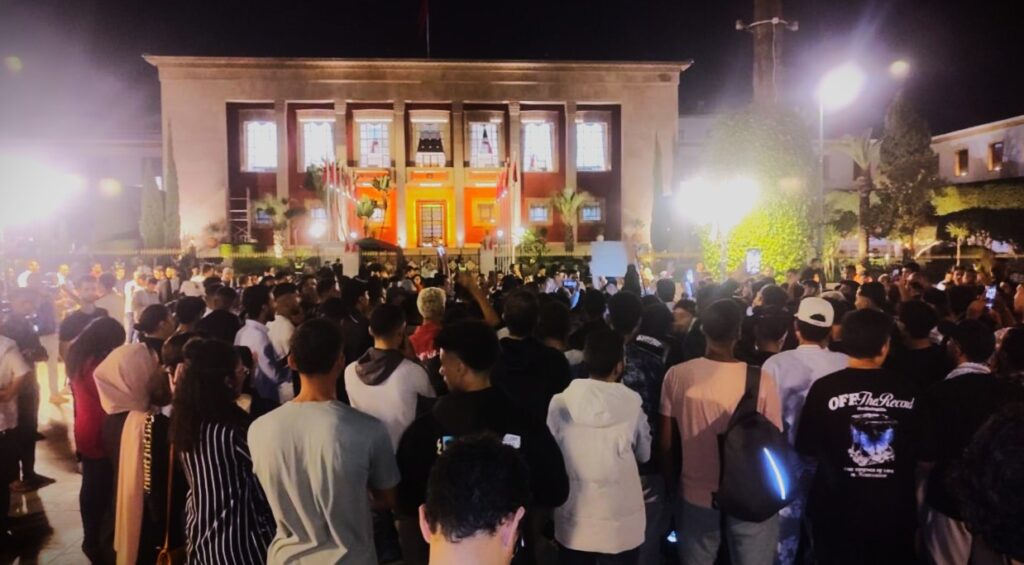
It is in this climate that “Gen Z 212” has emerged: a self-named youth movement born from narrowing prospects and rising impatience. Following sustained inflation and global economic slowdown, young Moroccans confront the shrinking opportunities and persistent regional inequalities that expose long-standing governance gaps. Expanded access to social media has lowered the threshold for mobilisation, allowing discontent to circulate horizontally, rapidly, and creatively. The movement is far from symbolic: several young protesters lost their lives in the initial wave of demonstrations, dozens were injured, and thousands were detained. What began as a response to economic pressures now signals a broader generational renegotiation of citizenship, where demands for employment and equitable services increasingly converge with calls for transparency, accountability, and the right to speak. While Morocco remains more stable and reform-oriented than many neighbours, Gen Z 212 underscores a growing reality: stability without inclusion is no longer sufficient.
This article seeks to understand the emergence and trajectory of this youth-driven movement, its unique characteristics compared to earlier protest cycles, and its implications for Morocco and the wider Maghreb. Far from being a fleeting moment, Gen Z 212 may represent a new pattern of social mobilisation: one that blends loyalty and critique, hope and frustration, digital creativity and political caution.
The underlying causes of the tensions
Economic factors
For young Moroccans, the economic picture is bleak. The youth unemployment rate (age 15-24) hit 35.8% in the second quarter of 2025, while the overall unemployment rate stood at 12.8% the same quarter. The gaps for young people and for those in poorer regions remain stark. In a country where 45% of the population is under 25 years old, the mismatch between potential and opportunity is harsh. Many young Moroccans are absorbed into the informal economy, working without contracts, insurance, or social protection: conditions that leave them deeply exposed to economic shocks. According to World Bank data, Morocco’s informal sector is immense, reflecting a broader regional pattern. Across the MENA region, informal employment accounts for roughly 40-80% of total jobs, while informal output contributes 10-30% of GDP. In Morocco specifically, 83% of businesses operated informally in 2018, far higher than Tunisia’s 40% or Lebanon’s similar rate in 2019. The scale of informality is also mirrored in the structure of employment: 86% of Moroccan workers are employed in firms with fewer than ten employees, compared to an OECD average of 35%. Such figures reveal not only the fragility of the Moroccan labour market but also help explain the intensity of recent protests. When an overwhelming share of youth depend on precarious, low-income work outside the social safety net, the frustration with economic stagnation and the absence of protection becomes fertile ground for mobilisation, turning economic vulnerability into political discontent.
Against this backdrop of structural precarity and unmet socio-economic needs, attention turns to the role of the Makhzen: Morocco’s entrenched power apparatus. Rather than prioritising social investment, the Makhzen has channelled significant resources towards high-visibility projects and global branding initiatives, notably in the lead-up to the 2025 CAF African Cup and the 2030 FIFA World Cup. Such strategic spending enhances Morocco’s international image but stands in sharp contrast to the lived experience of many citizens (reflected in the above-mentioned data), particularly in rural and interior regions in which public services lag. This divergence fuels perceptions of unequal development and distributive injustice, a sentiment that is captured in the protest slogans “Hospitals first, we don’t want the World Cup”.
Cultural and generational factors
A generational shift is underway. The “Generation Z” cohort in Morocco is overwhelmingly digital, interconnected, and mobile, even if many feel immobilised by structural constraints. Social media platforms (TikTok, Discord, Instagram) serve as primary spaces of expression, coordination and meaning making. It seems that the digital sphere today functions as a mobilisation tool that simultaneously serves as a forum for political critique, a space for emotional resonance, and an archive of state response. Anonymous accounts, encrypted channels and meme-based discourse allow youth to circumvent traditional gatekeepers and reframe protests in their own idiom. Short-form videos documenting police presence or arrests circulate rapidly, shaping public perception in real time and creating a feedback loop between online outrage and offline mobilisation. At the same time, the heightened digital surveillance landscape (including the memory of recent spyware scandals and online monitoring) makes visibility both an asset and a risk, reinforcing the strategic use of anonymity and coded expression. This makes digital space not merely a tool of organisation, but a terrain of struggle over visibility, legitimacy, and narrative ownership. Traditional forms of mobilisation like trade unions or political parties carry less traction for this age group. Protest instead emerges as horizontal, networked, decentralised, and spontaneous: a mode of contention that is at once expressive and tactical.
Symbols and everyday objects further reinforce this symbolic politics. One emblematic case involved a young printing-shop worker arrested for producing protest-related designs on Moroccan football jerseys at a client’s request. The episode illustrates how clothing, particularly when associated with national symbols, becomes a vehicle of dissent. Fashion, in this sense, operates as political language: garments are carriers of meaning, enabling individuals to signal belonging, contestation and solidarity without formal organisation. The act of printing or wearing such shirts embodies the movement’s ethos: aesthetic, decentralised, and rooted in subtle yet potent gestures of defiance. If social media builds the collective consciousness, clothing expression anchors dissent in the everyday, making politics visible not only on screens but also in the street.
Political and institutional factors
The post-2011 moment in Morocco, marked by the adoption of a new constitution and promises of greater separation of powers, initially generated hope for gradual institutional reform. Yet over the past decade, those expectations have dimmed. For many young citizens, the perceived gap between constitutional text and political practice has widened, reinforcing the impression that reform has stalled rather than advanced. Political parties, rather than functioning as vehicles of representation and mediation, are widely seen as ineffective and disconnected from everyday concerns. The institutional ecosystem struggles to channel grievances or offer meaningful avenues for participation, leaving many young people feeling politically orphaned. Formal mechanisms of accountability appear distant, and the centralisation of decision-making authority fuels perceptions that political power remains insulated from social pressure.
This erosion of trust in representative structures transforms economic frustration into a deeper critique of governance. What begins as anger over unemployment, inflation, and social inequality increasingly translates into demands for voice, transparency, and dignity. Thus, the political system (not simply economic conditions) becomes the focal point of contention. The message from Gen Z demands institutional accountability. In short, while the protests are triggered by socio-economic strain, they reveal an underlying crisis of political legitimacy: the social contract is being questioned not only for failing to provide material opportunity, but also for limiting agency and participation.
Shifting scope of demands during the protests
A notable feature of the Gen Z 212 protest cycle is the shift in the object of the protest. Some of the earliest demonstrations followed the maternal deaths of 8 women in an Agadir under-resourced hospital; a tangible failure of the social infrastructure. What initially emerges as an articulation of socio-economic grievances (employment insecurity, housing pressures, deficient public services) gradually broadens into claims for political voice and civil liberties. This evolution is closely linked to the dynamics of state response: as detentions increase throughout the protests, perceptions of constrained expression become more salient. Consequently, economic discontent becomes increasingly intertwined with questions of representation, accountability, and dignity. In effect, the movement reflects a transition from a primarily material claim (“we need jobs and services”) to an explicitly political one (“we require the right to express dissent”). That shift mirrors, in part, the trajectories of past protest waves, but also marks a new phase.
Commonalities and differences with Arab Spring movements
There are clear parallels with the 2011 uprisings: youth once again stand at the forefront as the principal drivers of change, propelled by a combination of socio-economic frustration and dashed hopes. The same sense of exclusion and inequality that animated the Arab Spring reverberates through this new generation, who additionally suffers the unfulfilled expectations of change. High unemployment and shrinking opportunities continue to fuel resentment, while the absence of credible representation leaves young people to forge their own channels of expression. As in 2011, social media has emerged as the key tool for mobilisation and narrative building. An arena emerges where collective emotion, political critique, and calls for dignity converge in real time, turning digital networks into both an organising space and a mirror of social discontent.
Yet the differences are equally notable. Whereas the Arab Spring often carried a profoundly ideological or regime-change character, Gen Z 212 appears less ideological, less revolutionary. The demands are for improvement and not outright overthrow, which stems from a perception that institutional reform remains achievable, leading youth to prioritise accountability and policy change over regime collapse. The discourse is rarely religious in tone, unlike some earlier movements. The early phase of mobilization in Morocco is comparatively calm and symbolic. There has been no “Mohamed Bouazizi” moment of self-immolation, or mass revolutionary outburst.
Finally, there is a new dimension in Morocco’s social contract that is far more present than in 2011, in light of current geopolitics: Dissatisfaction with the country’s relations with Israel, given the Palestinian cause. Public indignation over the genocide in Gaza runs deep in Morocco, rooted in a shared Arab and Islamic identity and a moral sense of solidarity. However, open denunciation of Zionism within the Moroccan state remains rare because it carries a high political and economic cost, especially in the wake of the 2020 normalisation with Israel and the signature of the Abraham Accords. The fact that Morocco has moved to deepen defence ties, security cooperation, and business links with Tel Aviv despite widespread domestic protest underlines how global geopolitics now intersects with local discontent.
Overall, while the Arab Spring was about rupture, Gen Z 212 is more about recomposition: a new generation, new vocabulary, new claims.
Regional context: the Maghreb mirror
The Gen Z 212 movement cannot be seen in isolation. It reflects a broader Maghreb constellation of frustration.
Post-Hirak Algeria now sees a regime that has tightened control, with youth unemployment around 30% in 2024, heavy dependence on hydrocarbons and very limited space for expression. While dissatisfaction is high, the scope for protest is narrower than during the 2019-2021 demonstrations due to a harshening repression of the freedom of opinion and expression. As seen in Morocco, only with widened margins of expression will the youth be able to translate frustration into collective mobilisation. For young Algerians under stricter restraint, discontent remains simmering rather than explosive, contained within private or digital spaces rather than the public square.
Tunisia, once hailed as the success story of the Arab Spring, now faces democratic backsliding under President Kaïs Saïed, alongside mounting inflation, public-debt distress, and a youth exodus. The civic energy that once filled Tunisian streets has largely faded into resignation. Still, the same socio-economic pressures that fuel Morocco’s protests (joblessness, regional inequality, and generational frustration) persist.
In Libya, the challenges are even more severe. Youth unemployment is estimated at 48% in 2024, among the highest in the region, while dependence on oil revenues and chronic political fragmentation prevent coherent reform. The security environment is marked by rival militias and divided governance, which leaves little room for collective protest, even as disillusionment runs deep. Here, economic frustration often turns inward or migratory rather than public and organised. The Moroccan case thus offers a telling contrast: where expression is possible, mobilisation takes symbolic and digital form; where it is not, silence and emigration become the only outlets.
Mauritania, meanwhile, mirrors many of the same structural fragilities: high youth unemployment, uneven development, and limited institutional trust. The political space remains tightly managed, as shown by the arrests and reported deaths of demonstrators following electoral unrest in 2024. Episodes of youth mobilisation remain sporadic and swiftly contained. The grievances are real, but without channels for sustained expression, they dissipate quickly. As in Libya, the absence of open civic space curbs the emergence of movements comparable to Morocco’s Gen Z 212.
In each case, the structural foundations of discontent are strikingly similar: a large youth population, scarce formal employment, and deep regional disparities. What differs is the space for expression and the pipeline of expectation: Morocco’s youth still believe their voices might trigger reform, while in neighbouring states frustration too often meets silence. Whether Morocco’s experiment becomes a reference point or a cautionary tale will depend on how far its rulers turn symbolic gestures into genuine change.
Symbolism and sociological import of the movement
The choice of the label “Gen Z 212” is no accident: it portrays a young identity within a globalised digital space. It speaks to a generation who refuses to be invisible, who assert presence in an architecture of power that often omits them. Their slogans blend humour, imagery and rage: “We want hospitals not stadiums”, “No World Cup until we have dignity.” The movement is young, connected and critical, but not revolutionary in the classical sense.
What is striking is the balance between dissent and allegiance: while the movement critiques institutions, many participants maintain a sense of national identity and loyalty to the monarchy. What they appear to reject is not “Morocco” but “this Morocco” which fails to keep its promises.
Future perspectives – What potential for real change?
This section reflects the author’s perception of the ongoing situation in Morocco.
The outlook is uncertain. The Inshallah of the previous generation may not satisfy Gen Z 212. The real options include, among others[1]:
- Substantive socio-economic reform under the current government: targeted youth programmes, regional investment, participatory governance.
- Political reset: although revolution‐style rupture seems unlikely, the movement could demand more direct accountability. Perhaps even the replacement of key governmental figures, and the prosecution of political or administrative actors found guilty of corruption, embezzlement of public funds or conflicts of interest.
- Generational dialogue: a configured social contract that places youth at the centre, not the periphery.
- Stalemate: reform rhetoric without delivery, leading to demobilisation, exit or radicalisation.
The key to change lies in whether the questions raised are taken seriously. In this sense, the monarch’s speech at the start of the fifth legislative year in October 2025, emphasising social justice and territorial equality, can be seen as a first attempt to respond to these signals. A couple of weeks later, a council presided by King Mohammed VI agreed to increase spending in a historic move. The draft 2026 Finance Law allocates 140 billion dirhams to the health and education sectors, up from 118 billion dirhams in 2025 (a 19% increase). This decision signals a concrete response to the youth-led protests demanding better public services and could mark a turning point.
Yet, the real test lies in whether this budgetary commitment translates into tangible change or simply becomes another chapter in the deferred promises of reform. Youth dissatisfaction and lack of trust are likely to remain high as long as the political system continues to reproduce its own failures. Without genuine accountability, new measures are mere gestures. And while the protests have stabilised, they are probably just the first wave of a movement that will grow steadily as we approach 2030: The year of the World Cup and coincidentally, a year packed with the symbolism of the 2030 Agenda’s sustainable development goals. The Moroccan youth now questions the extent to which the agenda is composed of ‘showcase indicators’ with no real impact on the ground.
Gen Z 212 as a mirror of contemporary Morocco
The Gen Z 212 movement reveals a society that is young, active, digitally connected, and sharply critical, but not necessarily revolutionary. Its demands do not call for systemic rupture but for the fulfilment of social promises, dignified participation, and institutional responsiveness. The balance ahead will be found between political stability and social pressure: between an established governance model and a generation that refuses to remain peripheral. The essential question is whether Morocco can turn this wave of discontent into a motor of reform, rather than allowing it to simmer as a destabilising under-current. Will the country’s regional neighbours follow? Time will tell, and the answer may hinge on whether Morocco can demonstrate that gradual reform is both possible and credible.
Looking forward, several policy avenues stand out. First, a shift toward more inclusive governance would require institutionalising youth consultation mechanisms, not merely symbolic engagement. Targeted employment schemes and social-protection expansion must move beyond pilot programmes to achieve national scale, particularly in under-served regions. Strengthening judicial independence, ensuring transparency in public tenders, and expanding participatory budgeting at the local level would reinforce trust in institutions. Finally, addressing the digital sphere (both through safeguarding freedom of expression and developing ethical oversight of surveillance technologies) will be crucial in an era where political participation increasingly occurs online. Whether Morocco chooses incremental reform, accelerated institutional adaptation, or containment through security-led approaches will shape not only the trajectory of Gen Z 212, but also the contours of the country’s political evolution over the coming decade.
Notes
[1] Editor’s note: This information reflects the author’s perception of the ongoing situation in Morocco.