


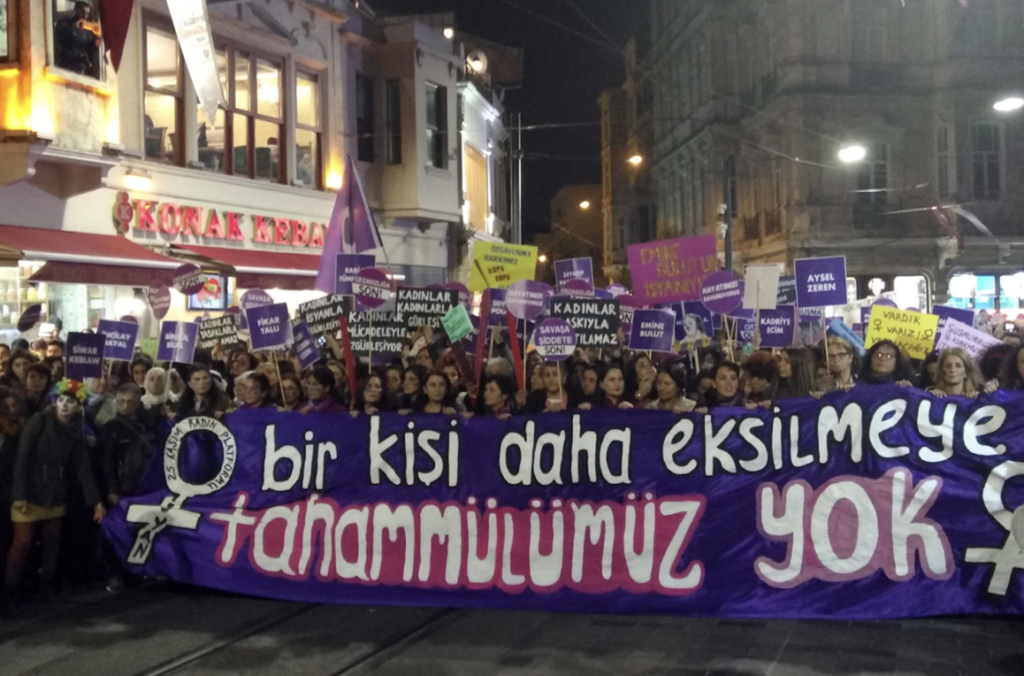

At the OECD level, Turkey stands out as one of the countries most affected by violence against women. On the occasion of November 25, the International Day for the Elimination of Violence against Women, it becomes necessary to understand why this date resonates so strongly in the country. Since its withdrawal from the Istanbul Convention in 2021, Turkey—having been the first country to ratify it in 2012—became, nine years later, the first state to withdraw from it. This reversal was justified by the authorities in the name of defending the “family structure” and combating the “imposition of Western norms,” particularly gender equality and the recognition of sexual minorities. Yet a very different reality exists: legal protections have been weakened, while violence remains widespread and under-documented. According to the We Will Stop Femicide Platform, 394 femicides and 258 suspicious deaths of women were recorded in 2024, the highest level since monitoring began in 2010. By way of reminder, the United Nations General Recommendation defines gender-based violence as any violence “directed against a woman because she is a woman or that affects women disproportionately,” including physical, psychological, sexual, or economic harm, as well as threats, coercion, and deprivation of liberty.
Moreover, the World Economic Forum’s 2024 Global Gender Gap Index ranks Turkey 127th out of 146 countries, highlighting women’s low participation in economic life, their difficulties in accessing education, their underrepresentation in political life, and the persistent impact of traditional social norms—often incompatible with legislative reforms adopted on paper. Thus, between the ambitious reforms of the 2010s and the conservative turn of the 2020s, the situation of women’s rights in Turkey has undergone profound transformations. This shift helps to better understand the political dynamics that have shaped the current framework. This article therefore seeks to analyze these developments and shed light on the contemporary situation of women’s rights in the country.
When laws change but norms do not
The improvement of women’s status in Turkey is part of a long history marked by legal ruptures, modernizing ambitions, and the persistence of patriarchal norms that limit the scope of these transformations. It is therefore important to briefly revisit the chronology of legislative and institutional changes concerning the protection of women. As early as the second half of the nineteenth century, a women’s movement emerged within the Ottoman Empire to demand legal equality. However, it was only with the founding of the Republic in 1923 that the most radical reforms were introduced: the abolition of polygamy, the prohibition of unilateral repudiation, the overhaul of the civil code, and, notably, the granting of women’s suffrage in 1934—ten years before France. Nevertheless, this top-down modernization quickly collided with everyday realities: patriarchal norms remained deeply entrenched, reducing the real impact of these legal advances.
A second wave of reforms took place in the 2000s. While encouraged by the process of accession to the European Union, it was also driven by internal dynamics: Turkey modernized its institutions, reformed its legal framework, and responded to the growing mobilization of feminist movements. All of these factors contributed to the adoption of new measures, including the creation of listening and information centers, more systematic interventions by the police and gendarmerie, and an expanded role for judges in protecting victims. For example, adultery ceased to be a crime in 1998. More broadly, that same year, Law No. 4320 on the “Protection of the Family” became the first Turkish legislation explicitly targeting domestic violence. During the same period, the new Civil Code (2002) and the new Penal Code (2005) marked decisive turning points. The Penal Code eliminated all references to chastity, honor, or marriage in the definition of sexual crimes: sexual crimes were henceforth treated as offenses against the individual. Sexual harassment in the workplace was criminalized. Provisions allowing reduced sentences for murderers in the name of “defense of honor” were abolished, and penalties were increased.
Turkey even played a pioneering role at the international level by becoming the first country to ratify the Istanbul Convention, before promulgating Law No. 6284 (2012), the cornerstone of the fight against violence against women. However, this momentum was abruptly interrupted in 2021 when the country withdrew from the Convention, immediately weakening the legal architecture built over previous years. Thus, in 2021, at least 33 women who were nevertheless benefiting from protection measures provided for under Law No. 6284 were killed. Public audits and international reports point to the same conclusion: the gap between legislation and its implementation remains immense, due to deeply rooted social and family norms that hinder the effectiveness of protective mechanisms. In this regard, the joint UN Women–TÜİK report, Women in Türkiye: A Statistical Overview 2024, also highlights a “major gap” between legislation and practice, explaining that deeply entrenched social and family norms limit the effectiveness of measures.
In this context, it is important to stress that the growing normalization of violence against women requires rethinking the phenomenon beyond patriarchal and cultural norms alone, by situating it within the broader context of the gender policies pursued by the AKP (Justice and Development Party, in power since 2002). While, upon coming to power, the party emphasized adherence to Western democratic values and a liberal economic vision, this orientation gradually shifted. From 2007 onward, the AKP moved its discourse toward moral and patriarchal references supported by a more pronounced religiosity, profoundly transforming the state’s approach to women’s rights. This evolution is also reflected in public statements by its leaders. In 2010, Recep Tayyip Erdoğan, then Prime Minister, stated that he did not believe in full equality between men and women. Four years later, in 2014, he declared: “You cannot put women and men on an equal footing; it is against nature, because their nature is different.[1]” Today, violence against women in Turkey remains a massive and under-documented phenomenon. In the absence of comprehensive official data, NGOs such as Kadın Cinayetlerini Durduracağız (“We Will Stop Femicide”) and Mor Çatı(“Purple Roof”) carry out most of the documentation work. The lack of reliable statistics constitutes a major obstacle: without clear political recognition and visibility, violence remains invisible and, in effect, systemic. This helps explain why violence has become routine in the media, which reports daily cases of women being raped, killed, or abused. Added to this is often problematic media coverage: mainstream press outlets frequently resort to the language of “crimes of passion,” which depoliticizes structural violence and reinforces the idea of an individual rather than a systemic problem.
To illustrate the scale of the phenomenon, one can refer to the latest chart published by the OECD in 2023, which presents the proportion of women who have experienced physical or sexual violence by an intimate partner at least once in their lifetime and in the past twelve months (2018 data). This chart clearly shows that Turkey is among the countries with the highest rates:
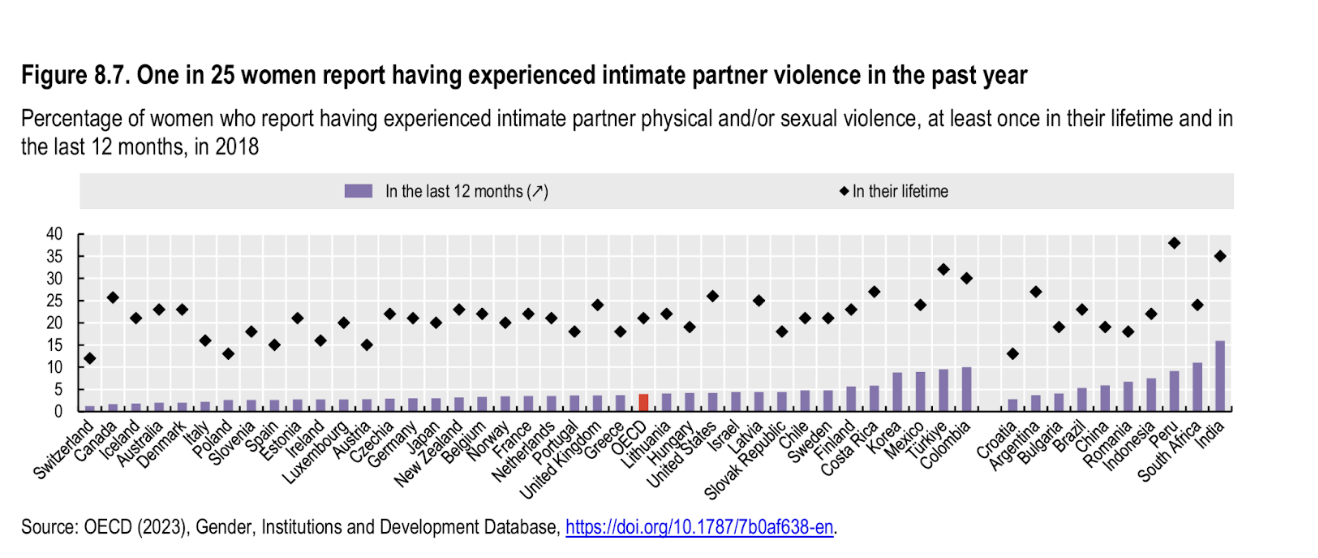
To provide further clarity on these data, it should be added that the British government noted in July 2025 that it is “difficult to estimate” the true prevalence of violence in Turkey due to the absence of a comprehensive national data collection system. Nevertheless, one survey found that approximately 38% of women had experienced physical and/or sexual violence at least once. Some forms of violence take particularly tragic expressions, notably women’s suicides. Orhan Pamuk’s novel Snow, inspired by real events, depicts the suicides of young girls in Kars, highlighting the pressure of honor, religion, shame, and family in a system where control over the female body becomes a political and moral issue. These suicides demonstrate that, behind legal developments, patriarchal norms continue to profoundly shape women’s lives.
The emergence of a combative feminism in the face of weakened institutional protections
In a changing political context, a particularly vibrant feminist movement has taken shape in Turkey. Far from being confined to an intellectual or academic elite, it cuts across generations and social classes and largely transcends partisan divides. Every November 25, on the occasion of the International Day for the Elimination of Violence against Women, Istanbul becomes the scene of a recurring confrontation between demonstrators and law enforcement. Gatherings are regularly banned and often violently dispersed, particularly on Istiklal Avenue—an emblematic artery of Istanbul and a historic site of political and social mobilization. The use of tear gas, police charges, and arrests has become routine. However, despite this repressive climate, demonstrations have never disappeared. As recently as 2024, the police completely sealed off Istiklal Avenue and Taksim Square, barring access to demonstrators, as documented by VOA Türkçe. During these protests, several activists were detained. That same year, for instance, 169 people were arrested in Istanbul during the November 25 gathering, according to Bianet. The government justifies these police interventions on the grounds of public order; for feminist organizations, however, arresting demonstrators sends a signal that is hardly compatible with the defense of women’s rights[2].
In many European countries, feminist marches take place in a public space where freedom of assembly, although sometimes regulated, is generally recognized and exercised without systematic obstruction. This is not the case in Turkey, where repeated bans and police interventions at feminist gatherings have become a regular practice of the authorities. This gap illustrates that Turkish feminist mobilization operates in a far more constrained environment, where simply gaining access to the street already constitutes a major political issue. It is this structural restriction of the space for protest that makes the Turkish situation particularly important to observe and document.
At the same time, the rise of digital platforms has profoundly transformed forms of mobilization. Hashtag campaigns, online communities, and viral videos: social media have become essential tools for informing, raising awareness, and organizing action. They make it possible to:
- widely disseminate testimonies and personal narratives;
- mobilize thousands of people around campaigns such as #KadınCinayetleriniDurduracağız (“We Will Stop Femicide”) or #MeToo;
- give a powerful voice to new generations, who use TikTok, Instagram, and Twitter/X to denounce inequalities and make visible what institutions do not always acknowledge.
In Turkey, this dimension is all the more central given the particularly high use of social media: nearly 20 million people use X/Twitter, placing the country among the world’s top ten. In a highly polarized media landscape, where social networks themselves may be subject to restrictions, these platforms become an essential space for circumventing the limits of the public sphere. In this context, online feminist campaigns are not merely an extension of street mobilizations; they constitute an indispensable arena for bearing witness, coordinating action, and forcing the issue of gender-based violence onto the public agenda. This movement gained renewed momentum following the public testimony of actress and stage director Simge Günsan on August 27, 2025, in which she revealed violence she had suffered thirteen years earlier. Her account triggered a tidal wave: more than 5,000 people shared their experiences of gender-based and sexual violence on social media, generating over 30 million views in one week. The initial allegations targeted figures in professional photography, before the movement spread to the artistic, academic, and then associative spheres. The reported violence—ranging from online harassment to physical assault and drug-facilitated rape—reveals a common thread: the persistence of a culture of impunity[3].
If mobilization is so intense today, it is because it is rooted in a longer-standing legacy, built since the 1980s. This historical continuity explains its resilience. As early as 1985, Turkey ratified the Convention on the Elimination of All Forms of Discrimination against Women (CEDAW). While the initiative formally came from the state, feminist movements played a central role: public campaigns, alternative reports, monitoring of commitments, and the establishment of the first institutional mechanisms in favor of equality. It was also in this context that the first shelters for battered women emerged. The 1990s and 2000s saw the consolidation of pioneering organizations: Mor Çatı (1987), which would become one of the main actors in the fight against domestic violence; Women for Women’s Human Rights – New Ways (1993), a driving force behind reforms of the Penal Code and the Civil Code; the KAMER Foundation, very active in the southeast of the country; and KA-DER (1997), committed to women’s political representation. Over the decades, Turkish feminism has been structured around autonomous and innovative tools: independent documentation of femicides in the absence of reliable official data; legal support for victims and their families; mutual aid networks to escape violence; and, more recently, the extensive use of social media to expose injustices and circumvent institutional silence.
Conclusion
On the occasion of November 25, despite occasional legal advances, the reality of violence against women in Turkey remains alarming and largely under-documented. Between the withdrawal from the Istanbul Convention, the insufficient enforcement of existing laws, and the persistence of patriarchal norms, both statistics and testimonies reveal the scale of a deeply entrenched phenomenon. In this context, feminist mobilization—on the streets, online, and in the courts—remains one of the few levers capable of making this violence visible and keeping the issue of women’s rights at the center of public debate. Moreover, this issue extends far beyond national borders: Turkey’s withdrawal from the Istanbul Convention in 2021, followed more recently by the Latvian parliament’s vote in favor of leaving the same treaty, shows that both setbacks and advances circulate from one country to another. Nevertheless, it is important to stress that highlighting the failures of the Turkish system does not mean claiming that other countries are exemplary. On the contrary, several European states, including France, also face serious shortcomings in the prevention of and response to violence. France recorded at least 94 femicides in 2024, proof that even in legal and institutional contexts considered more protective, mechanisms remain insufficient and structural failures persist.
Notes
[1] Elif Gözdasoglu Küçükalioglu, “Framing Gender-Based Violence in Turkey”, OpenEdition, 2018.
[2] “Police in Turkey detain demonstrators seeking more protection for women against violence”, APnews, 26 novembre 2024.
[3] “#MeToo wave sweeps across Turkey, starting in the world of photography”, Le Monde, 9 septembre 2025.