

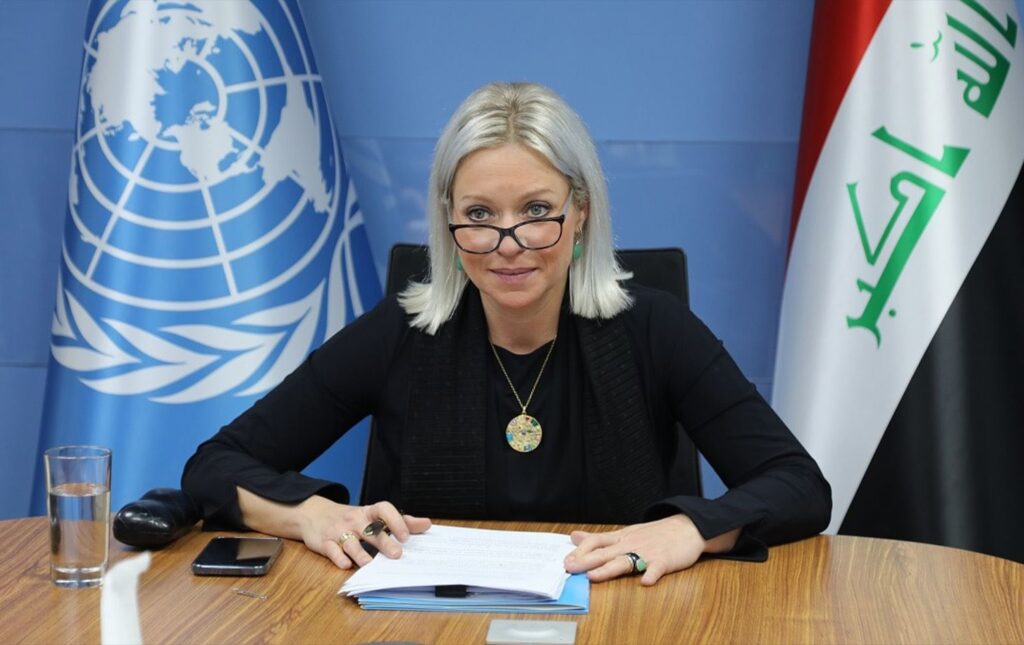

On May 16, 2024, Special Representative of the Secretary-General for Iraq Jeanine Hennis-Plasschaert announced the end of her tenure, signaling the eventual withdrawal of UNAMI from all Iraqi territory. This is with the possible exception of the Kurdistan Region, which views the mission as an international safeguard against humanitarian, social, political, and security crises. The Iraqi government also expressed a desire to terminate the mission, as articulated by its Prime Minister, Mohammed Shia’ Al Sudani. Last month, the UN Security Council decided to withdraw UNAMI at Baghdad’s request. Although UN missions require the approval of the host state, the Security Council’s unanimous decision acknowledged this request and decided to extend the UN mission’s mandate for a final period of 19 months, until December 31, 2025, after which its operations will cease.
In her final address, J. Hennis-Plasschaert noted that Iraq in 2024 is experiencing rapid transformation. The security situation in Iraq has improved significantly, and the country is witnessing substantial progress in service delivery and reconstruction. However, as Hennis-Plasschaert noted, armed groups operating outside the law remain a significant challenge to the Iraqi state. She also highlighted the urgent need for elections in the Kurdistan Region. On May 10, 2024, Al-Sudani sent a strongly worded letter sent to UN Secretary-General António Guterres requesting the end of the mission after more than two decades of its diverse political, security, and developmental activities in Iraq. The Prime Minister and the parties supporting him within the Coordination Framework (CF) believe that UNAMI’s presence in Iraq is no longer justified, given the significant progress achieved by successive Iraqi governments. However, this perspective was only supported by Shiite parties, with Sunni and Kurdish parties expressing concerns about UNAMI’s departure.
Nevertheless, the Iraqi government stressed the importance of cooperating with the 22 UN specialized agencies operating in Iraq under the Resident Coordinator Mechanism. This position enjoys near total support from Shiite parties who influence the government, political decisions and parliament, regardless of the positions of Sunni and Kurdish forces, who, on their end, have expressed their deep concerns about the matter on several occasions.
The National Movement for Reform and Development Party (Al-Hal) suggested this decision requires a thorough review, pointing out that the UN mission is sometimes influenced by political, partisan and personal interests. The Party also remarked that Hennis-Plasschaert has played a role in influencing the leadership and direction of the mission, favoring successive governments. Meanwhile, the main Kurdish parties of the Kurdistan Region, notably the Kurdistan Democratic Party, the Patriotic Union of Kurdistan, the Movement for Change, the Kurdistan Islamic Group, and the Kurdistan Islamic Union, are in unanimous agreement that the UN mission should continue. Their fear is that Shiite dominance could jeopardize the interests of Kurds, Sunnis, and other minorities in Iraq.
However, Prime Minister Al-Sudani and his supporting parties are ignoring these calls. He recently had a phone call with the UN Secretary-General, António Guterres, during which they exchanged views on the termination of UNAMI in Iraq. The Prime Minister reiterated his appreciation for the efforts of the United Nations and their mission in Iraq, a remark which surprised civil political entities and civil society organizations in Iraq. The latter fear that the attention to human rights and humanitarian issues will diminish in the absence of UNAMI. On the ground, it is clear that all sectors of Iraqi society require a modicum of international oversight, highlighting Iraq’s lack of progress in various areas. Recent indicators confirm Iraq’s low level of democracy, a pressing need to support marginalized segments of society impacted by economic decline, not to mention the ongoing marginalization of journalists and activists in influencing public opinion discourse and expression.
UNAMI was established following the entry of US forces and the ousting of Saddam Hussein’s regime in 2003. Its headquarters have remained in Baghdad’s heavily fortified Green Zone, focusing on developing Iraqi institutions, supporting political dialogue and elections, and promoting human rights. Since the US-led occupation, the Iraqi government has gradually moved towards scaling back operations of several international missions, including the 2014 US-led coalition formed to combat ISIS, alongside the UN mission aimed at ensuring accountability for the terrorist group’s crimes. Political, social and activist circles in Iraq argue J. Hennis-Plasschaert overstepped her role in her dealings with the Kurds, in addition to supporting Sunni factions, civil groups and the new secular parties formed after the popular protests known as the “Tishreen Uprising” in October 2019. She was also highly critical of armed factions, which serve as the armed wings of political parties.
At the same time, influential Shiite parties in government criticize the former UN representative for her perceived ambiguous role in the management of Iraqi affairs and for purportedly criticizing corruption while allegedly being connected through one of her advisors. The UN mission has also been accused of misunderstanding the complexities of the Iraqi landscape, leading it praise Mustafa al-Kadhimi’s government while criticizing the decline in democracy and freedoms. J. Hennis-Plasschaert also lauded the progress made in terms of services and security, while maintaining pressure on the armed forces which are seen as pivotal to the ruling parties’ influence. These factors have placed J. Hennis-Plasschaert in a delicate situation, although the fluctuation in her positions mirrors shifts in the international community’s stance on Iraqi issues. It appears her actions have upset certain figures in government, prompting them to push for a permanent end to her mission.
Furthermore, there are genuine concerns about the mission’s future role in Iraq, including its involvement in overseeing the upcoming parliamentary elections slated for late next year. This is particularly relevant as all signs point to Muqtada al-Sadr’s re-engagement in Iraqi politics following a two-year hiatus due to his failure to form a government, especially as his bloc has secured the largest share of seats in Parliament. If al-Sadr does indeed return to the political arena, he is expected to participate in elections and is likely to insist on the presence of a UN mission to monitor and supervise the electoral process, aiming to prevent any fraud or manipulation of the results. This demand is not supported by other Shiite parties seeking to compete with al-Sadr, whether through fair or potentially manipulated elections. Their main concern in the period ahead is preventing al-Sadr from forming a government, a scenario they want to avoid because of its potential complications, which could then lead to a period of political isolation coupled with security challenges.
Al-Sudani’s government is seeking to close the election, political affairs, and human rights sections of UNAMI while retaining the role of UN Resident Coordinator. In Baghdad, activists and journalists believe that the delegation’s departure marks a lack of international oversight amid Iraq’s instability, often exacerbated by political conflicts that often escalate into armed confrontations between certain factions. Some diplomats and UN officials are also expressing concern about human rights and accountability in a country ranked among the world’s most corrupt.