


From Iraq’s perspective, the 34th Ordinary Arab League Summit, scheduled for May 17, is of crucial importance for the country’s future. Baghdad is staking its credibility on the regional diplomatic stage: this is the first high-level international conference to be held on Iraqi soil since 2012[1]. More than asserting regional influence, Iraq aims to demonstrate that it is a stable, normalised, and respectable country—one that is reengaging with the Arab world. “The Arab Summit in Baghdad is a watershed moment; Iraq’s national aspirations intersect with the broader Arab pursuit of overcoming divisions and embarking on a path toward a framework for effective and comprehensive Arab cooperation,” wrote Prime Minister Mohammed Shia al-Sudani in an op-ed published by Asharq al-Awsat.
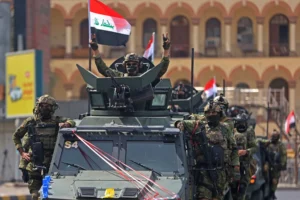
Preparations for the summit have been closely covered by the media. They included the renovation of the airport and of Route Irish—once dubbed the most dangerous road in the world—which leads to the Green Zone. Demonstrations were banned for ten days, and public holidays were declared from May 15 to 18. Over the past two years, under the leadership of Prime Minister Mohammed al-Sudani, Baghdad has undergone significant changes: checkpoints between neighbourhoods have been removed, the Green Zone has been opened up, roads, bridges, and buildings have been constructed, traffic has been brought under control, and violence dropped by 15% in 2024. This progress is what Iraq hopes to showcase to the rest of the Arab world, whose leaders rarely make the trip to Baghdad.
Yet, favorable security conditions alone will not be enough to make the summit a success. Torn between Iranian political influence and American economic power, and still grappling with the aftermath of ISIS (which remains only barely under control) Baghdad continues to struggle with internal reconciliation and strained relations with its neighbours. As neighbouring Syria enters a new chapter following the fall of Bashar al-Assad, Prime Minister Mohammed al-Sudani took the initiative to invite Ahmed al-Sharaa, the interim president and former al-Qaeda member once imprisoned in Iraq. The move sparked a scandal among the Shiite elite, further fueled by protests in Basra, leading al-Sharaa to ultimately decline the invitation. He was then replaced by Foreign Minister Asaad al-Shaibani.
What will be the consequences of this setback? Sudani and his outstretched hand have been ridiculed, and Iraq, despite sharing a long border with Syria, now appears divided and has missed a valuable opportunity to ease tensions with its long-standing adversary. Already, during the Arab League summits held in Baghdad in 2012 and 1990, the Syrian question was on the agenda, and the absence of Syrian presidents hindered the discussions. At the very least, while the diplomatic impact of the summit will be diminished by al-Sharaa’s absence, despite his being received abroad, security risks will likely be reduced as a result. Still, the porous border between the two countries, the ongoing struggle against terrorism, and the economic opportunities that could emerge from a potential lifting of U.S. sanctions remain pressing issues that both nations must address.
Adding to this internal setback is Donald Trump’s tour of the Middle East, choosing Saudi Arabia, Qatar, and the United Arab Emirates for his first international trip since his re-election, with an agenda strikingly similar to that of the Arab League summit: the war in Gaza, economic cooperation, and the Syrian issue. It’s an unfair competition for Baghdad, which had hoped to rally Arab countries around its leadership and begin freeing itself from foreign interference.
In Riyadh, Mohammed bin Salman rolled out the purple carpet for Trump and his entourage of investors, who achieved staggering results: the lifting of U.S. sanctions on Syria, a meeting with President al-Sharaa, $600 billion in strategic partnerships with Saudi Arabia (in defence and artificial intelligence), a $200 billion aircraft order from Qatar to Boeing, and potentially, a resolution to the Iranian nuclear issue. According to a close adviser to Ayatollah Khamenei, Iran, weakened since the October 7 attacks, is reportedly willing to abandon its pursuit of nuclear weapons in exchange for the immediate lifting of U.S. sanctions. As for the Palestinian issue, Donald Trump is determined to pressure Gulf countries and Syria toward normalization with Israel, an idea that remains unthinkable in Iraq, which does not recognise Israel’s existence.
Meanwhile in Baghdad, refusals and controversies continue to pile up, for a summit that is barely covered by the regional press, and even less by the international media. Several states have opted to send only low-level delegations. Firstly, Algeria, which is far away, citing both security reasons and a general disagreement with the Arab League’s decision-making, which is too focused on certain countries. Adding to the tension is a diplomatic misstep: Iraq’s support for Morocco. As a result, Algeria is sending its weakest delegation ever to an Arab League summit—just an ambassador.
Then there’s Lebanon: for the first time, the president of this Iraqi-allied country will miss an Arab League summit. The official reason is a visit to the Vatican for the Pope’s inaugural mass, but unofficially, multiple factors are being cited, ranging from diplomatic excuses to feelings of offense. Last month, remarks by Joseph Aoun—who stated his intention to “disarm Hezbollah” rather than turn it into a Lebanese version of Iraq’s Hashd al-Shaabi, the militia integrated into the Iraqi army—sparked an outcry in Iraq, according to the Lebanese daily L’Orient-Le Jour.
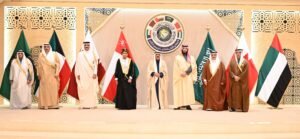
Among the confirmed guests, loyal King Abdullah II of Jordan is expected to attend and has already praised the summit’s exemplary organisation. Prime Minister Sheikh Mohammed bin Rashid Al Maktoum and the Egyptian president have also confirmed their presence. The name of Mohammed bin Salman, however, has been appearing and disappearing from the list of attendees depending on the day and the source. Controversy surrounding the absence of major figures prompted the government spokesperson to respond: “Registration on the summit’s dedicated platform for the delegations is very honorable and befitting Iraq, and there will be pleasant surprises regarding the level and weight of representation (…) What is being reported about heads of state abstaining from attending is inaccurate, and we confirm that representation will be honorable.”
The presence of the highest-ranking representatives from the Gulf states, however, is far from guaranteed. The longstanding territorial dispute over the Khor Abdallah waterway, opposing Iraq and Kuwait for decades, was recently swept under the rug by Iraq’s president and prime minister, but perhaps not quickly enough. On April 30, less than three weeks before the summit, the Iraqi government intervened at the last minute to block a court ruling that aimed to challenge the maritime border with Kuwait—despite that border having been established in 1993. Just a week later, all Gulf Cooperation Council (GCC) member states convened to express their full support for Kuwait. This reaction raised fears of a potential boycott of the summit.
Despite Baghdad’s efforts to restore peace, security, and a sense of normalcy in hopes of regaining diplomatic weight in the region, the outcomes of the Arab League summit are likely to be limited. Old neighbourhood disputes, decades of trauma and violence, foreign interference in domestic politics, and ongoing internal tensions between factions and sects continue to prevent Iraq from taking control of its own destiny, let alone influencing the region’s. To this must be added Donald Trump’s extravagant Middle East tour, which only further pushes Iraq to the margins of regional decision-making, at best an ally, or perhaps even a vassal of the region’s major and minor powers, including the United States, from whose influence Iraq is still trying to break free.
Notes
[1] Not counting the Gulf Cup of Nations football tournament held in Basra in 2023