


The sequence that began in January 2026 in northeastern Syria crossed a political threshold on 30 January with the announcement by the Syrian Democratic Forces (SDF) of a comprehensive ceasefire and their commitment to a process of gradual integration of their military and administrative structures into the Syrian state apparatus. This development, unprecedented since the emergence of Rojava, goes far beyond a mere tactical adjustment and instead reveals a profound inflection in regional power balances. It simultaneously signals the progressive restoration of Damascus’s sovereignty, the weakening of asymmetric alliances based on external support, and the renewed centrality of states as key arbiters of peripheral conflicts. In this context, Syrian Kurdistan appears less as an autonomous political project than as a strategic adjustment variable, subject to ongoing regional reconfigurations and the shifting priorities of the powers involved.
A crisis revealing regional reconfigurations
The dynamics unfolding in northeastern Syria extend well beyond the confines of a local confrontation. They act as a revealing indicator of the place accorded to non-state actors within a rapidly reconfiguring regional order. When a security architecture relies primarily on external support, the central issue is never the short-term intensity of the alliance, but rather its long-term strategic credibility. The ongoing shift surrounding the Syrian Democratic Forces (SDF) sharply illustrates the classic dilemma identified by Glenn H. Snyder[1]: the permanent trade-off between the risk of abandonment and the risk of entrapment. This dilemma—historically recurrent for the Kurds since the end of the Ottoman Empire—is today distinguished by the speed with which it materializes, as local power relations deteriorate and the priorities of external powers are redefined.
The restoration of Syrian sovereignty
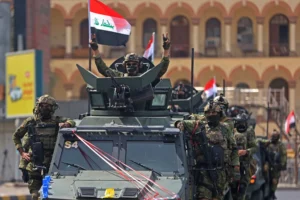
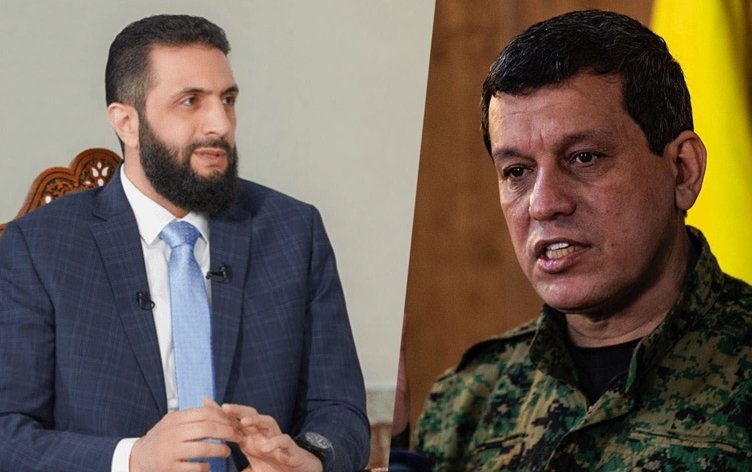
The announcement of a ceasefire on 30 January and of a process integrating Kurdish structures into the Syrian state apparatus, under the presidency of Ahmed al-Sharaa, confirms that Damascus has regained sufficient room for maneuver to reassert a fundamental Westphalian principle: the restoration of sovereignty through control of borders, institutions, and the monopoly over organized coercion. Available information points to a partial integration of Kurdish forces into the Syrian national army and a redeployment of the state in governorates—particularly Raqqa and Deir ez-Zor—previously controlled by the SDF, following localized fighting, indirect military pressure, and negotiated withdrawals. This “victory” is less ideological than structural: it stems neither from political adherence to Damascus’s project nor from the total military defeat of Kurdish forces, but rather from an institutional rebalancing of power relations. By progressively reclaiming sovereign prerogatives—security, territorial administration, border control, and resource management—the Syrian state does not seek to formally annihilate Kurdish autonomy, but to reconfigure it within a hierarchical framework in which strategic initiative remains centralized. Autonomy thus persists as a conditional delegation of authority, dependent on Damascus’s security and political arbitration, rather than as an accomplished fact sustained by an external balance of power. This structural asymmetry transforms negotiation into a constrained process, in which Kurdish room for maneuver is tightly indexed to their acceptance of the restoration of state sovereignty.
Western abandonment and the end of the protective illusion
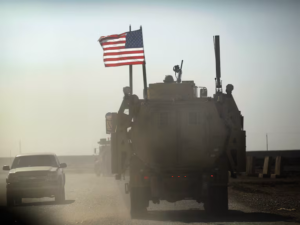
The evolution of Western postures has fueled a sense of abandonment among Syrian Kurdish actors, despite their having been a central tactical partner in the fight against the Islamic State. Once the issue shifts to a sovereignty conflict between a recognized state and a de facto autonomous entity, American incentives to incur risk diminish mechanically. This withdrawal is not the product of caprice, but of strategic reprioritization. As Thomas C. Schelling[2] emphasized, a guarantee no longer backed by a credible commitment ceases to be a deterrent. Western protection thus becomes a rhetorical promise, insufficient to durably structure the behavior of regional actors. The Kurdish question thereby returns to its historical condition: a subordinate issue within higher-order geopolitical equilibria.
Syrian Kurdistan as a space of transaction
Within this configuration, Syrian Kurdistan ceases to function as an alternative political laboratory and reverts to being a space of strategic transaction. For Turkey, Kurdish autonomy remains a source of political and security contagion risk, justifying a policy of sustained neutralization south of its border. For Iran, the United States, or Israel, northeastern Syria is embedded in a broader cartography of influence, indirect deterrence, and intersecting rivalries. The territory no longer carries an autonomous political project, but instead becomes an object of negotiation among powers.
The battle of symbols and the reorientation toward Erbil
The symbolic dimension sheds further light on the depth of this shift, as the gradual replacement of Rojava emblems by the flag of Iraqi Kurdistan in several predominantly Kurdish cities marks a major inflection point. The transborder Kurdish space is no longer conceived as a revolutionary continuum, but as a corridor under contested sovereignty and therefore subject to negotiation. Mobilizations observed in Iraqi Kurdistan in support of Syrian Kurds—humanitarian convoys, political statements, calls for compromise—reflect both transnational solidarity and a battle over representations. In this context, Masoud Barzani’s words retain a structuring resonance. As early as 2019, he stated: “Kurds cannot survive in this region except through dialogue, compromise, and recognition of existing balances. A solitary adventure always leads to tragedy.” This assertion now resonates as a key regional interpretive lens.
The Iraqi model: a regional tolerable compromise
The current sequence suggests that the relative winners may be Iraqi Kurdish actors, foremost among them the KDP and the PUK. These actors have gradually internalized a central constraint: in a hostile regional environment, political survival depends on institutionalized autonomy embedded within a constitutional framework and underpinned by power arrangements, rather than on substantive autonomy resting on a fait accompli durably protected from the outside. This is not a normative judgment, but an analytical observation: what endures is not necessarily what is ideologically most coherent, but what is structurally compatible with the constraints imposed by neighboring states and with the grammar of international recognition.
Risks of escalation displacement
This relative comparative advantage of Iraqi Kurdistan is nonetheless accompanied by an immediate risk: that of escalation displacement. An American refocusing around Erbil could transform the Kurdistan Regional Government (KRG) into a compensatory arena for regional rivalries, particularly in the event of heightened tensions between Iran and the United States or an expansion of Turkish–PKK dynamics. Added to this is an often underestimated aggravating factor: the management of camps and prisons linked to the Islamic State, which has become an object of transfer and negotiation and thus a source of regional strategic vulnerability.
Conclusion
The ongoing recomposition delineates two distinct Kurdish models: the Syrian model, born of an opportunity window opened by the war against the Islamic State and now colliding with the restoration of the Syrian state amid Western disengagement; and the Iraqi model, imperfect but institutionalized, which appears as the most tolerable compromise for regional powers precisely because it is negotiable and controllable. Damascus’s “victory” can thus be read as an indirect validation of a central principle: the autonomy that survives is the one that accepts being a subsystem. The tragic constant nonetheless remains unchanged: for any sub-state actor, abandonment is always possible. The only variable lies in the capacity to absorb its cost without collapse.
Notes
[1] Glenn H. Snyder (1928–2013) was one of the leading American theorists of alliance politics in international relations. A professor at the University of North Carolina and a major figure within the realist tradition, he formalized the alliance dilemma—opposing the risk of abandonment to the risk of entrapment—in his seminal work Alliance Politics (Cornell University Press, 1997). His scholarship analyzes how states—and, by extension, actors dependent on external protection—arbitrate between the credibility of commitments, the costs of strategic solidarity, and the prioritization of security interests.
[2] Thomas C. Schelling (1921–2016) was an American economist and strategist, and a leading figure in the application of game theory to international relations. Awarded the Nobel Prize in Economic Sciences in 2005, he was notably the author of The Strategy of Conflict (1960) and Arms and Influence (1966), foundational works in the analysis of deterrence, the credibility of commitments, and strategic coercion. Schelling demonstrated that the value of a threat or a guarantee depends less on its formulation than on the perception of the issuer’s actual commitment—a central analytical lens for understanding asymmetric alliance dynamics and patterns of retrenchment or reassurance by major powers.